View Article

Abstract

Solubility plays a crucial role whenever a drug’s effectiveness depends on it’s ability to disperse homogenously in the liqid phase. On the other hand, the majority of active of active pharmacological subastances have low watersolubility. One of the most important factors in the success of formulation development in the solubility of the drugs. A difficult challenge in drug devlopment is improving the drugs are unable to enter solubility, dissolution rate & bioavailability over 40% of novel chemical entities reported to dated to date are poorly water-soluble medications.Despite having promising pharmakokinetic properties, alarge number of innovative drugs are unable to enter the market because of poor water solubility. The aqeous solubility of drug also affects the physical, chemical & dose stability, it sets a standard for purity, dissolution rate & extent of extent of absorption & it achieve the required. Pharmacological response in the systemic circulation in order to achieve the required pharmacological response in the systemic circulation. In this review, solubilization techniqe such as chemical modification, physical modification& other methods were disussed as they open up new pathways for the production of potent & marketable drugs in pharmaceutical industry

Keywords

Solubilization techniqes, Absorption, Bioavailability, Dissolution dispersion

Introduction

× Popup Image

Solubility is defined as the maximum amount of solute that can dissolved in a given amount of solvent to form a homogeneous solution under a specific condition. Solubility means how well a substance (like a drug) can dissolve in a liquid, usually water. It’s very important in medicine because if a drug doesn’t dissolve well, it may not work properly in the body. Many new drugs don’t dissolve easily in water, which can make them less effective.To fix this problem, scientists use different methods to help drugs dissolved better. These method called as “Solubility enhancement techniqes”.Solubility plays a vital role in the effectiveness of orally administered drugs. For a drug to be absorbed into the bloodstream and produce its intended effect, it must first dissolve in the fluids of the gastrointestinal tract. However, a large number of new drug candidates developed today are poorly water-soluble, which leads to low bioavailability and limited therapeutic effect solubility enhancement techniques are used to overcome this challenge by improving the dissolution rate and solubility of such drugs. These techniques include physical, chemical, and formulation-based approaches, such as particle size reduction, salt formation, solid dispersions, use of surfactants, and nanotechnology-based systems.The single most desirable route for administering a drug is the oral route due to its convenience, patient compliance, and cost-effectiveness. However, for a drug to exert its therapeutic effect, it must first be absorbed into the systemic circulation. This process critically depends on two main factors: solubility (the ability to dissolve in gastrointestinal fluids) and permeability (the ability to cross the gastrointestinal membrane). The successful development of a new pharmaceutical drug hinges on its ability to reach the site of action in a therapeutically effective concentration. For orally administered drugs, this journey critically depends on two factors: solubility and permeability. A drug must first dissolve in the gastrointestinal (GI) fluids (solubility) before it can pass through the intestinal wall and enter the systemic circulation. (permeability). In the contemporary pharmaceutical landscape, a significant hurdle in drug development is the issue of low aqueous solubility. It is estimated that a large proportion (often cited as over 40%) of New Chemical Entities (NCEs) generated through high-throughput screening and medicinal chemistry are poorly water-soluble.

BCS CLASSIFICATION TABLE:-


Sr.

NO

BCS Class

Solubility

Permeability

Example

1

Class I

High

High

Metoprolol, Amlodipine

2

Class II

Low

High

Ibuprofen, Naproxen

3

Class III

High

Low

Cimetidine, Ranitidine

4

Class IV

Low

Low

Furosemide, Nelfinavir


PRINCIPLE:- The fundamental principle behind solubility enhancement techniques is to improve the dissolution rate and aqueous solubility of “poorly water-soluble drugs”in order to increase their bioavailability. According to the Noyes–Whitney equation, the” dissolution rate of a drug is directly proportional to its surface area and solubility in the dissolution medium”. Therefore, modifying a drug’s physical or chemical properties to enhance its interaction with the solvent can lead to better solubility and absorption This principle can be explained using the Noyes–Whitney equation, which describes the rate of dissolution of solids in liquid.

NOYES-WHITNEY EQUATION

  • Where:- dc/dt=DA(Cs-c)/h
  • Dc/dt = rate of dissolution
  • D = diffusion coefficient
  • A = surface area of the drug
  • Cs = saturation solubility of drug
  • C = concentration of drug in bulk solution
  • h = thickness of diffusion layer

3 IMPORTANCE OF SOLUBILITY:-

3.1 Chemical Reactions

Faster Reactions: When substances dissolve in a liquid, they mix better, which makes it easier for them to react with each other. If something doesn’t dissolve well, it might take longer to react.

Equilibrium: Some reactions reach a balance, and how much a substance can dissolve affects where this balance happens.

3.2 Medicine

How Well Drugs Work: For a medicine to work, it needs to dissolve in the body. If a drug doesn’t dissolve easily, your body may not be able to absorb it properly, and it might not work as well.

Effectiveness: How much of a drug gets into your bloodstream depends on how well it dissolves. Poor solubility means the drug won’t be as effective.

3.3 Environment

Pollution: Some harmful substances dissolve easily in water, spreading more quickly and polluting the environment. Understanding this helps us manage pollution.

Water Treatment: When cleaning water, knowing how substances dissolve helps figure out how to remove them.

3.3. Biology

Absorbing Nutrients: In living things, nutrients like vitamins and minerals need to dissolve properly so cells can absorb them.

Oxygen in Blood: Oxygen needs to dissolve in the blood to travel through the body. Some substances, like hemoglobin, help oxygen dissolve better.

3.4 Industry

Making Products: In industries like food, cosmetics, or manufacturing, knowing how ingredients dissolve helps create products with the right texture and taste.

Solvents: Solvents are liquids used to dissolve other chemicals. Knowing which ones work best is important for making products or cleaning.

3.5. Crystallization

Making Crystals: When a substance dissolves in a liquid, it might later form crystals when the liquid evaporates. This is important for purifying chemicals or making certain products.

Supersaturation: Sometimes a solution can hold more of a substance than it normally can, which can cause crystals to form. This is useful in many fields.

3.6. Food

Flavor: Solubility affects how flavors mix in food and drinks. Some flavors dissolve better, making the taste stronger or more evenly spread.

Preserving Food :- Solubility also helps preservatives dissolve in food.

4. SOLUBILITY ENHANCEMENT TECHNIQES:-
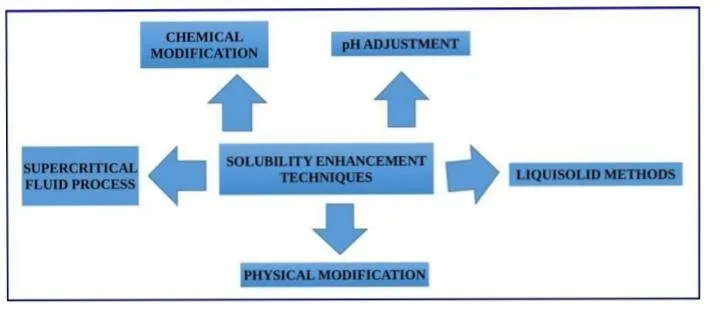


(1) PHYSICAL MODIFICATION:-

(A)Particle size reduction

  • Micronization
  • Nanosuspension
  1. Crystal habit modification
    • Polymorphs
    • Pseudopolymorphs
  2. Drug dispersion in carrier:
    • Solid solutions
    • solid dispersion
  3. Solubilization by surfactant
    • microemulsion
  4. Complexation

(2 ) CHEMICAL MODIFICATION

  1. pH ADJUSTMENT
  2. SUPERCRITICAL FLUID PROCESS
  3. LIQUISOLID METHOD

(1) PHYSICAL MODIFICATION :-

 Physical modification methods alter the physical form or characteristics of a drug without changing its chemical structure. These methods improve solubility by increasing surface area, decreasing particle size, improving wettability, or converting the drug into a higher-energy (more soluble) form

(A) Particle size reduction

 Reducing particle size increases surface area and improves dissolution rate (as per the Noyes–Whitney equation).

Micronization:-

 Uses jet mills or ball mills to reduce drug particles to the micron range (1–10 µm).

 Advantages: Simple, cost-effective.

 Limitations: May cause thermal degradation; not effective for drugs with very low solubility.

Nanosuspension:-

 Produces nanocrystals (<1000 nm) via wet milling, high-pressure homogenization, or precipitation.

 Advantages: Enhanced solubility and dissolution; possible for poorly soluble drugs  Limitations: Stability issues (aggregation), need for stabilizers.

(B) Crystal habit modifications

 Modifications of crystal babit

Polymorphism

 Different polymorphic forms of a drug can have different solubilities due to variations in molecular packing and crystal energy.  Approach:

 Selecting or preparing the most soluble polymorph.

 Controlling crystallization conditions (solvent, temperature, rate of cooling).

 Example:

  • Ritonavir (antiviral) had solubility issues due to formation of a less soluble polymorph.
  • Limitation:
  • Metastable forms may convert to more stable (less soluble) forms during storage.

Pseudopolymorphism: Effect on solubility:-

 Pseudopolymorphism greatly influences solubility and bioavailability:

 Hydrates often show lower solubility than anhydrous forms, because the crystal lattice is stabilized by strong hydrogen bonding with water molecules.

 Anhydrous forms are usually more soluble, as they have weaker lattice energies.

 Solvates may show higher or lower solubility depending on the solvent involved.

 Example: o Ampicillin trihydrate is less soluble than anhydrous ampicillin.

  • Caffeine anhydrate dissolves faster than caffeine monohydrate.

(C ) Drug dispersion im carrier:-

 Drug dispersion in carrier refers to the molecular or particulate distribution of a poorly soluble drug within a solid carrier matrix (usually a hydrophilic polymer).

 This approach called a solid dispersion — is a physical modification technique used to improve solubility, dissolution rate, and sometimes bioavailability of poorly water-soluble drugs.

Solid solutions

 A solid solution is a homogeneous one-phase system where the drug is molecularly dispersed within the crystalline or amorphous carrier.

 Types:

 Substitutional Solid Solution

 Drug molecules substitute carrier molecules in the lattice.

 Requires similar molecular size (ratio ≤ 15%).

 Example: Sulfathiazole–urea.

 Interstitial Solid Solution

 Drug molecules occupy interstitial spaces within the carrier lattice.

 Drug molecules must be much smaller.

 Example: Small molecule in PEG lattice.

Adventages

 Improved solubility and dissolution rate – drug is molecularly dispersed.

 Enhanced bioavailability – better absorption in the body.

 Physical stability – prevents drug recrystallization.

 Uniform drug distribution – ensures dose consistency.

 Formulation versatility – usable in tablets, capsules, films, etc.

 Reduced need for surfactants – safer formulations.

 Potential for controlled release – depending on carrier choice

Solid dispersion:-

 Solid dispersion (SD) is a pharmaceutical strategy where a poorly water-soluble drug is dispersed in an inert carrier (usually hydrophilic) at the solid state to enhance its dissolution rate and bioavailability.

 Goal: Improve solubility and oral absorption of drugs with low water solubility (BCS Class II drugs).

 Key Concept: By dispersing the drug at a molecular or particulate level in a carrier, the drug’s surface area increases, and its crystallinity can decrease, improving solubility

Adventages

 Improved solubility and dissolution rate of poorly water-soluble drugs.

 Versatile dosage forms (tablets, capsules Enhanced bioavailability.

 Lower required doses → fewer side effects.

 Better stability and taste masking.  Potential for controlled release.

Solubility by surfactant :- increases solubility of poorly soluble drugs.

 Surfactants are amphiphilic molecules, meaning they have both hydrophilic (waterloving) and lipophilic (oil-loving) parts. Examples include:

 Anionic: Sodium lauryl sulfate (SLS)

 Cationic: Cetyltrimethylammonium bromide

 Nonionic: Tween 80, Cremophor EL

 Zwitterionic: Lecithin

 Mechanism of solubility enhancement by surfactants:

Micelle Formation:

 When surfactant concentration exceeds the critical micelle concentration (CMC), surfactants form micelles.

 Hydrophobic drug molecules are solubilized in the hydrophobic core of micelles.

 Hydrophilic shell interacts with water, enhancing overall solubility.

 Reduction of Interfacial Tension:

 Surfactants reduce the surface tension between drug particles and aqueous medium, improving wetting and dissolution.

Complex Formation:

 Surfactants can form molecular complexes with drugs, improving solubility even below the CMC.

 Stabilization of Supersaturated Solutions:

 Certain surfactants prevent precipitation of drugs in solution, maintaining higher concentrations.

 Adventages

 Simple and widely applicable.

 Can achieve high solubility enhancement.

 Improve dissolution rate and sometimes bioavailability.

(2) CHEMICAL MODIFICATIONS

Here’s a clear, structured explanation of chemical modification techniques for solubility enhancement—commonly used in pharmaceuticals to improve dissolution, bioavailability, and therapeutic effectiveness of poorly soluble drugs.

Adventages

  1. Increases solubility

Chemical changes help the drug dissolve better in water.

  1. Better absorption

When a drug dissolves well, the body can absorb it more easily.

  1. Works for many drugs

Some methods can be used even if the drug is very poorly soluble.

  1. Can improve taste and stability

Some chemical changes make the drug taste better or last longer on the shelf.

  1. Helps make new versions of old drugs

Companies can create new forms of the same drug and get new patents.

  1. Can control how fast the drug works

Chemical changes can make the drug work faster or slower as needed.

Disadvantages

  1. The material may lose its natural function.
  2. The chemical may react with the wrong parts.
  3. The process can damage sensitive materials.
  4. The reaction may not work completely.
  5. It can be hard to separate the products.

(3) pH ADJUSTMENT:-

  • Many drugs dissolve better when they are in their ionized form (charged form).
  • Changing the pH of the solution can increase the ionization of the drug.
  • Weak acids dissolve better in high pH (more basic).
  • Weak bases dissolve better in low pH (more acidic).
  • By adjusting the pH, the drug becomes more soluble in water, helping in making solutionsor improving absorption.

PRINCIPLE:-

Solubility of a drug increases when the drug is converted into its ionized (charged) form. By adjusting the pH of the solution, weak acidic or basic drugs become ionized, and the ionized form is more water-soluble than the unionized form.

Advantages:

  • Improves solubility of weakly acidic and basic drugs.
  • S imple and easy method to apply.
  • No chemical change to the drug (drug stays the same).
  • Can give large increase in solubility.
  • Useful for making oral solutions, syrups, and injections.
  • Often reduces the need for other complex techniques.

Disadvantages:

  • Works only for ionizable drugs (weak acids or bases).
  • Extreme pH can cause irritation or discomfort, especially in injections.
  • Drug may become unstable at very high or very low pH.
  • Possible precipitation when the solution returns to normal body pH.
  • May require buffers or other additives to maintain pH.

Mechanism:-

  • Change the pH of the solution using an acid or base.
  • The drug (weak acid or weak base) becomes ionized at the adjusted pH.
  • Ionized drugs dissolve better in water because they interact strongly with water molecules.
  • As ionization increases, solubility increases.
  • The drug stays in solution as long as the pH remains in the ionization range.

(4) SUPERCRITICAL FLUID PROCESS:-

What is a Supercritical Fluid?

A supercritical fluid is a substance that is at a temperature and pressure above its critical point, where it exhibits:

Gas-like properties (low viscosity, high diffusivity)

Liquid-like properties (good solvating power)

Supercritical CO₂ (SC-CO₂) is the most widely used SCF because it is:

  • Non-toxic
  • Easily available
  • Has mild critical conditions (Tc = 31.1°C, Pc = 73.8 bar)

Why SCF Technology is Useful for Solubility Enhancement

Supercritical Fluid (especially supercritical CO₂) is useful because it can transform poorly water-soluble  drugs   into      forms  that      dissolve           much   more            easily, improving their bioavailability.

•Makes drug particles very, very small

•Smaller particles dissolve faster.

→ Fast and better solubility

    1. Changes the drug into a form that dissolves easily

It can make the drug less crystalline or amorphous, which dissolves better.

→ More soluble form

    1. Helps water mix with the drug easily

SCF makes the drug surface better for wetting.

→ Water can spread on the drug → better dissolution

    1. Uses no harmful solvents

SCF (usually CO₂) leaves no toxic residue.

→ Safe and clean method

    1. Works at low temperature

Good for drugs that get damaged by heat.

→ Drug remains stable

ADVENTAGES

  1. Makes drug particles very small → helps them dissolve faster.
  2. Does not use high heat → safe for sensitive drugs.
  3. Uses safe CO₂ instead of harmful solvents.
  4. Leaves no chemical residue → product is very pure.
  5. Improves solubility and absorption of drugs.
  6. Eco-friendly and clean process.
  7. Can be used for many types of drugs.

DISADVANTAGES

  1. Machines are costly.
  2. Needs very high pressure, which can be risky.
  3. Process is complicated.
  4. Does not work for all drugs.
  5. Needs trained people to operate.
  6. Not widely used because it is expensive.

(5)LIQUISOLID METHOD :-

A liquisolid system is a dry, free-flowing, compressible powder mixture that contains a liquid drug solution or suspension absorbed onto selected carrier and coating materials.

→ Purpose:

To enhance the solubility, dissolution rate, and bioavailability of poorly watersoluble drugs, especially BCS Class.


PRINCIPLE :-

A poorly soluble drug is dissolved or dispersed in a non-volatile solvent (e.g., PEG 400, propylene glycol, Tween 80).

This drug-loaded liquid is then converted into a dry powder using: Carrier materials (high absorption):

Microcrystalline cellulose (MCC), Lactose Coating materials (high surface area):

Colloidal silicon dioxide (Aerosil 200)

The powder is then compressed into tablets or filled into capsules.

MECHANISM

First, the drug is dissolved in a liquid. The drug is mixed with a non-volatile liquid (like PEG). So the drug is already in a “dissolved” form. Then this liquid is converted into dry powder Special powders (carriers and coating materials) absorb the liquid.Even though the drug is in a liquid, the final mixture looks dry and flows like normal powder.

  1. When you swallow the tablet and it reaches water The liquid containing the drug comes out quickly from the powder. Since the drug was already dissolved, it mixes with water very fast.
  2. Result: Faster solubility and faster drug release. The drug dissolves much more quickly than regular tablets. This improves its absorption in the body.

Adventages

  1. Makes poorly soluble drugs dissolve better.0
  2. Helps the drug release faster from the ablet.
  3. Improves how much drug gets absorbed in the body.
  4. Easy and cheap to prepare.
  5. No special machines needed.
  6. Final powder looks dry and flows well.
  7. Works for many types of drugs.

Limitations

  1. Tablets can become too big for high-dose drugs.
  2. Cannot be used if the drug is not stable in the liquid.
  3. Too much liquid can make the powder sticky.
  4. Not very useful for drugs that already dissolve well.
  5. Needs careful balancing of powder and liquid.

5. Literature Review

Many medicines do not dissolve well in water, which makes them less effective in the body. To improve this, scientists use different solubility-enhancement techniques. These include making the drug particles smaller, turning the drug into a salt, changing the pH, using surfactants to help it mix with water, and mixing the drug with soluble carriers. Newer methods use nanotechnology, special solvents, or porous materials to increase how well the drug dissolves. Each method has advantages and disadvantages, but all aim to help the drug dissolve better so it can work properly.

CONCLUSION

Solubility enhancement techniques play a crucial role in improving the bioavailability and therapeutic effectiveness of poorly water-soluble drugs. By applying approaches such as particle size    reduction, solid dispersions, complexation, salt formation, nanotechnology-based systems, and the use of surfactants or co-solvents, it is possible to significantly increase the dissolution rate and absorption of these compounds. Each technique has its own advantages, limitations, and suitability depending on the physicochemical properties of the drug. Overall, the rational selection of an appropriate solubility-enhancement strategy not only optimizes drug performance but also contributes to the successful development of safe, effective, and patient-friendly pharmaceutical formulations.

REFERENCES

  1. Sinko, P. J. (2011). Martin’s physical pharmacy and pharmaceutical sciences (6th ed.). Lippincott Williams & Wilkins.
  2. Aulton, M. E., & Taylor, K. (Eds.). (2018). Aulton’s pharmaceutics: The design and manufacture of medicines (6th ed.). Churchill Livingstone.
  3. Leuner, C., & Dressman, J. (2000). Improving drug solubility for oral delivery using solid dispersions. European Journal of Pharmaceutics and Biopharmaceutics, 50(1), 47–60.
  4. Adeboye, O. S., & Anderson, R. J. (Eds.). (2020). Remington: The science and practice of pharmacy (23rd ed.). Pharmaceutical Press.
  5. Zhang, Y., Wang, S., Dai, M., Nai, J., Zhu, L. and Sheng, H., 2020. Solubility andbioavailability enhancement oforidonin: A review. Molecules, 25(2), p.332.
  6. Kale, A.R., Kakade, S. and Bhosale, A., 2020. A Review on: Solubility enhancementtechniques. Journal of CurrentPharma Research, 10(2), pp.3630-3647.
  7. Singh, N., Allawadi, D., Singh, S. and Arora, S.S., 2013. Techniques forbioavailability enhancement of BCS class IIdrugs:A review. International Journal of Pharmaceutical and Chemical Sciences, 2(2), pp.1092-1101.
  8. Shah, R., Eldridge, D., Palombo, E. and Harding, I., 2015. Lipid nanoparticles: production, characterization andstability (Vol. 1, pp. 23-43). New York, NY, USA:: Springer International Publishing.
  9. Sharma, A., & Jain, C. P. (2011). Solid dispersion: A promising technique to enhance solubility of poorly water soluble drug. International Journal of Drug Delivery, 3(2), 149–170.
  10. 10.Verma, R., Kaushik, D., Kaushik, R., & Singh, V. (2021). Different Methodologies for Improving Solubility and Bioavailability. In A Comprehensive Text Book on Selfemulsifying Drug Delivery Systems (Bentham Science).
  11. Vimalson, D. C. (2016). Techniques to Enhance Solubility of Hydrophobic Drugs: An Overview. Asian Journal of Pharmaceutics, 10(2).
  12. Suresh, T. A., Jeevan, T. N., & Maradimath, O. (2024). Advances in Solubility Enhancement Strategies for Poorly Water-soluble Drugs: A Comprehensive Review. International Journal of Vaccines.
  13. Narmada, I. (2023). Contemporary Review on Solubility Enhancement Techniques. Journal of Drug Delivery & Therapeutics, 13(2).
  14. Pawar, S. R., & Barhate, S. D. Solubility enhancement (Solid Dispersions) – novel boon to increase bioavailability. Journal of Drug Delivery & Therapeutics.
  15. Patel, C. J., Asija, R., & Asija, S. (2012). Different Methods of Enhancement of Solubilization and Bioavailability of Poorly Soluble Drugs: A Recent Review. PharmaTutor.
  16. Textbook: Formulating Poorly Water Soluble Drugs (Springer, AAPS Advances in the Pharmaceutical Sciences Series).
  17. Bhalani, D. V., Nutan, B., Kumar, A., & Chandel, A. K. S. (2022). Bioavailability Enhancement Techniques for Poorly Aqueous Soluble Drugs and Therapeutics. Biomedicines, 10(9), 2055.
  18. Narmada, I. (2023). Contemporary Review on Solubility Enhancement Techniques. Journal of Drug Delivery & Therapeutics, 13(2).
  19. Kumar, A. M. S., Rajesh, M., & Subramanian, L. (2023). Solubility Enhancement Techniques: A Comprehensive Review. World Journal of Biology, Pharmacy and Health Sciences, 13(03), 141–149.
  20. Yadav, K., Sachan, A. K., Kumar, S., & Dubey, A. (2022). Techniques for Increasing Solubility: A Review of Conventional and New Strategies. Asian Journal of Pharmaceutical Research and Development, 10(2), 144–153.
  21. Sanagarapu, N., Lakamalla, J., & Eswaraiah, M. C. (2024). Recent Advances in Solubility Enhancement Techniques for Poorly Soluble Drugs. In Pharmaceutical Research: Recent Advances and Trends, Vol. 10.
  22. Ghule, P. B., Jamdade, S. S., Chaudary, S. D., & Pondkule, A. V. (2022). A Complete Review on Solubility Enhancement Technique. International Journal of Creative Research Thoughts (IJCRT), 10(1).
  23. Ainurofiq, A., Putro, D. S., Ramadhani, D. A., Putra, G. M., & Do Espirito Santo, L. D. C. (2021). A Review on Solubility Enhancement Methods for Poorly Water-soluble Drugs. Journal of Reports in Pharmaceutical Sciences, 10(1), 137–147.
  24. Bhalani, D. V., Nutan, B., Kumar, A., & Chandel, A. K. S. (2022). Bioavailability Enhancement Techniques for Poorly Aqueous Soluble Drugs and Therapeutics. Biomedicines, 10(9), 2055.
  25. Krosuri, P. K., & Mothilal, M. (2022). Recent Advances in the Development of Nanoparticles in Enhancement of Solubility of Poorly Soluble Drugs. Journal of Pharmaceutical Negative Results, 13 (Special Issue), 3512–3527.
  26. 26.Kumar, A. M. S., Rajesh, M., & Subramanian, L. (2023). Solubility Enhancement Techniques: A Comprehensive Review. World Journal of Biology, Pharmacy and Health Sciences, 13(03), 141–149.
  27. 27.Yadav, K., Sachan, A. K., Kumar, S., & Dubey, A. (2022). Techniques for Increasing Solubility: A Review of Conventional and New Strategies. Asian Journal of Pharmaceutical Research and Development, 10(2), 144–153.
  28. 28.Borgaonkar, V. B., Jain, C. M., Jaiswal, A. R., Irache, P., Yelane, A. H., & Tattu, H. P. (2024). A Review on Solubility Enhancement Technique for Pharmaceutical Drugs. GSC Biological and Pharmaceutical Sciences, 26(2), 239–253.
  29. 29.Chaudhary, N., Tripathi, D., & Rai, A. K. (2020). A Technical Approach of Solubility
  30. Enhancement of Poorly Soluble Drugs: Liquisolid Technique. Current Drug Delivery, 17(8).

Reference

  1. Sinko, P. J. (2011). Martin’s physical pharmacy and pharmaceutical sciences (6th ed.). Lippincott Williams & Wilkins.
  2. Aulton, M. E., & Taylor, K. (Eds.). (2018). Aulton’s pharmaceutics: The design and manufacture of medicines (6th ed.). Churchill Livingstone.
  3. Leuner, C., & Dressman, J. (2000). Improving drug solubility for oral delivery using solid dispersions. European Journal of Pharmaceutics and Biopharmaceutics, 50(1), 47–60.
  4. Adeboye, O. S., & Anderson, R. J. (Eds.). (2020). Remington: The science and practice of pharmacy (23rd ed.). Pharmaceutical Press.
  5. Zhang, Y., Wang, S., Dai, M., Nai, J., Zhu, L. and Sheng, H., 2020. Solubility andbioavailability enhancement oforidonin: A review. Molecules, 25(2), p.332.
  6. Kale, A.R., Kakade, S. and Bhosale, A., 2020. A Review on: Solubility enhancementtechniques. Journal of CurrentPharma Research, 10(2), pp.3630-3647.
  7. Singh, N., Allawadi, D., Singh, S. and Arora, S.S., 2013. Techniques forbioavailability enhancement of BCS class IIdrugs:A review. International Journal of Pharmaceutical and Chemical Sciences, 2(2), pp.1092-1101.
  8. Shah, R., Eldridge, D., Palombo, E. and Harding, I., 2015. Lipid nanoparticles: production, characterization andstability (Vol. 1, pp. 23-43). New York, NY, USA:: Springer International Publishing.
  9. Sharma, A., & Jain, C. P. (2011). Solid dispersion: A promising technique to enhance solubility of poorly water soluble drug. International Journal of Drug Delivery, 3(2), 149–170.
  10. 10.Verma, R., Kaushik, D., Kaushik, R., & Singh, V. (2021). Different Methodologies for Improving Solubility and Bioavailability. In A Comprehensive Text Book on Selfemulsifying Drug Delivery Systems (Bentham Science).
  11. Vimalson, D. C. (2016). Techniques to Enhance Solubility of Hydrophobic Drugs: An Overview. Asian Journal of Pharmaceutics, 10(2).
  12. Suresh, T. A., Jeevan, T. N., & Maradimath, O. (2024). Advances in Solubility Enhancement Strategies for Poorly Water-soluble Drugs: A Comprehensive Review. International Journal of Vaccines.
  13. Narmada, I. (2023). Contemporary Review on Solubility Enhancement Techniques. Journal of Drug Delivery & Therapeutics, 13(2).
  14. Pawar, S. R., & Barhate, S. D. Solubility enhancement (Solid Dispersions) – novel boon to increase bioavailability. Journal of Drug Delivery & Therapeutics.
  15. Patel, C. J., Asija, R., & Asija, S. (2012). Different Methods of Enhancement of Solubilization and Bioavailability of Poorly Soluble Drugs: A Recent Review. PharmaTutor.
  16. Textbook: Formulating Poorly Water Soluble Drugs (Springer, AAPS Advances in the Pharmaceutical Sciences Series).
  17. Bhalani, D. V., Nutan, B., Kumar, A., & Chandel, A. K. S. (2022). Bioavailability Enhancement Techniques for Poorly Aqueous Soluble Drugs and Therapeutics. Biomedicines, 10(9), 2055.
  18. Narmada, I. (2023). Contemporary Review on Solubility Enhancement Techniques. Journal of Drug Delivery & Therapeutics, 13(2).
  19. Kumar, A. M. S., Rajesh, M., & Subramanian, L. (2023). Solubility Enhancement Techniques: A Comprehensive Review. World Journal of Biology, Pharmacy and Health Sciences, 13(03), 141–149.
  20. Yadav, K., Sachan, A. K., Kumar, S., & Dubey, A. (2022). Techniques for Increasing Solubility: A Review of Conventional and New Strategies. Asian Journal of Pharmaceutical Research and Development, 10(2), 144–153.
  21. Sanagarapu, N., Lakamalla, J., & Eswaraiah, M. C. (2024). Recent Advances in Solubility Enhancement Techniques for Poorly Soluble Drugs. In Pharmaceutical Research: Recent Advances and Trends, Vol. 10.
  22. Ghule, P. B., Jamdade, S. S., Chaudary, S. D., & Pondkule, A. V. (2022). A Complete Review on Solubility Enhancement Technique. International Journal of Creative Research Thoughts (IJCRT), 10(1).
  23. Ainurofiq, A., Putro, D. S., Ramadhani, D. A., Putra, G. M., & Do Espirito Santo, L. D. C. (2021). A Review on Solubility Enhancement Methods for Poorly Water-soluble Drugs. Journal of Reports in Pharmaceutical Sciences, 10(1), 137–147.
  24. Bhalani, D. V., Nutan, B., Kumar, A., & Chandel, A. K. S. (2022). Bioavailability Enhancement Techniques for Poorly Aqueous Soluble Drugs and Therapeutics. Biomedicines, 10(9), 2055.
  25. Krosuri, P. K., & Mothilal, M. (2022). Recent Advances in the Development of Nanoparticles in Enhancement of Solubility of Poorly Soluble Drugs. Journal of Pharmaceutical Negative Results, 13 (Special Issue), 3512–3527.
  26. 26.Kumar, A. M. S., Rajesh, M., & Subramanian, L. (2023). Solubility Enhancement Techniques: A Comprehensive Review. World Journal of Biology, Pharmacy and Health Sciences, 13(03), 141–149.
  27. 27.Yadav, K., Sachan, A. K., Kumar, S., & Dubey, A. (2022). Techniques for Increasing Solubility: A Review of Conventional and New Strategies. Asian Journal of Pharmaceutical Research and Development, 10(2), 144–153.
  28. 28.Borgaonkar, V. B., Jain, C. M., Jaiswal, A. R., Irache, P., Yelane, A. H., & Tattu, H. P. (2024). A Review on Solubility Enhancement Technique for Pharmaceutical Drugs. GSC Biological and Pharmaceutical Sciences, 26(2), 239–253.
  29. 29.Chaudhary, N., Tripathi, D., & Rai, A. K. (2020). A Technical Approach of Solubility
  30. Enhancement of Poorly Soluble Drugs: Liquisolid Technique. Current Drug Delivery, 17(8).

Photo
Pranjal Sonwane
Corresponding author

Department of Pharmaceutics, Srinath college of pharmacy, Chhatrapati Sambhajinagar.

Photo
Shraddha Siraskar
Co-author

Department of Pharmaceutics, Srinath college of pharmacy, Chhatrapati Sambhajinagar.

Photo
Shreyash somani
Co-author

Department of Pharmaceutics, Srinath college of pharmacy, Chhatrapati Sambhajinagar.

Photo
Khushi singh
Co-author

Department of Pharmaceutics, Srinath college of pharmacy, Chhatrapati Sambhajinagar.

Photo
Shubhangi Bichewar
Co-author

Department of Pharmaceutics, Srinath college of pharmacy, Chhatrapati Sambhajinagar.

Pranjal Sonwane, Shraddha Siraskar, Shreyash Somani, Khushi Singh, Shubhangi Bichewar, Review on Solubility Enhancement Technique, Int. J. of Pharm. Sci., 2026, Vol 4, Issue 5, 8145-8154, https://doi.org/10.5281/zenodo.20465779

More related articles
Microsponge Drug Delivery Systems: A Comprehensive...
Om Thakkar, D. B Meshram, Komal Rahevar...
Levofloxcin: Chemistry, Analytical Methods, Pharma...
Yadav Abhishek , Dama Ganesh, Gaikwad Asmita , Tekale Mandar , Th...
Digital Therapeutics as Adjuncts to Pharmacotherapy: Regulatory Landscape, Clini...
Chaya Rani, Gurvinder Pal Singh, Akshay Sharma, Amit Kumar...
Potentiometric Titration in Highly Polar and Nonaqueous Solvents: Principles, So...
Amruta Alavekar, V.S. Pattankude, Bhavana Patil, Kalyani Bavade, Lina Nagpure ...
Related Articles
Phytopharmacological Overview of Vitex Trifolia L.: Traditional Uses to Therapeu...
Dr. Anant Deshpande, Supriya Kumbhargave, Aarti Kalshetti, Shraddha Belkunde, Amar Fulsundar, Ikrama...
Probiotic chocolate, Albendazole, Lactobacillus acidophilus, Pediatric drug deli...
Akshay Nemade, Suchismita Sahoo, Rushikesh Sakhare, Shruti Pinglaskar, Vanita Pawar, Shraddha Pawar...
Therapeutic Potential of Ziziphus mauritiana and Black Seed Oil in Herbal Hair C...
Padwal Payal , More Nisha , Panmand Sayali , Modhave Rutuja , Walunj Kajal ...
Development and Evaluation of Herbal Chewable Tablets Using Orange Peel Powder a...
Sanika Parkare, Yogesh Kolekar, Prathamesh Agawane, Devyani Divase, Omkar Dhanawade, Suhas Sangolkar...
More related articles
Levofloxcin: Chemistry, Analytical Methods, Pharmacokinetics, And Clinical Appli...
Yadav Abhishek , Dama Ganesh, Gaikwad Asmita , Tekale Mandar , Thorat Om , Tembhekar Swaraj ...