

We use cookies to ensure our website works properly and to personalise your experience. Cookies policy
Pioneer Pharmacy College, Vadodara, Gujarat, India - 390019
Digital pills, sometimes referred to as swallowable electronics, are a new class of smart medical devices that combine medications with biosensors and tiny electronics to improve patient care. Poor drug adherence and restricted access to non-invasive diagnostic techniques are two significant issues facing the healthcare industry that these solutions are intended to address. The first FDA-approved digital pill, Abilify MyCite, paired aripiprazole with a wearable patch and an ingestible event marker to track ingestion in real time. Despite being novel, it was eventually dropped because of safety and technological issues. Capsule endoscopy tools like CapsoCam Plus offer a panoramic view of the gastrointestinal tract for diagnostic purposes. They have shown promise in treating unexplained gastrointestinal hemorrhage, Crohn's disease, celiac disease, ulcerative colitis, and colonic polyps. More recently, the creation of PillTrek, a "lab-in-a-pill," has broadened the use of digital pills by facilitating real-time monitoring of gut biomarkers such as temperature, pH, glucose, and serotonin, thus connecting biochemical analysis and diagnoses. Even while these technologies show great promise for increasing adherence, improving diagnostic precision, and facilitating individualized therapy, issues with patient acceptance, cost, energy constraints, and device dependability still exist. These obstacles should be removed by ongoing research in biodegradable materials, wireless connectivity, biosensor miniaturization, and artificial intelligence. All things considered, swallowable electronics represent a paradigm shift in the provision of healthcare by providing safer, more accurate, and more patient-friendly options for non-invasive diagnostics and adherence monitoring.
Digital pills are a step forward in healthcare. They use technology to help people take their medicine and manage their health better. This is a change in the way healthcare works. Now we have tools that can track what is going on in time and help prevent problems. [1]
Digital pills can monitor if people are taking their medicine and if it is working. This is a help because a lot of people do not take their medicine like they are supposed to. To make treatment work well we need to understand the body and how it works. Digital pills are not just for one kind of disease they can be used for different kinds of diseases both long term and short term. [2]
People have been working on pills for a long time. In the 1900s new technologies made it possible to create new medical tools. The first device that could be swallowed was made in 1957. It sent out information about temperature and pressure. In the 1970s researchers started testing ways to deliver medicine remotely. This led to the creation of pills. A digital pill is a kind of pill that has a sensor inside it. The sensor can be eaten by the body. It can be a special kind of sensor. When you take a pill the sensor starts to move through your body. The main goal of pills is to track if people are taking their medicine. They were first made to help people remember to take their medicine. Forgetting to take medicine is a problem in healthcare. [3] There are reasons why people do not take their medicine. Sometimes doctors prescribe medicine. People do not pick it up. Sometimes people start taking medicine but then stop. This can happen if people do not understand what the doctor is saying. Sometimes people want to take their medicine. They cannot. This can be because they do not have the money or the time. [4] Digital pills can help healthcare professionals track if people are taking their medicine and if it is working. Digital pills are especially good for helping people with term diseases. They are more expensive than tools like pillboxes or reminder apps. They give the most accurate information about if people are taking their medicine. [5] Digital pills can do things. They can track if medicine is being absorbed by the body. They can take pictures and track chemicals in the body. They can even detect gas in the stomach. The FDA and EMA have concerns about pills. They want to make sure they are safe and that peoples private information is protected. [6] Some people are worried about using pills. They are worried about their privacy. They think the devices are too complicated. They are also worried about the cost. To get past these problems we need to make sure people understand how digital pills work and that they are easy to use. We need to build trust with people so they feel comfortable using pills. [7] Digital pills are a step forward, in healthcare. They can help people take their medicine and manage their health better. We just need to make sure they are safe and easy to use. Digital pills can help people with different kinds of diseases. They can track if people are taking their medicine and if it is working. This is a help because a lot of people do not take their medicine like they are supposed to. Digital pills are the future of healthcare. [8]
ABILIFY MYCITE: DIGITAL PILLS FOR ADHERENCE
Otsuka Pharmaceutical Co., Ltd. And Proteus Digital Health made an announcement on November 13 2017. They said that Abilify MyCite, which is the digital medicine system was approved by the U.S. Food and Drug Administration. This system includes aripiprazole tablets with a sensor. This sensor is called an event marker. The Abilify MyCite system is used to treat adults who have depressive disorder bipolar I disorder and schizophrenia. Aripiprazole is a type of medication that is used to treat these conditions. When a patient takes the tablet the sensor sends a signal. This signal shows that the patient has taken the medication [9]. The Abilify MyCite system also includes a patch, a smartphone app and a website that doctors and caregivers can use. The wearable patch is called the MyCite Patch. It was created by Proteus. When the patch gets the signal from the sensor it sends the information to the smartphone app. The app then shows the patient when they took their medication. Doctors and caregivers can also use the website to see when the patient took their medication. They can track how well the patient is taking their medication over time. This approval is a deal because it helps doctors and patients keep track of medication better. It is also a step forward, for digital medicine. The Abilify MyCite system is a way to manage treatment and it is going to make a big difference [10].
Need of Abilify Mycite
This thing helps people take their medication on time by checking that they have taken the medicine they are supposed to take. If someone misses a dose or does not take it regularly it can help reduce the chance of getting sick and having to go to the hospital. It helps doctors and nurses keep an eye on patients and their medication, in time. We can use this technology to manage the medicines that patients take. So it makes the treatment and care of patients better. It really improves medication adherence by confirming that patients have taken their medication. [11]
COMPONENTS
It consists of:
Aripiprazole tablet - Treats schizophrenia, bipolar I disorder, and major depressive disorder
Ingestible event marker (IEM) - Confirms tablet ingestion after activation in the stomach
MyCite® Patch - Receives and records the sensor signal
MyCite® Smartphone App - Displays medication adherence information
Web Portal - Allows healthcare providers and caregivers to monitor adherence. [12]
METHOD OF PREPARATION
The wearable patch gets a signal from the ingestion sensor. Then the wearable patch sends the data to the smartphone app. The patient sees the drug intake data that the smartphone app collected. [13] The healthcare professionals and caregivers can look at the data on the web portals. They use the web portals to track if the patient is taking the drugs on time. This is a deal for patient monitoring and treatment management. It is a step forward for digital medicine. The wearable patch gets a signal from the ingestion sensor. Then the wearable patch sends the data to the smartphone app. [14] The patient sees the drug intake data that the smartphone app collected. The healthcare professionals and caregivers can look at the data on the web portals. They use the web portals to track if the patient is taking the drugs on time. This is a deal for patient monitoring and treatment management. It is a step forward, for digital medicine. [15]
MECHANISM OF ABILIFY MYCITE [16]
Patient Swallows
Abilify MyCite Tablet
↓
Ingestible Sensor Activated by Gastric Fluid
↓
Sensor Generates a Signal Confirming
Drug Identity & Time of Ingestion
↓
Wearable MyCite Patch Receives Signal
(Also Records Heart Rate & Activity)
↓
Patch Wirelessly Transfers Data via
Bluetooth to Smartphone
↓
MyCite Mobile App Records and
Displays Medication Adherence Data
↓
Secure Web Portal Shares Information
with Healthcare Providers & Caregivers
(With Patient Consent)
↓
Medication Reminders, Alerts for Missed
Doses, and Continuous Patient Monitoring
↓
Sensor Safely Passes Through the Body
Naturally Without Causing Harm
USES OF ABILIFY MYCITE:
Abilify MyCite is a kind of treatment that uses a special sensor. This sensor is inside the aripiprazole tablets. It helps doctors know when you take your Abilify MyCite. The sensor is like a messenger that sends a signal when you swallow the tablet.
Abilify MyCite is approved by the US FDA. Doctors use Abilify MyCite to help people with problems, like Schizophrenia and bipolar. [17]
Limitations
Patient should not take this medicine if you have had a reaction to aripiprazole before.
Aripiprazole can cause reactions and these reactions to aripiprazole can be mild or it can be very serious.
The allergic reactions to aripiprazole can be as simple as a skin rash. It can be as serious as anaphylaxis which is life threatening. [18]
Market Withdrawal of Abilify MyCite®:
Although Abilify MyCite® brought a way of using digital medicine it was taken off the market because the system did not always track if the medicine was taken properly. There were also safety issues and bad reactions, on the skin connected to the patch. [10,19]
DIAGNOSIS BY DIGITAL PILLS
Table 1: Applications of Digital Pills for Diagnosis
|
Diseases / Disorders |
Applications |
|
Gastrointestinal Disorders |
Capsule endoscopy enables visualization of the esophagus, stomach, small intestine and colon to detect bleeding, ulcers, polyps, tumors, and inflammatory bowel diseases such as Crohn's disease. [20] |
|
Gastrointestinal Motility Assessment |
Smart capsules measure physiological parameters such as pH, pressure, and temperature to assess gastric emptying, intestinal transit time and gastrointestinal motility disorders. [21] |
|
Esophageal Diseases |
Digital capsules aid in the diagnosis of gastroesophageal reflux disease (GERD), Barrett's esophagus and esophageal motility abnormalities. [22] |
|
Drug Absorption Studies |
Digital pills evaluate drug dissolution, absorption, and gastrointestinal transit, facilitating pharmaceutical research and supporting personalized medicine. [23] |
|
Microbiome and Biomarker Monitoring |
Advanced digital capsules are being investigated for detecting biomarkers, metabolites, inflammatory mediators and alterations in the gut microbiome associated with gastrointestinal diseases. [24] |
|
Early Disease Detection |
Digital pills have potential applications in the early identification of gastrointestinal cancers, ulcers, and inflammatory lesions, enabling timely diagnosis and intervention. [25] |
Capsule Endoscopy
Introduction
Capsule endoscopy is a way to look inside the body without surgery. It uses a capsule that patient has to swallow and this capsule has a small camera, a light, a battery and a special transmitter. The capsule endoscopy helps doctors to watch the tract, which is also called the GI tract and it is especially good at looking at the small intestine.
It helps us to watch the parts of the body that are hard to reach with regular endoscopy. So, doctors started using capsule endoscopy which has become an important tool for finding various defects in the gastrointestinal tract. [26]
TYPES OF CAPSULE ENDOSCOPY:
|
Sr. No. |
Types |
Organ Part |
|
1 |
Esophageal Capsule Endoscopy |
Esophagus |
|
2 |
Magnetically Controlled Gastric Capsule |
Stomach |
|
3 |
Small Bowel Capsule Endoscopy |
Small Intestine |
|
4 |
Colon Capsule Endoscopy |
Colon |
INDICATIONS OF CAPSULE ENDOSCOPY
As discuss above CE mainly uses for the diagnosis of GIT disease such as CD (Crohn’s disease), celiac disease, polyposis, gastrointestinal bleeding and ulcerative colitis. [27,28]
LIMITATIONS OF CAPSULE ENDOSCOPY:
Capsule endoscopy is very useful for looking inside the small intestine, but it has some important limitations: [29]
No treatment possible – The capsule can only take pictures; it cannot perform any treatment or stop bleeding. [30]
Missed areas – Sometimes the capsule moves too quickly through parts of the intestine, so some problems may not be captured clearly. Pictures can also be blurred if there is leftover stool or food, which is why proper bowel cleaning before the test is very important. [31]
Battery limit – The capsule’s battery lasts about 8 hours. If the capsule moves too slowly, it may not cover the whole small intestine before the battery dies. [32]
Hard to locate problems – Even if an abnormal area is found, it can be difficult to know the exact location in the intestine, which makes surgery or further treatment harder. [33]
Risk of blockage – If there are narrow areas (strictures) or tumors, the capsule can get stuck and block the intestine. In such cases, surgery may be needed to remove it. To avoid this, doctors may first use a special dummy capsule that dissolves on its own if it gets stuck. This shows if the intestine is safe for the real capsule. [34]
Time-consuming review – The capsule takes tens of thousands of pictures, which the doctor has to carefully check. This makes the process long and tiring. [35]
AI IMPLEMENTATION IN CAPSULE ENDOSCOPY:
We can implement AI in CE as it has many advantage as describe below: [38,39]
1. Speeds up Reading
2. Detects Bleeding & Lesions
3. Depth and Location Estimation
4. Runs on the Capsule Itself
5. Smarter Diagnosis
COMPARISON BETWEEN TRADITIONAL AND CAPSULE ENDOSCOPY:
Table 2: Traditional versus Capsule Endoscopy
|
Traditional Endoscopy |
Capsule Endoscopy |
|
An invasive procedure using a flexible endoscope inserted through the mouth or rectum to visualize the gastrointestinal (GI) tract. |
A noninvasive procedure in which the patient swallows a small capsule equipped with a camera to capture images of the GI tract. [41] |
|
Performed by a trained endoscopist in a hospital or clinic. |
Patient swallows the capsule, which naturally passes through the GI tract while capturing images. [42] |
|
Invasive |
Minimally invasive/Noninvasive |
|
May cause discomfort and gagging; sedation is often required. |
Comfortable and painless; sedation is generally not required. [43] |
|
Usually required |
Not required |
|
Primarily the esophagus, stomach, duodenum, and colon. |
Especially useful for visualizing the entire small intestine, which is difficult to access with conventional endoscopy. [44] |
|
Real-time visualization controlled by the physician. |
Images are automatically captured as the capsule travels through the GI tract. [45] |
|
Allows biopsy, polyp removal, bleeding control, and other therapeutic interventions. |
Diagnostic only; cannot perform biopsy or therapeutic procedures. [46] |
|
Highly accurate for accessible regions of the GI tract. |
Excellent for detecting small bowel lesions but limited in therapeutic assessment. [47] |
|
Small risk of bleeding, perforation, infection, and sedation-related complications. |
Very low risk; capsule retention may occur in patients with intestinal strictures. [48] |
|
Recovery is needed after sedation; patients may require observation. |
No recovery period; patients can usually resume normal activities immediately. [49] |
|
Approximately 15–60 minutes depending on the examination. |
Capsule records images for about 8–12 hours while passing naturally through the GI tract. [50] |
|
Usually performed as an outpatient procedure but requires clinical supervision. |
Usually performed on an outpatient basis without continuous medical supervision. [51] |
|
Generally lower for routine procedures but varies with therapeutic interventions. |
Often more expensive due to specialized capsule technology. [52] |
|
Enables direct visualization, biopsy, and immediate treatment. |
Noninvasive, painless, and provides comprehensive visualization of the small intestine. [53] |
|
Invasive, requires sedation, and has limited access to the small intestine. |
Cannot obtain tissue samples or perform treatment; capsule retention is a potential limitation. [54] |
PILL TREK: LAB-IN-A-PILL
The digestive system does a lot more than just break down food. It makes hormones, immune cells and nerve signals. This makes it a useful place to look for signs of disease. Traditional ways like looking at poop or taking tissue samples are not easy and do not give continuous information. To fix this problem scientist at Caltech made a smart capsule called PillTrek. It is 7 mm by 25 mm. It has sensors that use very little power. These sensors can check things, like the acidity, temperature, salts and other chemicals in time. This gives a way to check the health of the system without needing surgery or uncomfortable tests.
COMPONENTS OF PILL TREK:
Pilltrek have following components: [55]
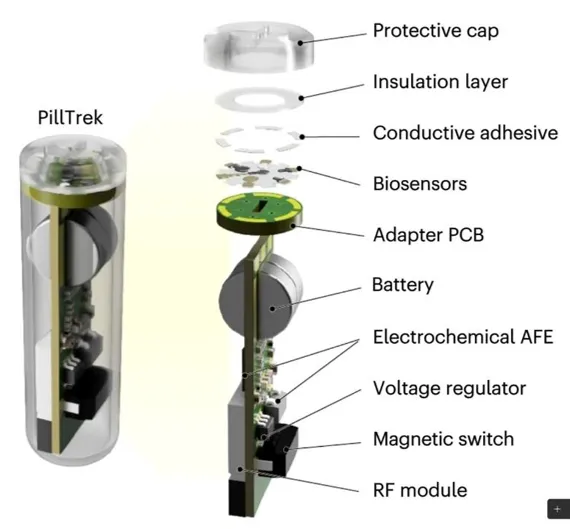
Fig-14: Showing components of pilltrek [56]
WORKING
The patient took the PillTrek capsule. It moved through the stomach and intestines in a natural way. As it moved the special sensors in the capsule kept measuring things like how the body's working and the chemicals inside it. The capsule had a computer that looked at all the information it was getting and sent it to a phone or a special receiver. The doctors looked at the information to see if the patients stomach and intestines were healthy and to find out if there were any problems. After the capsule finished its job it came out of the body when the patient went to the bathroom.
PillTrek can find out lots of things about the body like how acidic or basic it's the temperature, glucose levels serotonin levels and the balance of salts and other tiny particles. It can also measure hormones and other chemicals in the body. So doctors can use PillTrek to figure out what is wrong with the stomach and intestines to keep an eye on people with bowel disease to check how bad Crohns disease is, to see if there are problems with the way the body uses food to study the tiny living things in the gut to make personalized treatment plans to see how well drugs are working and to do research, for new medicines. [57]
FUTURE PROSPECTIVES
The smart pills market is getting bigger fast. In 2023 the smart pills market was worth $0.6 billion. It will probably be worth $1.1 billion by 2028, which is a big increase of about 11.8% every year. The future of pills looks very good. These special capsules can really change the way we do healthcare by making it easier for doctors to figure out what is wrong with someone keep an eye on their health and give them the treatment. [58] This means people who are sick will get results and their lives will be better overall. Smart pills will not work by themselves. They need to be connected to digital health tools like electronic health records, telemedicine platforms and wearable devices. When all these systems are connected doctors will have all the information they need about a patient’s health. They can do something, about it right away using the latest information. [59] The smart pills market is going to get even bigger because of technologies people spending more money on healthcare and more people wanting medical devices that do not invade their body. For the smart pills market to get as big as it can be researchers, healthcare providers and technology companies need to work. At the time getting better at looking at data will help us make the most of the information that smart pills collect about people’s health. [60]
CONCLUSION
Integrating medication with swallowable microelectronics and sensors, these innovative digital pills mark a significant advancement in modern healthcare. They open up ways to check for illness without needing surgery and to watch a person’s health in real time (like with CapsoCam Plus and PillTrek). They also help people take their medicine as they should (like with Abilify MyCite). These changes show how using tools in medicine can create better more accurate and more comfortable solutions for patients.
There are still problems with these systems. People may not like them. They can be expensive. They don’t last on a single charge. They can only do a thing. The data they collect may not always be correct. To make digital pills a regular part of how doctors treat patients these problems need to be solved.
New progress in communication, materials science, sensor design, smaller sizes and artificial intelligence is filling these gaps quickly.
Looking ahead future work will probably focus on:
Using intelligence and machine learning to automatically look at pictures find signs of disease and predict health issues.
Sending power wirelessly. Making circuits that use less energy to solve the problem of short battery life and to keep watching for longer.
Capsules that can give medicine where it is needed in the stomach and intestines.
Materials that are safe for the body and break down naturally to make sure they don’t stay and cause problems.
Connecting easily with health systems, like electronic health records telemedicine and devices people wear all the time to give complete real-time health checks.
Swallowable electronics are ready to help change how healthcare works by focusing on keeping people healthy and making treatment fit each person. These smart capsules could change how diseases are handled around the world by making it easier to find problems keep track of medicine and watch health all the time. Digital pills could become a part of future healthcare if research continues, if they are tested properly and if companies, doctors and rules makers work together.
REFERENCES

Rashmi Rajeghorpade, Satyajit Sahoo, Sapna Desai, Archana Kaushik, Sarankhawala Aadil S., Swallowable Electronics: A Review on Digital Pills from Adherence to Diagnostic, Int. J. of Pharm. Sci., 2026, Vol 4, Issue 9, 2587-2599. https://doi.org/10.5281/zenodo.22890730
 10.5281/zenodo.22890730