

We use cookies to ensure our website works properly and to personalise your experience. Cookies policy
Department of Chemistry Gurukula Kangri University Haridwar-249404, India
Ligands of Schiff base were synthesized from the method developed by Hugo Schiff. We have also synthesized the Ligands of Schiff base and its metals complexes by the condensation of naphthaldehyde and 3,4-diaminotoluene and then we synthesized metal complexes by refluxing. Characterization of the metal complexes was done using FTIR, UV, elemental analysis, mass NMR etc. The IR spectroscopy implies the formation of azomethine group which is confirmed by the band between 1600-1620 cm-1. The band for carbonyl group at 1700 cm-1was also disappeared. The ultraviolet spectroscopy shows the band near 550 to 600 nm wavelength which corresponds to d-d transition. The antibacterial activity of the generated Schiff base metal complexes was evaluated against gram-negative bacteria P. aeruginosa, S. typhi, E. coli, and gram-positive bacteria B. cereus, S. pneumoniae, S. aureus. The nickel and cobalt complexes were discovered to be highly effective against every type of bacterium in comparison to the standard chloramphenicol.
The name "Schiff base" comes from Hugo Schiff, who is attributed for developing the reversed acid-catalysed reaction between primary amine and carbonyl substances [1-10]. The chemical molecules that are used as Schiff bases are very adaptable and are created when different amino acids react with imines, ketones, or aldehydes. The reason Schiff base ligands are considered preferred ligands is because they are simple to synthesise via condensation. Their applications are diverse and include biology, industry, medicine, food packaging, pharmaceuticals, coordination chemistry, and other domains. [11]. They may be employed as an O2 detector as well. Azomethine nitrogen is utilised to coordinate metal ions by Schiff bases, an important category of ligands for coordination chemistry [12-16] Schiff base ligands have attracted a lot of interest in the field of coordination chemistry, mostly because of their easy synthesis, availability, and electrical properties. Schiff base coordination chemistry has drawn a lot of attention lately due to its significance in chemical production, chemistry for analysis, metal refinery, metallurgy, electroplating, and photography [17-20].
Numerous Schiff bases have been found to exhibit outstanding antimicrobial, antifungal, and anticancer properties [21-24]. The C=N moiety in this family of compounds is crucial for biological activity. By utilizing a variety of Schiff base ligands, the biological activities of transition metal complexes, including antibacterial, anticancer, and antifungal properties, have been documented [25-28]. For example, a variety of Schiff base ligands formed from 5-bromosalicylaldehyde and a-amino acids, including L-phenylalanine, L-arginine, L-aspartic acid, L-histidine, L-alanine, and have been used to create and produce a number of Fe (II) complexes [29-35].
Experimental
MATERIALS AND METHODS
The chemicals applied for production of ligands and complexes were of analytical grade of HIMEDIA and These were utilised without being cleansed. The FTIR, UV and XRD techniques were performed at SAIF IIT Roorkee. Thermo Scientific's NICOLET 6700 FT-IR infrared spectrometer was used to capture the IR spectrum data while using KBr as a supporting substance in the range of 400-4000cm. A Shimadzu UV-2450 UV-Vis spectrometer with a region of 200-800 nm wavelength was used to measure UV spectrum. Complexes weighing 0.0059 grams were dissolved in methanol to prepare the sample. In table 1, synthetic complexes have been characterized in terms of their physical characteristics. Mass and NMR analysis has been done at IIT Roper.
Antibacterial studies of synthesized metal compounds have been checked using agar well diffusion method for Gram positive and Gram-negative bacteria.
Synthesis of Schiff base ligand(L1)
The ligand was synthesized according to method reported earlier.[36]
The ration of aldehyde and amine reacted was 2:1. At first,2-naphthaldehyde (3.12 gm, 20 millimoles) were diffused in 10 millilitres methanol and the mixture was included into another solution of 3,4-diaminotoluene (1.22 gm, 10 mmol) in 10 ml methanol with continuous stirring. Then, we refluxed this reaction mixture for 5 hours at 60-700C. After refluxing, to separate the precipitate, the reaction solution was allowed to cool, dried, and then rinsed with methanol and filtered. The following scheme illustrates the created Schiff base ligand:
Reaction Scheme: Synthesis of ligand C29H22N2 (L1)
Synthesis of Schiff base metal complexes
For production of metal complexes of ligand, the chlorides of metals and Schiff base ligand were taken in the ration of 1:1 (2 mmol of the ligand and 2 mmol of metal chlorides MCl2) in 40 ml methanol and refluxed for 5-6 hours where M=Mn, Co, and Ni. After refluxing, the mixture was evaporated to 1/3rd amount and then cooled. The mixture was dried in oven and collected in sample tubes.
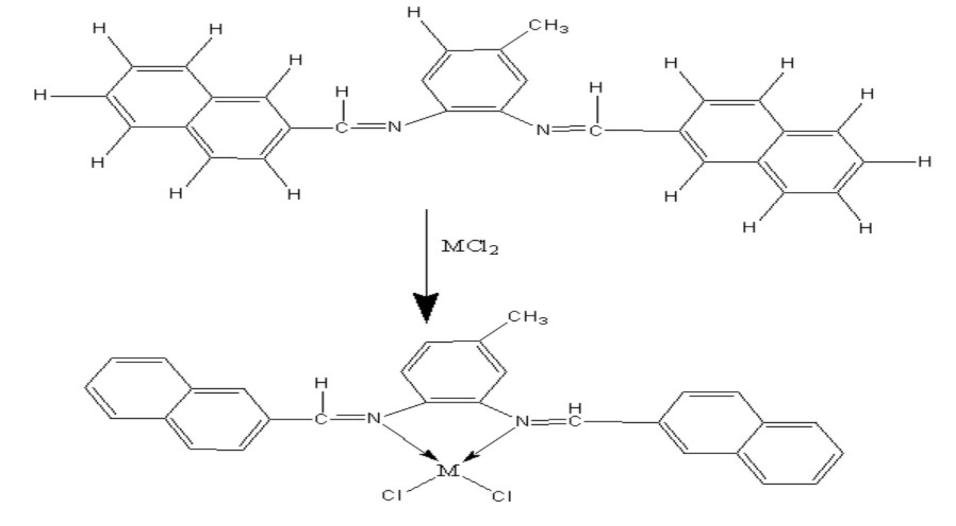
Scheme 2. Proposed scheme of Synthesis of metal complexesM[C29H22N2Cl2]
RESULTS AND DISCUSSIONS
Elemental analysis
|
Complex |
Colour |
Melting Point(0C) |
Molecular weight |
% Metal |
%Carbon |
%Hydrogen |
%Nitrogen |
|
Mn[C29H22N2Cl2] |
Pale yellow |
289 |
522.93 |
10.50 |
66.54(65.92) |
4.20(3.96) |
5.35(5.14) |
|
Co[C29H22N2Cl2] |
Green |
286 |
527.93 |
11.16 |
65.91(65.29) |
4.16(4.10) |
5.30(5.16) |
|
Ni[C29H22N2Cl2] |
Brown |
290 |
527.69 |
11.12 |
65.94(95.32) |
4.16(4.08) |
5.30(5.16) |
IR Spectroscopy
The Fourier Transform Infrared Spectroscopy was done to check the formation of complexes. The absorbance due to azomethine group is shown in the region of 1645-1650 cm-1. [37-39]
The created metal complexes have shown absorbance at the wavelength around 1621 cm-1. The lower wavelength can be explained by lower electron density due to the coordination between metals and azomethinenitrogen. [40-42]
Additionally, there is no absorption near 1700 cm-1, indicating that there is no carbonyl group present. The absorbance due to ?(M-N) stretching appeared at 475 cm-1. The flat band in the region of 3367 cm-1 to 3485cm-1 has shown the ?(O-H) stretching vibrations of water molecules [43-44]. The IR data are shown in following figures-
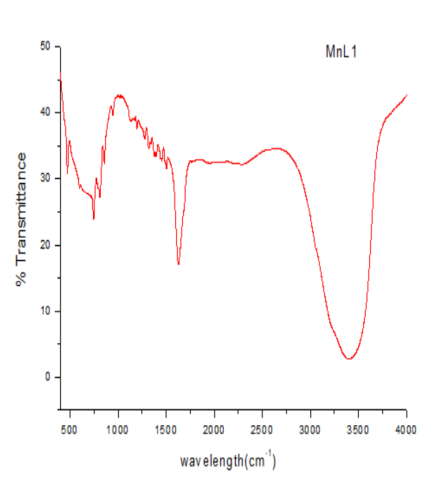
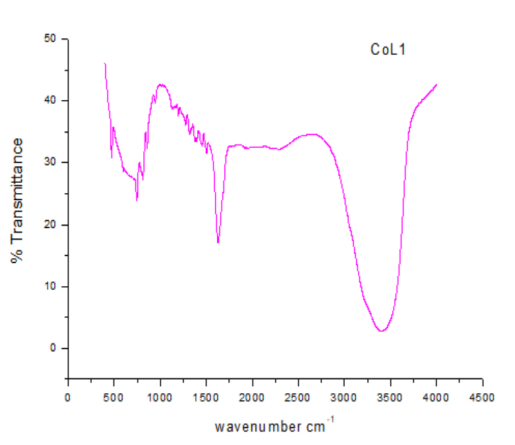
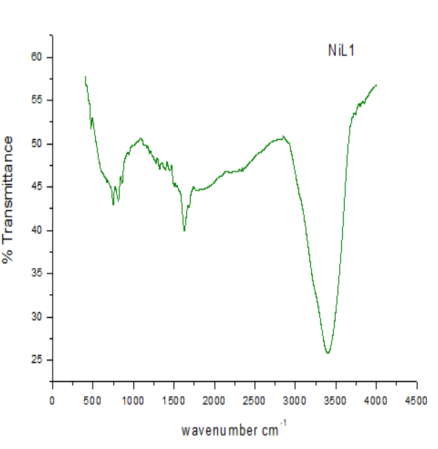
IR data of MnL1IR , CoL1IR data of NiL1
UV spectroscopy
The electronic spectra showed the peaks at 311 nm and 283nm that are assigned to n- π * to π -π * and2B1g 4A2gtransition. The shifting of absorption to longer wavelength is due to linkage of azomethine group and lower electron density on nitrogen because of bonding with metal. A broad band appeared within the range 545-630 nm which indicates the d-d transition and 2Eg 3T2g transition. The spectra suggest the square planer structure of the compound [45, 47].
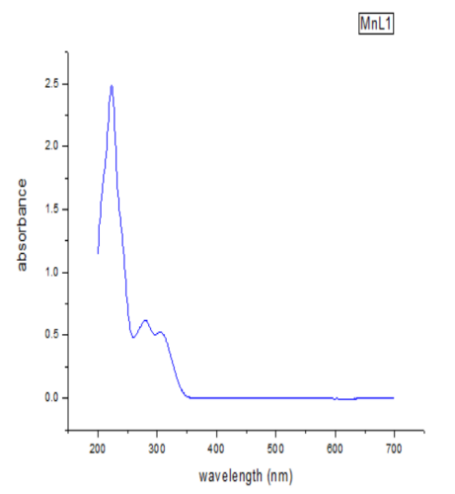
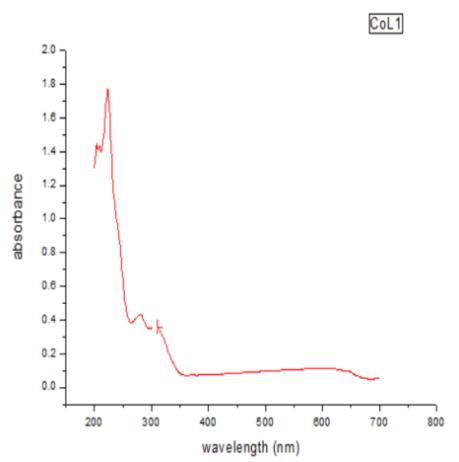
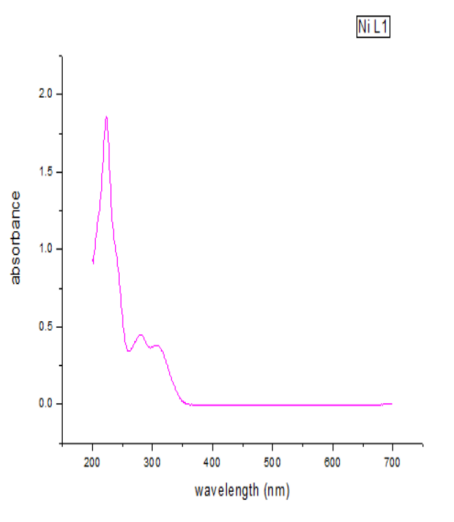
Mass spectroscopy
Mass spectroscopy confirmed the formation of complex as m/z peaks were appeared at 522.93 for Manganese,527.93 for Co and 527.69 for Ni complexes which are in good agreement with molecular weights. Other peaks also appeared for different stable fragments. The mass spectra for all three complexes have been shown in following figures-
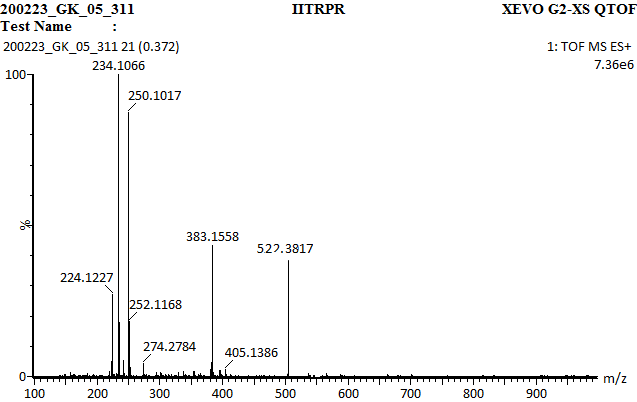
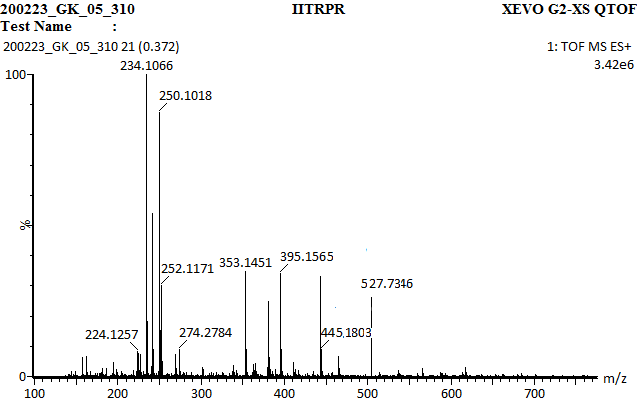
Mass spectra of MnL1Mass spectra of CoL1
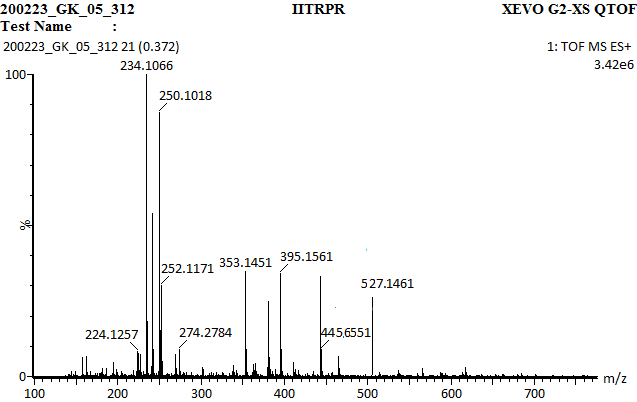
Mass spectra of NiL1
NMR spectra
Every complex's 1H-NMR result indicates a signal between 8.84 and 10.6 ppm. These numbers relate to the 2-naphthaldehyde moiety's NH protons. The signals for the protons in the aromatic ring of 3,4-DAT fall between 6.07 and 7.67 [48].
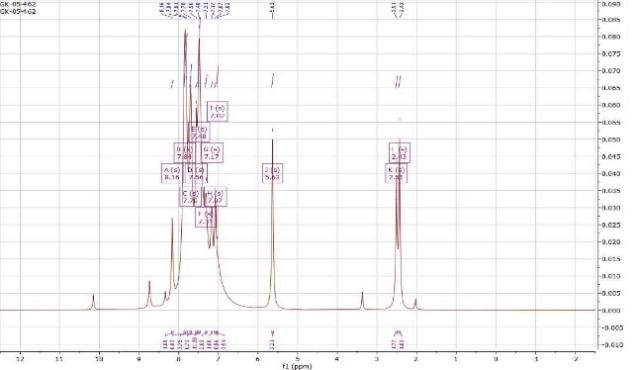
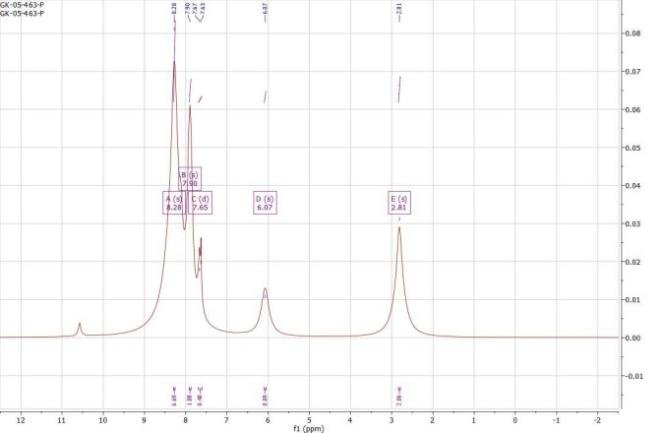
NMR Spectrum Of MnL1 NMR Spectrum Of CoL1
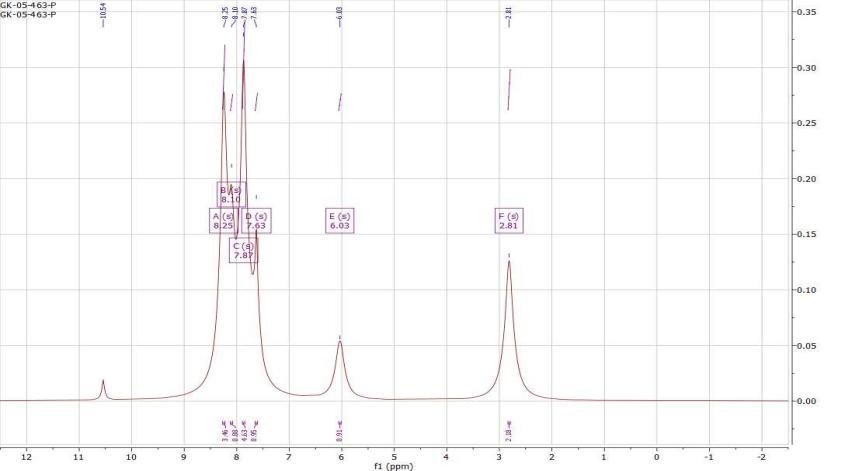
NMR Spectrum Of NiL1
Antimicrobial activity
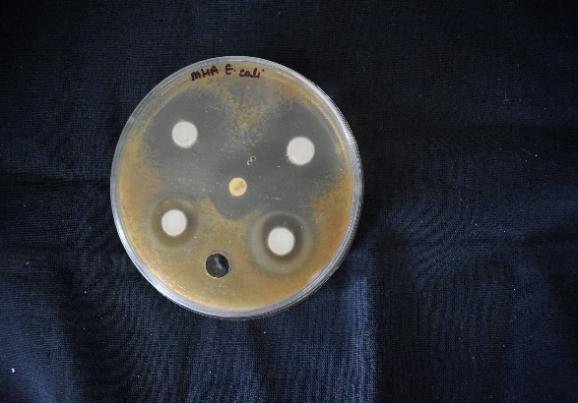
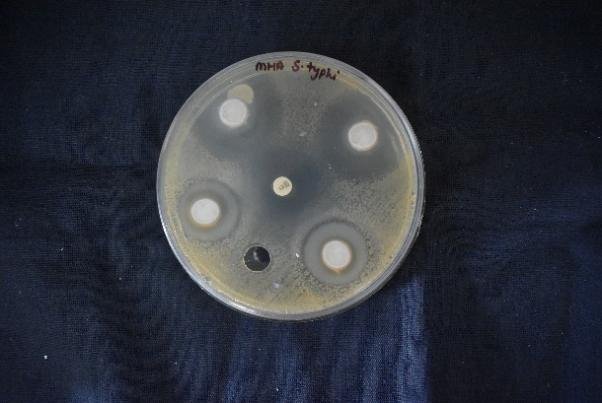
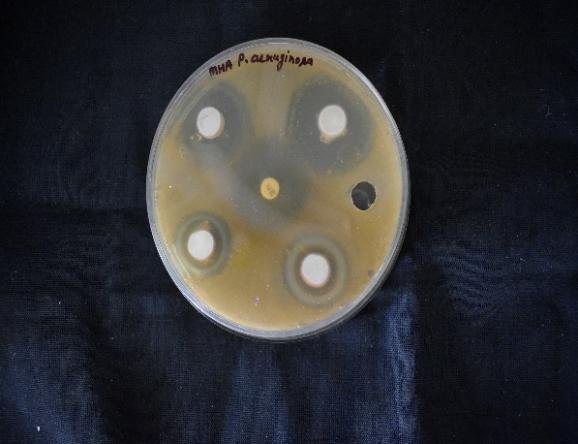
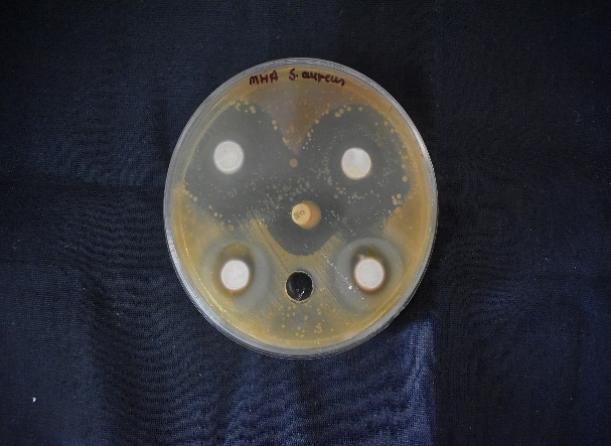
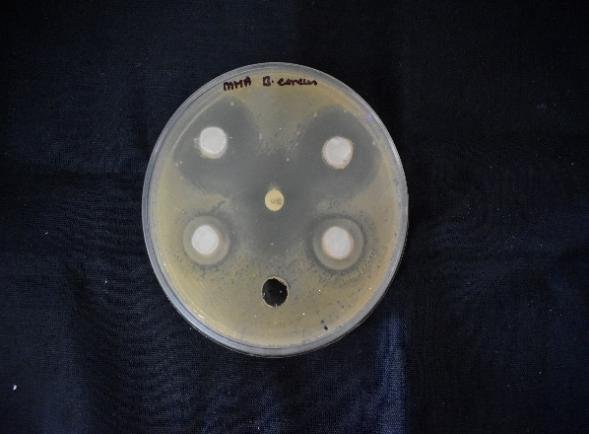
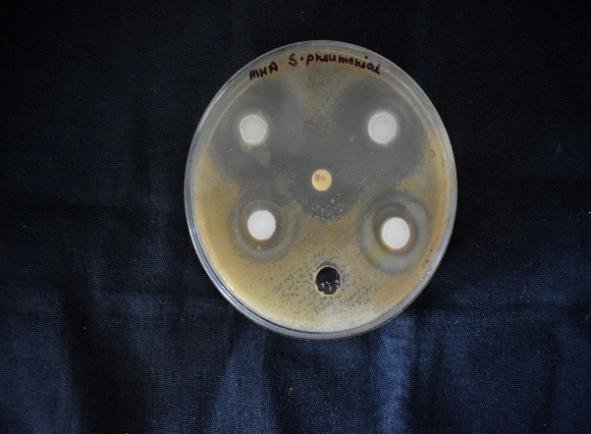
The antibacterial activity of the generated Schiff base metal complexes was evaluated against gram-negative bacteria P. aeruginosa, S. typhi, E. coli, and gram-positive bacteria B. cereus, S. pneumoniae, S. aureus.The solutions of complexes have been prepared containing 100 mg/ml concentration using DMSO as solvent. There were four wells in the plates each having 100 µL volume of the solution. Two out of four wells have one compound and two have another compound. DMSO was used as negative control and anti-bacterial drug chloramphenicol was used as standard. The metal complexes have shown very good activity against these bacteria. The cobalt and nickel complexes have shown the greatest potency against all strains in comparison to the standard chloramphenicol, but the nickel complex has appeared to be a very good antimicrobial property for Staphylococcus aureus. The inhibitory zone values of each complex has been shown in the table below-
|
Microorganism |
MnL1 |
CoL1 |
NiL1 |
Chloramphenicol |
|
|
|
E. coli |
22.7, 23.8 |
30.6, 24.7 |
28.8, 27.1 |
26.2 |
|
|
S. typhi |
19.4, 18.6 |
26.1,12.6 |
27.1, 29.7 |
26.1 |
|
|
P. aeruginosa |
19.2, 22.9 |
30.5, 22.2 |
30.5, 21.8 |
25.1 |
|
|
B. cereus |
15.3, 16.8 |
23.2, 15.2 |
26.5, 25.2 |
29.4 |
|
|
S. aureus |
24.5, 27.1 |
26.9, 27.0 |
36.9, 37.2 |
24.2 |
|
|
S. pneumonia |
22.8, 20.3 |
19.522.6 |
26.6, 28.0 |
24.2 |
CONCLUSION
Using a non-template technique, the Schiff base ligand is produced from 2-nahthaldehyde and 3-4 diamino toluene to create the complexes of Mn, Co, and Ni. These compounds were described by means of various spectroscopic methods, such as NMR, IR, and UV. These techniques suggest the formation of complexes was done and structure of complexes was found to be square planer. Additionally, the complexes' antibacterial properties against both gram-positive and gram-negative microorganisms were examined. The nickel and cobalt complexes were discovered to be highly effective against every type of bacterium.
Conflict of interest
A conflict of interest does not exist.
REFERENCES




Prashant Tevatia, Sumit Kumar, Priyansh Kumar Utsuk and Sagar Vishwakarma Synthesis, characterization, and antibacterial studies of Diaza Schiff base metal complexes of Mn, Co and Ni, Int. J. of Pharm. Sci., 2026, Vol 4, Issue 2, 3187-3194. https://doi.org/10.5281/zenodo.18709083
 10.5281/zenodo.18709083