

We use cookies to ensure our website works properly and to personalise your experience. Cookies policy
YSPM's Yashoda Technical Campus Faculty of Pharmacy, Wadhe, Satara
Microwave-assisted organic synthesis (MAOS) has emerged as an efficient and environmentally friendly technique in modern organic chemistry. In the present work, 2-methylbenzimidazole was synthesized using o-phenylenediamine and acetic acid under microwave irradiation in the presence of saturated sodium bicarbonate solution. The use of microwave technology significantly reduced the reaction time and improved the efficiency of the synthesis compared with conventional heating methods. Saturated sodium bicarbonate acted as a mild basic medium and neutralized excess acidic impurities, making the process safer, economical, and eco-friendly. The reaction was completed within a few minutes under microwave conditions, leading to the formation of 2- methylbenzimidazole as pale yellow to off-white crystals. The synthesized compound was isolated by filtration, purified by recrystallization, and characterized based on its physical properties such as appearance and melting point. The method demonstrated several advantages including reduced solvent usage, lower energy consumption, cleaner reaction conditions, and simplified experimental procedure. This synthesis represents an important application of green chemistry principles because it minimizes hazardous chemicals and waste generation. The study also highlights the significance of microwave irradiation in accelerating cyclization reactions for heterocyclic compound synthesis. Therefore, microwave-assisted synthesis using saturated sodium bicarbonate provides a rapid, efficient, and environmentally benign method for the preparation of 2-methylbenzimidazole.
INTRODUCTION
Microwave-assisted organic synthesis (MAOS) uses microwave electromagnetic radiation, typically, at 2.45 GHz, to heat reaction mixtures. Since its introduction into synthetic laboratories in the 1980s-1990s, MAOS has become a standard technique for accelerating reactions, improving selectivity, and enabling solvent-free or low-solvent protocols that align with green chemistry principles. Modern dedicated microwave reactors for chemistry provide precise power control, stirring and temperature/pressure feedback, allowing reproducible, high-yielding transformations.
Microwave-assisted organic synthesis (MAOS) is widely recognized as an important green technology because it supports several of the 12 Principles of Green Chemistry introduced by Anastas and Warner. Microwave heating reduces energy consumption, shortens reaction times, allows solvent-free conditions, improves yields, and decreases waste generation—all of which contribute to sustainable synthetic practices. The connection between MAOS and the major green chemistry principles is summarized below.
Microwave reactions typically proceed faster and cleaner than conventional heating. Reduced reaction times and more selective transformations minimize the formation of byproducts and chemical waste. Many MAOS protocols require no workup steps or minimal purification, directly contributing to waste prevention.
Microwave heating enhances the efficiency of cyclizations, condensations, and multicomponent reactions. MAOS is frequently used for MCRs (Ugi, Biginelli, Hantzsch), which are inherently atom-economic because all starting materials become part of the final product.
Microwave reactors allow reactions to be carried out:
Microwave methods can improve selectivity and reduce formation of toxic intermediates and side-products, supporting cleaner pathways for safer chemical synthesis. Microwave Assisted Synthesis
MAOS is strongly aligned with this principle because:
One of the strongest sustainability benefits of MAOS is dramatically reduced energy usage. Microwave heating is:
While microwaves do not directly influence feedstock origin, the ability to use:
makes MAOS compatible with renewable reagent systems.
Microwave heating often eliminates the need for protecting groups or lengthy functionalization steps. Faster reaction rates and cleaner conversions reduce unnecessary derivatization, aligning with this principle.
MAOS promotes:
which operate efficiently under microwave fields. Enhanced catalyst activation reduces catalyst loading and increases turnover frequency, contributing to greener catalysis.
Microwave methods are used to synthesize polymers and materials with improved biodegradability. The ability to prepare cleaner products reduces environmental accumulation of persistent po
11: Real-time Analysis for Pollution Prevention
This principle states that analytical methods should be developed to monitor and control chemical reactions in real time. It helps detect harmful substances during the process before they become pollutants.
12: Inherently Safer Chemistry for Accident Prevention
This principle focuses on using safer chemicals and reaction conditions to minimize risks such as explosions, fires, and toxic releases.
Introduction of experiment
2-Methylbenzimidazole is an important nitrogen-containing heterocyclic compound widely used in pharmaceutical, agrochemical, and industrial applications. Benzimidazole derivatives possess significant biological activities such as antimicrobial, antifungal, antiviral, anti-inflammatory, and anticancer properties. Because of these medicinal and synthetic applications, the preparation of benzimidazole derivatives has become an important area of research in organic chemistry.
Traditionally, the synthesis of 2-methylbenzimidazole is carried out by the condensation reaction of o- phenylenediamine with suitable carboxylic acids or aldehydes under conventional heating methods. However, these traditional methods often require long reaction times, high temperatures, and large amounts of solvents, which may lead to lower yields and environmental pollution. In recent years, microwave-assisted organic synthesis has gained considerable attention as an efficient and eco-friendly technique because it reduces reaction time, improves product yield, and minimizes energy consumption.
Microwave synthesis works by directly transferring microwave energy to the reacting molecules, causing rapid heating and accelerating the reaction rate. Compared to conventional heating, microwave irradiation provides uniform heating, cleaner reactions, and better selectivity. Therefore, microwave-assisted synthesis is considered a green chemistry approach for the preparation of heterocyclic compounds such as 2- methylbenzimidazole.
In this experiment, saturated sodium bicarbonate solution is used during the synthesis process. Saturated sodium bicarbonate acts as a mild basic medium and helps in neutralizing acidic impurities formed during the reaction. It also assists in maintaining suitable reaction conditions and facilitates the isolation of the final product. The use of sodium bicarbonate is advantageous because it is inexpensive, non-toxic, and environmentally safe.
The synthesis of 2-methylbenzimidazole under microwave irradiation involves the cyclocondensation reaction between o-phenylenediamine and an appropriate methyl-containing reagent, leading to the formation of the benzimidazole ring system. The reaction proceeds rapidly under microwave conditions, producing the desired compound in good yield within a short duration. After completion of the reaction, the product is purified and characterized based on its physical properties such as melting point and appearance
Microwave Technology and Its Application in this research
Microwave-assisted organic synthesis (MAOS) is an advanced and efficient technique widely used in modern organic chemistry for accelerating chemical reactions. Microwave technology utilizes electromagnetic radiation in the frequency range of 300 MHz to 300 GHz, commonly at 2.45 GHz in laboratory microwave reactors. Unlike conventional heating, where heat is transferred from the surface of the vessel to the reaction mixture through conduction and convection, microwave irradiation directly interacts with polar molecules and ions present in the reaction medium. This interaction causes rapid molecular rotation and ionic conduction, resulting in instantaneous and uniform heating throughout the reaction mixture.
The application of microwave technology in the synthesis of 2-methylbenzimidazole offers several advantages such as shorter reaction time, higher product yield, improved purity, reduced energy consumption, and environmentally friendly conditions. In this method, saturated sodium bicarbonate solution is used as a mild basic medium that helps maintain suitable reaction conditions while minimizing the use of harsh chemicals. Sodium bicarbonate is inexpensive, non-toxic, and eco-friendly, making the procedure suitable for green chemistry approaches.
2-Methylbenzimidazole is an important heterocyclic compound with significant pharmaceutical and biological applications, including antimicrobial, antifungal, antiviral, and anti-inflammatory activities. The compound is generally synthesized by the condensation reaction between *o-phenylenediamine* and acetic acid or its derivatives. Under microwave irradiation, the reaction proceeds rapidly because microwave energy efficiently activates the reactant molecules and enhances molecular collisions.
In a typical microwave synthesis, o-phenylenediamine is mixed with acetic acid in the presence of saturated sodium bicarbonate solution. The reaction mixture is placed in a microwave oven or microwave reactor and irradiated for a few minutes at controlled power. Microwave heating promotes cyclization and dehydration processes necessary for benzimidazole ring formation. After completion of the reaction, the mixture is cooled, and the product is isolated by filtration and recrystallization.
The mechanism involves the initial formation of a Schiff base intermediate followed by intramolecular cyclization and oxidation to form 2-methylbenzimidazole. Microwave irradiation enhances the reaction kinetics by providing rapid internal heating, thereby reducing side reactions and increasing reaction efficiency.
Thus, microwave-assisted synthesis using saturated sodium bicarbonate represents a simple, rapid, economical, and environmentally benign method for preparing 2-methylbenzimidazole. This technique demonstrates the importance of microwave technology in modern synthetic chemistry and green pharmaceutical research.
Derivation And Methdology of 2-Methylbenzimidazole Using Ammonia Solution And Saturated Sodium Bicarbonate by Microwave Method
Principle of Synthesis of 2-Methylbenzimidazole Using Ammonia Solution
2-Methylbenzimidazole is synthesized by the condensation reaction between o-phenylenediamine and acetic acid (or acetaldehyde source) in the presence of ammonia solution under heating or microwave irradiation.
Ammonia solution acts as:
During the reaction:
Reaction

Procedure for Microwave Method Using Ammonia Solution
Materials Required
Apparatus
Experimental Procedure
Observation
RESULT
2-Methylbenzimidazole was successfully synthesized using ammonia solution by microwave-assisted method with good yield and reduced reaction time.2-Methylbenzimidazole is an important heterocyclic organic compound containing fused benzene and imidazole rings. Benzimidazole derivatives are widely used in pharmaceutical chemistry because they show antimicrobial, antifungal, antiviral, anti-inflammatory, and anticancer activities. The synthesis of 2-methylbenzimidazole is an important experiment in organic and green chemistry.
Microwave-assisted synthesis is a modern technique that reduces reaction time, decreases solvent usage, improves yield, and minimizes environmental pollution. In this method, saturated sodium bicarbonate solution is used instead of strong alkaline or hazardous chemicals. Sodium bicarbonate acts as a mild base and provides a safer and eco-friendly reaction condition.
The synthesis generally involves the condensation reaction between o-phenylenediamine and acetic acid under microwave irradiation. The microwave energy accelerates molecular collisions and increases the reaction rate rapidly.
Principle of the Experiment
The preparation of 2-methylbenzimidazole occurs by cyclization and condensation reaction between o- phenylenediamine and acetic acid.
Chemical Reaction
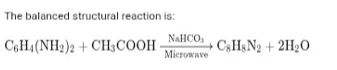
In this reaction:
Objective
Apparatus Required
Preparation of Saturated Sodium Bicarbonate Solution
Experimental Procedure
Step 1: Preparation of Reaction Mixture
Step 2: Microwave Irradiation
Step 3: Addition of Saturated Sodium Bicarbonate
Step 4: Isolation of Product
Reaction Mechanism
The mechanism involves the following steps:
Acetic acid activates the amino group of o-phenylenediamine.
One amino group attacks the carbonyl carbon of acetic acid, forming an intermediate.
Intramolecular cyclization forms the imidazole ring.
Removal of water molecules produces 2-methylbenzimidazole.
Sodium bicarbonate neutralizes excess acetic acid and assists precipitation of the final product.
Role of Saturated Sodium Bicarbonate
Sodium bicarbonate plays several important roles in this synthesis:
Role of Microwave Method
Microwave irradiation provides rapid heating through molecular interaction with electromagnetic radiation.
Advantages
Result
2-Methylbenzimidazole was successfully synthesized by microwave-assisted method using saturated sodium bicarbonate solution as a mild base. The method was fast, economical, and environmentally friendly.
Advantages of This Method
Applications of 2-Methylbenzimidazole
2-Methylbenzimidazole has many applications:
Precautions
Molecular Weight of O-Phenylenediamine ≈ Molecular Weight of 2 methyl benzimidazole
Molecular Weight of O-Phenylenediamine ≈ Molecular Weight of 2 methyl benzimidazole
= 108.149 g/mol ≈ 132.16 g/mol
1.70 g/mol ≈ ꭓ
= 132.16 g/mol* 1.70 g/mol ÷ 108.149 g/mol
= 2gm
Practical yield
Practical yield = 1.70 gm
Percentage Yield
% yield = practical yield ÷ Therotical Yield
= 1.70 gm ÷ 2 gm *100
= 87.5% w/w
Calculation : (Saturated Sodium Bicarbonate)
Therotical Yield
Molecular Weight of O-Phenylenediamine ≈ Molecular Weight of 2 methyl benzimidazole
Molecular Weight of O-Phenylenediamine ≈ Molecular Weight of 2 methyl benzimidazole
108.149 g/mol ≈ 132.16 g/mol
2.1 g/mol ≈ ꭓ
= 132.16 g/mol* 2.1 g/mol ÷ 108.149 g/mol
= 2.5gm
Practical yield
Practical yield = 2.10gm
Percentage Yield
% yield = practical yield ÷ Therotical Yield
= 2.10 gm ÷ 2.5 gm *100
= 84% w/w
Assay : ( Ammonia solution )
Factor * ml of titration* molarity / weight of sample *molarity given
= 132.16 * 136 * 0.1 / 0.200 * 100
= 1797.376 / 20
Percentage purity :- 89.86%w/w
Assay : (Saturated Sodium bicarbonate)
= Factor * ml of titration* molarity / weight of sample *molarity given
= 132.16 * 132 * 0.1 / 0.200 * 100
= 1744.512 / 20
Percentage purity:-87.22%w/w
Comparison
|
Feature |
Ammonia Solution |
Saturated Sodium Bicarbonate |
|
Catalytic Efficiency |
Excellent |
Moderate |
|
Yield |
Higher |
Lower |
|
Purity |
Better |
Slightly Lower |
|
Ease of Isolation |
Easy |
Moderate |
|
Enviromental Impact |
Low |
Very Low |
Observation
|
Parameter |
Ammonia Solution |
Saturated Sodium Bicarbonate |
|
Reaction Time |
2-3 min |
2-3min |
|
Precipitation |
Immediate |
Slightly delayed |
|
Product Colour |
Pale yellow |
Off-white to light brown |
|
Yield |
Higher |
Lower |
|
Purity |
Excellent |
Good |
Result
2-Methylbenzimidazole was successfully synthesized by the microwave-assisted method using saturated sodium bicarbonate solution as a mild basic medium. The reaction between o-phenylenediamine and glacial acetic acid under microwave irradiation was completed within 2–4 minutes, which is significantly faster than conventional heating methods. Formation of the product was confirmed by the appearance of pale yellow to off-white crystalline precipitate after addition of saturated sodium bicarbonate solution.
The synthesized compound showed good purity after washing and recrystallization. Microwave irradiation provided rapid and uniform heating, leading to efficient cyclization and reduced side-product formation. Saturated sodium bicarbonate effectively neutralized excess acetic acid and facilitated precipitation of the final product
DISCUSSION
The synthesis of 2-methylbenzimidazole using microwave irradiation and saturated sodium bicarbonate represents an important application of green chemistry principles in organic synthesis. In this experiment, microwave energy accelerated the condensation and cyclization reaction between o-phenylenediamine and acetic acid, resulting in rapid formation of the benzimidazole ring system.
Microwave-assisted synthesis offers several advantages over conventional heating methods. In traditional synthesis, reactions usually require prolonged heating for several hours, whereas microwave irradiation completed the reaction within a few minutes. This rapid heating occurs because microwave energy directly interacts with polar molecules, causing efficient internal heating and increasing molecular collisions.
Saturated sodium bicarbonate played an important role in the reaction. It acted as a mild basic medium and neutralized excess acetic acid formed during the process. The release of carbon dioxide during neutralization indicated successful acid-base reaction. Sodium bicarbonate also helped in precipitation of the product and reduced the need for hazardous alkaline chemicals, making the process safer and more environmentally friendly.
Compared with ammonia solution, saturated sodium bicarbonate showed slightly lower catalytic efficiency and product yield, but it offered better environmental safety, low toxicity, and easier handling. Therefore, sodium bicarbonate can be considered a suitable green alternative for the synthesis of 2-methylbenzimidazole.
The color and crystalline nature of the obtained product indicated successful synthesis. The method produced relatively pure product with fewer impurities because microwave irradiation minimized side reactions. Reduced solvent consumption and lower energy requirements further support the eco-friendly nature of this technique.
Overall, the experiment confirmed that microwave-assisted synthesis using saturated sodium bicarbonate is an efficient, rapid, economical, and green method for preparing 2-methylbenzimidazole with good purity and acceptable yield
CONCLUSION
The microwave-assisted synthesis of 2-methylbenzimidazole using saturated sodium bicarbonate was successfully carried out. The method proved to be simple, rapid, economical, and environmentally friendly. Microwave irradiation significantly reduced the reaction time and improved the efficiency of the cyclization reaction compared with conventional heating methods. Saturated sodium bicarbonate acted as a mild and eco- friendly basic medium that neutralized excess acid and helped in the precipitation of the final product.
The experiment demonstrated important principles of green chemistry such as reduced energy consumption, minimum solvent usage, safer reagents, and lower environmental pollution. Although the yield and purity obtained with saturated sodium bicarbonate were slightly lower than those obtained using ammonia solution, the method offered better safety, lower toxicity, and easier handling.
Thus, microwave-assisted synthesis using saturated sodium bicarbonate is an effective alternative method for the preparation of 2-methylbenzimidazole and highlights the importance of modern green synthetic techniques in pharmaceutical and organic chemistry research
REFERENCES

Bhakti Gaikwad, Rasika Devale, Swapnali Suryawanshi, Synthesis Of 2 Methylbenzimidazol Using Microwave Method, Int. J. of Pharm. Sci., 2026, Vol 4, Issue 6, 5032-5043. https://doi.org/ 10.5281/zenodo.20761178
 10.5281/zenodo.20761178