

We use cookies to ensure our website works properly and to personalise your experience. Cookies policy
School of Pharmacy & Research Centre, Sanskriti University, Chhata, Mathura, India.
Targeted covalent inhibitors (TCIs) are an important group of drugs used in modern drug discovery. These drugs first bind to a specific protein and then form a strong covalent bond with it. This helps the drug stay attached to its target for a long time and can produce a longer-lasting effect. In the past, covalent drugs were associated with problems such as toxicity, immune reactions, and unwanted binding to other proteins. Advances in medicinal chemistry, structural biology, computer-based drug design, and chemo proteomics have helped scientists develop more selective and safer covalent drugs. Several covalent drugs, such as afatinib, osimertinib, ibrutinib, acalabrutinib, zanubrutinib, sotorasib, and adagrasib, have shown strong clinical success. Most of these drugs are used in cancer treatment. Their success has shown that covalent drugs can selectively target disease-related proteins and provide long-lasting therapeutic effects. This review explains the development and basic principles of targeted covalent inhibitors. It discusses how these drugs work, the different types of electrophilic warheads used to form covalent bonds, and the relationship between their chemical structure and activity. It also describes approved covalent drugs and their clinical uses. The review further discusses the main advantages and limitations of TCIs. It explains how cancer cells can develop resistance to these drugs and reduce their effectiveness. Special attention is given to important targets such as EGFR, BTK, and KRAS G12C, which have become major targets in cancer treatment. Finally, the review discusses the future of targeted covalent inhibitors. New applications are being studied in autoimmune diseases, infectious diseases, and neurological disorders. These developments may lead to safer, more selective, and more effective covalent drugs in the future.
Drug discovery has made great progress over the last few decades. This progress has been supported by advances in molecular biology, medicinal chemistry, structural biology, computer-based drug design, and medical research. Even with these advances, developing drugs that can act selectively on disease-related proteins is still a major challenge. For many years, reversible inhibitors have been widely used in drug discovery. These drugs bind to their target proteins without forming a permanent bond. They are useful because their effects can be controlled and they are generally considered safer. However, reversible inhibitors also have some limitations. They may not remain attached to the target for a long time, may require frequent dosing, and may lose their effectiveness because of drug resistance. These problems have encouraged researchers to develop new approaches to drug design.1
One important approach is the development of targeted covalent inhibitors (TCIs). TCIs combine the selectivity of reversible binding with the long-lasting effect of covalent bonding. First, the drug binds to a specific site on the target protein through normal non-covalent interactions. It then forms a covalent bond with a suitable amino acid residue in the protein. Because of this two-step process, TCIs can remain attached to their targets for a longer period and can produce a prolonged drug effect.2
In the past, covalent drugs were used with caution. Researchers were concerned that these drugs could cause toxicity, immune reactions, and unwanted modification of other proteins. During the late twentieth century, many pharmaceutical companies therefore preferred reversible drugs. Irreversible binding was often considered risky because it could lead to unexpected biological effects. However, some successful drugs showed that covalent binding can also be useful in medicine. Examples include aspirin, penicillin, proton pump inhibitors, and several anticancer drugs.3 The success of these medicines showed that covalent drug action can be safe and effective when it is properly controlled. This led researchers to take a new interest in covalent drug design.4
The development of modern technologies has further increased interest in TCIs. Techniques such as X-ray crystallography, cryo-electron microscopy, computational chemistry, and chemical proteomics help researchers understand how drugs interact with proteins. These methods can also help identify suitable amino acid residues and improve the design of electrophilic groups. As a result, newer covalent inhibitors can be made more selective than many earlier covalent drugs.5
Cysteine is one of the most commonly targeted amino acids in covalent drug design. Its thiol group can react with suitable electrophilic groups under normal biological conditions. Some disease-related proteins contain cysteine residues that can be selectively targeted by carefully designed drugs. Other amino acids, such as lysine, tyrosine, serine, histidine, and threonine, can also be used as sites for covalent binding.6
Different electrophilic groups, known as warheads, are used to form covalent bonds with these amino acid residues. Common examples include acrylamides, chloroacetamides, boronic acids, nitriles, vinyl sulfonamides, and sulfonyl fluorides.7 Choosing the right warhead is very important. If it is too reactive, it may react with unwanted proteins and cause toxicity. If it is not reactive enough, the drug may not produce a strong therapeutic effect. The greatest success of TCIs has been seen in cancer treatment. Several covalent drugs, including afatinib, osimertinib, ibrutinib, acalabrutinib, zanubrutinib, sotorasib, and adagrasib, have been approved for the treatment of different cancers. These drugs have shown that covalent inhibition can provide strong and long-lasting effects. The development of KRAS G12C inhibitors is especially important because KRAS was considered a difficult protein to target for many years.8
TCIs are not limited to cancer treatment. Researchers are also studying them for inflammatory diseases, autoimmune diseases, infectious diseases, and neurological disorders. New methods such as chemoproteomics, activity-based protein profiling, covalent fragment screening, and artificial intelligence are helping researchers find new targets for covalent drugs. These methods may also help identify protein sites that were previously difficult to target.9
Because of their long-lasting effects and wide range of possible applications, targeted covalent inhibitors have become an important area of modern drug research.10 This review discusses the development of TCIs, their basic mechanisms, drug design strategies, clinical applications, advantages, limitations, resistance mechanisms, and future possibilities. The review also highlights how new technologies may help in the development of safer and more effective covalent drugs.11
2. HISTORICAL EVOLUTION OF COVALENT DRUGS
The history of covalent therapeutics extends over more than a century and includes some of the most influential drugs ever developed. Although the molecular mechanisms of these agents were initially unknown, subsequent research revealed that many successful medicines exert their effects through covalent interactions with biological targets.12
One of the earliest and most important examples is aspirin, first introduced in the late nineteenth century.13 Aspirin irreversibly acetylates cyclooxygenase enzymes, thereby inhibiting prostaglandin synthesis and producing anti-inflammatory, analgesic, and antiplatelet effects. The long duration of aspirin’s action despite its short plasma half-life provided early evidence of the therapeutic value of covalent target modification.14
Another landmark discovery was penicillin, identified by Alexander Fleming in 1928.15 Penicillin and related β-lactam antibiotics form covalent adducts with bacterial transpeptidase enzymes, disrupting cell wall biosynthesis and ultimately causing bacterial death. The extraordinary success of penicillin established covalent inhibition as an effective therapeutic strategy long before the underlying molecular mechanisms were fully understood.16
By the 1970s and 1980s, medicinal chemistry had shifted largely toward reversible inhibitors.17 Pharmaceutical scientists believed that reversible interactions offered greater control over drug action and reduced the risk of permanent biological damage. Consequently, many drug discovery programs actively avoided highly reactive molecules and excluded compounds containing electrophilic functional groups.18
Today, targeted covalent inhibitors are widely recognized as one of the fastest-growing areas of pharmaceutical chemistry.19 Increasing numbers of approved drugs, expanding clinical pipelines, and continuous technological innovation indicate that covalent therapeutics will remain a major focus of future drug discovery efforts.20
3. MECHANISM OF ACTION OF TARGETED COVALENT INHIBITORS
Targeted covalent inhibitors differ fundamentally from traditional reversible inhibitors, this two-step process enables exceptional potency, prolonged target engagement and improved pharmacological performance.21
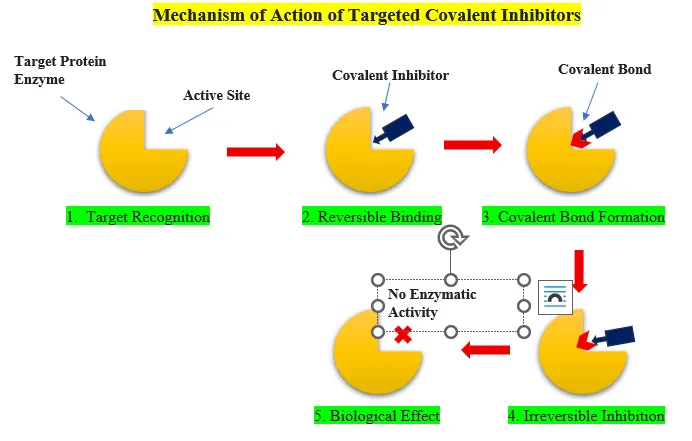
3.1 Target Recognition: The inhibitor binds to the target protein through non covalent interactions.22
3.2 Reversible Binding: The inhibitor reversibly binds at the active site or nearly pocket, positioning the reactive warhead close to a nucleophilic residue.
3.3 Covalent Bond Formation: The reactive warheads covalently react with a nucleophilic amino acid (eg. Cysteine, serine or lysine) in the target protein.23
3.4 Irreversible Inhibition: The covalent bond leads to irreversible inhibition of the target protein’s activity.24,25
3.5 Biological Effect: Inhibition of target protein blocks downstream signalling pathways leading to the desired therapeutic effect (eg. Inhibition of tumour growth).26
3.6 Advantages of Covalent Mechanisms27, 28, 29
The covalent mechanism provides several pharmacological benefits:
Prolonged Target Occupancy: Drug activity may persist significantly longer than plasma half-life.
Reduced Dosing Frequency: Sustained inhibition often allows less frequent administration.
Enhanced Potency: Permanent target modification can improve biological efficacy.
Overcoming Competitive Limitations: Covalent inhibitors are less affected by fluctuations in endogenous substrate concentrations.
Improved Clinical Responses: Sustained target suppression may reduce disease progression and improve therapeutic outcomes.
4. ELECTROPHILIC WARHEADS IN TARGETED COVALENT INHIBITOR DESIGN
Electrophilic warheads are important components of targeted covalent inhibitors. They are reactive chemical groups that can form a covalent bond with specific amino acids in proteins. These warheads help inhibitors bind strongly and permanently to their target proteins.30 Common target amino acids include cysteine, lysine, serine, and tyrosine. The inhibitor first binds to the target protein through normal interactions. The electrophilic warhead then reacts with a nearby amino acid residue. This reaction produces a stable covalent bond between the drug and the protein. Different warheads, such as acrylamides and sulfonyl fluorides, are used in drug design. Their reactivity must be carefully controlled to avoid unwanted reactions with other proteins.31
Therefore, selecting the right electrophilic warhead is important for developing safe and effective drugs.
4.1 Characteristics of an Ideal Electrophilic Warhead32, 33
An ideal warhead should possess the following properties:
4.2 Acrylamide Warheads34
Acrylamide warheads are important chemical groups used in targeted covalent inhibitor design. They are commonly used because they can react with specific amino acids in target proteins, especially cysteine residues. The acrylamide group contains an electrophilic part that reacts with the nucleophilic cysteine residue. This reaction forms a strong and stable covalent bond between the inhibitor and the target protein. As a result, the inhibitor can produce a strong and long-lasting effect. Acrylamide warheads can also be designed to improve the selectivity of the inhibitor toward a particular target. However, their reactivity must be carefully controlled to avoid unwanted reactions with other proteins. Therefore, acrylamide warheads are useful tools for developing effective and selective covalent drugs.
Advantages
Limitations
Approved Drugs Utilizing Acrylamides
4.3 Chloroacetamide Warheads
Chloroacetamide warheads are important electrophilic groups used in targeted covalent inhibitor design. They are mainly used because they can react with specific amino acids in target proteins, especially cysteine residues. The chloroacetamide group contains a reactive carbon that can form a covalent bond with the cysteine residue.35 This reaction helps the inhibitor bind strongly and permanently to the target protein. As a result, chloroacetamide warheads can provide a long-lasting inhibitory effect. Their high reactivity can also be useful when the target protein has a suitable cysteine residue. However, their reactivity needs to be carefully controlled to reduce unwanted reactions with other proteins. Therefore, chloroacetamide warheads are useful for developing potent and selective covalent inhibitors.
Advantages36
Limitations37
Because of their high intrinsic reactivity, chloroacetamides are often employed during early-stage drug discovery rather than in final clinical candidates.
4.4 Boronic Acid Warheads
Boronic acid warheads are useful chemical groups in targeted covalent inhibitor design. They can interact with specific amino acid residues present in target proteins. These warheads are especially known for reacting with nucleophilic groups such as serine and lysine. The boronic acid group can form a stable bond with the target site and help inhibit protein activity. Their controlled reactivity can improve the selectivity of the inhibitor. Boronic acid warheads have been studied for developing inhibitors against several important enzymes. Therefore, they are valuable tools for designing effective and selective covalent inhibitors.38
Advantages39
Example
Bortezomib, a proteasome inhibitor used in multiple myeloma, represents one of the most successful boronic acid-containing therapeutics.
Clinical Importance
Boronic acids demonstrate that irreversible inhibition is not always necessary to achieve effective covalent target engagement.40
Table 1: Major Electrophilic Warheads Used in Covalent Drug Discovery
| Warhead | Target Residue | Reactivity | Clinical Status |
|---|---|---|---|
| Acrylamide | Cysteine | Moderate | Widely Approved |
| Chloroacetamide | Cysteine | High | Experimental |
| Boronic Acid | Serine | Moderate | Approved |
| Sulfonyl Fluoride | Lysine/Tyrosine | Moderate | Emerging |
| Nitrile | Cysteine | Low–Moderate | Emerging |
| Cyanoacrylamide | Cysteine | Reversible | Development |
5. STRUCTURE–ACTIVITY RELATIONSHIP (SAR) OF TARGETED COVALENT INHIBITORS
5.1. Warhead: The warhead is the reactive group of a targeted covalent inhibitor. It forms a covalent bond with a specific nucleophilic amino acid, commonly cysteine, present in the target protein. The warhead should have controlled reactivity to avoid unwanted reactions with other proteins.
5.2. Electrophilic Reactivity: The electrophilic nature of the warhead plays an important role in inhibitor activity. Appropriate reactivity allows the inhibitor to form a covalent bond efficiently after binding to the target. Excessive reactivity can increase nonspecific interactions and toxicity.
5.3. Target-Binding Moiety: The binding moiety provides the initial interaction with the target protein through non-covalent interactions such as hydrogen bonding, hydrophobic interactions, and π–π interactions. Strong target binding helps bring the warhead close to the reactive amino acid.
5.4. Linker: The linker connects the target-binding group with the warhead. Its length, flexibility, and chemical composition affect the overall activity of the inhibitor. An appropriately designed linker helps position the warhead correctly within the binding pocket.41
5.5. Warhead Position and Orientation: Correct positioning of the warhead is essential for covalent bond formation. The warhead must be located at a suitable distance and orientation from the target residue. Even small structural changes can significantly influence covalent binding and potency.
5.6. Selectivity: Selectivity is one of the major goals in the design of targeted covalent inhibitors. The inhibitor should preferentially bind to the intended protein and react with the desired amino acid. High selectivity can reduce off-target effects and improve the safety profile.
5.7. Steric Effects: Steric factors influence how well the inhibitor fits into the target binding site. Large or bulky substituents may prevent proper binding or block access to the target residue. However, suitable bulky groups can sometimes improve selectivity by occupying specific regions of the binding pocket.
5.8. Electronic Effects: The electronic nature of substituents can affect the reactivity of the warhead and the strength of interactions with the target. Appropriate electronic modifications can help control the rate of covalent bond formation and improve inhibitor potency.
5.9. Lipophilicity and Solubility: Balanced lipophilicity is important for cellular penetration and target binding. Excessive lipophilicity may increase nonspecific protein binding, while very low lipophilicity may reduce membrane permeability. Good aqueous solubility is also desirable for suitable drug properties.42
5.10. Hydrogen Bonding and Other Interactions: Hydrogen bonding and other non-covalent interactions help stabilize the inhibitor within the target binding site. Proper placement of hydrogen-bond donors and acceptors can improve binding affinity and help maintain the correct orientation of the warhead.
5.11. Metabolic Stability: Structural modifications can influence the metabolic stability of the inhibitor. Improving stability may increase the duration of action, while avoiding metabolically unstable groups can improve the overall pharmacokinetic profile.
5.12. Overall SAR Optimization: The design of targeted covalent inhibitors requires a balance between covalent reactivity and non-covalent target recognition. Optimization of the warhead, binding moiety, linker, steric and electronic properties, selectivity, and physicochemical characteristics can lead to potent and selective inhibitors with prolonged target inhibition.43
6. FDA-APPROVED TARGETED COVALENT INHIBITORS
The successful development of targeted covalent inhibitors has resulted in the approval of several therapeutically important drugs across multiple disease areas. These agents demonstrate that rational covalent drug design can achieve high efficacy while maintaining acceptable safety profiles.44
The majority of approved TCIs belong to the kinase inhibitor class, particularly those used in oncology. However, covalent therapeutics are also well established in cardiovascular diseases, gastrointestinal disorders, and infectious diseases.45
Table 2: Major FDA-Approved Covalent Drugs
| Drug | Target | Indication | Approval Significance |
|---|---|---|---|
| Aspirin | COX-1 | Cardiovascular Disease | Classic covalent drug |
| Penicillin | Transpeptidase | Bacterial Infection | First major antibiotic |
| Omeprazole | H+/K+ ATPase | Acid Disorders | Proton pump inhibitor |
| Afatinib | EGFR | NSCLC | First irreversible EGFR inhibitor |
| Osimertinib | EGFR T790M | NSCLC | Precision oncology breakthrough |
| Ibrutinib | BTK | CLL/MCL | First BTK inhibitor |
| Acalabrutinib | BTK | Leukemia | Improved selectivity |
| Zanubrutinib | BTK | B-cell Malignancies | Next-generation BTK inhibitor |
| Sotorasib | KRAS G12C | Solid Tumors | First KRAS inhibitor |
| Adagrasib | KRAS G12C | NSCLC | Expanded KRAS targeting |
7. CLINICAL APPLICATIONS OF TARGETED COVALENT INHIBITORS46
7.1 Applications in Oncology
Cancer therapy represents the most successful application of targeted covalent inhibition. Advances in cancer genomics have enabled identification of disease-driving mutations that can be selectively targeted by covalent drugs.
Advantages in oncology include:
The most important oncological targets currently include:
7.1.1. EGFR (Epidermal Growth Factor Receptor)
EGFR is a cell-surface receptor that controls cell growth and survival. It is frequently overactive or mutated in several cancers. Targeting EGFR can block signals responsible for uncontrolled tumor growth. Covalent EGFR inhibitors are designed to bind strongly to specific residues such as cysteine.
7.1.2. BTK (Bruton’s Tyrosine Kinase)
BTK is an important enzyme involved in B-cell receptor signaling. It plays a major role in the growth and survival of B-cell malignancies. Inhibition of BTK can reduce abnormal B-cell proliferation. Covalent BTK inhibitors can form a stable bond with a cysteine residue in BTK.
7.1.3. KRAS
KRAS is a signalling protein that regulates cell growth and proliferation. Mutations in KRAS can keep growth signals continuously active in cancer cells. Mutant KRAS, especially KRAS G12C, is an important target for cancer therapy. Covalent inhibitors can selectively bind to the mutant KRAS G12C protein.
7.1.4. HER2 (Human Epidermal Growth Factor Receptor 2)
HER2 is a receptor involved in cell growth and survival signaling. Increased HER2 activity is associated with cancers such as breast and gastric cancer. Blocking HER2 can reduce cancer cell proliferation and survival. Targeted inhibitors can interfere with HER2 signaling and help control tumor growth.
7.1.5. FGFR (Fibroblast Growth Factor Receptor)
FGFRs are receptor tyrosine kinases that regulate cell growth and development. Abnormal FGFR activation or mutations can contribute to cancer progression. FGFR inhibition can block growth and survival signals in tumor cells. Covalent inhibitors are being investigated to achieve selective and long-lasting FGFR inhibition.
7.1.6. JAK Kinases (Janus Kinases)
JAK kinases are important enzymes involved in cytokine and growth-factor signaling. Abnormal JAK signaling can promote cell proliferation and cancer development. Inhibiting JAK activity can reduce abnormal signaling pathways in cancer cells. JAK inhibitors are therefore being studied as potential targeted therapies for different malignancies
8. APPLICATIONS BEYOND ONCOLOGY
Although oncology remains the dominant application area, targeted covalent inhibitors are increasingly being explored in other therapeutic fields.47
8.1 Autoimmune Diseases
Potential applications include:
8.2 Infectious Diseases
Historically, infectious disease therapy has relied heavily on covalent mechanisms.
Examples include:
8.3 Neurodegenerative Diseases
Emerging research suggests potential applications in:
9. ARTIFICIAL INTELLIGENCE IN COVALENT DRUG DISCOVERY
Artificial intelligence (AI) has emerged as a transformative tool in pharmaceutical research.48
AI applications include:
Target identification: AI helps identify important disease targets where a drug can act.
Lead generation: AI helps find and design new molecules that may become potential drug candidates.
Toxicity prediction: AI can predict whether a drug molecule may cause harmful or toxic effects.
Covalent docking: AI helps predict how a covalent drug molecule binds with its target protein.
Pharmacokinetic optimization: AI helps improve how the drug is absorbed, distributed, metabolized, and eliminated from the body.
10. FUTURE PERSPECTIVES
DISCUSSION
Targeted covalent inhibitors (TCIs) are an important approach in modern drug discovery. These drugs are designed to act on a specific target protein. First, the drug molecule reaches and recognizes the target protein. After binding, it forms a strong covalent bond with a particular amino acid of the protein. Cysteine is one of the most commonly targeted amino acids in covalent drug discovery. This strong bond helps the drug stay attached to the target for a longer time. Because of this, targeted covalent inhibitors can produce a long-lasting effect. AI can make the discovery of these drugs easier and faster. It can help researchers identify suitable targets and find new drug molecules. AI can also predict how the drug molecule will bind to the target protein. Covalent docking can help in understanding the formation of the covalent bond. AI can also help predict the activity and possible toxicity of new molecules. It can further help improve the pharmacokinetic properties of drug candidates. Important targets such as EGFR, BTK, KRAS, HER2, FGFR, and JAK are being studied for targeted covalent drug development. However, AI predictions must be checked through laboratory experiments. Overall, AI can reduce the time and cost of targeted covalent drug discovery. It can also help researchers develop more effective and safer covalent drugs in the future.
CONCLUSION
Targeted covalent drug discovery is a promising area of modern pharmaceutical research. It provides a new way to develop drugs with strong and long-lasting action. The main aim is to develop drugs that act on the desired target with minimum unwanted effects. Proper selection of the target and reactive site is important for successful drug development. New technologies are making the study of covalent drugs easier and more accurate. Safety and selectivity are also important factors during drug development. Researchers are working to overcome the limitations of current covalent drugs. Future research may help in developing more selective, safer, and effective medicines. Targeted covalent inhibitors may be useful in the treatment of serious diseases such as cancer. Overall, targeted covalent inhibitors have a bright future in modern drug discovery and pharmaceutical research.
ACKNOWLEDGEMENTS
The author expresses sincere gratitude to Sanskriti University, Mathura for providing academic support and an environment conducive to learning and research. The author also acknowledges the contributions of faculty members, researchers, and scientists whose published work has significantly contributed to the advancement of targeted covalent inhibitor research.
CONFLICT OF INTEREST
The author declares that there are no conflicts of interest regarding the publication of this review article.
FUNDING STATEMENT
No external funding was received for the preparation of this review article.
REFERENCES

Sharma Anjali, Mishra Ravindra, Targeted Covalent Inhibitors in Modern Drug Discovery: Mechanisms, Design Strategies, Clinical Applications and Future Perspectives, Int. J. of Pharm. Sci., 2026, Vol 4, Issue 10, 4930-4930. https://doi.org/10.5281/zenodo.23830399
 10.5281/zenodo.23830399