
View Article

  • 3D Printing of Pharmaceutical Dosage Forms: A Review

  • Research scholar, P. R. Pote Patil College Of Pharmacy, Kathora Road, Amravati- 444604, Maharashtra, India.

Abstract

Three-dimensional (3D) printing, or additive manufacturing, is a newer route to making medicines in which a dosage form is assembled layer upon layer from a computer-generated model. In contrast to traditional production, the approach lets formulators adjust dose, size, shape, internal geometry, composition and drug-release behaviour to suit the needs of each patient. This review outlines the main printing technologies used for pharmaceuticals, namely binder jetting, fused deposition modelling (FDM), semi-solid extrusion (SSE), material extrusion deposition (MED), stereolithography (SLA) and digital light processing (DLP), and describes the materials and excipients that make successful printing possible. Polymers have a central role, supplying structural strength, printability and control over drug release, whereas plasticizers, lubricants, disintegrants, fillers, binders and other additives affect how the formulation is processed and how the finished product performs. The main quality parameters discussed are mechanical and tensile strength, structural fidelity, layer adhesion, resolution, drug distribution and release profile. Possible uses include personalized medicine, paediatric and geriatric treatment, preclinical research, veterinary products and cancer surgery. Even so, expensive equipment, a narrow choice of printable pharmaceutical materials, drugs that are sensitive to heat or light, difficulties in scale-up, reproducibility, quality control and still-developing regulation continue to hold the field back. On balance, 3D printing offers a promising path to adaptable, patient-centred and individualized dosage forms.

Keywords

3D printing, pharmaceutical dosage forms, additive manufacturing, personalized medicine, drug delivery, 3D-printed tablets

Introduction

× Popup Image

3D printing, also called additive manufacturing, creates an object from a digital model by laying down or solidifying material one layer at a time. Having started as a tool for industrial prototyping, it moved into healthcare, first for medical devices and implants and more recently for pharmaceutical products. The chief attraction in pharmaceutics is that the same manufacturing platform can yield dosage forms that differ in dose, geometry, composition, appearance and release behaviour, so that each product can be matched to the individual patient [1-4].

Pioneering work showed that drug-delivery devices and oral dosage forms could indeed be made by 3D printing. Wu et al. described solid free-form fabrication of drug-delivery devices in 1996, and Katstra et al. went on to show that orally administered dosage forms could be produced in the same way [5,6]. Researchers have since examined printing for immediate-, delayed- and controlled-release systems, for products containing more than one drug, and for dosage forms with doses set for a specific patient [2,4,7].

Compared with conventional large-scale manufacturing, the main benefit is freedom of design. By editing the digital model, one can change the dose strength, internal structure, surface area, drug combination, release profile or even the look of the product to make it more patient-friendly. This matters most when marketed strengths do not fit a patient's dosing needs, as in paediatric and geriatric care or in treatment with narrow-therapeutic-index drugs [3,7,8].

FUNDAMENTALS:

Principle of Binder Jetting (BJ-3DP):

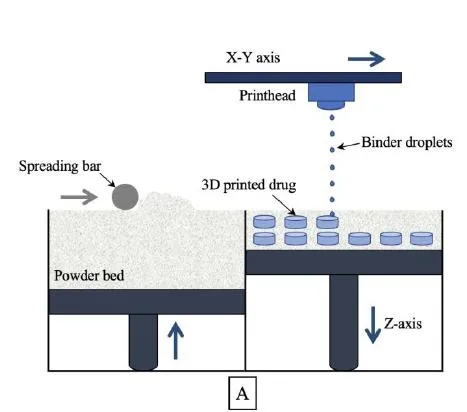
Binder jetting starts by spreading a thin layer of powder, made of the drug and excipients, across the build platform. A printhead then dispenses droplets of binder onto chosen areas so that the particles there stick together. Next the platform moves down and fresh powder is spread over the previous layer. By repeating these steps the dosage form is built up; loose powder is then taken away and any needed post-processing is carried out. The API can either be mixed into the powder bed or supplied through a printable liquid [8-10].
figure

Figure 1: Schematic of the Binder-Jet 3D Printing Principle for Preparing Pharmaceutical Tablets [8].

Principle of Fused Deposition Modelling (FDM):

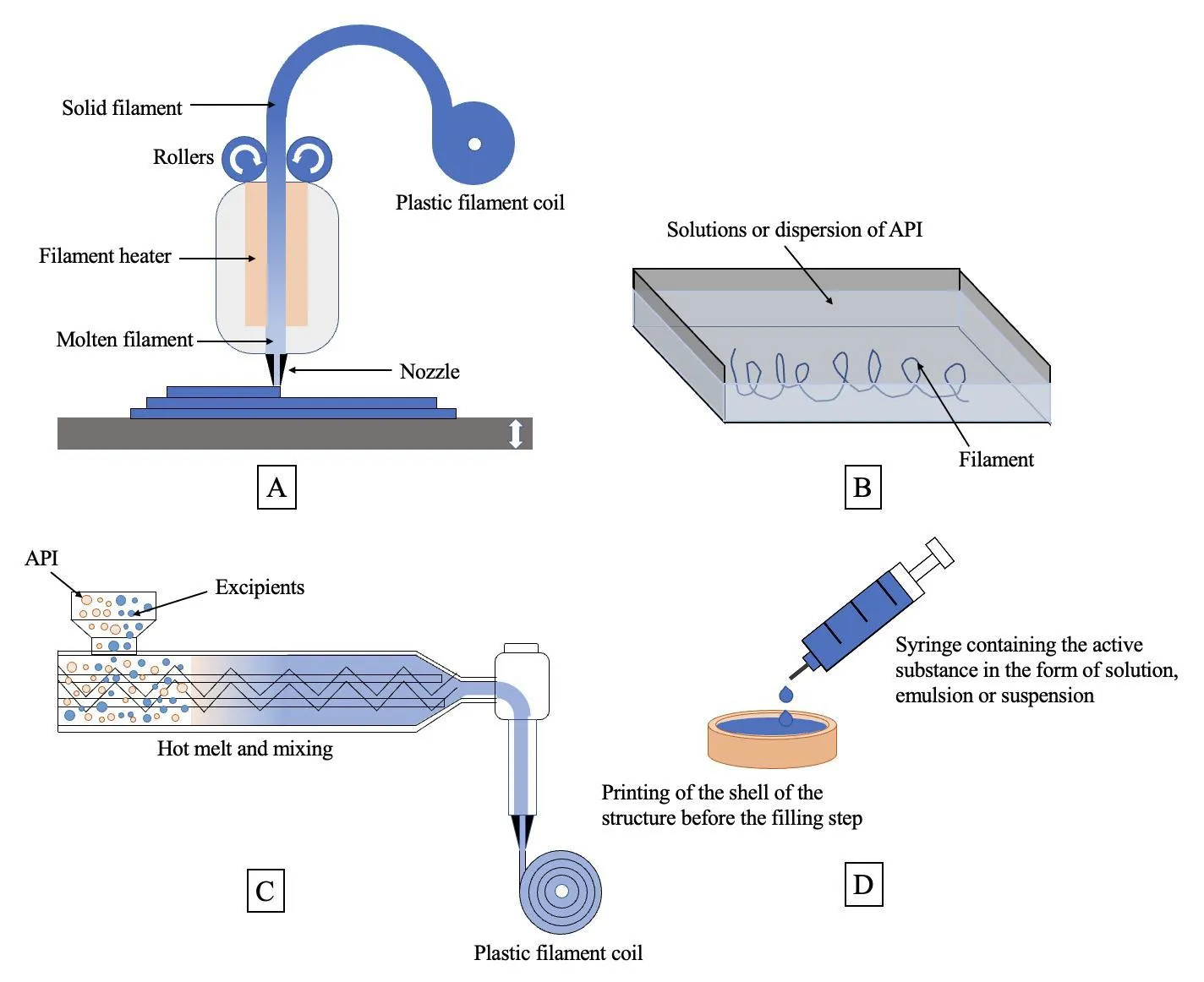
In FDM, a filament loaded with drug is pushed through a heated nozzle, where it softens and is laid down along paths controlled by computer in the X–Y plane. Once a layer is complete, the platform shifts along the Z axis and the following layer is printed on top. Drug-loaded filaments can be made by soaking, by hot-melt extrusion (HME), or by printing a hollow shell, filling it with drug and then sealing it [11-14]. HME-FDM is popular because the API is spread fairly evenly through the polymer filament. Its main drawback is the high processing temperature, which makes the method less suitable for heat-labile APIs [12,14].
figure

Figure 2: Schematic of the FDM Principle and the Ways of Preparing Drug-Containing Printed Tablets [8].

Principle of Semi-Solid Extrusion (SSE):

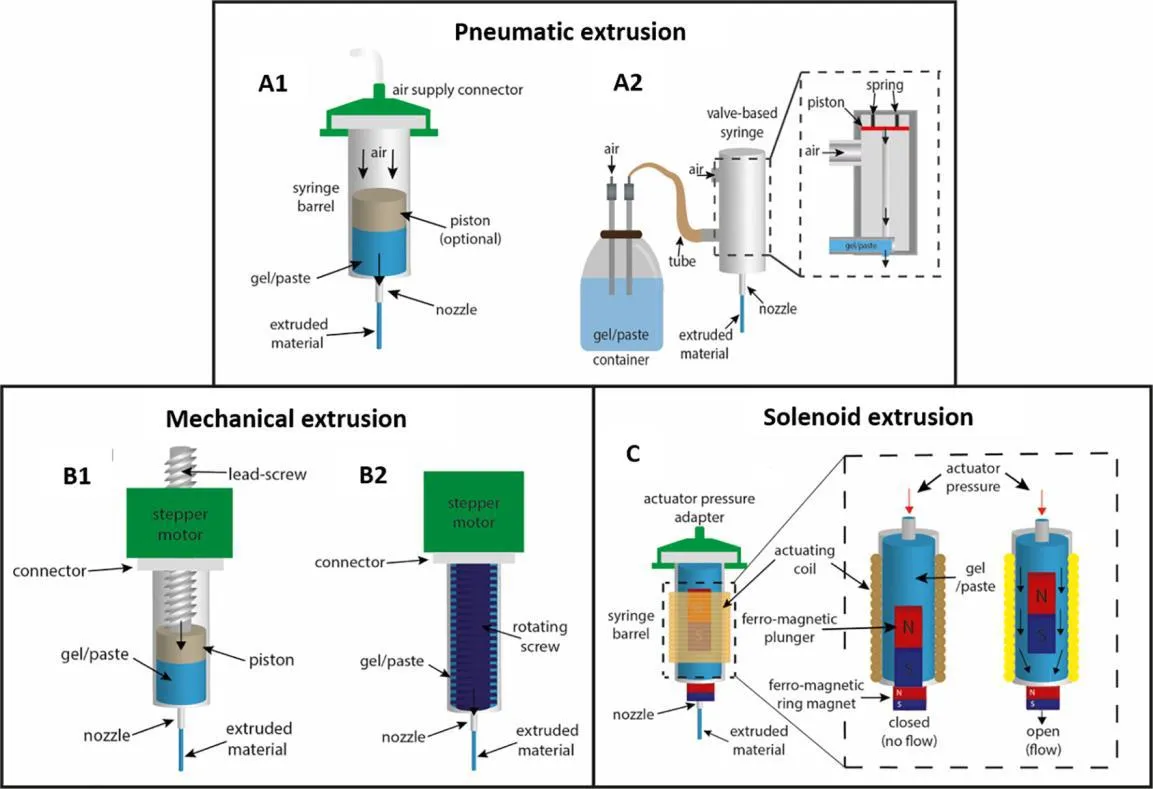
In SSE, a semisolid material is pushed out of an extrusion head that follows a programmed path, building the object layer after layer. The formulation normally sits in a syringe or cartridge, and the force that drives it out can be pneumatic, mechanical or electromagnetic. As printing can take place at fairly low temperature, SSE suits drugs that are sensitive to heat and has been used for immediate-release, orodispersible, chewable, controlled-release and gastroretentive systems. How well it works depends largely on the viscosity and rheology of the material: if it is too viscous the flow may block, while if it is too thin the printed shape may not hold. A drying step or other post-processing may also be needed [15].
figure

Figure 3: Extrusion Mechanisms Employed in Semi-Solid Extrusion 3D Printing [8].

Principle of Material Extrusion Deposition (MED):

MED merges material extrusion with hot-melt extrusion and allows several materials to be supplied from coordinated printing stations. The API and the excipients may be fed in separately, blended, and brought to a uniform molten state before being deposited. Under controlled pressure and temperature, different materials can then be laid down to form intricate dosage forms such as modified-release structures [16].

Principle of SLA and DLP:

Stereolithography (SLA) hardens a liquid resin at selected positions through photopolymerization, usually with a laser that works layer by layer. Because of its fine spatial resolution, SLA is well suited to intricate structures and specialized drug-delivery devices. Digital light processing (DLP) instead uses a digital micromirror device to cure a whole layer in a single exposure, which usually makes it quicker than SLA. DLP has been studied for sustained-release tablets and microneedle arrays. For both methods, the photopolymerizable materials must be chosen with care, and residual resin and the compatibility of the drug with light need attention [17-19].

MATERIALS IN 3D-PRINTED PHARMACEUTICALS:

The choice of materials governs printability, structural integrity, drug stability and release behaviour. Polymers are the main formulation components because they can serve both as the structural matrix and as agents that control release. For FDM, thermoplastic polymers such as hydroxypropyl methylcellulose (HPMC), polyvinyl alcohol (PVA), polylactic acid (PLA) and polycaprolactone (PCL) are often considered. Hydrogels, including polyethylene glycol (PEG), alginate, gelatin and chitosan, are suitable for extrusion-based printing, and photopolymerizable materials such as PEG diacrylate are applied in light-based methods [20,21].

A polymer intended for pharmaceutical printing should ideally be biocompatible, be cleared from the body without unacceptable effects, be compatible with the API, give the required release profile, and print well in the chosen process. Depending on the technology, it may be provided as a filament, powder, paste, hydrogel, solution or colloidal suspension [20].

Further excipients serve particular roles in processing or in the dosage form. Plasticizers, for example triethyl citrate, make filaments less brittle and more flexible and easier to process, which is especially useful in FDM. Lubricants help powders flow, lower friction and prevent sticking to equipment. Disintegrants encourage water uptake and the breaking apart of the tablet, and fillers add bulk and can improve structural quality. Binders, surfactants, colorants, flavours and release modifiers may also change integrity, wetting, dissolution, appearance and how readily patients accept the medicine [21-25].

The API has to stay stable both during printing and afterwards in storage. Consequently, the process is selected by weighing API properties, polymer compatibility, exposure to heat or light, formulation viscosity, mechanical needs and the target release profile. A wide range of drug classes has been tried with 3D printing, and the technique also makes it possible to include several APIs in one dosage form [15,26].

TYPES OF 3D PRINTING USED IN PHARMACEUTICALS:

Of the approaches applied in pharmaceuticals, FDM, SSE, binder jetting, MED, SLA and DLP are the main ones. FDM is relatively easy to access and can create complex internal architectures, although its heat requirements rule out some APIs. SSE copes better with temperature-sensitive materials and accepts many kinds of semisolid formulation, but viscosity, resolution and post-processing can be troublesome. Binder jetting relies on the interaction between powder and binder and is especially relevant for porous dosage forms. MED deposits materials in a coordinated way and shows promise for modified-release and multi-material products. SLA and DLP give high geometric accuracy, so they suit complex structures, but the photopolymer chemistry and leftover material must be considered [8,11,15-19].

Hence, the printing technology should be chosen by looking at API stability, excipient properties, viscosity or melt behaviour, needed resolution, intended release profile, dosage-form geometry and available equipment, and not simply by how fast the printer works.

EVALUATION OF 3D-PRINTED DOSAGE FORMS:

Evaluation is needed to verify that a printed product has sufficient mechanical integrity, accurate structure, uniform dose and the right drug-release performance. The usual tablet quality attributes still apply, but additive manufacturing adds further characteristics that arise from the digital design and the layer-by-layer process.

Hardness and Tensile Strength:

Hardness, or breaking force, shows how well a dosage form withstands mechanical damage during processing, handling and transport, and it may also affect disintegration and drug release. Tensile strength describes mechanical performance more in terms of the material itself, and it is particularly useful when tablets have unconventional shapes [27,28].

Structural Fidelity, Layer Adhesion and Resolution:

A printed dosage form should match the intended digital geometry with suitable dimensional accuracy. Structural fidelity, adhesion between layers, layer resolution and surface features are key quality attributes, since even slight changes in geometry or internal structure can alter mechanical behaviour and drug release. They matter even more for personalized products, in which every digital design may be different [13,27,28].

Drug Distribution and Release:

The distribution of drug and the uniformity of content should be examined to make sure that the intended dose is delivered every time. Dissolution or drug-release testing is essential, because polymer type, infill, porosity, surface area and internal geometry can all be purposely varied to alter release. In personalised and multi-drug systems, each API should be confirmed analytically [24,27].

CURRENT REGULATORY FRAMEWORK:

Regulation of pharmaceutical 3D printing has not yet caught up with the technology. Present regulatory approaches offer helpful principles, yet detailed, product-specific frameworks for 3D-printed medicines are still being worked out. The FDA Emerging Technology Program gives a route for discussing new manufacturing technologies, and European initiatives have dealt with innovation and certain aspects of 3D printing. Quality-by-Design (QbD) is highly relevant, as it promotes systematic control of material attributes, process parameters and critical quality attributes across development [8,29-35].

In assessing pharmaceutical 3D printing, regulators need to consider the qualification of raw materials, control of software and digital designs, printer performance, process reproducibility, dose accuracy, product stability, mechanical properties, drug release and traceability. Because some products are individualized, it is also unclear how to manage changes in digital designs, formulations and manufacturing sites. For wider clinical and commercial use, standardized test methods and dependable process controls will be needed [8,29,32,34-36].

ADVANTAGES AND LIMITATIONS:

Advantages:

Customization is the leading advantage. Dose strength, drug combinations, shape, colour, flavour and release behaviour can all be adapted to what the patient needs. Complex internal structures that would be hard to make by conventional compression are also possible. Because production can be on demand and in small batches, there may be less need to stock several conventional strengths, and decentralized or point-of-care preparation could be supported [2,7,35].

Patient acceptability can also be improved, through patient-friendly shapes, taste-masking and dosage forms adjusted to the patient's ability to swallow. In addition, personalized polypharmacy becomes feasible, either by combining several APIs in one unit or by giving different regions of a printed structure different release profiles [26,37].

Limitations and Challenges:

The main limitations are the high upfront cost of equipment and software, the need for specialist skills, the small number of suitable pharmaceutical-grade printable excipients, the heat or light sensitivity of some APIs, and the difficulty of moving from laboratory printing to large-scale production. Reproducibility can also suffer from process variability, ageing of materials, post-processing steps and differences between printers. Uncertain regulation and the lack of standardized quality-control methods remain serious obstacles [35-39].

For this reason, the technology is unlikely to displace conventional high-throughput manufacturing across all products. It is expected to be most valuable in the near term for individualized, complex or low-volume dosage forms, where customization brings a distinct clinical benefit.

CLINICAL AND PRECLINICAL APPLICATIONS:

Preclinical Applications:

Preclinical work needs dosage forms that fit small animal models, for which doses and sizes can differ greatly from those of human products. 3D printing can make small capsules, pellets and miniprintlets with controlled dimensions and drug content set for each case. Such flexibility can make dosing easier and permits release characteristics to be matched to the experimental model [40,41].

Personalized Medicine:

Personalized medicine is arguably the most significant potential use. Printlets can be produced in small or single batches, each with its own dose, formulation, drug combination and appearance. This is particularly useful for narrow-therapeutic-index drugs and for patients whose needed dose lies between available strengths. Control through digital design can lessen the need for manually splitting or crushing tablets, which can otherwise lead to dosing errors [8,42].

Pediatric Applications:

Doses for children are often calculated from body weight or body surface area, and taste strongly influences whether a medicine is accepted. FDM has been applied to make candy-like chewable printlets with custom shapes and taste-masking features, and patient acceptability of printed shapes has been assessed. Such examples show that dose and acceptability can be tackled together [13,43].

Adult and Geriatric Applications:

In adults and older patients, 3D printing can yield dosage forms with altered geometry, dimensions that are easy to swallow, individualized doses and several medicines in one. Researchers have assessed how acceptable patients find different printlet shapes, and SSE has been used to print pH-responsive polypills that combine several drugs in one unit. Such approaches could be useful for polypharmacy and for patients who have difficulty swallowing [43,44].

Veterinary Applications:

Doses in veterinary medicine usually depend on the species, age and body weight of the animal. Ordinary tablets often have to be divided or concealed in food, which raises the chance of inaccurate dosing or refusal by the animal. SSE has been studied for producing tailored chewable veterinary dosage forms, showing the scope for individualized dose and palatability in animal medicine [45].

Cancer Surgery and Clinical Planning:

Apart from dosage forms, 3D printing is used clinically in surgical planning, including cancer surgery. Patient-specific anatomical models and printed guides help clinicians picture complicated anatomy, prepare procedures and educate patients [18].

3D-PRINTING CENTRES IN INDIA AND THEIR FACILITIES RELEVANT TO PHARMACEUTICAL RESEARCH:

Dr. Rajendra Gode College of Pharmacy, Malkapur, Maharashtra. The Centre of Excellence in 3D Printing at Dr. Rajendra Gode College of Pharmacy, Malkapur, was established in association with ThInCr Technologies India Pvt. Ltd. The centre reports access to fused deposition modelling (FDM), stereolithography (SLA), semi-solid extrusion (SSE), and hot-melt extrusion (HME). Its stated facilities include computer-aided design (CAD) tools, printing with different materials, hands-on training, live demonstrations, project guidance, and consultancy for 3D modelling and printing. The centre identifies pharmaceutical model development and customised drug-delivery systems among its application areas. These facilities may support learning and early-stage research in pharmaceutical 3D printing; the availability of a specific drug-containing dosage-form workflow should be confirmed with the institution [46].

Chitkara University, Punjab. The Pharmaceutics Research Laboratory at Chitkara University reports research on the formulation, development, evaluation, and optimization of advanced drug-delivery systems. The laboratory lists dosage-form development using technologies such as 3D printing, microneedles, and spray drying. Its stated equipment includes Franz diffusion cells, a high-shear homogeniser, a probe sonicator, a double-compression tablet machine, a disintegrator, and a rheometer. These facilities support pharmaceutical formulation and characterisation work, while the university identifies 3D printing as one of its approaches to dosage-form development. The public description does not specify the printer models or confirm that external users can access the equipment [47].

National Institute of Pharmaceutical Education and Research (NIPER), Kolkata, West Bengal. NIPER Kolkata's Department of Pharmaceutics describes research into pharmaceutical product development, nanoparticulate drug-delivery systems, polymeric amorphous dispersions, and the development of reliable three-dimensional in-vitro models for drug development using 3D bioprinting. The department also identifies research into pharmaceutical manufacturing and process control, medical-device development, and analytical services for small-scale pharmaceutical industries. The institute's published research information additionally lists 3D bioprinting and electrospinning under medical-device-related research. These activities make the institute relevant to bioprinting-based drug-development models and interdisciplinary pharmaceutical research; the available information does not establish that the department provides routine 3D printing of oral tablets [48,49].

Sathyabama Institute of Science and Technology, Chennai, Tamil Nadu. The institute's Makerspace is identified as a Centre of Excellence for Additive Manufacturing. Its documented infrastructure includes fused-deposition-modelling printers, a PolyJet printer, a design laboratory with 3D modelling and simulation software, scanners, a chemical-processing laboratory, a material-testing laboratory, and a tissue-engineering laboratory. The material-testing facilities include a universal testing machine, a contact-angle measuring system, and a UV–visible spectrophotometer. The tissue-engineering laboratory supports research involving bone, cartilage, and skin engineering, as well as drug delivery from 3D scaffolds and cytotoxicity testing of materials. These facilities are relevant to printed biomedical structures and scaffold-based drug-delivery research, but the institution's general additive-manufacturing infrastructure should not be interpreted as proof of a dedicated pharmaceutical-tablet manufacturing service [50].

CONCLUSION:

3D printing has become a promising additive-manufacturing approach for developing pharmaceutical dosage forms. Its greatest strength is that dose, geometry, composition and release behaviour can be controlled through the digital design, which opens the way to personalized, patient-centred treatment. Binder jetting, FDM, SSE, MED, SLA and DLP give different processing options depending on the API, the polymers and the dosage form wanted. Polymers and supporting excipients are fundamental to printability, mechanical integrity and drug release, and evaluation has to cover both the usual tablet attributes and those specific to additive manufacturing, such as structural fidelity and layer adhesion.

The technology has shown potential in preclinical research, personalized medicine, paediatric and geriatric therapy, veterinary formulations and clinical or surgical uses. Before it can be widely adopted, however, limits in materials, drug stability, equipment cost, scalability, reproducibility, quality control and regulation must be resolved. Further progress in printable pharmaceutical materials, standardized evaluation, process control, digital quality systems and QbD-based regulatory strategies could help move 3D-printed dosage forms from the laboratory into everyday pharmaceutical and clinical practice.

REFERENCES

  1. Zhu X, Li H, Huang L, Zhang M, Fan W, Cui L. 3D printing promotes the development of drugs. Biomed Pharmacother. 2020;131:110644.
  2. Lim SH, Kathuria H, Jia J, Tan Y, Kang L. 3D printed drug delivery and testing systems—A passing fad or the future? Adv Drug Deliv Rev. 2018;132:139-168.
  3. Beg S, Almalki WH, Malik A, Farhan M, Aatif M, Rahman Z, et al. 3D printing for drug delivery and biomedical applications. Drug Discov Today. 2020;25:1668-1681.
  4. Goole J, Amighi K. 3D printing in pharmaceutics: a new tool for designing customized drug delivery systems. Int J Pharm. 2016;499:376-394.
  5. Wu BM, Borland SW, Giordano RA, Cima LG, Sachs EM, Cima MJ. Solid free-form fabrication of drug delivery devices. J Control Release. 1996;40:77-87.
  6. Katstra WE, Palazzolo RD, Rowe CW, Giritlioglu B, Teung P, Cima MJ. Oral dosage forms fabricated by Three Dimensional Printing. J Control Release. 2000;66:1-9.
  7. Alhnan MA, Okwuosa TC, Sadia M, Wan KW, Ahmed W, Arafat B. Emergence of 3D printed dosage forms: opportunities and challenges. Pharm Res. 2016;33 (8):1817-1832.
  8. Wang S, Chen X, Han X, Hong X, Li X, Zhang H, et al. A review of 3D printing technology in pharmaceutics: technology and applications, now and future. Pharmaceutics. 2023;15 (2):416.
  9. Trenfield SJ, Madla CM, Basit AW, Gaisford S. Binder Jet Printing in Pharmaceutical Manufacturing. In: Basit AW, Gaisford S, editors. 3D Printing of Pharmaceuticals. Cham: Springer; 2018. p. 41-54.
  10. Chen G, Xu Y, Kwok PCL, Kang L. Pharmaceutical applications of 3D printing. Addit Manuf. 2020;34:101209.
  11. Awad A, Gaisford S, Basit AW. Fused deposition modelling: advances in engineering and medicine. In: Basit AW, Gaisford S, editors. 3D Printing of Pharmaceuticals. Cham: Springer; 2018. p. 107-132.
  12. Cailleaux S, Sanchez-Ballester NM, Gueche YA, Bataille B, Soulairol I. Fused deposition modeling (FDM), the new asset for the production of tailored medicines. J Control Release. 2021;330:821-841.
  13. Quodbach J, Bogdahn M, Breitkreutz J, Chamberlain R, Eggenreich K, Elia AG, et al. Quality of FDM 3D printed medicines for pediatrics: considerations for formulation development, filament extrusion, printing process and printer design. Ther Innov Regul Sci. 2022;56:910-928.
  14. Melocchi A, Uboldi M, Cerea M, Foppoli A, Maroni A, Moutaharrik S, et al. A graphical review on the escalation of fused deposition modeling (FDM) 3D printing in the pharmaceutical field. J Pharm Sci. 2020;109:2943-2957.
  15. Seoane-Viaño I, Januskaite P, Alvarez-Lorenzo C, Basit AW, Goyanes A. Semi-solid extrusion 3D printing in drug delivery and biomedicine: personalised solutions for healthcare challenges. J Control Release. 2021;332:367-389.
  16. Zheng Y, Deng F, Wang B, Wu Y, Luo Q, Zuo X, et al. Melt extrusion deposition (MED™) 3D printing technology—a paradigm shift in design and development of modified release drug products. Int J Pharm. 2021;602:120639.
  17. Dabbagh SR, Sarabi MR, Rahbarghazi R, Sokullu E, Yetisen AK, Tasoglu S. 3D-printed microneedles in biomedical applications. iScience. 2021;24:102012.
  18. Zhang J, Hu Q, Wang S, Tao J, Gou M. Digital light processing based three-dimensional printing for medical applications. Int J Bioprint. 2020;6:242.
  19. Kundu A, Arnett P, Bagde A, Azim N, Kouagou E, Singh M, et al. DLP 3D printed intelligent microneedle array for stimuli responsive release of drugs and its in vitro and ex vivo characterization. J Microelectromech Syst. 2020;29:685-691.
  20. Khaled SA, Burley JC, Alexander MR, Roberts CJ. Desktop 3D printing of controlled-release pharmaceutical bilayer tablets. Int J Pharm. 2014;461:105-111.
  21. Khaled SA, Burley JC, Alexander MR, Yang J, Roberts CJ. 3D printing of tablets containing multiple drugs with defined release profiles. Int J Pharm. 2015;494:643-650.
  22. Pietrzak K, Isreb A, Alhnan MA. A flexible-dose dispenser for immediate and extended release 3D printed tablets. Eur J Pharm Biopharm. 2015;96:380-387.
  23. Goyanes A, Chang H, Sedough D, Hatton GB, Wang J, Buanz A, et al. Fabrication of controlled-release budesonide tablets via desktop (FDM) 3D printing. Int J Pharm. 2015;496:414-420.
  24. Sadia M, Arafat B, Ahmed W, Forbes RT, Alhnan MA. Channelled tablets: an innovative approach to accelerating drug release from 3D printed tablets. J Control Release. 2018;269:355-363.
  25. Sadia M, Sośnicka A, Arafat B, Isreb A, Ahmed W, Kelarakis A, et al. Adaptation of pharmaceutical excipients to FDM 3D printing for the fabrication of patient-tailored immediate release tablets. Int J Pharm. 2016;513:659-668.
  26. Cerda JR, Arifi T, Ayyoubi S, Knief P, Ballesteros MP, Keeble W, et al. Personalised 3D printed medicines: optimising material properties for successful passive diffusion loading of filaments for fused deposition modelling of solid dosage forms. Pharmaceutics. 2020;12 (4):345.
  27. Lafeber I, Tichem J, Ouwerkerk N, Van Unen A, Van Uitert J, Bijleveld-Olierook H, et al. 3D printed furosemide and sildenafil tablets: innovative production and quality control. Int J Pharm. 2021;603:120694.
  28. Johannesson J, Wu M, Johansson M, Bergström CA. Quality attributes for printable emulsion gels and 3D-printed tablets: towards production of personalized dosage forms. Int J Pharm. 2023;646:123413.
  29. Khairuzzaman A. Regulatory perspectives on 3D printing in pharmaceuticals. In: Basit AW, Gaisford S, editors. 3D Printing of Pharmaceuticals. Cham: Springer; 2018. p. 215-236.
  30. U.S. Food and Drug Administration. Emerging Technology Program (ETP). Silver Spring (MD): FDA; 2023.
  31. European Medicines Agency. Supporting innovations. Amsterdam: EMA; 2025.
  32. Sangshetti JN, Deshpande M, Zaheer Z, Shinde DB, Arote R. Quality by design approach: regulatory need. Arab J Chem. 2017;10:S3412-S3425.
  33. Tracy T, Wu L, Liu X, Cheng S, Li X. 3D printing: innovative solutions for patients and pharmaceutical industry. Int J Pharm. 2023;631:122480.
  34. Huanbutta K, Burapapadh K, Sriamornsak P, Sangnim T. Practical application of 3D printing for pharmaceuticals in hospitals and pharmacies. Pharmaceutics. 2023;15:1877.
  35. Desu PK, Maddiboyina B, Vanitha K, Rao Gudhanti SNK, Anusha R, Jhawat V. 3D printing technology in pharmaceutical dosage forms: advantages and challenges. Curr Drug Targets. 2021;22:1901-1914.
  36. Vidiyala N, Sunkishala P, Mandati P, Parupathi P, Nyavanandi D. Integrating 3D printing and additive manufacturing into personalized medicine for pharmaceuticals: opportunities, limitations, and future perspectives. Sci Pharm. 2025;93:61.
  37. Trenfield SJ, Awad A, Goyanes A, Gaisford S, Basit AW. 3D printing pharmaceuticals: drug development to frontline care. Trends Pharmacol Sci. 2018;39:440-451.
  38. Beer N, Kaae S, Genina N, Sporrong SK, Alves TL, Hoebert J, et al. Magistral compounding with 3D printing: a promising way to achieve personalized medicine. Ther Innov Regul Sci. 2023;57:26-36.
  39. Pandey M, Choudhury H, Fern JLC, Kee ATK, Kou J, Jing JLJ, et al. 3D printing for oral drug delivery: a new tool to customize drug delivery. Drug Deliv Transl Res. 2020;10:986-1001.
  40. Gao Y, Gesenberg C, Zheng W. Oral formulations for preclinical studies: principle, design, and development considerations. In: Developing Solid Oral Dosage Forms. 2nd ed. Boston: Academic Press; 2017. p. 455-495.
  41. Awad A, Fina F, Trenfield SJ, Patel P, Goyanes A, Gaisford S, et al. 3D printed pellets (miniprintlets): a novel, multi-drug, controlled release platform technology. Pharmaceutics. 2019;11 (4):148.
  42. Alomari M, Mohamed FH, Basit AW, Gaisford S. Personalised dosing: printing a dose of one's own medicine. Int J Pharm. 2015;494:568-577.
  43. Goyanes A, Scarpa M, Kamlow M, Gaisford S, Basit AW, Orlu M. Patient acceptability of 3D printed medicines. Int J Pharm. 2017;530:71-78.
  44. Wang F, Li L, Zhu X, Chen F, Han X. Development of pH-responsive polypills via semi-solid extrusion 3D printing. Bioengineering. 2023;10:402.
  45. Sjöholm E, Mathiyalagan R, Lindfors L, Wang X, Ojala S, Sandler N. Semi-solid extrusion 3D printing of tailored ChewTs for veterinary use—a focus on spectrophotometric quantification of gabapentin. Eur J Pharm Sci. 2022;174:106190.
  46. Dr. Rajendra Gode College of Pharmacy. Center of Excellence in 3D Printing Lab [Internet]. Malkapur: Dr. Rajendra Gode College of Pharmacy; Available from: https://drgcop.ac.in/page.php?page_title=CENTER+OF+EXCELLENCE
  47. Chitkara University Research and Innovation Network. Pharmaceutics Research Laboratory [Internet]. Punjab: Chitkara University; Available from: https://curin.chitkara.edu.in/pharmaceutics-research-laboratory
  48. National Institute of Pharmaceutical Education and Research Kolkata. Department of Pharmaceutics [Internet]. Kolkata: NIPER Kolkata; Available from: https://niperkolkata.edu.in/DepartmentSubjectDetails.aspx?Department=16
  49. National Institute of Pharmaceutical Education and Research Kolkata. Research activities [Internet]. Kolkata: NIPER Kolkata; Available from: https://niperkolkata.edu.in/research.aspx
  50. Sathyabama Institute of Science and Technology. Makerspace: Centre of Excellence for Additive Manufacturing by Stratasys, India [Internet]. Chennai: Sathyabama Institute of Science and Technology; Available from: https://www.sathyabama.ac.in/research_centre/makerspace
  51. Karalia D, Siamidi A, Karalis V, Vlachou M. 3D-printed oral dosage forms: mechanical properties, computational approaches and applications. Pharmaceutics. 2021;13:1401.
  52. Bernatoniene J, Stabrauskiene J, Kazlauskaite JA, Bernatonyte U, Kopustinskiene DM. The future of medicine: how 3D printing is transforming pharmaceuticals. Pharmaceutics. 2024;16 (10):1246.
  53. Dizon JRC, Espera AH, Chen Q, Advincula RC. Mechanical characterization of 3D-printed polymers. Addit Manuf. 2018;20:44-67.
  54. Goyanes A, Fina F, Martorana A, Sedough D, Gaisford S, Basit AW. Development of modified release 3D printed tablets (printlets) with pharmaceutical excipients using additive manufacturing. Int J Pharm. 2017;527:21-30.

Reference

  1. Zhu X, Li H, Huang L, Zhang M, Fan W, Cui L. 3D printing promotes the development of drugs. Biomed Pharmacother. 2020;131:110644.
  2. Lim SH, Kathuria H, Jia J, Tan Y, Kang L. 3D printed drug delivery and testing systems—A passing fad or the future? Adv Drug Deliv Rev. 2018;132:139-168.
  3. Beg S, Almalki WH, Malik A, Farhan M, Aatif M, Rahman Z, et al. 3D printing for drug delivery and biomedical applications. Drug Discov Today. 2020;25:1668-1681.
  4. Goole J, Amighi K. 3D printing in pharmaceutics: a new tool for designing customized drug delivery systems. Int J Pharm. 2016;499:376-394.
  5. Wu BM, Borland SW, Giordano RA, Cima LG, Sachs EM, Cima MJ. Solid free-form fabrication of drug delivery devices. J Control Release. 1996;40:77-87.
  6. Katstra WE, Palazzolo RD, Rowe CW, Giritlioglu B, Teung P, Cima MJ. Oral dosage forms fabricated by Three Dimensional Printing. J Control Release. 2000;66:1-9.
  7. Alhnan MA, Okwuosa TC, Sadia M, Wan KW, Ahmed W, Arafat B. Emergence of 3D printed dosage forms: opportunities and challenges. Pharm Res. 2016;33 (8):1817-1832.
  8. Wang S, Chen X, Han X, Hong X, Li X, Zhang H, et al. A review of 3D printing technology in pharmaceutics: technology and applications, now and future. Pharmaceutics. 2023;15 (2):416.
  9. Trenfield SJ, Madla CM, Basit AW, Gaisford S. Binder Jet Printing in Pharmaceutical Manufacturing. In: Basit AW, Gaisford S, editors. 3D Printing of Pharmaceuticals. Cham: Springer; 2018. p. 41-54.
  10. Chen G, Xu Y, Kwok PCL, Kang L. Pharmaceutical applications of 3D printing. Addit Manuf. 2020;34:101209.
  11. Awad A, Gaisford S, Basit AW. Fused deposition modelling: advances in engineering and medicine. In: Basit AW, Gaisford S, editors. 3D Printing of Pharmaceuticals. Cham: Springer; 2018. p. 107-132.
  12. Cailleaux S, Sanchez-Ballester NM, Gueche YA, Bataille B, Soulairol I. Fused deposition modeling (FDM), the new asset for the production of tailored medicines. J Control Release. 2021;330:821-841.
  13. Quodbach J, Bogdahn M, Breitkreutz J, Chamberlain R, Eggenreich K, Elia AG, et al. Quality of FDM 3D printed medicines for pediatrics: considerations for formulation development, filament extrusion, printing process and printer design. Ther Innov Regul Sci. 2022;56:910-928.
  14. Melocchi A, Uboldi M, Cerea M, Foppoli A, Maroni A, Moutaharrik S, et al. A graphical review on the escalation of fused deposition modeling (FDM) 3D printing in the pharmaceutical field. J Pharm Sci. 2020;109:2943-2957.
  15. Seoane-Viaño I, Januskaite P, Alvarez-Lorenzo C, Basit AW, Goyanes A. Semi-solid extrusion 3D printing in drug delivery and biomedicine: personalised solutions for healthcare challenges. J Control Release. 2021;332:367-389.
  16. Zheng Y, Deng F, Wang B, Wu Y, Luo Q, Zuo X, et al. Melt extrusion deposition (MED™) 3D printing technology—a paradigm shift in design and development of modified release drug products. Int J Pharm. 2021;602:120639.
  17. Dabbagh SR, Sarabi MR, Rahbarghazi R, Sokullu E, Yetisen AK, Tasoglu S. 3D-printed microneedles in biomedical applications. iScience. 2021;24:102012.
  18. Zhang J, Hu Q, Wang S, Tao J, Gou M. Digital light processing based three-dimensional printing for medical applications. Int J Bioprint. 2020;6:242.
  19. Kundu A, Arnett P, Bagde A, Azim N, Kouagou E, Singh M, et al. DLP 3D printed intelligent microneedle array for stimuli responsive release of drugs and its in vitro and ex vivo characterization. J Microelectromech Syst. 2020;29:685-691.
  20. Khaled SA, Burley JC, Alexander MR, Roberts CJ. Desktop 3D printing of controlled-release pharmaceutical bilayer tablets. Int J Pharm. 2014;461:105-111.
  21. Khaled SA, Burley JC, Alexander MR, Yang J, Roberts CJ. 3D printing of tablets containing multiple drugs with defined release profiles. Int J Pharm. 2015;494:643-650.
  22. Pietrzak K, Isreb A, Alhnan MA. A flexible-dose dispenser for immediate and extended release 3D printed tablets. Eur J Pharm Biopharm. 2015;96:380-387.
  23. Goyanes A, Chang H, Sedough D, Hatton GB, Wang J, Buanz A, et al. Fabrication of controlled-release budesonide tablets via desktop (FDM) 3D printing. Int J Pharm. 2015;496:414-420.
  24. Sadia M, Arafat B, Ahmed W, Forbes RT, Alhnan MA. Channelled tablets: an innovative approach to accelerating drug release from 3D printed tablets. J Control Release. 2018;269:355-363.
  25. Sadia M, So?nicka A, Arafat B, Isreb A, Ahmed W, Kelarakis A, et al. Adaptation of pharmaceutical excipients to FDM 3D printing for the fabrication of patient-tailored immediate release tablets. Int J Pharm. 2016;513:659-668.
  26. Cerda JR, Arifi T, Ayyoubi S, Knief P, Ballesteros MP, Keeble W, et al. Personalised 3D printed medicines: optimising material properties for successful passive diffusion loading of filaments for fused deposition modelling of solid dosage forms. Pharmaceutics. 2020;12 (4):345.
  27. Lafeber I, Tichem J, Ouwerkerk N, Van Unen A, Van Uitert J, Bijleveld-Olierook H, et al. 3D printed furosemide and sildenafil tablets: innovative production and quality control. Int J Pharm. 2021;603:120694.
  28. Johannesson J, Wu M, Johansson M, Bergström CA. Quality attributes for printable emulsion gels and 3D-printed tablets: towards production of personalized dosage forms. Int J Pharm. 2023;646:123413.
  29. Khairuzzaman A. Regulatory perspectives on 3D printing in pharmaceuticals. In: Basit AW, Gaisford S, editors. 3D Printing of Pharmaceuticals. Cham: Springer; 2018. p. 215-236.
  30. U.S. Food and Drug Administration. Emerging Technology Program (ETP). Silver Spring (MD): FDA; 2023.
  31. European Medicines Agency. Supporting innovations. Amsterdam: EMA; 2025.
  32. Sangshetti JN, Deshpande M, Zaheer Z, Shinde DB, Arote R. Quality by design approach: regulatory need. Arab J Chem. 2017;10:S3412-S3425.
  33. Tracy T, Wu L, Liu X, Cheng S, Li X. 3D printing: innovative solutions for patients and pharmaceutical industry. Int J Pharm. 2023;631:122480.
  34. Huanbutta K, Burapapadh K, Sriamornsak P, Sangnim T. Practical application of 3D printing for pharmaceuticals in hospitals and pharmacies. Pharmaceutics. 2023;15:1877.
  35. Desu PK, Maddiboyina B, Vanitha K, Rao Gudhanti SNK, Anusha R, Jhawat V. 3D printing technology in pharmaceutical dosage forms: advantages and challenges. Curr Drug Targets. 2021;22:1901-1914.
  36. Vidiyala N, Sunkishala P, Mandati P, Parupathi P, Nyavanandi D. Integrating 3D printing and additive manufacturing into personalized medicine for pharmaceuticals: opportunities, limitations, and future perspectives. Sci Pharm. 2025;93:61.
  37. Trenfield SJ, Awad A, Goyanes A, Gaisford S, Basit AW. 3D printing pharmaceuticals: drug development to frontline care. Trends Pharmacol Sci. 2018;39:440-451.
  38. Beer N, Kaae S, Genina N, Sporrong SK, Alves TL, Hoebert J, et al. Magistral compounding with 3D printing: a promising way to achieve personalized medicine. Ther Innov Regul Sci. 2023;57:26-36.
  39. Pandey M, Choudhury H, Fern JLC, Kee ATK, Kou J, Jing JLJ, et al. 3D printing for oral drug delivery: a new tool to customize drug delivery. Drug Deliv Transl Res. 2020;10:986-1001.
  40. Gao Y, Gesenberg C, Zheng W. Oral formulations for preclinical studies: principle, design, and development considerations. In: Developing Solid Oral Dosage Forms. 2nd ed. Boston: Academic Press; 2017. p. 455-495.
  41. Awad A, Fina F, Trenfield SJ, Patel P, Goyanes A, Gaisford S, et al. 3D printed pellets (miniprintlets): a novel, multi-drug, controlled release platform technology. Pharmaceutics. 2019;11 (4):148.
  42. Alomari M, Mohamed FH, Basit AW, Gaisford S. Personalised dosing: printing a dose of one's own medicine. Int J Pharm. 2015;494:568-577.
  43. Goyanes A, Scarpa M, Kamlow M, Gaisford S, Basit AW, Orlu M. Patient acceptability of 3D printed medicines. Int J Pharm. 2017;530:71-78.
  44. Wang F, Li L, Zhu X, Chen F, Han X. Development of pH-responsive polypills via semi-solid extrusion 3D printing. Bioengineering. 2023;10:402.
  45. Sjöholm E, Mathiyalagan R, Lindfors L, Wang X, Ojala S, Sandler N. Semi-solid extrusion 3D printing of tailored ChewTs for veterinary use—a focus on spectrophotometric quantification of gabapentin. Eur J Pharm Sci. 2022;174:106190.
  46. Dr. Rajendra Gode College of Pharmacy. Center of Excellence in 3D Printing Lab [Internet]. Malkapur: Dr. Rajendra Gode College of Pharmacy; Available from: https://drgcop.ac.in/page.php?page_title=CENTER+OF+EXCELLENCE
  47. Chitkara University Research and Innovation Network. Pharmaceutics Research Laboratory [Internet]. Punjab: Chitkara University; Available from: https://curin.chitkara.edu.in/pharmaceutics-research-laboratory
  48. National Institute of Pharmaceutical Education and Research Kolkata. Department of Pharmaceutics [Internet]. Kolkata: NIPER Kolkata; Available from: https://niperkolkata.edu.in/DepartmentSubjectDetails.aspx?Department=16
  49. National Institute of Pharmaceutical Education and Research Kolkata. Research activities [Internet]. Kolkata: NIPER Kolkata; Available from: https://niperkolkata.edu.in/research.aspx
  50. Sathyabama Institute of Science and Technology. Makerspace: Centre of Excellence for Additive Manufacturing by Stratasys, India [Internet]. Chennai: Sathyabama Institute of Science and Technology; Available from: https://www.sathyabama.ac.in/research_centre/makerspace
  51. Karalia D, Siamidi A, Karalis V, Vlachou M. 3D-printed oral dosage forms: mechanical properties, computational approaches and applications. Pharmaceutics. 2021;13:1401.
  52. Bernatoniene J, Stabrauskiene J, Kazlauskaite JA, Bernatonyte U, Kopustinskiene DM. The future of medicine: how 3D printing is transforming pharmaceuticals. Pharmaceutics. 2024;16 (10):1246.
  53. Dizon JRC, Espera AH, Chen Q, Advincula RC. Mechanical characterization of 3D-printed polymers. Addit Manuf. 2018;20:44-67.
  54. Goyanes A, Fina F, Martorana A, Sedough D, Gaisford S, Basit AW. Development of modified release 3D printed tablets (printlets) with pharmaceutical excipients using additive manufacturing. Int J Pharm. 2017;527:21-30.

Photo
Siddhesh Dhumale
Corresponding author

Research scholar, P. R. Pote Patil College Of Pharmacy, Kathora Road, Amravati- 444604, Maharashtra, India.

Photo
Amit Jaiswal
Co-author

Research scholar, P. R. Pote Patil College Of Pharmacy, Kathora Road, Amravati- 444604, Maharashtra, India.

Siddhesh Dhumale, Amit Jaiswal, 3D Printing of Pharmaceutical Dosage Forms: A Review, Int. J. of Pharm. Sci., 2026, Vol 4, Issue 10, 3896-3905. https://doi.org/10.5281/zenodo.23658329

More related articles
Cosmeceuticals: A Critical Review on Therapeutic S...
Yash Pushkar, Dr. Tarkeshwar Prasad Shukla, Pramod Kumar Mishra, ...
Counting the Cost of Supply Errors: An Analysis of...
Kim Jerry Bot, Gyang Mansaseh, Jerry Ashom, Ashom Ajik, Meshak Da...
Warehouse Operations: Factors Responsible for Inco...
Kim Jerry Bot, Gyang Mansaseh, Jerry Ashom, Julina Rotji, Ashom A...
Related Articles
Development of AI-Driven Pharmacokinetic Models for Optimizing Drug Dosing...
Kishan Agrahari, Kishan Ajay Kumar Gupta, Bhavini Gharia...
Vesicular Carriers in Transdermal Drug Delivery: Exploring Skin Permeation Mecha...
Sindhura Pallavi, Sushmitha, Renuka, Meghabai P. M., Janani N. P., Ashitha...
Review on: Pharmacogenomics from Genetic Code to Personalized Drug Therapy....
Saurabh Wani, Sandhya Ahire, Sujeetkumar Ahire, Toral Patil...
Cosmeceuticals: A Critical Review on Therapeutic Skincare Hybrids, Recent Advanc...
Yash Pushkar, Dr. Tarkeshwar Prasad Shukla, Pramod Kumar Mishra, Sujeet Pratap Singh...
More related articles
Cosmeceuticals: A Critical Review on Therapeutic Skincare Hybrids, Recent Advanc...
Yash Pushkar, Dr. Tarkeshwar Prasad Shukla, Pramod Kumar Mishra, Sujeet Pratap Singh...
Counting the Cost of Supply Errors: An Analysis of Product Fulfilment Failures i...
Kim Jerry Bot, Gyang Mansaseh, Jerry Ashom, Ashom Ajik, Meshak Dayol, Gyang Patrick, Cyril Fwanshak,...
Warehouse Operations: Factors Responsible for Incomplete Order Fulfillmentin Med...
Kim Jerry Bot, Gyang Mansaseh, Jerry Ashom, Julina Rotji, Ashom Ajik, Meshak Dayol, Gyang Patrick, C...
