

We use cookies to ensure our website works properly and to personalise your experience. Cookies policy
Department Of Education, M. L. K. (P.G.) College Balrampur.
In the treatment of a patient, the healthcare system—primarily concerning the medications administered—relies heavily on the role of doctors and health authorities to verify the efficacy of these treatments. This verification is essential to ensure that patients receive effective care and that their lives can be saved. In short, the right medication, combined with proper treatment from a doctor, can save a patient and lead to their recovery. Today, millions of types of medicines and vaccines are available globally; however, only a select few are truly effective in facilitating a rapid and complete recovery. Many others are either minimally effective or entirely ineffective. Yet, health authorities often grant market approval to a vast array of these products, effectively gambling with patients' lives—prioritizing economic interests over human well-being. Conversely, through the diligent, disciplined practice of doctors and the timely administration of appropriate medication, a patient’s life can be saved—earning the doctor a status akin to that of a God. Furthermore, the significant variations in drug pricing—which are often opaque to the patient—add another layer of complexity. Ultimately, this entire system needs to be streamlined; it is the responsibility of the healthcare system to ensure that only authentic, effective, and reliable medications reach the market. Moreover, this sector should be made transparent and easily understandable for everyone.
In the present day, the prevalence of diseases is on the rise, driven by a multitude of factors. In my view, the primary cause is directly linked to the harm inflicted upon nature. It is not that people did not fall ill in the past—they certainly did, but far less frequently. Today, there are numerous contributing factors; despite the existence of a vast array of medicines and vaccines—far outnumbering the diseases themselves—we remain unable to effectively curb the spread of illness. Hospitals continue to be crowded with patients, and the emergence of a major disease creates a grave crisis for healthcare systems, medical professionals, and the world at large—a reality we have witnessed in the past. Most recently, we experienced a catastrophic event in the form of the COVID-19 pandemic, which affected every corner of the globe and claimed countless lives. At that time, it felt as though we were all doomed—that no one would survive. Many, in fact, did lose their lives. We were gripped by profound fear—a fear that permeated the entire world. Yet, just a few years later, we are already beginning to forget.However, such crises offer us profound lessons; they are, in fact, the consequences of our own mistakes—manifesting as major, devastating calamities.In reality, it is our own mistakes that lead us toward the greatest illnesses.
There are 'divine' illnesses—those that arise from natural, divinely ordained processes—and then there are 'human-made' illnesses, which account for nearly 90 percent of the ailments we encounter in various forms. These are inflicted by humans upon other humans.
Examples:
1.Include water
2.Contamination
3.Pollution
4.Social upheaval
5.Stress
6.Physical irregularities
7.The wealth gap (poverty versus extreme affluence)
8. Lack of education
9.Issues stemming from laboratory-related activities
10.The degradation of forests and wildlife etc.
These factors serve as the root causes of disease. In such a situation, it has become absolutely essential to ensure that the right medicines reach the people. If we rely on an incorrect medicine to treat a patient, we are, in effect, causing harm—not just to the patient, but to their entire family. Such a medicine will not lead to recovery; instead, it will worsen the patient's condition, while the financial resources invested by the family will be squandered. Ultimately, everything they have could be lost. In the end, the family may accept the outcome, believing that the patient received the correct treatment—but in reality, that may not have been the case. If a life is lost, it could be due to negligence or the trade in counterfeit or substandard medicines. If the medicine is genuine, and despite our best efforts, an unfortunate outcome occurs—where we are unable to save the patient—that is a different matter. However, our primary duty is to ensure that treatment is administered in a correct and safe manner.Nowadays, whether for a minor or a major ailment, medications are available in a wide variety of forms. However, each one has a different level of efficacy; it is impossible for us to know the exact degree of effectiveness of any given medicine. We simply take what the doctor has prescribed and proceed with the treatment. Yet, if an inappropriate medication—one with very low efficacy—is used for even a minor illness, the recovery process can end up taking more than 15 days.
Good Medicine:
An authentic and effective medicine shows its impact on illnesses in a short span of time; it serves as a source of trust for a patient's family. If we fall ill and fail to get the right medicine, we could find ourselves in serious trouble.
Ineffective Medicines:
Ineffective medicines have little impact on an illness. If a patient is ill and is being treated with such medicines, they will never recover; instead, the recovery process will only take longer, and the body will gradually become weaker. For example, if someone has a fever and a doctor—underestimating the condition—treats it with ineffective medicines, the patient will derive no real benefit. At most, the patient might experience temporary relief only while the medicine remains active in their system; however, once they stop taking the medication—even after a continuous 10-day course—the illness will immediately return.
How a Patient is killed by Ineffective Medicines:
When someone from a poor family falls ill with a common ailment, they typically go to a nearby local pharmacy or medical shop for treatment. These shops usually stock a wide range of medicines. The patient describes their symptoms, and the person at the shop provides some pills and injections—often a 5-day course or a supply for a few days. The cost for this treatment averages around 200 rupees per day, whereas a more effective course of treatment could cost as much as 1,000 rupees per day. Consequently, poor families often rely entirely on these local medical outlets. If the patient’s condition worsens—after they have spent about 10 days taking these ineffective medications—their health becomes critical. When the family returns to the same local provider, the patient’s serious state becomes apparent; however, the provider is no longer equipped to handle the situation. They inform the family that the patient’s condition has deteriorated too severely to be treated there and advise them to seek help from a more qualified doctor or a larger medical facility. In this scenario, the poor family has already spent money over the course of 10 days, yet the treatment was ineffective. As the patient’s condition turns critical, the family must scramble to gather more funds to seek care elsewhere.
Upon reaching a new facility, (Hospital) the patient is admitted, where the cost of treatment averages approximately 2,000 rupees per day. He remained admitted there for 15 days. During this time, he could only observe his surroundings; he required assistance even to use the toilet or bathroom, and could only walk when someone held onto him. After about 15 days, his condition there deteriorated further. The doctors at that facility stated that his state had become too critical, explaining that they lacked the necessary equipment and advised taking him to a larger hospital.
Following this, he was taken to a major hospital, where he was admitted. The cost of care there averaged between 4,000 and 7,000 rupees per day. Although he received proper treatment and even showed slight improvement after a day or two, his body eventually succumbed to extreme weakness. In the end, he passed away. His entire family is left in deep grief and anguish, yet they are helpless—there is nothing they can do. They have lost their loved one, as well as all the money they had raised by selling everything they owned to pay for his treatment. This raises a profound question: should we simply dismiss this as "God’s will" and move on, or was it a grave error on our part—could a different outcome have been achieved had we initiated treatment with effective medication right from the start?
In this sense, both we and the entire medical system should be held accountable if we fail to save a patient. Granted, in cases of severe, complex illnesses, if a patient cannot be saved, it cannot necessarily be attributed to our fault. However, if a common, manageable illness escalates—due to the administration of incorrect medication or sheer negligence—and the patient ultimately does not survive, then that is entirely wrong. We must acknowledge our error and ensure that such incidents do not recur. Yet, the patient's family often believes that it was simply God’s will—that God chose not to save them. While praying to God can certainly be beneficial, consider this: if a thief commits a theft and then prays to God to be saved from the police, how could that possibly work? When we engage in wrong doing, there will inevitably be negative consequences; sooner or later, we will be caught. Similarly, if we attempt to treat someone using ineffective medication, God is not the one performing the treatment—it is only natural that the outcome will not be positive, as the treatment will simply fail to have the intended effect.
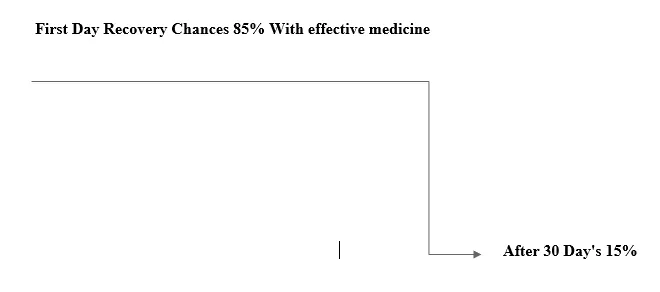
Figure None: Declining Recovery Rate
It is evident from this case that if the patient had received high-quality medication from the very first day, the chances of recovery would have been significantly higher. Instead, the use of ineffective drugs caused his immune system to weaken day by day. By the time he finally received effective medication, his chances of recovery were already very slim, and he could not be saved. This case highlights the urgent need to ensure access to effective medications from the very beginning. Furthermore, the use of ineffective drugs must be stopped, and those who administer such treatments must be held accountable.
"Our body is our life; we should not gamble with it for the sake of saving a little money."
In the Medical and Hospital System:
Treatment should be provided using high-quality medicines so that patients can maintain their trust in the system. If a facility lacks the necessary resources or expertise to treat a patient, it should decline the case immediately and provide guidance on where the patient can receive proper, comprehensive care. We must not gamble with a patient's well-being for the sake of financial gain. It is essential to understand that a human being is not a machine that can be manipulated at will; it is a delicate body. Any negligence—or even a minor mistake—could cost a patient their life.
Advance Preparation:
We live in an era that is moving at an incredibly rapid pace; it is truly the age of machines. The global population is growing swiftly, leading to a very high population density. Numerous factors contribute to the emergence of diseases, and their prevalence has increased significantly. A major, large-scale disease could arise at any time, potentially affecting the entire world. Therefore, it is essential that we proactively engage in ongoing research and the development of various types of medical treatments. As soon as we receive even the slightest indication of an emerging threat, we must act immediately to contain it—regardless of the sector involved. We must continue to study and conduct research concerning humans, animals, birds, and plants alike. If a virus or disease were to affect any of these, the consequences could be catastrophic, as everything is interconnected. Consequently, we must ensure the safety of all.
It is essential to halt, in a timely manner, any actions that could give rise to a major disease in the future.
Often, in the pursuit of our own objectives, we lose sight of this and engage in activities that later manifest as a severe illness or virus, affecting the entire world. The global community must remain vigilant and ensure that no actions are taken that could precipitate a worldwide medical emergency.
CONCLUSION:
Strengthening our medicines and the regulatory systems governing them will lead to greater success. We must ensure effective implementation at the grassroots level. The current global landscape is vast, and a significant number of people are suffering from illnesses—in fact, it is common to find someone in almost every household grappling with some form of health condition, often requiring lifelong medication with little hope of a full recovery. We must strive to discover effective treatments for every disease. Furthermore, many people put their lives at risk by using ineffective medicines. Despite the high number of hospitals worldwide, many individuals still lose their lives due to the use of such ineffective treatments. We must address this at an early stage, facilitate the entry of effective medicines into the market, and prioritize the ongoing research, development, and production of efficacious treatments for the future.
REFERENCES
Ravi Sharma, Authentic Medicines and the Right Treatment for a Patient, Int. J. of Pharm. Sci., 2026, Vol 4, Issue 11, 2424-2427. https://doi.org/10.5281/zenodo.24276430
 10.5281/zenodo.24276430