

We use cookies to ensure our website works properly and to personalise your experience. Cookies policy
Vidyaniketan College of Pharmacy, Anjangaon Surji, Amravati, Maharashtra 444705
The methods and the technologies followed from the traditional times were going through a long time consuming, costly, irregular or less precise results, and difficult to be operated by the person undergoing studies or research purposes for the development or discovery of a new drug molecule. These methods also included the target identification, target validation, and drug molecule optimizations; whereas, the technologies to be used from the traditional times such as X-rays, magnetic resonance imaging, electrocardiogram (ECG), and histopathological imaging. But, with the collaboration or working together with artificial intelligence (AI) based models such as machine learning (ML), deep learning (DL), reinforcement learning (RL) found relatable, responsive, and productive in various pharmacological developments or procedures. AI is also found helpful in pharmacokinetic as well as pharmacodynamic modeling for the reduction of the toxicity or safety concerns relating the drug use or their modifications for the better therapeutic actions or effects on living beings. This review reveals the development and advancement of methodologies along with certain case studies to relate the changes with the recent times.
Pharmacology is a branch of science that is defined as the scientific study of drugs and their interlinkage with living ones. It has its core areas in Pharmacodynamics i.e the study of what the drug does to the body (mechanisms of action, physiological effects), whereas Pharmacokinetics is the study of what will be the actions of the body in response to the administered drug, ADME processes i.e., absorption, distribution, metabolism, excretion. The term Pharmacology was derived from Greek words, where Pharmakon means drug and Logos refers to its studies. AI or Artificial intelligence is the ability of a computer or program to match human behavior or thinking and perform human tasks. ML or machine learning is a branch of artificial intelligence (AI) and computer science that grips the data and algorithms to enable AI systems which make it learn and improve in a manner similar to humans that help in enhancing their accuracy over a period of time. DL or Deep learning is a subset of machine learning methods, these methods are based on neural network methods (which are also a machine learning method) and those methods have been around since the 1960s. Deep learning is a type of ML and AI that trains computers to learn from extensive data sets. Computational tools, methods, and database resources have the potential for optimization and lead discovery. Lead molecules can be identified using the scoring functions and search algorithms using different software packages available for molecular docking and virtual screening, such as AutoDock vina, Glide, etc [1]. Molecular docking is a fundamental computational technique in structure based drug design used to predict the preferred orientation and binding affinity of a small molecule (ligand) to a receptor (protein or nucleic acid) (Fig.1). These methodologies play a vital role in planning and designing new drugs; these approaches are carried for the prediction and estimation of the binding modes and affinities of a small molecule within the binding sites of targeted receptors. In recent times, molecular docking is widely used to screen out the food derived BAPs (Bioactive Peptides) and demonstrate their biological mechanisms [2].
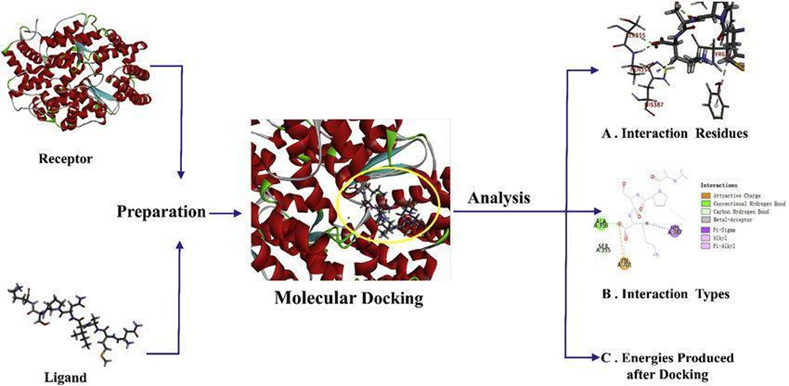
FIG.1 PROCESS OF MOLECULAR DOCKING [2].
The availability of biology research, saturating drug discovery can be influenced by the ‘omics’-scale data. Scalability of the data and the complexity of the underlying system, necessarily involves the use of computational approaches, 3D structures or high-confidence structural models are being used specifically to address a higher resolution with a comparison of 3D structures of the target protein(s) with other proteins in its own cell or any other suitable cell, also following the substructure or functional site comparison [3].
CURRENT SCENARIO OF AI IN PHARMACOLOGY
Traditionally, the experimental pharmacology studies were associated with the long going and complex procedures, which has low rate of precisions of results and high chances of errors but it gets corrected and fastened with the applications of AI (Artificial intelligence) in this field. The current scenarios for Artificial intelligence in Pharmacology are as following:
Drug Discovery, Target Identification, and optimization:
De novo drug design (DNDD), autoencoder (AE), recurrent neural network (RNN), graph-based neural network (GNN), CNN, etc. methods are being used for new drugs with unprecedented benefits. This process involves two stages i.e, the generation of unknown molecules based on instructions (SMILES, molecular graphs) collected the data obtained from the software such as CHEMBL, ZINC, PubChem, and another one is the training process to accelerate the learning process e.g. In silico prediction of digestion, degradation, metabolism, excretion and toxicity tolerance (ADMET) which has been improved and by the creation of accurate simulations. When a drug is in the early stages of development, it has the risks and problems which are evaluated before it reaches the market. Development of new drugs requires a lot of work, money and time. The concept of drug repurposing involves the various purposes used differently, which can offer a great opportunity to modify existing drugs to achieve desired therapeutic goals. Many algorithms, such as molecular docking, had shown their contributions by creating effective libraries to evaluate the effects of drugs on various targets [4].
In recent years, various techniques are adopted for the increase in the sensitivity of target identification directly related to the affinity of purification, ligand based protein labeling, whereas the PAL (Photoaffinity labeling) is developed recently to study the protein-ligand interactions for the identification of targets of ligands. The concept of PAL was introduced by Westheimer in the 1960s while he was practicing the acylation process for the incorporation of an aliphatic diazo group in chymotrypsin (enzyme). These molecules were crosslinked via photolysis; a chemical entity is being used to make covalent bonds to its target when activated in the presence of light. In drug discovery, Drug target identification is a milestone for advancement of knowledge and technology. The productivity and predictability of the models can be improved by replacing affinity models with the phenotype models [5, 6]. The importance of target identification and drug discovery are- Individualized treatment selection, improved treatment efficacy, personalized risk assessment, drug development and clinical trials, minimization of adverse events, enhanced patient engagement, and cut down the cost of research and development; in case of drug discovery, Minimizing off- target effects, accelerating drug development, precision medicine, reducing late-stage failures, diversifying the drug pipeline, and addressing unmet medical needs to enhance global health outcomes [7].
Pharmacokinetics and Pharmacodynamics modeling with toxicity and safety optimization:
Pharmacokinetics is defined as how the body affects a drug, involving absorption, distribution, metabolism, and excretion, it examines the overall journey of a drug throughout the body where it runs from absorption into the bloodstream to its elimination and it involves the measurements such as absorption rate, bioavailability, half-life, and clearance of drug from body; whereas, Pharmacodynamics deals with the effects of a drug to the body, including mechanism of action and physiological effects. Pharmacodynamics is the representation of the number of atoms of a particular element within a molecule, including several parameters such as efficacy, potency, and the dose-response relationship. The relationship between pharmacokinetics and pharmacodynamics is essential to be known when the toxicological profile of chemicals undergoes determination. Pharmacokinetic-pharmacodynamic modeling helps in the prediction of how the duration of drug or chemical substances takes for the exposure of toxic effects. Several interaction patterns are found to increase or mitigate their toxicity to Synergistic toxicity i.e when two or more chemicals are present, they may result in enhancing each other’s toxic effects. For example, the combination of ethanol and acetaminophen can elevate liver toxicity, as ethanol depletes glutathione, a key enzyme in detoxifying acetaminophen metabolites. Antagonistic effects are the presence of one chemical which can reduce the toxicity of another one. A common example is the use of naloxone to counteract opioid overdose by competitively binding to opioid receptors without activating themselves, thus found helpful in preventing respiratory depression. Metabolic competition is defined as the metabolism of many chemicals by the same enzymes; they can compete with each other or these metabolic pathways, which leads to the alteration of toxicity profiles. For example, fluoxetine (an antidepressant) and codeine are both metabolized by CYP2D6, which can result in the alteration of analgesic effects of codeine when co-administered with fluoxetine. Individual variability is the pharmacokinetic and pharmacodynamic interaction that varies between individuals based on genetic polymorphisms, age, sex, and disease conditions. Polymorphisms in CYP enzymes can result in poor or ultra-rapid metabolism of drugs, alteration of their therapeutic and toxic effects [8]. The derivations of the pharmacokinetic parameters are considered with the help of the two or three compartment models with linear or non linear methods of elimination. The residual variability can be characterized by assessing the proportional, additive, and mixed types for the incorporation of diverse error models.
CASE STUDIES
The case studies are based on the combination of the calculating formulas in pharmacology for dose determination using traditionally and the ML’s mathematical models e.g. pharmacokinetics formula for bioavailability measurement of a drug substance using Plasma level time is-
FA = [AUC] ORAL*DIV / [AUC]IV*DORAL----1
Fr = [AUC] test*Dstd / [AUC] std*Dtest----2
Where, FA is absolute bioavailability, Fr is relative bioavailability, AUC is area under curve for oral and intravenous administration of drug.
Fr = [AUC]test*Dstd*τ test / [AUC]std*Dtest*τstd ---- for multiple dose studies.
Where, Fr is relative bioavailability, AUC is area under curve for test and standard, τ is dosing interval [9]. These formulas are converted into the summary metrics like AUC, C max, T max, and then feeding to a ML’s model syntax for the determination of bioavailability of a plasma level time is-
Main syntax for AUC calculation:
import numpy as np
import pandas as pd
from sklearn. M
etrics import auc
# Example: Plasma concentrations (mcg/ml) and Time (hours)
time = [0, 0.5, 1, 2, 4]
conc = [0, 1.5, 3.2, 4.0,1.5]
#Now we can calculate the Area Under the Curve (AUC) using Trapezoidal rule
auc_value = auc (time, conc)
print (f"AUC: {auc_value} mcg*h/ml")
ML syntax for bioavailability prediction:
from sklearn. ensemble import RandomForestRegressor
from sklearn. model_selection import train_test_split
from sklearn. metrics import mean_squared_error
‘ X’ show Feature like LogP, Molecular Weight, Initial conc at 30min
‘ y’ allows target (Bioavailability)
X_train, X_test, y_train, y_test = train_test_split(X, y, test_size=0.2)
* Train a Random Forest Model
model = RandomForestRegressor (n_estimators=100)
model.fit(X_train, y_train)
* Predict bioavailability
predictions = model.predict(Y_test)
print (f"MSE: {mean_squared_error(y_test, predictions)}")
The studies that are suitable for the criteria calculated in NONlinear Mixed Effects Modeling (NONMEN) software, by relating their respective compartments and equations. Pharmacokinetic parameters were implemented for the resulting values from each model; the estimated values of the concentrations are evaluated using the working software. The performance of the pharmacokinetic models is evaluated by using the prediction error (PE) in percent;
PE (%) = Ci,pred -Cobs/ Cobs*100
MPE (%) = 1/N*N∑i=1*PE|
MAPE (%) =median of |PE|
RMSE (%) = √1/N*N∑i=1(PE)2
Where, PE is prediction error, MPE: Median Prediction Error, MAPE: Median Absolute Prediction Error, RMSE: Root Mean Squared Error, N is the number of observed Methotrexate concentrations and Ci is the individual or population prediction of MTX.[10].
b. There are many case studies that have potential for significant comparative timelines such as artificial intelligence based platforms working on the advance programs to cover the target identification processes within less duration of time that conventionally takes four to five years, these advance programs does the rapid identification of novel inhibitor drugs and the discovery of a newly developed class of antibiotics using deep learning models (Table. 1). A drug is designed with the help of artificial intelligence which was found successful while accelerating and augmenting the tools in drug discovery for faster and powerful results [11].
TABLE 1. CASE STUDY OF AI DRIVEN DRUG DISCOVERY [11]
|
Sr. No |
Tools to be used |
Therapeutic zones |
AI based Approaches |
Followed Achievement |
|
1 |
Insilico Medicine |
Idiopathic Pulmonary Fibrosis (IPF) |
Models for designing the de novo and target ID |
AI based drug designed candidate for Phase II of clinical trials. |
|
2 |
Exscientia and Sumitomo Dainippon Pharma |
Psychiatry or CNS |
Models for active learning and optimizing the results |
Novel serotonin 5-HT1A receptor agonist identified fewer than 12 months of clinical trials. |
|
3 |
Recursion Pharmaceuticals |
Rare Diseases or Oncology |
CNN using for Image oriented phenotypic screening |
Building of large-scale platform models that identify thousands of diseases for potential therapeutics in clinical stages. |
|
4 |
AbCellera and Eli Lilly |
Infectious Disease (COVID-19) |
AI oriented analysis of immune responses for antibodies identification |
The discovery of bamlanivimab antibody for COVID-19. |
AI BASED TOOLS AND PLATFORMS EMERGING IN PHARMACOLOGY
There are various tools, platforms as well as softwares based on artificial intelligence models in which include the machine learning, deep learning models; whereas, clustering and dimension reduction (Table. 2). The examples of AI or ML learning models are-
TABLE 2. AI/ML LEARNING MODELS [12].
|
Sr. no. |
Artificial intelligence or Machine learning models / platforms |
|
1 |
Convolutional Neural Networks (CNNs) |
|
2 |
Reinforcement Learning (RL) |
|
3 |
Deep Q-Networks (DQNs) |
|
4 |
Recurrent Neural Networks (RNNs) |
|
6 |
Graph Neural Networks (GNNs) |
Whereas, the examples of AI tools used for the drug discovery in Pharmacology are DeepChem, ChemBERTa, RDKit, AutoDock Vina, IBM RXN for Chemistry, and GENTRL (Generative Tensorial Reinforcement Learning), etc [12]. The modern lifespan follows the production of a wide and huge source of medicinal data that undergoes various complexities where AI found beneficial in solving problematic situations in pharmaceutical sciences, particularly in pharmacological research as it grew there. Pharmaceutical science greatly impacted by artificial intelligence and machine learning, when it is compared to the traditional technologies such as electrocardiogram (ECG), MRIs, X-rays, and histopathological imaging gathers more accurate results by collaborating with various sensors and data acquisition systems. The various methods of artificial intelligence involves natural language processing (NLP), artificial neural network (ANN), reinforcement learning (RL), evolutionary polymorphic neural network (EPNN), spatial analysis with self-organizing neural network (SPAWNN), LapRLS, VigiGrade [13].
Applications of Artificial intelligence in Pharmacology:
There are various fields in Pharmacology where artificial intelligence has vital roles as follows:
CHALLENGES AND LIMITATIONS WHILE ADOPTING AI
Artificial intelligence based studies have several limitations as the empirical analysis is based on a restricted sample of AI-driven data quality and compliance systems, which may be limited for the generalized abilities of the findings across the industries and organizational levels. In addition, the rapid evolution of AI technologies and regulatory framework faces some technical challenges as they may change over a time, therefore requiring a continuous reassessment [14]. The specific data science package is being used by machine learning experts to determine the interpretability models; a little research has been done to focus on the investigation of holistic models undergoing processes of interpretability within the different workings in various organizations. The problematic attempts are considered while undergoing the interpretability through various measurable, fixed aspects of interactions with a model by defining the interpretation in ongoing results of negotiation within an organization [15]. Data cleansing using AI for managing the complex world of data protection and ethical issues therefore, AI based models need frequent access to a large source of datasets, where some information consists of a private, sensitive material. The satisfaction of international data protection laws like GDPR (General Data Protection Regulation) and HIPAA (Health Insurance Portability and Accountability Act) for these models are must, but more challenging. The permission issues, data ownership, and the misuse possibilities are some of the ethical issues that alter the management and modification of data gathered from artificial intelligence. AI based data cleansing solutions are challenging while implementing in current data management frameworks [16].Incase of transparency the decision making process of AI systems are user-friendly, but it differs over a time regarding the definition of fairness; also the intersectionality considered as the way in which different dimensions of identity interact and affect outcomes while considering the complex intersections and ensures the fairness across the multiple dimensions [17]. The consideration of ethics in AI programming and designing creates new challenges in integrating religious principles as this process is bringing religious and ethical values into the structural form of algorithms and models, by keeping the technology aligned with moral principles. It found challenging for the social responsibilities of developers, as they are essential to be understand the impact of technology on society and respond to it with a solid commitment by considering the ethical and moral values inherited or incorporated in the tradition [18].
FUTURE DIRECTIONS
In previous times the rising cost of drug development was presenting the significant challenges for the pharmaceutical industry but with the incorporation of the AI tools resulting the improvement of the target identification, target validation, optimization and selection of molecules which results in the support in research and development that leads to significant time and cost saving, and improves the rate of translational successes.AI has proven that it improves efficiency and help in generating better evidence for treatments throughout clinical trials [19]. The simulations based on Machine learning (ML) techniques and molecular dynamics (MD) models are being used in the various fields like designing of de novo drug for establishing the efficiency and accuracy improvement. The explorations are possible with the combination of the both ML and MD methods in search of advantages regarding the synergies between them. The interpretable machine learning (IML) and deep learning (DL) methods are being used by considering their contribution in reducing efforts. By utilizing the abilities of AI and MD, researchers are possibly building simpler designing of drugs more effectively and efficiently than ever before. The improvement of accuracy and efficiency of clinical trials can be possible with the collaboration of artificial intelligence and molecular docking, because AI algorithms efficiently work for the analysis of data gathered while undergoing trials for the identification of potential adverse effects of the drugs during its testing [20]. Pharmacovigilance techniques undergo various difficulties while the drug safety monitoring is in process but AI analysis of real-world data helps to tackle that problematic situation. Natural language processing (NLP), Machine learning (ML) and artificial intelligence based hypothetical predictions and detection of adverse drug events (ADEs), corrects the medicinal data gathered from the diversified data sources such as the electronic health records (EHR) and databases of pharmacovigilance. There are several critical diseases states in which the individual patient care is difficult like epilepsy treatment, around 30% of epilepsy patients are unable to achieve satisfactory results on control over the symptoms with available anti-epileptic drugs (AEDs); this may lead to challenging situations such as increase in the mortality risk, reduction in the quality of life and unwell treatment costs. Machine learning (ML) techniques contribute to the potential integration of clinical and genetic data while predicting the drug responses and dosage optimization that is essential for precision for pharmacotherapy. Patient-specific individuality and data, relating clinical information and biomarkers, involves the AI algorithms for the determination of dosage optimization. The identification of patterns and correlations for personalized dosing regimens for better efficacy and safety made easier for both the physicians and patients to deal with the medicine in a better way to reduce the errors and the chances of adverse drug effects or adverse drug events by showing their interaction with the random forest (RF), support vector machine (SVM), recurrent neural network (RNN), and convolutional neural network (CNN) [21].
CONCLUSION
As discussed in the above article it is disclosed that artificial intelligence found helpful and more effective in the development of pharmacological studies and researches to elevate the productivity of work with the desired results require the recognition techniques such as RF, RN, CNN, ANN, SVM etc like machine learning algorithms for precisions . The integration of the AI based machine learning models such as pharmacokinetic or pharmacodynamic mathematical models for the prediction of the pharmacological results which reduces the cost of procedures, working load, and a long duration of time for obtaining experimental data for studies or research purposes.
REFERENCES





Anand Khode, Gaurav Kirdak, Yash Jawanjal, Shivam Bhagat, Akash Khandare, Applications of Artificial Intelligence in Pharmacological Drug Development and Research: Current Scenario and Future Directions, Int. J. of Pharm. Sci., 2026, Vol 4, Issue 3, 3144-3153. https://doi.org/10.5281/zenodo.19354741
 10.5281/zenodo.19354741