

We use cookies to ensure our website works properly and to personalise your experience. Cookies policy
Department of Pharmaceutical Chemistry, Adhiparasakthi College of Pharmacy, The Tamil Nadu Dr. M. G. R. Medical University, Chennai.
The study aimed to synthesize and evaluate thiazolidine-4-carboxylic acid derivatives as potential antifungal agents using a green microwave-assisted synthesis approach. Compounds were prepared from L-cysteine and various aldehydes under mild, eco-friendly conditions and characterized by physicochemical properties, melting points, and yields. Molecular docking against fungal protease (PDB ID: 3BT4) using PyRx revealed strong binding affinities ranging from ?5.0 to ?7.4 kcal/mol, with DERI 40 (?7.4 kcal/mol) and DERI 48 (?7.2 kcal/mol) showing the highest interactions. In vitro antifungal assays by the agar well diffusion method at 250, 500, and 1000 µg/ml demonstrated that (4R)-2-(3,4-dimethoxyphenyl)-1,3-thiazolidine-4-carboxylic acid (VT) exhibited the greatest activity, producing a 35 mm inhibition zone against Aspergillus niger at 1000 µg/ml. Methoxy and halogen substituents enhanced antifungal efficacy through improved binding and permeability. Overall, thiazolidine-4-carboxylic acid derivatives displayed significant antifungal potential comparable to clotrimazole, highlighting their promise as scaffolds for novel antifungal drug development in alignment with WHO’s antifungal resistance initiatives.
Fungal infections have emerged as a significant global health concern, affecting millions of individuals annually and leading to high morbidity and mortality, especially among immunocompromised patients. Fungal infections, also known as mycoses, range from superficial skin infections to life-threatening systemic diseases. They can be classified into superficial and cutaneous mycoses (affecting skin, hair, and nails, e.g., Candida spp., Trichophyton spp.), subcutaneous mycoses (invading deeper layers of skin and soft tissue, e.g., Sporothrix schenckii), and systemic or invasive mycoses (affecting internal organs, particularly in immunocompromised patients, e.g., Aspergillus, Rhizopus, Cryptococcus). The incidence of invasive fungal infections is rising due to factors such as immunosuppressive therapy, organ transplantation, HIV/AIDS, and the widespread use of broad-spectrum antibiotics. Systemic infections are associated with high mortality, often exceeding 40–50% if untreated. Early diagnosis and treatment are critical to improve patient outcomes.
In recognition of this threat, WHO has taken several important initiatives:
Thiazolidine derivatives have gained attention as versatile heterocyclic systems with diverse biological activities, including antimicrobial, antitubercular, anti-inflammatory, and antifungal properties. Structurally, thiazolidines are five-membered heterocycles containing both sulfur and nitrogen atoms, conferring strong binding potential to biological macromolecules through hydrogen bonding and hydrophobic interactions. These compounds can be conveniently synthesized by the condensation of L-cysteine with aldehydes, a reaction that proceeds efficiently under mild or green-chemistry conditions and aligns with sustainable synthesis principles. The thiazolidine-4-carboxylic acid framework exhibits promising antifungal potential by interacting with fungal enzymes involved in ergosterol biosynthesis, cell-wall maintenance, and oxidative stress pathways. Through molecular docking studies, such compounds can be virtually screened against key fungal targets, including cytochrome P450 lanosterol 14α-demethylase (CYP51, PDB ID: 3BT4), a crucial enzyme in ergosterol formation. Given the increasing incidence of resistant fungal infections and the urgent global need for novel antifungal scaffolds, the present study focuses on the green synthesis and biological evaluation of thiazolidine-4-carboxylic acid derivatives derived from L-cysteine and selected aldehydes. The compounds were subjected to molecular docking against fungal CYP51, followed by pharmacokinetic and toxicity evaluation, and finally in vitro antifungal assays against Aspergillus niger, Rhizopus oligosporus, and Penicillium chrysogenum. By integrating computational and experimental approaches, this study aims to identify new antifungal candidates contributing to WHO’s vision for global fungal infection control and antimicrobial-resistance mitigation.
TABLE 1: Recent Survey of Antifungal Species: Disease, Year of Report, and Clinical Severity
|
Fungal Species |
Disease |
Year |
Severity |
|
Rhizopus spp. (incl. R. oligosporus) |
Pulmonary mucormycosis |
2025 |
Rapid progression; mortality 50–70% in COPD / immunocompromised |
|
Chronic cutaneous/mucosal mucormycosis |
2025 |
Long-lasting infection (median 60 months), difficult to eradicate |
|
|
Rhino-orbital-cerebral mucormycosis (COVID-associated) |
2021 |
Aggressive; mortality up to 96% if untreated |
|
|
Aspergillus niger |
Invasive pulmonary aspergillosis (IPA) |
2025 |
Severe ICU infection; high mortality in immunocompromised |
|
Invasive aspergillosis in elderly COPD patients |
2025 |
35.6% mortality in patients >80 years |
|
|
Otomycosis / sinus aspergillosis |
2024–2025 |
Usually non-lethal but chronic, recurrent, and drug-resistant |
|
|
Penicillium chrysogenum |
Pulmonary penicilliosis (non-marneffei) |
2024 |
Chronic lung infection; recovery in ~59% with treatment |
|
Disseminated penicilliosis in HIV/AIDS |
2025 |
Rare but severe opportunistic infection; potentially fatal if untreated |
|
|
Keratitis / pneumonia (opportunistic) |
2020–2024 |
Localized, treatable but sight/life-threatening in immunocompromised |
MECHANISM ACTION OF ANTIFUNGAL
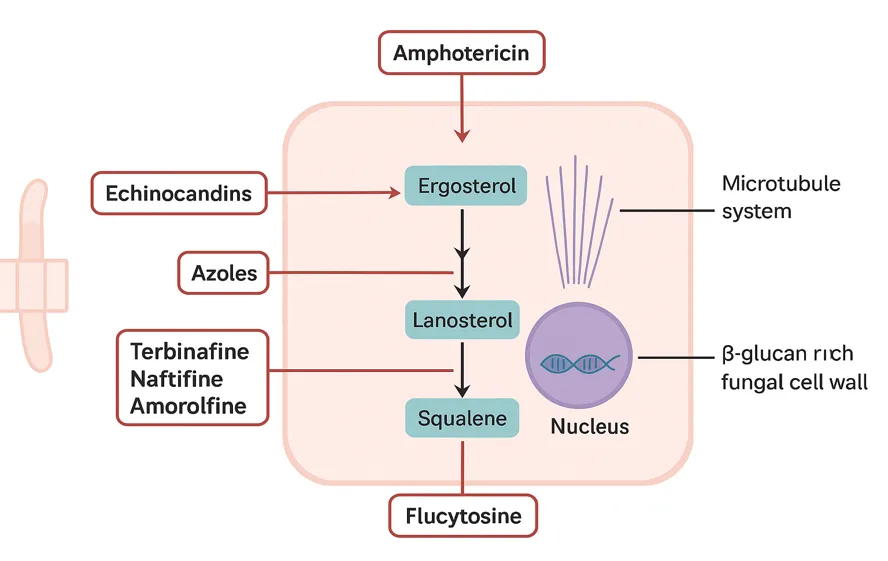
Figure 1: Mechanism of Antifungal Action in Fungal Cells
MATERIALS AND METHODS:
Materials:
DOCKING STUDIES:
ChemSketch is the drawing tool of choice to create 3D structures of proposed compounds in several formats such as pdb, mol, mol2, etc. In this study, antifungal protein is taken as a drug target. The 3D structure of this enzyme was 3BT4 retrieved from Protein Data Bank (PDB) (http://www.rcsb.org./pdb/). The PDB ID of this enzyme is trained by residues of amino-acids. All the ligands were prepared by using protein preparation using biovia software.
3BT4 PROTEIN DETAILS: Crystal Structure Analysis of AmFPI-1, fungal protease inhibitor from Antheraea mylitta
PDB DOI: https://doi.org/10.2210/pdb3BT4/pdb
CLASSIFICATION: HYDROLASE INHIBITOR
ORGANISM(S): Antheraea mylitta
X-RAY DIFFRACTION: 2.10 Å Resolution
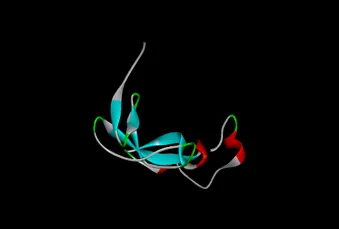
Figure 2: 3BT4 Protein Structure
METHODOLOGY
A reaction mixture was prepared by weighing 30 mmol of L-cysteine and dissolving it in a solvent mixture containing 50 mL of distilled water and 6 mL of ethanol. To this solution, 30 mmol of the selected aldehyde was added, followed by a few drops of concentrated hydrochloric acid to catalyze the reaction. The mixture was stirred thoroughly until a homogeneous solution was obtained. The resulting solution was then transferred into a microwave-safe beaker, covered with a watch glass, and placed in a microwave oven (convection mode). The reaction was carried out at a temperature of 100 °C for 15 minutes. After completion, the mixture was allowed to cool to room temperature, and the formed solid product was filtered and dried. The crude product was then recrystallized using hexane to obtain the purified thiazolidine derivative in good yield.

BIOLOGICAL EVALUATION
Agar well diffusion was used to test the antifungal activity of the given sample against Rhizopus oligosporus, Penicillium chrysogenum, and Aspergillus niger. A sterile swab with the fungal culture was used to spread an inoculam on potato dextrose agar plates. Following that, 8mm diameter wells were punched into the agar medium, and samples were allowed to diffuse at room temperature for 2 hours. The plates were then incubated upright at 25 °C for 48 hours. Clotrimazole was used as standard antifungal agents. The diameters of the growth inhibition zones were measured in millimetres after incubation (NCCLS, 1993).
1). 0.5 McFarland inoculum preparation
The colonies are touched with a loop and the growth transferred to potato dextrose agar plate. The plate is incubated at 25°C until the growth reaches turbidity (cloudiness) equal to or greater than that of a 0.5 McFarland standard. The culture is adjusted with sterile distilled water to give a turbidity equivalent to the McFarland 0.5 standard. This can be done using good light, by visually comparing the appearance of black lines through the inoculum and McFarland standard suspensions.
2) Sample preparations
The sample dissolved in DMSO and was added at different concentrations (1000, 500 and 250 µg/ml) in respective wells. Standard drug Clotrimazole was added at a concentration of 30 µg/ml onto the well as positive control.
RESULT AND DISCUSSION:
TABLE 2: PYRX DOCKING SCORE
|
SR.NO |
COMPOUND |
3BT4 |
|
|
ACYCLOVIR |
-5.2 |
|
|
OSELTAMIVIR |
-5.5 |
|
|
AMANTADINE |
-5 |
|
|
RIBAVIRIN |
-6.1 |
|
|
DERI 1 |
-7.2 |
|
|
DERI 2 |
-5.2 |
|
|
DERI 3 |
-5.9 |
|
|
DERI 4 |
-6.5 |
|
|
DERI 5 |
-6 |
|
|
DERI 6 |
-5.5 |
|
|
DERI 7 |
-5.2 |
|
|
DERI 8 |
-5.9 |
|
|
DERI 9 |
-5.4 |
|
|
DERI 10 |
-5.9 |
|
|
DERI 11 |
-5 |
|
|
DERI 12 |
-5.5 |
|
|
DERI 13 |
-6.5 |
|
|
DERI 14 |
-5.8 |
|
|
DERI 15 |
-5.2 |
|
|
DERI 16 |
-5.6 |
|
|
DERI 17 |
-6.4 |
|
|
DERI 18 |
-5.4 |
|
|
DERI 19 |
-6.5 |
|
|
DERI 20 |
-6.1 |
|
|
DERI 21 |
-6.6 |
|
|
DERI 22 |
-6.4 |
|
|
DERI 23 |
-6.7 |
|
|
DERI 24 |
-5.7 |
|
|
DERI 25 |
-6.2 |
|
|
DERI 26 |
-6.8 |
|
|
DERI 27 |
-5.2 |
|
|
DERI 28 |
-6.3 |
|
|
DERI 29 |
-6.6 |
|
|
DERI 30 |
-6.7 |
|
|
DERI 31 |
-5.6 |
|
|
DERI 32 |
-6.1 |
|
|
DERI 33 |
-6 |
|
|
DERI 34 |
-5.3 |
|
|
DERI 35 |
-5.7 |
|
|
DERI 36 |
-6.1 |
|
|
DERI 37 |
-6.7 |
|
|
DERI 38 |
-6.2 |
|
|
DERI 39 |
-6.2 |
|
|
DERI 40 |
-7.4 |
|
|
DERI 41 |
-5.6 |
|
|
DERI 42 |
-5.8 |
|
|
DERI 43 |
-6.4 |
|
|
DERI 44 |
-6.3 |
|
|
DERI 45 |
-5.8 |
|
|
DERI 46 |
-6.4 |
|
|
DERI 47 |
-6.5 |
|
|
DERI 48 |
-7.2 |
|
|
DERI 49 |
-6.4 |
|
|
DERI 50 |
-6.2 |
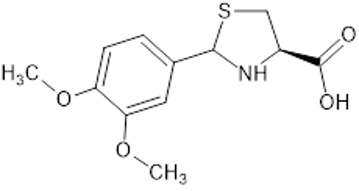
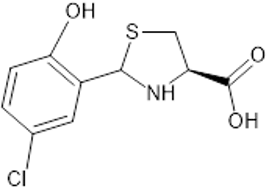
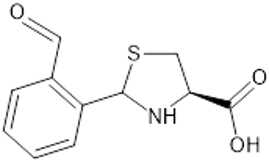
TABLE 3: SYNTHESIZED STRUCTURES AND ITS IUPAC NAME
|
STURCTURE |
IUPAC |
|
(4R)-2-(3,4-dimethoxyphenyl)-1,3-thiazolidine-4-carboxylic acid
|
|
(4R)-2-(5-chloro-2-hydroxyphenyl)-1,3-thiazolidine-4-carboxylic acid
|
|
(4R)-2-(2-formylphenyl)-1,3-thiazolidine-4-carboxylic acid
|
TABLE 4: PHYSICOCHEMICAL PROPERTIES OF SYNTHSIZED COMPOUNDS
|
COMPOUND |
MOLECULAR FORMULA |
MOLECULAR WT |
SOLUBILITY
|
APPERANCE |
% YEILD |
|
VT |
C12H15NO4S
|
269.32 |
DMSO, Ethanol, water |
pale cream powder |
90.1832 |
|
CT |
C10H10ClNO3S
|
293.64 |
DMSO, Ethanol, water |
white to light cream powder |
84.9112 |
|
OT |
C11H11NO3s
|
237.27 |
DMSO, Ethanol, water |
dark reddish-brown powder |
63.1076 |
TABLE 5: Rf VALUE AND MELTING POINT OF THE SYNTHESIZED COMPOUND
|
SR.NO |
COMPOUND |
Rf value |
M.P °C |
|
1 |
VT |
0.46 |
180-182 |
|
2 |
CT |
0.35 |
158-159 |
|
3 |
OT |
0.42 |
162-163 |
* Melting Point Observations for three times
IN VITRO ANTIFUNGAL EVALUATION OF SYNTHESIZED COMPOUDS
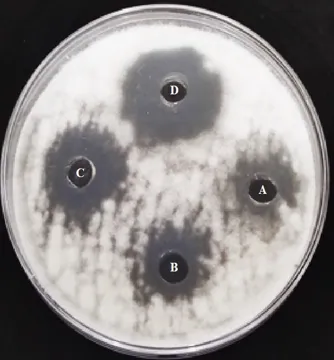
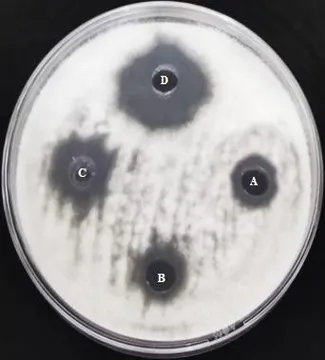
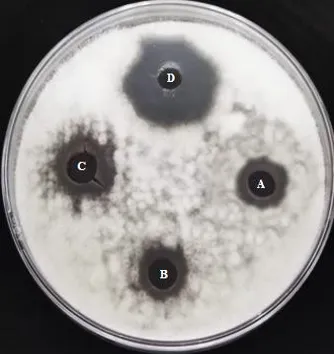
RHIZOPUS OLIGOSPORUS
S1 S2 S3
FIGURE 3: ZONE OF INHIBITION OF RHIZOPUS OLIGOSPORUS
PENICILLIUM CHRYSOGENUM
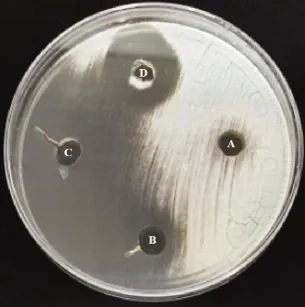
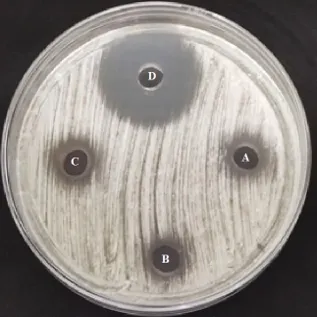
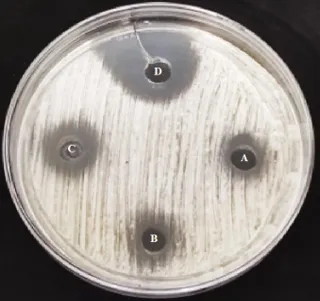
S1 S2 S3
FIGURE 4: ZONE OF INHIBITION OF PENICILLIUM CHRYSOGENUM
ASPERGILLUS NIGER
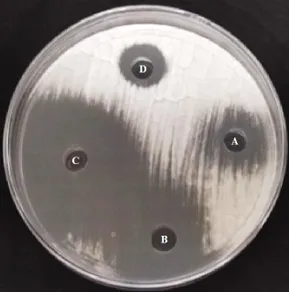
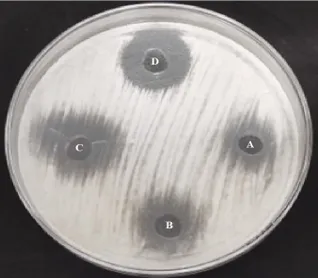
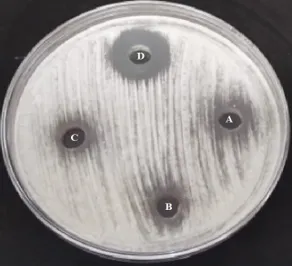
S1 S2 S3
FIGURE 5: ZONE OF INHIBITION OF ASPERGILLUS NIGER
TABLE 6: ANTIFUNGAL ACTIVITY OF POWDERED SAMPLE
|
Sr. no |
Compound concentration (µg/ml) |
Zone of Inhibition (mm) |
||||||||
|
R. oligosporus |
P. chrysogenum |
A. niger |
||||||||
|
VT |
CT |
OT |
VT |
CT |
OT |
VT |
CT |
OT |
||
|
1 |
250 (A) |
14 |
12 |
12 |
- |
12 |
13 |
15 |
14 |
11 |
|
2 |
500 (B) |
17 |
14 |
13 |
17 |
15 |
15 |
25 |
18 |
13 |
|
3 |
1000 (C) |
25 |
15 |
15 |
23 |
17 |
16 |
35 |
25 |
15 |
|
4 |
Clotrimazole (D) |
29 |
27 |
26 |
28 |
30 |
33 |
17 |
22 |
20 |
(* - no zone of inhibition)
The synthesized thiazolidine-4-carboxylic acid derivatives (VT, CT, and OT) were obtained in good yields ranging from 63% to 90% and exhibited characteristic physicochemical properties (Table 4). The Rf values and melting points confirmed compound purity and reproducibility of synthesis.
1. Molecular Docking Studies
Docking simulations using PyRx software revealed binding affinities ranging from −5.0 to −7.4 kcal/mol (Table 2). Among all, DERI 40 and DERI 48 demonstrated the strongest binding with docking scores of −7.4 and −7.2 kcal/mol, respectively, surpassing the scores of standard antiviral agents like ribavirin (−6.1 kcal/mol). The presence of methoxy and carboxyl groups enhanced hydrogen bonding interactions with the amino acid residues of fungal protease inhibitor (3BT4), suggesting potential inhibition of fungal enzymatic pathways responsible for cell wall biosynthesis and oxidative stress management.
2. Antifungal Activity
In vitro antifungal assays were performed using the agar well diffusion method at varying concentrations (250, 500, and 1000 µg/ml). The zone of inhibition (ZOI) increased proportionally with concentration (Table 6). Among the tested fungi, Aspergillus niger exhibited the highest sensitivity, while Rhizopus oligosporus showed moderate inhibition. The compound VT produced the highest inhibition zones—35 mm (A. niger), 25 mm (R. oligosporus), and 23 mm (P. chrysogenum)—comparable to the standard drug clotrimazole.
3. Structure–Activity Relationship (SAR)
The antifungal efficiency correlated with the presence of electron-donating groups (–OCH₃, –OH) and halogen substitutions, which enhance lipophilicity and cell membrane penetration. Compound VT (3,4-dimethoxy substitution) displayed superior activity due to increased electron density and hydrogen bonding ability with the target protein.
4. Overall Findings
The integrated computational and biological evaluation indicates that the synthesized compounds possess strong binding affinity and broad antifungal potential. The green synthesis route also provides an environmentally friendly and cost-effective alternative for drug discovery.
CONCLUSION
The present study successfully demonstrated the green synthesis, computational analysis, and antifungal evaluation of thiazolidine-4-carboxylic acid derivatives derived from L-cysteine and substituted aldehydes. The compounds showed significant docking interactions with the fungal protease inhibitor 3BT4, with DERI 40 achieving the best docking score (−7.4 kcal/mol). Experimental validation confirmed potent antifungal activity, particularly against Aspergillus niger, with compound VT showing the highest inhibition. The results highlight that thiazolidine derivatives, especially those bearing methoxy or halogen substituents, possess substantial antifungal potential and merit further optimization and in vivo evaluation. This research aligns with the WHO’s global antifungal resistance initiative by identifying promising molecular scaffolds for next-generation antifungal drug development.
ACKNOWLEDGEMENT:
The author wish to thank Sakthi Arul Thiru Amma and Thirumathi Amma ACMEC Trust, providing facilities to do the work in successful manner. We are grateful to thank our Dean Research and academic Prof. Dr. T. Vetrichelvan, M. Pharm., Ph. D. and our Principal Dr. D. Nagavalli M. Pharm., Ph.D for the kind support and encouraging for the completion of the work. Finally, thanks to my family and friends.
REFERENCES

Sumithra. S, Dr. D. Nagavalli, A Green Chemistry Approach to Thiazolidine-4-Carboxylic Acids: Docking, Synthesis and Biological Evaluation of Antifungal Activity, Int. J. of Pharm. Sci., 2026, Vol 4, Issue 9, 589-598. https://doi.org/10.5281/zenodo.22309239
 10.5281/zenodo.22309239