

We use cookies to ensure our website works properly and to personalise your experience. Cookies policy
Department of Pharmaceutical Chemistry, Ashokrao Mane Institute of Pharmaceutical Sciences and Research, Save, Dr. Babasaheb Ambedkar Technological University, Lonere, Raigad, Kolhapur-416213, Maharashtra, India.
The global resurgence of mpox formerly known as monkeypox declared a public health emergency of international concern by the WHO, has underscored the critical need for specific and effective antiviral therapeutics. Current treatment regimens rely heavily on repurposed drugs like tenovirimat, leaving a narrow pharmacopia to combat emerging varients. To accelerate the drug discovery pipeline, computer aided drug design (CADD) and IN-SILICO techniques have emerged as pivotal strategies to identify novel lead molecules with minimal cost and time. This reviews comprehensively summarizes recent advancements in the computational identification and optimization of small molecules and natural phytoconstituents targeting core mpox virus proteins. We evaluate the multisteps in silico pipeline utilized in recent different literatures, including: Homology modeling to construct 3D stuctures of uncharacterized viral proteins High Throughput Virtual Screening (HTVS) of diverse chemicals and natural product libraries. Molecular docking to elucidate binding affinities and non covalent interaction patterns, molecular dynamic simulations alongside gives MM-PBSA/GBSA calculation to evaluate ligand receptor stability and free binding energy also ADMET profiling to predict pharmacokinetic viability drug and drug likeness. Furthermore, this review highlights critical macromolecular drug targets that are highly conserved across orthopoxviruses including DNA-dependent RNA polymerase (DpRp), thymidylate kinase (TMPK), the D13L caspid protein, core proteases, and A42R profilin like protein. This review serves as a structured compendium for computational chemists and virologist aiming to develop the next generation of targeted anti-mpox therapeutics.
For roughly 50 years, Mpox, also known as monkeypox, was thought to be endemic in Central and West Africa, with sporadic outbreaks in the United States and Europe. It is a zoonotic infectious disease caused by the monkeypox virus (MPXV), which is a member of the orthopox virus (OPXV) genus of the poxviridae family[1]. The number of MPXV cases exceeded 80,000 in just six months, from May to October 2022, with many of the outbreaks taking place in areas where MPXV had never been reported before[2]. In 1958, MPXV was discovered to be a disease that resembled pox and was affecting monkeys housed in a Copenhagen, Denmark, research facility[3]. In 1970, a nine-month-old boy in the Democratic Republic of the Congo became the first person to contract MPXV[3].
In 2024, Mpox clade1 infected a 38-year-old male from Kerala's Malappuram district[4]. Clade I and Clade II are the two primary clades of MPXV genomes. Based on a sample taken in 1996, the Congo Basin (Central Africa) clade is known as Clade I, and the West African clade is known as Clade II. Their RefSeq genomes are NC_003310.1 and NC_063383, respectively. There are two primary MPXV genomic clades: Clade I and Clade II. With a RefSeq genome NC_003310.1 based on a 1996 sample, Clade I is the Congo Basin (Central Africa) clade, and Clade II is the West African clade with a RefSeq genome NC_063383.1 based on a 2018 sample.Clade II is further differentiated into IIa and IIb, with the 2022 Mpox outbreak being caused by the IIb lineages[5].
Despite the dramatic rise in MPXV cases, there are currently relatively few therapy options and no FDA-approved medications that are specific to MPXV. In the US, the smallpox vaccine was just authorized for clinical use against mpox. The U.S. Food and Drug Administration (FDA) has authorized the medications brincidofovir and tecovirimat for the treatment of smallpox under the agency's animal rule[3]. Pains, fever followed by skin lesions, weariness lymphadenectasis (lymph node swelling), inflammation of the spleen and liver, back discomfort, and systemic rashes and blisters are the typical symptoms of the Mpox virus[6].

Fig(1): Common symtoms of Mpox
EPIDERMIOLOGY:
In 1970, the first human monkeypox case was found in the Congo. Research conducted between 1981 and 1986 showed that in the tropical rainforest regions of Central and Western Africa, human monkeypox is a rare illness brought on by MPV transfer from animals to people. About 28% of the cases were secondary human-to-human spread; tertiary and quaternary chains of transmission were uncommon. Of the 418 instances of human monkeypox that were reported between 1970 and 1995, 388 happened in Zaire, which is now known as the Democratic Republic of the Congo, or DRC. In 1996 and 1997, the DRC health officials reported more than 500 probable cases of human monkeypox, and in January 1999, they reported several hundred further cases.There is worry that the number of human monkeypox cases is rising, even though the majority of these cases have not been verified by laboratory testing. The incidents have been intermittent since August 1970. According to Figure 2, there were six cases in 1970, three in 1971, five in 1972, three in 1973, one in 1974, two in 1975, three in 1976, six in 1977, twelve in 1978, and six in 1979. Although cases have been documented all year long, they have been more frequent during the dry season. In Zaire, rash appeared in 20 out of 38 cases between January and March[7].
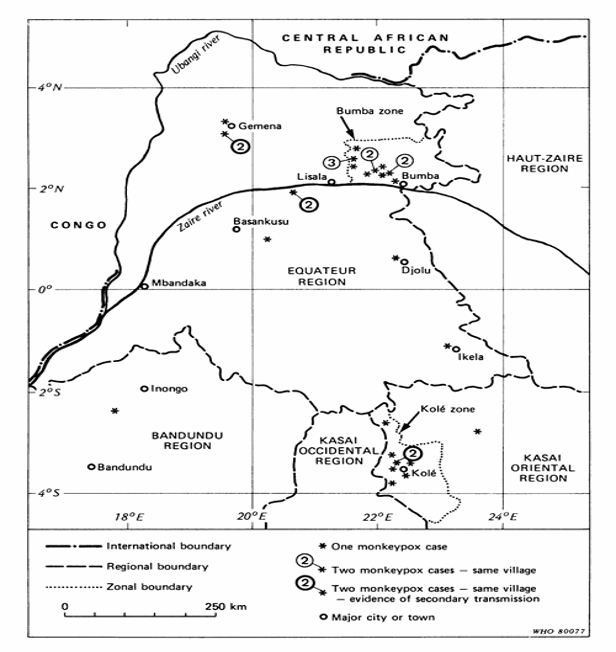
Fig(2):Distribution of 31 human monkeypox cases in northwestern and central Zaire, 1970-79.
Pathogenesis:
Close contact or coming into contact with bodily fluids or sores from an infected person or animal can spread MPXV from one person to another. Direct contact with or ingestion of animal hosts, such as non-human primates but more frequently rodents like tree squirrels, Gambian pouched rats, and dormice, is how MPXV is zoonotically transmitted[3]. These illnesses' detrimental impacts on social, economic, and psychological well-being as well as their impact on global health are documented. Fear, a feeling of anxiety and uncertainty, and the circulation of unsubstantiated information are all linked to infectious disease outbreaks. While some patients have hundreds or more skin lesions, others may only have one or a handful. They can appear anywhere into the body including[8]:
MPXV can incubate for three to seventeen days, and it typically takes two weeks to a month to fully recover without serious consequences. Patients who are infected need to be hospitalized and kept in a single room to manage their pain and stop the virus from spreading. MPXV can be lethal or result in serious side effects include encephalitis, pneumonia, sepsis, and vision loss from eye infections. Extended hospital stays and stays in the intensive care unit (ICU) while immunocompromised can also raise the risk of nosocomial infections leading to secondary diseases. Children, individuals who come into contact with animal hosts, and patients with various illnesses are typically the groups most at risk of contracting MPXV[3].
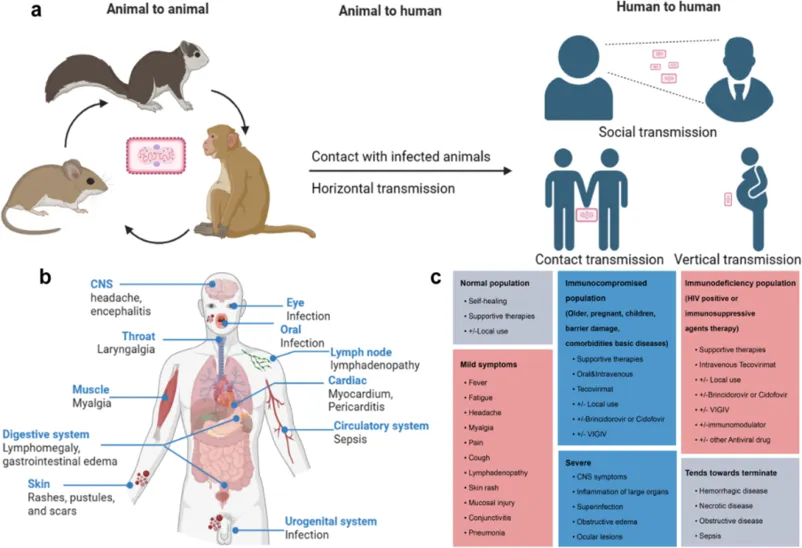
Fig(3): a) The transmission of Mpox occurs through animal-to-animal, animal-to-human, and human-to-human routes. b) Clinical symptoms typically manifest after Mpox infection. c) Symptoms of Mpox infection may vary based on the immune status and clinical treatment options and clinical treatment options are listed.
LITERATURE SURVEY 1:
Anshuman Sahu et al.[9] found in this paper that 69 highly conserved proteins were found in 125 publicly accessible Mpox virus genomes. Then, using a subtracted proteomics workflow, these proteins were manually selected to find four highly druggable, non-host homologous targets: A20R, I7L, Top1B, and VETFS. Molecular dynamic stimulation was used to further validate the common inhibitors, namely batefenterol, burixafor, and eluxadoline, in order to determine their optimal possible binding modes.
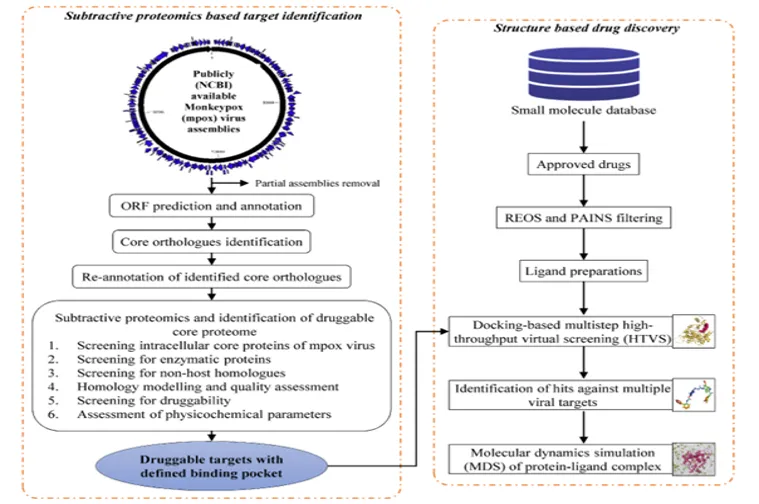
Fig.(4). Computational framework of the genome-to-drug approach used in this study.
In silico REOS and PAINS filtering: Using the RDKit, a Python-based program, the SMILES of every molecule were put through a rapid elimination of swill (REOS) and pan-assay interferences (PAINS) filter[10].
Ligand preparation: To get precise 3D energy minimized Lewis structures, all non-redundant ligands were pre-processed using the OPLS_2005 force field in the LigPrep v5.3 module.
Virtual screening of FDA-approved/investigational small molecules in highly druggable binding sites: Three docking protocols—high throughput virtual screening (HTVS), Standard Precision (SP) mode, and Extra Precision (XP) mode—were used in conjunction with the Glide program and its virtual screening workflow to find hits against the highly druggable target proteins.
Molecular dynamics simulations: The CHARMM General Force Field (CGenFF) online service was used to construct the topology of ligands, whereas the built-in module of GROMACS was used to generate the topology of proteins[11].
Table no.1- Protein-ligand interactions with the representative hydrogen bond and hydrophobic bond of amino acids.
|
TARGET |
LIGAND |
HYDROGEN BOND |
HYDROPHOBIC BOND |
|
I7L
|
Batefenterol
|
|
|
|
|
Burixafor
|
|
|
|
|
Eluxadoline
|
|
|
|
Top1B
|
Batefenterol
|
|
|
|
|
Burixafor
|
|
|
|
|
Eluxadoline
|
|
|
|
VETFS
|
Batefenterol
|
|
|
|
|
Burixafor
|
|
|
|
|
Eluxadoline |
|
|
LITERATURE SURVEY 2:
Ranjan K. Mohapatra et al.[12] found in this article that the mpox virus's A42R profilin-like protein (PDB ID: 4QWO) may be a desirable target lead. Using molecular docking, the binding affinities of popular medications and monoclonal antibodies (mAbs) such as tecovirimat, brincidofovir, and cidofovir for the A42R profilin-like protein were investigated in silico. Additionally, the outcomes were contrasted with those of the phytochemicals theaflavin, rutin, and curcumin. The stability of ligand-protein interactions in natural charge, molecular electrostatic potential, and frontier molecular orbital studies was determined by molecular dynamics simulation of the theaflavin–4QWO complex. All compounds' anticipated QSAR and pharmacokinetic characteristics were assessed in order to identify a good fit for the creation of novel medications. Compared to the other medications in the QSAR investigation, brincidofovir and tecovirimat had higher estimated log P values. Theaflavin's remarkable log P of 4.77 suggests that it has a high level of biological activity.
Methods & Materials:
1. Quantum chemical analyses: The Gaussian 09 W program was used to estimate the test molecules' characteristics ab initio. The Becke, three-parameter, Lee–Yang–Parr (B3LYP) hybrid functional with a 6–311++G (d,p) basis set was utilized to evaluate electronic structure characteristics. Frontier molecular orbitals (FMOs) and molecular electrostatic potential (MEP) were utilized to optimize the molecular structures of test molecules.
2. Molecular docking study: Using the open-source AutoDock Vina software, receptor-oriented molecular docking was used to determine the test drugs' affinity for the A42R profilin-like protein (PDB ID: 4QWO)[13].20, 21 The PDB database provided the 3D protein structure. The Chimera suite was used to create the X-Ray Crystal Structure. Ligands were saved by converting them into the PDBQT format after being acquired from PubChem in the.sdf format. A grid box was created around the protein-binding site using the AutoGrid engine. Discovery Studio 3.5 was used to visualize the 2D and 3D interactions.
3. Half-maximal inhibitory concentration, or IC 50 prediction: For each test ligand, the estimated IC50 was calculated using AutoDock v4.2. To gather binding energies with IC50 values for different docking forms, Lamarckian genetic algorithm (LGA) cluster analysis was employed. The docking results' lowest binding energy was taken into consideration in relation to the IC50.
For tecovirimat and theaflavin, the estimated IC50 values were 4.39 and 7.54 lM, respectively.
Tecovirimat and theaflavin were chosen as lead compounds based on the binding energy, anticipated IC50 values, and ADMET characteristics.
Table 2 :- Docking of the test ligands with A42R profilin-like protein (PDB ID: 4QWO).
|
Sr. No. |
Ligand |
Binding energy (Kcal/mol) |
IC50 value |
|
1 |
Brincidofovir |
-1.5 |
79.59 mM |
|
2 |
Cidofovir |
-3.5 |
2.70 mM |
|
3 |
Tecovirimate |
-7.31 |
4.39 uM |
|
4 |
Curcumin |
-5.03 |
204.76 uM |
|
5 |
Rutin |
-3.91 |
1.36 mM |
|
6 |
Theaflavin |
-6.99 |
7.54 uM |
4. Molecular dynamics (MD) simulation: The Desmond v3.6 software was used to identify the receptor-ligand systems' best-scored conformations. To analyze the flavin–4QWO complex, a 100 ns OPLS_2005 force field MD simulation was run. The Nose–Hoover chain thermostat and the Martyna–Tobias–Klein barostat techniques were used to control the temperature and pressure.
5.Molecular Docking Analysis: The target protein's (PDB ID: 4QWO) binding interactions with the test ligands (tecovirimat, rutin, curcumin, theaflavin, and brincidofovir) were predicted. All of the substances bound to the amino acids HIS5, HIS55, PRO36, ASN30, ASN37, ALA33, ALA41, and ILE8 after interacting with the A42R profilin-like protein of mpox in the binding pocket cavity.
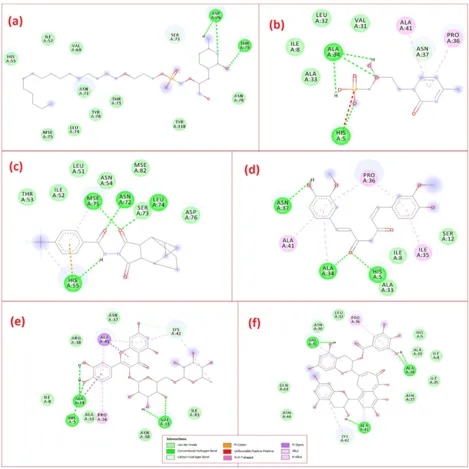
Fig (5): Interactions of the test ligands with A42R profilin-like protein
6. MD Stimulation: Tecovirimat and theaflavin demonstrated noteworthy interactions with the protein target 4QWO, as evidenced by their high binding energies and low predicted IC50 values. Aflavin was exposed to the primary chemical is MD simulation. for information regarding the theaflavin–A42R profilein-like protein complex's stability.
7. Protein RMSD: Schrödinger's Desmond package was used to conduct the MD simulation in order to investigate the P-L interactions. Aflavin's total RMSD peaked at 2.0 Å, indicating that the complex was stable (more stability is indicated by a lower RMSD).
LITERATURE SURVEY 3:

The A42R profilin-like protein of the MPXV is a crucial therapeutic target for orthopox viruses because it plays a role in cell growth and motility, according to research by Carolyn N. Ashley et al[3]. This study used computational methods to find possible A42R inhibitors for the treatment of MPXV. A library of 36,366 compounds from the Traditional Chinese Medicine (TCM), AfroDb, and PubChem databases, as well as the well-known inhibitor tecovirimat, were used for virtual screening of the energy-minimized 3D structure of the A42R profilin-like protein (PDB ID: 4QWO) using AutoDock Vina. Seven compounds in all, including PubChem CID: 11371962, ZINC000000899909, ZINC000001632866, ZINC000015151344, ZINC000013378519, ZINC000000086470, and ZINC000095486204, were shortlisted and molecular docking was suggested. All seven of the suggested compounds bound to A42R with higher affinities (-7.2 to -8.3 kcal/mol) than tecovirimat (-6.7 kcal/mol). According to the protein-ligand interaction maps produced by LigPlot+, the following residues are crucial for binding: Met1, Glu3, Trp4, Ile7, Arg127, Val128, Thr131, and Asn133. These seven chemicals provide a strong foundation for the creation of antivirals that combat MPXV and other orthopoxviruses.
Materials and procedures:
36,366 compounds from a small molecule library were screened for possible binding to the MPXV protein A42R. ADMET testing was then used to identify the compounds that had the highest affinity for A42R.
For the top compounds, searches for structural similarity and biological activity prediction were conducted.
To gain a better understanding of the A42R-ligand interaction, MM/PBSA calculations, protein-ligand interaction patterns, and MD simulations were evaluated for possible lead compounds (Fig.5).
Table: Method for detailing the process used in this study to identify potential A42R inhibitors
|
Sr. No. |
Software |
Work / Function |
|
1 |
A42R PDB ID: 4QWO |
Structure of protein |
|
2 |
GROMACS |
Minimize energy of A42R protein |
|
3 |
CASTp |
Binding site prediction |
|
4 |
Autodock Vina |
Screening |
|
5 |
PubChem |
For compounds with structural similarity to known inhibitors |
|
6 |
AfroDb |
Database of natural products from African source |
|
7 |
TCM |
Provide resource for research and drug discovery |
1. Drug target and binding site prediction:
The RCSB PDB had the MPXV protein A42R (PDB ID: 4QWO), which was experimentally identified by X-ray diffraction with a resolution of 1.52 Å. Using PyMOL[14], the ligands, ions, cofactors, and water molecules that were in complex with the RSCB PDB structure were eliminated. GROningen MAchine for Chemical Simulations (GROMACS) v5.1.1 was utilized to energy minimize the protein structure utilizing two distinct force fields, OPLS/AA and CHARMM36 force fields. The entire A42R sequence was obtained from UniProt with the associated ID: Q8V4T7. CASTp 3.0 was used to anticipate the A42R's binding locations.
2. Screening library preparation and collection:
To perform structure-based virtual screening (SBVS) and find possible A42R binders, a screening library was created. 36,366 chemicals from the Traditional Chinese Medicine (TCM) database, which was sourced from TCM@Taiwan, African Medical Plants (AfroDB), and PubChem, were assembled into an integrated screening library. There were 880 chemicals from AfroDb and 35,161 from TCM. As previously done, 25,196 compounds were used from TCM after the 35,161 compounds were pre-filtered for compounds having molecular weights between 150 g/mol and 600 g/mol. 325 molecules that have structural similarities with the smallpox inhibitors cidofovir, tecovirimat, and tembexa were acquired from PubChem. The chemicals from AfroDb were combined with the ligand structures that were downloaded as a 3D spatial data file (.sdf) from PubChem. After importing all compound structures into PyRx, they were transformed to pdbqt format and their energy was reduced using the universal force field (UFF) and conjugate gradient algorithm in 200 steps.
3. Protocol validation and molecular docking:
The library was screened for possible A42R binders using AutoDock Vina, a docking software frequently used to carry out protein-ligand docking (included into PyRx version 0.9.2). With grid box dimensions of 37.964 × 20.791 × 28.223 Å3 and A42R centered at x = 30.406 Å, y = 22.08 Å, and z = 27.741 Å, docking employed an exhaustiveness set to 8. Met1, Glu3, Trp4, Lys6, Ile7, Asp10, Ile22, Thr99, Ile104, His124, Ala125, Arg127, Val128, Thr131, and Asn133 were the residues that were put to the box in order to create the grid. PyMOL was used to visualize the postures in order to confirm that the ligand was correctly bound in pocket 1 (the chosen binding site). The AutoDock Vina-specific binding energy threshold of -7.0 kcal/mol distinguishes putative binders from non-binders. All ligands below the –7.0 kcal/mol criteria for AfroDB and PubChem, as well as the top 1% of TCM ligands, were then shortlisted.
4. Sub-library ADMET predictions:
SwissADME was used to conduct ADME testing on the chosen compounds in order to describe their pharmacokinetic profiles and drug-likeness. Compounds that passed Veber's rule and Lipinski's rule of five were chosen.If the chemical possesses one or fewer of the following criteria—≤ five hydrogen bond donors, ≤ ten hydrogen bond acceptors, a molecular weight < 500 Da, and a lipophilicity or octanol-water partition coefficient (logP) ≤ 5—it satisfies Lipinski's rule of five. < 10 rotatable bonds and a topological polar surface area (TPSA) ≤ 140 Å2 are prerequisites for Veber's rule. OSIRIS DataWarrior version 5.5.0 was utilized to forecast the compounds' hazardous profiles with respect to possible mutagenicity, tumorigenicity, irritancy, and reproductive consequences. DataWarrior forecasts a compound's possible toxicity. Because MPXV has been associated with increased tumor immunity and hypothesized to enhance the likelihood of tumor growth, it was important to eliminate potential carcinogens. Although there have been reports of possible toxicity with relation to reproductive impacts, the chemicals were not eliminated for considerations.
5. Antiviral activity predictions:
The biological activity of the compounds on the shortlist was predicted using the Prediction of Activity Spectra of Substances (PASS). After reading the compound's SMILES format, PASS compares the molecule's structures to its collection of active and inactive structural groups. Each compound's readout then compares the likelihood of activity (Pa) to the probability of inactivity (Pi), with a compound having the potential for that activity when Pa is greater than Pi. DrugBank was used to find structural similarities with compounds that have antiviral activity that has been experimentally confirmed in order to assess the potential activity of the shortlisted compounds.
6. Molecular dynamics simulations:
MD simulations were performed using GROMACS v5.1.1. The correctness of the GROMACS program has been evaluated by contrasting it with experimental data that demonstrates its application for CADD. The conformational shifts and motions connected to receptor-ligand binding interactions are taken into consideration in MD simulations. These simulations are a computer technique that uses physics to regulate electric force changes in bonded and non-bonded atoms in order to examine the mobility of atoms in a system. LigParGen was used to construct the ligand topologies for the OPLS force field in order to get the ligands ready for MD. The "TIP4P" water model was used to solve the systems in a cubic box, and charges were neutralized by adding sodium or chlorine ions.Before MD modeling, A42R-ligand systems were exposed to NVT (constant number, constant volume, and constant temperature) as well as NVT (constant number, constant pressure, and NPT stands for consistent temperature. The RMSD, radius of gyration (Rg), and root mean square fluctuation (RMSF) were computed after the MD simulations to assess the structural stability, folding, and conformational variations of A42R. Snapshots were taken using A42R to determine the position of the ligands at 25 ns intervals.
7. Explaining MM/PBSA computations and A42R-ligand interactions:
LigPlot+ was used to create interaction maps of the top seven compounds and tecovirimat with A42R. Using GROMACS "gmx hbond," hydrogen bonds were tracked throughout the MD simulations. Understanding the molecular interactions between the ligands and the A42R binding pocket is crucial for upcoming research as possible therapeutic possibilities. Protein-ligand interactions can be analyzed more effectively and reliably using MM/PBSA techniques, which have also been successfully used to replicate experimental results and provide reasonably accurate free energy estimations. The Gibbs free energy of binding, or DG(bind), of ligands to proteins is estimated via MM/PBSA. For every A42R-ligand complex, binding free energies and the energy contributions per residue were calculated using the MM/PBSA technique.
Table 3 :- Binding energies from AutoDock Vina of the seven lead compounds and tecovirimat with A42R.
|
Sr. No. |
Compound |
Binding energy (Kcal/mol) |
|
1 |
Tecomirimat |
-6.7 |
|
2 |
Pubchem CID: 11371962 |
-7.2 |
|
3 |
ZINC000001632866 |
-8.0 |
|
4 |
ZINC000015151344 |
-7.9 |
|
5 |
ZINC000013378519 |
-8.1 |
|
6 |
ZINC000000086470 |
-7.6 |
|
7 |
ZINC0000095486204 |
-8.3 |
|
8 |
ZINC000000899909 |
-7.8 |
LITERATURE SURVEY 4:
Through the biocatalytic reaction of precursor polyprotein cleavage, M. Valan Arasu et al.[15] found that the Mpox virus participates in the viral reproduction cycle. AutoDock was used to screen for FDA-approved drugs and retrieve the protein's primary and secondary structures. The molecular interactions were examined and the best hit was examined. The peptide, hydrogen bond energy, steric conflicts, and bond planarity are all examined during model validation. The ProSA-web tool was used to calculate the Z-score. The produced proteinase model was put through an ERRAT server analysis to examine the atom distribution.This investigation identified the enzyme's binding pockets, and the web server's automatic online tool was used to anticipate two binding pockets. The FDA-approved medications that were chosen were arranged according to the proteinase's minimum binding energy.
Materials and techniques:
1. FDA-approved medication screening:
As a possible source for ligand screening, we examined an FDA-approved drug library for this investigation. The medication was downloaded, and its 3D configurations were examined on the drug discovery platform. The FDA-approved medications that were chosen underwent screening. The Schrodinger software suite's LigPrep program was used to validate and get the ligands ready for docking. utilizing the Powell-Reeves conjugate gradient approach with 2500 steps and a convergence threshold of 0.05, ligands were created utilizing the OPLS3 force field in water while maintaining the necessary chirality.
2. Glide grid generation, docking, and docking score analysis:
The active site was predicted using the CASTp software, and the receptor grid was generated using Glide. The generated docking score was used to choose the grid. Protein-ligand binding free energy was examined after the binding free energy was computed and Molecular Mechanics – Generalized-Born Surface Area (MM-GBSA) was used. Docking tests were conducted using the top-ranked FDA-approved medication, and the medications' 2D and 3D conformances were created.
3. Analysis of binding pocket prediction:
The enzyme's ligand binding sites were predicted using the DoGSiteScorer program. The binding pockets are ranked using the DoGSiteScorer program according to their size, druggability, and surface area.
4. Model validation:
The model's projected structural quality was confirmed. Using the ProSA-web tool[16], ERRAT tool[17], and Ramachandran Plot Server[18], the cysteine proteinase structure was put together.
Model validation for monkeypox cysteine proteinase :
Using online bioinformatics tools, the modeled structure for monkeypox cysteine proteinase and the improved three-dimensional structure were evaluated and validated; the outcome is shown in Fig. 3. The protein structure was predicted using the Ramachandran plot. The peptide, hydrogen bond energy, steric conflicts, and bond planarity are all examined during model validation. The produced proteinase model was put through an ERRAT server analysis of the atom distribution, and the outcome was shown. The percentage of the protein for which the computed error value is less than the 95% rejection limit was used to express the outcome. This investigation found that the overall quality factor was 88.535. ProSA-web was used to generate the Z-score. This study's Z-score fell within the range of -4.17, which was confirmed for the native enzyme. The web server-based automatic online program anticipated two binding pockets. Compared to binding pocket 2, binding pocket 1 displayed higher volume, druggability score, and surface area.
Table 4 :- Analysis of binding pockets for the modeled monkeypox virus cysteine proteinase.
|
Sr. No. |
Pocket No. |
Volume (A3) |
Surface Area(A2) |
Druggability score |
|
1 |
P_0 |
615.62 |
1163.81 |
0.81833 |
|
2 |
P_1 |
434.82 |
932.15 |
0.712166 |
|
3 |
P_2 |
428.67 |
695.43 |
0.641034 |
|
4 |
P_3 |
349.82 |
482.58 |
0.656263 |
|
5 |
P_4 |
312.58 |
683.38 |
0.796914 |
|
6 |
P_5 |
161.34 |
317.79 |
0.383722 |
|
7 |
P_6 |
151.42 |
304 |
0.312994 |
|
8 |
P_7 |
139.97 |
216.54 |
0.287946 |
|
9 |
P_8 |
121.28 |
206.92 |
0.511829 |
|
10 |
P_9 |
113.15 |
206.96 |
0.211382 |
|
11 |
P_10 |
110.66 |
270.08 |
0.219905 |
The involvement of several hydrophobic interactions between the ligand and amino acid residues of the monkeypox virus proteinase was demonstrated by molecular docking experiments. Figure 5 shows the two-dimensional image used for docking analysis of tolvaptan, conivaptan, nafarelin, and idarubicin. Docking of (A) Conivaptan and (B) Azelastine against the 2019-nCoV major protease crystal is shown in two dimensions. Active site residues are represented by colorful disks, while interaction bonds are indicated by dashed lines
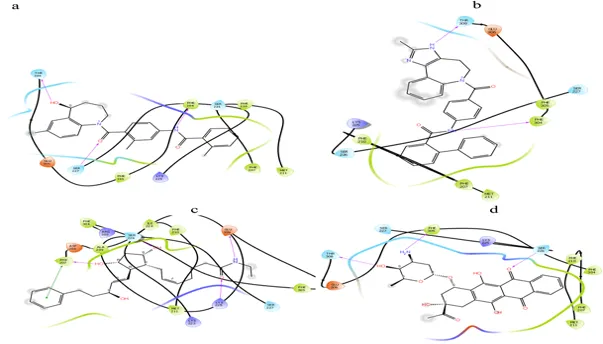
Fig.(7): Docking of tolvaptan (a), conivaptan (b), nafarelin (c) and Idarubicin (d) against monkeypox virus enzyme. The dashed lines indicate interaction bonds and the colored disks represent active site residues.
LIERATURE SURVEY 5:
Hemanth Kumar Manikyam et al.[19] evaluated natural items and repurposed antiviral medications in this paper through an in silico docking analysis utilizing CB Dock2. They highlighted a number of natural substances, including Physalin A, Sitoindoside IX, Withanolide, Shatavarin 1, Kutkoside, and Berberine HCl, as possible inhibitors and concentrated on important viral targets for inhibition, such as VP39 2'-O Methyltransferase, viral topoisomerase DNA complexes, and poxin. The most successful repurposed antiviral was found to be tecovirimat. Based on their binding affinities and Vina scores, the natural compounds Withanolide, Sitoindoside IX, and Physalin A showed encouraging inhibitory potential. However, tecovirimat continues to be the most effective inhibitor against all examined targets, highlighting its ongoing importance in the battle against MPXV. Three important proteins in MPXV have been found by the studies to be possible therapeutic targets: Poxin, viral topoisomerase, and VP39 2-O methyltransferase. Blocking these proteins may prevent the virus from replicating and spreading, providing a viable path for the creation of novel antiviral medications.
1. VP39 2-O Methyltransferase (PDBID-8B07)
Role in Mpox Pathogenesis :An essential part of digesting viral mRNA is VP39. This enzyme performs the 2'-O methylation of the 5' cap of viral mRNA, a modification required for the host cell's translation machinery to correctly recognize viral mRNAs. Without this alteration, the virus's capacity to replicate would be severely hampered by the host's immune system's easier recognition and degradation of the viral RNA. VP39-mediated methylation not only increases translation efficiency but also shields viral RNA from detection by host antiviral defenses such the interferon response. Viral protein production can be decreased and the virus exposed to the host's innate defense system by inhibiting VP39.
Drug Target Potential: By inhibiting VP39 methyltransferase activity, the virus would be unable to replicate efficiently inside host cells. By blocking this enzyme, the virus's capacity to conceal its RNA from the immune system is lessened, which may result in the host clearing the infection more quickly.
2. Viral Topoisomerase-DNA Complex (PDBID-3IGC) :
Role in Mpox Pathogenesis : An essential enzyme that fixes topological problems that occur during transcription and DNA replication is viral topoisomerase. Topoisomerase makes sure that the viral DNA can be properly unwound and rewound in the case of the Mpox virus, which has a huge and complicated DNA genome. In order to alleviate torsional stress during replication, the Mpox topoisomerase interacts with the viral DNA to introduce brief breaks. Viral DNA replication may be incomplete if the replication fork stalls due to disruptions in the enzyme's function. This enzyme's significance in pathogenesis is further highlighted by the fact that it also helps to prevent supercoiling and ensure that transcription progresses normally.
Drug Target Potential: Viral propagation can be decreased by targeting the viral topoisomerase, which can interfere with MPXV's capacity to duplicate its genome. Medications intended to block or stabilize the topoisomerase-DNA complex may cause irreparable damage to the virus's DNA, stopping its life cycle.
3. Poxin (PDBID-8C9K) :
Role in Mpox Pathogenesis : Cyclic GMP-AMP (cGAMP), a crucial molecule in the STING (Stimulator of Interferon Genes) pathway and necessary for triggering an antiviral state in host cells, is one of the host immunological signaling molecules that MPXV breaks down using doxins. Poxins inhibit the activation of the STING pathway by breaking down cGAMP, which enables the virus to elude detection and the host's antiviral reactions, including the release of inflammatory cytokines and interferons. For the virus to infect and spread throughout the host, it must be able to inhibit the innate immune response. Since the virus would be quickly cleared by the immune system in the absence of functional Poxins, Poxin is crucial to MPXV pathogenesis.
Drug Target Potential: Restoring the host's capacity to identify and mount an immune response against the virus may be possible by blocking Poxin activity. When Poxin is blocked, cGAMP builds up, which activates STING and produces interferons that stop the transmission of the virus. The creation of doxin inhibitors may improve host defenses and lessen viral persistence.
Potential natural antiviral drugs:
METHODOLOGY :
Protein and Ligand Preparation :The Protein Data Bank provided the protein structures for VP39 2'-O Methyltransferase (PDB ID-8B07), viral topoisomerase-DNA complex (PDB ID-3IGC), and pyxin (PDB ID-8C9K), which are displayed in figs. A, B, and C. The PubChem database was used to obtain the natural ligands, which included Physalin A, Withanolide, Shatavarin 1, and other natural products. These were then synthesized in their three-dimensional conformations. The MMFF94 force field was used to decrease the energy of these ligands, guaranteeing that they were in the most stable and ideal shape for docking.
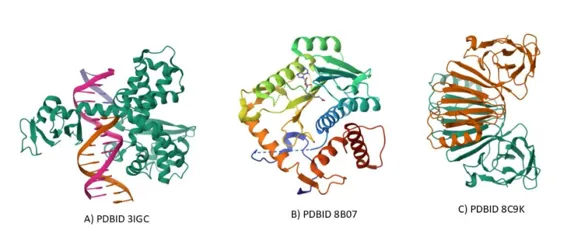
Fig.(8) :A : Viral Topoisomerase, B: VP39 2'-O Methyltransferase. C: Poxin
Docking Protocol with CB Dock2
Using the AutoDock Vina method, CB Dock2 is a well-liked tool for conducting docking investigations. Using a grid-based cavity prediction technique, CB Dock2 automatically finds binding cavities in the protein structure. Following the identification of these cavities, the ligands are made as energy-efficient as possible to prevent high-energy conformations that can obstruct the docking process. A scoring function in the software assesses binding affinities according to intermolecular forces, such as hydrophobic contacts, van der Waals interactions, and hydrogen bonds. By modifying the ligand's orientation and position within the binding site, the Vina algorithm iteratively enhances the ligand's binding posture; the final score indicates the free binding energy in kcal/mol.
CB Dock2 Algorithm & Workflow:
CB Dock2 uses a special mix of docking and cavity detection methods. First, using geometric cues like pockets and fissures on the protein surface, the cavity detection algorithm examines the protein's three-dimensional structure to determine the most likely binding sites. Following the ligand's docking into these anticipated cavities, the Vina algorithm adjusts the ligand's orientation in accordance with the determined interaction energy.
CONCLUSION
1. Anshuman Sahu et al. –
This study by Anshuman Sahu et al. showed how to combine subtractive proteomics and genomes to find treatment targets for the mpox virus. Our in silico studies and previous research suggest their druggability and applicability as therapeutic targets, even if this needs more confirmation. This may promote the use of structure-based analysis in the search for mpox antivirals. Batefenterol, burixafor, and eluxadoline were proposed as possible inhibitors of the multiple mpox virus by the virtual screening that was followed by MD simulation.
2. Ranjan K. Mohapatra et al. –
In order to determine the drugs' or mAbs' affinity for the A42R profilin-like protein, Ranjan K. Mohapatra et al. examined molecular docking of medications (tecovirimat, brincidofovir, and cidofovir) given against mpox .The substances were contrasted with the phytochemicals theaflavin, rutin, and curcumin. The Mpox virus's A42R profilin-like protein (PDB ID: 4QWO) may be a target for the creation of novel lead compounds. These substances may be taken into consideration for additional research. validation through in vitro experiments to create affordable, internationally accessible anti-mpox medications. This research should pave the way for the creation of more potent anti-mpox treatments.
3. Carolyn. N. Ashley et al.-
In this study,Carolyn. N. Ashley et al. identified seven compounds from a 36,366-compound library as possible anti-MPXV drugs that target the A42R protein. Based on MM/PBSA calculations and AutoDock Vina predictions, these molecules exhibited a good projected binding affinity to A42R. Compared to tecovirimat, a well-known MPXV inhibitor, all seven drugs show a greater predicted binding affinity to A42R. The A42R-ligand complexes' MD simulations demonstrated strong stability and validated the free binding energy findings from the MM/PBSA computations. Every one of the seven compounds passed the ADME test.Compounds ZINC000001632866 and ZINC000095486204 should not be considered for additional safety testing because they failed toxicity screening. Additionally, it should be noted that ZINC000001632866 and ZINC000013378519 were anticipated to not penetrate the blood-brain barrier and would need to be administered in a different way. Future drug optimization should take into account these three compounds' potential functional groups of interest and support for important contact residues inside the A42R binding pocket. These substances might be used as building blocks for future lead optimization and MPXV medication development.
4. M. Valan Arasu et al.-
According to this study, M. Valan Arasu et al. found that the monkeypox viral protease contributes to the virus's growth, making it a target for disease control. The molecular interactions between mpox and FDA-approved medications are examined in this study. Several molecular methods were used to assess the model and docking score, and the results showed that FDA-approved medications currently on the market are effective in treating mpox virus sickness
5. Hemanth Kumar Manikyam et al.-
This study demonstrates the prospective potential of targeting important viral proteins—VP39 2'-O Methyltransferase, viral topoisomerase, and Poxin as viable techniques for developing novel antiviral therapeutics against the Monkeypox Virus (MPXV). There is hope that natural substances like Physalin A, Withanolide, and Sitoindoside IX will prove to be effective treatment possibilities due to the strong binding affinities seen with these substances. These substances may be essential in boosting or completing current therapies, including Tecovirimat, which has demonstrated effectiveness in the treatment of MPXV.
ACKNOWLEDGMENTS
The authors are thankful to the management of Department of pharmaceutical chemistry, Ashokrao Mane Institute Of Pharmaceutical Sciences And Research, Save, Kolhapur, Maharashtra, India for providing Library and laboratory facility for completing this work successfully.
CONFLICT OF INTERESTS
The authors declare that there is no conflict of interest.
REFERENCES




Sumit Shinde, Vrushali Patil, Prarthna Mane, Srushti Ghadage, A Review of Novel Lead Molecules used Against Mpox Virus by Insilico Method, Int. J. of Pharm. Sci., 2026, Vol 4, Issue 10, 624-642. https://doi.org/10.5281/zenodo.23169064
 10.5281/zenodo.23169064