

We use cookies to ensure our website works properly and to personalise your experience. Cookies policy
Pharmacology Division, AU College of Pharmaceutical Sciences, Andhra University, Vishakhapatnam, Andhra Pradesh
Genitourinary tract syndrome in menopausal women (GSM) is also called vulvovaginal atrophy and atrophic vaginitis. For GSM, local vaginal estrogen is important treatment, while systemic hormone therapy may be considered when the woman also has other menopausal symptoms that require systemic treatment. Low-dose vaginal estrogen therapy is particularly preferred for localized treatment due to its effectiveness and safety profile. Vaginal DHEA (prasterone) inserts help alleviate GSM symptoms by locally replenishing hormone levels, while oral selective estrogen receptor modulators such as ospemifene improve vaginal tissue health and reduce discomfort. Non-hormonal pharmacological options include oxytocin gel, which may aid in tissue regeneration, and polycarbophil-based vaginal moisturizers that assist in maintaining vaginal moisture and pH balance. These treatments are often used in conjunction with non-pharmacological methods like lubricants, physical therapies, and lifestyle changes to optimize symptom management. Although many therapies offer short-term benefits, there is limited long-term safety data, particularly for women with a history of hormone-sensitive cancers, highlighting the importance of personalized treatment decisions based on patient risk factors and preferences.
Menopause is a natural stage where permanent cessation of menstruation due to low levels of estrogen because the ovaries stop releasing eggs. This occurs typically at the age of 45 -55 years. Every year, 1.5 million women enter the menopause state, experiencing symptoms like insomnia, body and joint pains, vaginal dryness, decreased libido, and vasomotor disturbances. Nearly 27-84% of women got suffered from sexual symptoms (pain, dyspareunia), genital symptoms (dryness, irritation and burning), urinary tract symptoms (urgency, dysuria, infections) Due to estrogen deficiency, vaginal tissues changes reduced elasticity and lubrication, leading to urinary or sexual symptoms that affect quality of life [1]. In 2014, the International Society for the Study of Women's Sexual Health and the North American Menopause Society (NAMS) introduced vulvovaginal atrophy (VVA) with genitourinary syndrome (GSM) [2]. According to a survey majority of women are suffering from GSM. The symptoms are vaginal dryness, burning sensation, urinary urgency, and dysuria. Sexual symptoms such as dysphoria, pain during intercourse, vaginal ph imbalance, decreased lubrication, and moisture. These symptoms affect the quality of life, sexual functioning, and emotional well-being [3]. Alterations in Vaginal microbiome in GSM. lactobacillus colonization stimulate collagen production improve tissue elasticity, and increases blood flow in vaginal tissue, reducing inflammation, and promoting tissue regeneration.[4]. Day –to day impact of vaginal gaining (DIVA) questionnaire is a questionnaire used to assess the severity of GSM. The DIVA questionnaire was used to evaluate the impact of vaginal dryness, soreness, itching, irritation, dysuria, daily functioning, and well-being, and the questionnaire was tested [5]. Declining estrogen causes bone depletion, disturbance in lipid metabolism, and vulvar atrophy. According to studies, vaginal creams, tablets, rings, and DHEA are approved by the USA and Canada, but Ospemifene is only approved by the USA unfortunately, these clinical manifestations are unapproved in Japan [6].
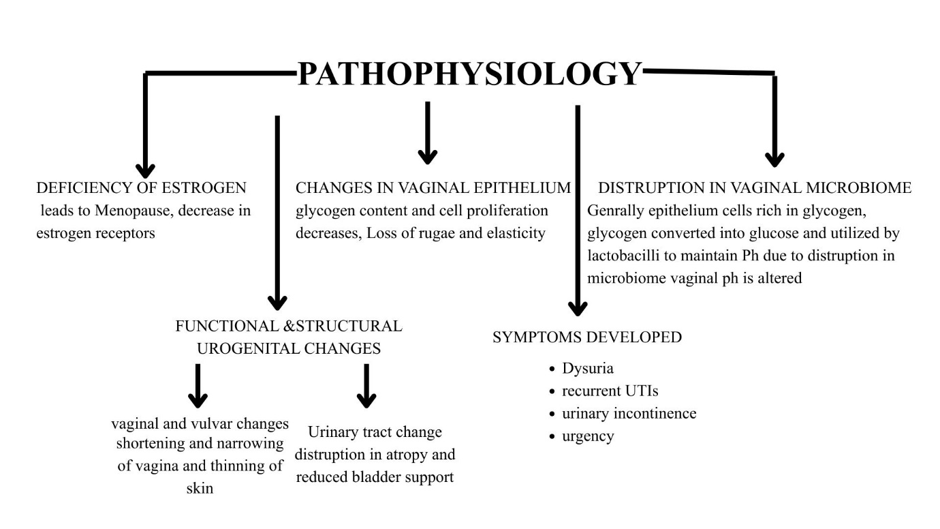
PATHOPHYSIOLOGY:
Estrogen levels decline during menopause, leading to a reduction in collagen, smooth muscles, and elasticity of tissue. Generally, estrogen receptors are widely distributed in the vagina, vulva, bladder, pelvic region, and endopelvic fascia. Reduced estrogen also lowers glycogen production, which in turn decreases the lactobacillus levels and imbalances normal pH of vagina. These changes lead to the shrinkage and thinning of vaginal tissue. ultimately resulting in the severe symptoms of genitourinary syndrome of menopause[7].
TREATMENT:
Includes two categories
NON-PHARMACOLOGICAL TREATMENTS
Platelets-Rich Plasma for GSM
The study evaluated the safety and feasibility of using autologous platelet – rich plasma injections in the vaginal canal and posterior fourchette to treat GSM in breast cancer survivors. Patient receiving menopausal hormonal therapy are excluded [9].
Physical therapies/dilators and lifestyle changes
The patients who are incompatible with hormonal therapy, physical therapies are prescribed [10]. Pelvic floor muscle function improves through pelvic floor muscle exercises. This therapy increases muscle strength and can be useful for appropriate patients[11]. The lifestyle of VVA women should be maintained carefully; they should avoid smoking, which increases the incidence of GSM. Physical exercises are mandatory [12].
Lubricants and moisturizers
To mitigate mild to moderate symptoms. Before intercourse lubricants are applied to the penis and female vulva to improve dyspareunia and discomfort but it does not reverse the vulvovaginal atrophy(VVA). Acceptable lubricant value up to 1,200 mOsm/kg. Hypo or hyperosmotic products cause irritation and toxicity to vaginal cells so iso-osmotic, water-based, silicone-based products are used which are compatible with vaginal physiology [13]. Used along with local hormonal therapy.
Vaginal moisturizers are non-hormonal products that act longer, applied to the vaginal wall two to three times a week. Which doesn’t regain its vaginal physiology but manage vaginal dryness [14]. Hyaluronic acid is present in the extracellular matrix of mammalian tissue which is a sulfur-free glycosaminoglycan [15].
The study supported laser treatment does not cure GSM. Laser therapy have been investigated as an alternative treatment for women who do not respond adequately to estrogen therapy. Laser therapy has been proposed to promotes tissue repair and remodelling, with changes in vascularization and vaginal tissue structure. There are two types of lasers: fractional CO2 and erbium YAG lasers. CO2 laser treatment had been reported to induce changes in the vaginal epithelium and lamina propria. Short- term adverse effects may include mild discomfort during the procedure, edema and transient vaginal discharge [16]. Treatment may be administered over a period of approximately three months, depending on the treatment protocol.For internal treatment, anesthesia may not be required, whereas topical anesthesia may be applied to the labia minora and majora for external treat[17]. The D(deka)-laser pulse is commonly used in some treatment protocols [18].
Photobiomodulation therapy
This therapy is safe, painless, and well-tolerated, and treats the sexual symptoms caused by GSM. Photobiomodulation therapy uses near infrared light to trigger an alteration in local tissue. Red and infrared rays cause alteration in mitochondrial activity, which in turn triggers cytochrome c oxidase [19].
PHARMACOLOGICAL TREATMENT
Systemic hormonal therapies
Systemic hormones show stimulatory effects on the endometrium. Low-dose estrogen is prescribed. [20].
Vaginal DHEA (pastrone)insert
DHEA (dehydroepiandrosterone) worked through an intracrine mechanism, it is present in the form of a vaginal insert. Generally, vaginal epithelium is oestrogenic in turn contains glycogen, which is taken by lactobacillus and maintains vaginal ph, collagen production, vaginal blood flow, moisture, lubrication, and secretions. After menopause, changes in the postmenstrual hormones causes lack of substrates involved in vaginal tissue maintenance and then alterations in vaginal ph, blood flow, secretion, and moisture can occur. So, DHEA acted directly on the vagina by converting intracrinology into androgen through vaginal enzymes. The androgens include testosterone, androstenedione, androstenediol, and dihydrotestosterone. Through aromatase enzyme androgens are converted into estrogen. DHEA treats dyspareunia symptoms. FDA-approved DHEA for dyspareunia, and it is a steroid hormone or precursor. DHEA shows beneficial effects when applied at 6.5mg nightly for 12 weeks. There are some minimal adverse effects like vaginal discharge and abnormal pap smear [21].
Low-dose vaginal therapy
Vaginal therapy is recommended only for women who are suffering from vaginal symptoms. Generally, low doses of estrogen are preferred. Low-dose estrogen is available in creams, sustained-release rings, vaginal tablets, and soft gel estradiol inserts. These creams, inserts, rings, and tablets improve symptoms compared with the placebo effect. It causes positive changes in vaginal atrophy, vaginal and urethral epithelium thickness [22].
Ospemifene
It is a selective estrogen receptor modulator (SERM). It shows agonistic actions on estrogen, which mimics the action of estrogen. Ospemifene is an FDA-approved drug for treating moderate to severe dyspareunia and vaginal dryness. One adverse effect is hot flashes. Other adverse events include vaginal discharge, muscle spasm, genital discharge, and hyperhidrosis (excessive sweating). Ospemifene is an oral alternative medicine that shows agonistic effects on vaginal tissue. 60 mg daily administration is followed .60 mg dose is sufficient to show beneficial results in a month. It preferably improves the maturation index and vaginal pH. Ospemifene is approved by the European Medicines Agency (EMA) [23].
Gel:
Oxytocin gel
Oxytocin is a hormone and a neuropeptide that plays a important roles uterine contractions in labor and milk ejection during breast feeding. Oxytocin reduces vaginal atrophy in postmenopausal women after 30 days of application of gel. The study reported an increase in superfacial vaginal cells but no significant improvement in cell maturation. It may improve blood circulation and lubrication Pre-clinical study reported an increase in endometrial thickness in rats and reduce progesterone levels in goats. Overall, study reported greater improvement with vaginal oxytocin gel compared with placebo [24].
Polycarbophil
Topical polycarbophil- based formulation have shown beneficial effects in women with GSM.. Polycarbophil is a hormone-free vaginal moisturizer available as a cream. This formulation contains purified water, polycarbophil, carbopol, glycerol, mineral oil, hydrogenated palm oil, glycerides, and sorbic acid. The cream did not show any cytotoxic effects in the study. The cream was associated with improvement in urinary symptoms associated with GSM. The vaginal moisturizers was applied to the vaginal and urethral areas every three days at bed time and showed beneficial effects [25].
CONCLUSION
GSM is caused in menopausal women due to decreased levels of estrogen and related hormones. This, in turn, causes symptoms that affect the quality of life of GSM women. There are several treatments available. Treatments are applied to every individual based on the severity of the disease and its symptoms. Severity levels are identified by asking questions and doing several diagnostic tests. GSM also affects vaginal atrophy, symptoms of urinary tract infections, lubrication, and dryness problems. A major limitations of GSM is underdiagnosis and underreporting. Hormonal therapies are not suitable for everyone. Challenges in managing breast cancer survivors were that hormonal therapies are restricted, and patients often hesitate to discuss symptoms. Future perspectives in the development of non-hormonal therapies for patients restricted to hormonal therapies include improved drug delivery systems and larger-scale clinical trials for newer therapies.
REFERENCES


Mavuri Roshini Surya Naga Sri Santoshi, Tadikamalla Lakshmi Bhavya Sri, Routhu Pratyusha, K. Eswar Kumar, Treatment of Genitourinary Syndrome of Menopause: A Review, Int. J. of Pharm. Sci., 2026, Vol 4, Issue 10, 592-598. https://doi.org/10.5281/zenodo.23165552
 10.5281/zenodo.23165552