

We use cookies to ensure our website works properly and to personalise your experience. Cookies policy
Pres's College of Pharmacy for Women Chincholi, Nashik, Maharashtra, India – 422102
A naturally occurring isoquinoline alkaloid, berberine (Brb), is found in several species of the genus Berberis, including Berberis vulgaris, Berberis aristata and Berberis microphylla. Daruharidra (Berberis aristata DC.), commonly referred to as Daruhaldi, is a traditional medicinal plant in which berberine is a major investigated alkaloid. Berberine has attracted pharmaceutical interest because of reported antimicrobial, anti-inflammatory, metabolic, antioxidant, neuroprotective and anticancer activities. However, its therapeutic development is limited by poor aqueous solubility, low intestinal permeability, efflux-mediated transport, first-pass metabolism, rapid systemic disposition and restricted tissue exposure. The supplied material reports that only about 0.5% of orally ingested berberine may be absorbed in the small intestine, with an even smaller fraction reported to reach systemic circulation. These limitations can substantially reduce the practical benefit of an otherwise biologically active compound. Nanotechnology provides a rational way to address these barriers by engineering the carrier rather than relying only on the free molecule. Nanoformulation strategies can improve apparent solubility and dissolution, protect the active during gastrointestinal transit, modify membrane interaction, reduce premature loss, provide sustained release and, when properly demonstrated, support site-specific delivery. Materials used for therapeutic nanoparticles may include lipids, polymers, polysaccharides and metals, with the choice governed by the biological barrier and therapeutic objective. For berberine, reported approaches include nanoemulsions, self-nanoemulsifying drug-delivery systems (SNEDDS), solid lipid nanoparticles, nanostructured lipid carriers, liposomes, polymeric nanoparticles, polysaccharide systems, micelles, lipid–polymer hybrids, intranasal carriers and stimuli-responsive platforms. These systems differ in composition, preparation principle, physicochemical properties, release behavior and pharmacokinetic performance. The present review focuses on formulation, characterization, controlled release, targeting and translational considerations for Daruhaldi-derived berberine. Evidence from the supplied literature indicates improvements in dissolution, intestinal permeability, relative bioavailability, sustained release and experimental pharmacodynamic activity for several nanocarrier classes. The supplied Berberis aristata SNEDDS study reported approximately 5.77- and 5.86-fold increases in the ex-vivo permeability coefficient under two surfactant conditions and sustained release for approximately 34 h. Lipid-based systems show particularly useful evidence for improving exposure, whereas polymeric and polysaccharide carriers offer opportunities for controlled or mucoadhesive delivery. Ligand-assisted systems using elements such as folate or transferrin, route-based approaches such as intranasal delivery, and pH-, redox-, enzyme-, ROS- or externally triggered systems provide additional targeting concepts. Nevertheless, a nanosized formulation should not automatically be called targeted. A credible targeting claim requires tissue localization, receptor-related evidence, intracellular trafficking where relevant and a measurable therapeutic advantage. Similarly, improved release or plasma exposure is an intermediate formulation outcome rather than proof of clinical efficacy. The most defensible development pathway is therefore to authenticate and standardize the botanical starting material, compare standardized Berberis aristata extract with purified berberine under matched conditions, select a carrier against a defined biological barrier, optimize critical quality attributes using a rational design strategy, establish pharmacokinetics and tissue distribution, evaluate safety, and address scale-up and regulatory requirements early. Most evidence remains preclinical, so future research should prioritize reproducible botanical preparations, nanotoxicology, validated targeting, controlled clinical studies and manufacturing feasibility.
Nanotechnology has changed drug-delivery design from simply selecting a dosage form to engineering the path taken by an active molecule after administration. A suitable nanocarrier can increase apparent solubility, protect a phytochemical from hostile gastrointestinal conditions, modify membrane interaction, prolong residence and regulate release. Smart systems add another layer by linking release or surface behavior to a biological or externally applied trigger. Daruhaldi, also known as Daruharidra, is associated with Berberis aristata. Berberine is one of the most investigated constituents and is discussed in relation to metabolic, inflammatory, antimicrobial and neurological models. The supplied literature emphasizes that pharmacological activity does not automatically translate into adequate exposure. For oral administration, dissolution, permeability, efflux and presystemic metabolism can act sequentially, so correcting one limitation may not correct the next. The formulation problem is therefore multidimensional. A carrier selected only because its particles are small may not solve the relevant biological barrier. Conversely, a slightly larger but stable system with controlled release, mucoadhesion or a validated route-to-tissue mechanism may be more useful. This review therefore organizes formulation options by the problem they are intended to solve.
Poor solubility → Efflux / metabolism → Low oral exposure → Limited tissue access
The review also maintains an important evidence boundary: direct evidence for B. aristata preparations should not be presented as if it were evidence for every purified-berberine nanocarrier. The supplied manuscript makes this distinction explicit and recommends standardized comparisons before translation.
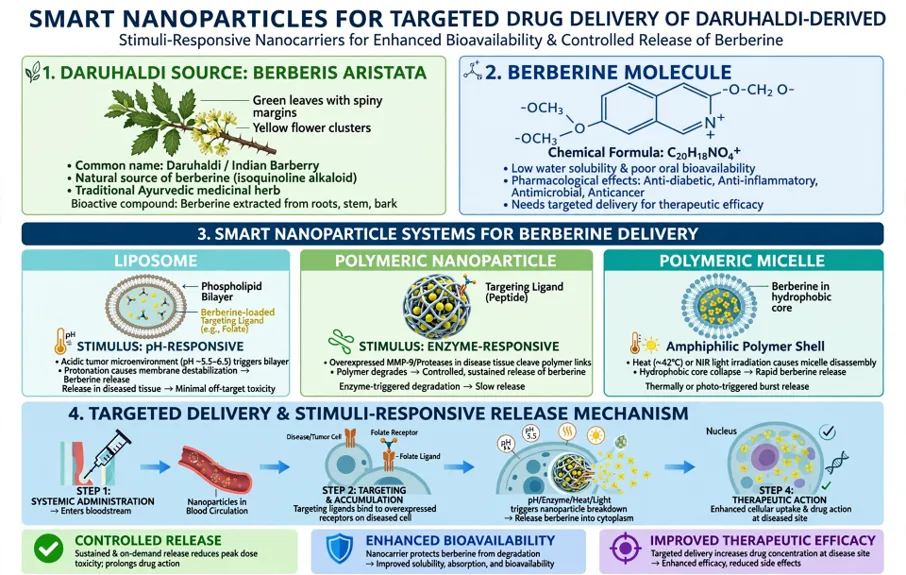
Graphical abstract: Smart Nanoparticles for Targeted Drug Delivery of Daruhaldi-Derived Berberine – Stimuli-Responsive Nanocarriers for Enhanced Bioavailability & Controlled Release of Berberine.
2. Review Methodology and Evidence Framing
The supplied review describes a narrative search strategy built around PubMed and publisher databases and concepts including Berberis aristata, Daruharidra, Daruhaldi, berberine, nanoparticles, nanocarriers, liposomes, nanostructured lipid carriers, nanoemulsions, micelles, polymeric nanoparticles, targeted delivery, brain delivery and stimuli-responsive systems. Priority was given to primary studies reporting formulation characteristics, release, permeability, pharmacokinetics, biodistribution, cellular experiments or in-vivo outcomes; reviews were used to establish broader concepts. For this expanded edition, evidence is grouped into: (i) botanical and phytochemical basis, (ii) delivery barriers, (iii) formulation platforms, (iv) preparation and characterization, (v) targeting and stimuli-responsive systems, (vi) therapeutic applications, and (vii) safety, manufacturing and regulatory translation.
How to read numerical results
Particle size, encapsulation efficiency, permeability enhancement and relative bioavailability values are reported as literature examples. They should not be treated as universal formulation specifications. The final formulation requires experimental optimization and validated analytical methods.
Originality and humanization
The prose in this revision is newly structured and paraphrased for a natural academic reading style. Nevertheless, no software or language model can certify that a manuscript contains zero overlap with every indexed publication. A formal similarity check remains essential before submission.
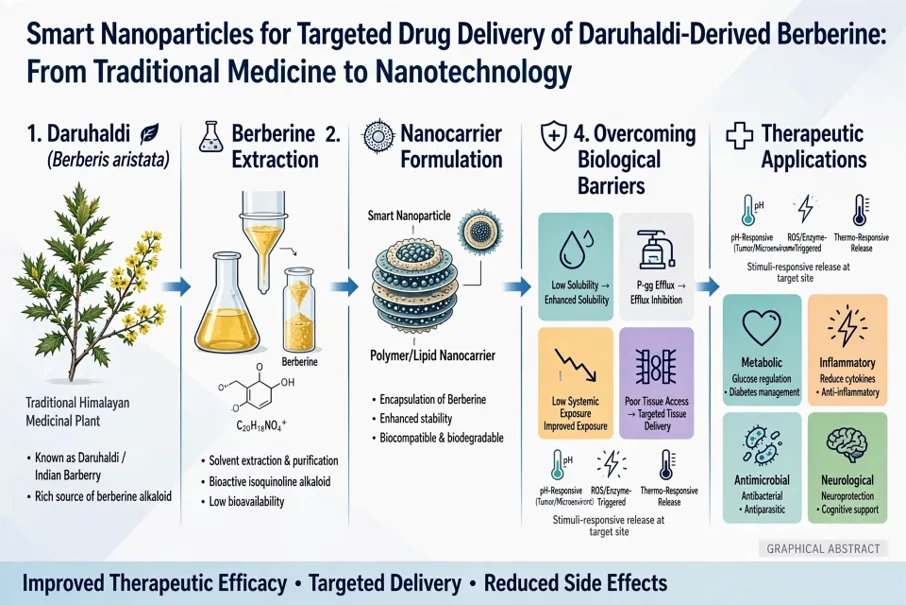
Smart Nanoparticles for Targeted Drug Delivery of Daruhaldi-Derived Berberine: From Traditional Medicine to Nanotechnology – graphical abstract.
3. Daruhaldi and Berberine: Botanical and Pharmacological Basis
Berberis aristata belongs to the Berberidaceae family. The supplied materials identify berberine as a major investigated isoquinoline alkaloid. The thesis describes berberine as a quaternary ammonium alkaloid and links it with anti-hyperglycemic, anti-lipidemic, antioxidant and antimicrobial activities. These effects are discussed in relation to glucose handling, lipid metabolism, oxidative stress and cellular signaling. The botanical matrix introduces an additional scientific variable. Extract composition can change with plant identity, plant part, geography, harvest stage, extraction solvent, processing and storage. Therefore, a Daruhaldi nanoformulation should report botanical authentication and a chemical fingerprint, rather than relying only on the plant name. Quantification of berberine can serve as one marker, but a whole-plant preparation may contain other constituents that contribute to the observed biological response. The supplied thesis specifically investigates B. aristata in a self-nanoemulsifying drug-delivery system. It describes formulation development through solubility screening, oil/surfactant/co-surfactant selection, pseudo-ternary phase diagrams, droplet-size and zeta-potential evaluation, thermodynamic stability, release, radical-scavenging and intestinal-permeation testing.
Critical interpretation
A standardized extract and purified berberine are different research materials. Their nanoformulations should be compared under matched dose, composition, route and analytical conditions before claims of superiority are made.
3.1 Standardization of Daruhaldi as a Nanomedicine Starting Material
A reproducible Daruhaldi formulation begins before nanoparticle preparation. The plant material should be authenticated to species and plant part, and the extraction process should be recorded sufficiently to reproduce the chemical profile. The supplied literature identifies berberine as a major investigated constituent, but the botanical matrix may contain additional constituents that influence biological activity. Consequently, reporting only a nominal extract mass is insufficient for meaningful formulation comparisons. Berberine assay, chromatographic fingerprinting and batch-to-batch consistency provide a stronger basis for comparing formulations. The formulation study should also state whether the payload is purified berberine, a standardized extract, or a mixture. This distinction is particularly important because much of the nanocarrier literature concerns purified berberine rather than whole Berberis aristata preparations. Matched-dose experiments can therefore help determine whether the carrier or the botanical matrix is responsible for the observed improvement.
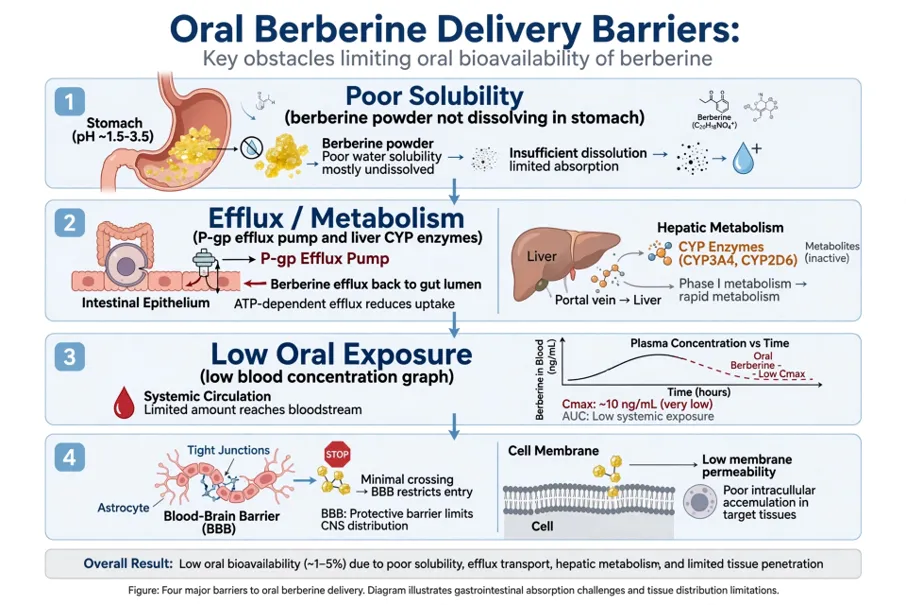
Figure: Four major barriers to oral berberine delivery. Diagram illustrates gastrointestinal absorption challenges and tissue distribution limitations.
4. Drug-Delivery Barriers of Berberine
The supplied literature identifies poor aqueous dissolution, limited intestinal permeability, P-glycoprotein-mediated efflux, intestinal and hepatic metabolism, rapid elimination and restricted access to protected tissues as major delivery barriers. These limitations help explain why an active compound can show strong pharmacology in experimental systems while producing relatively modest systemic exposure after oral dosing. The Arun Kumar thesis reports an especially useful formulation perspective. In its Berberis aristata SNEDDS study, the formulation produced approximately 5.77- and 5.86-fold increases in the ex-vivo permeability coefficient under two surfactant conditions, with sustained release reported for about 34 h. The thesis also explains that lipid-based systems may improve absorption through membrane interaction and potentially support lymphatic transport. The same source describes the general SNEDDS concept as an isotropic mixture of active, oil, surfactant and co-surfactant that forms a fine oil-in-water dispersion under aqueous dilution and gentle agitation. This property is attractive for poorly soluble phytochemicals because the active can remain solubilized during dilution instead of rapidly precipitating.
Design principle
Map the barrier before choosing the carrier: dissolution → intestinal stability → membrane permeation → efflux/metabolism → systemic exposure → tissue access. The best formulation is the one that addresses the limiting step.
Added mechanistic interpretation
Berberine absorption is affected by active intestinal transport and efflux. Caco-2 work demonstrated markedly greater basolateral-to-apical transport and inhibition by P-glycoprotein substrates, supporting efflux as a relevant barrier. Formulation strategies should therefore be assessed for both permeability and efflux behavior rather than particle size alone.
Dissolution → Permeation → Efflux → Exposure
4.1 Why Conventional Oral Delivery Is Challenging
The delivery problem for berberine is not represented by a single physicochemical limitation. Poor aqueous dissolution can restrict the amount available for absorption, while intestinal permeability and efflux can further reduce net uptake. After absorption, presystemic metabolism and elimination can limit the fraction reaching systemic circulation. The supplied literature also describes substantial plasma-protein binding and low oral bioavailability as factors that restrict tissue exposure. A formulation should therefore be evaluated across the sequence of dissolution, intestinal stability, membrane transport, efflux, metabolism and systemic exposure. This framework explains why an increase in dissolution alone may not produce a proportional increase in pharmacological effect. The reported Caco-2 evidence supporting an efflux contribution further indicates that permeability studies should distinguish passive movement from transporter-influenced transport. For publication-quality work, formulation claims should be linked to a clearly defined barrier and a measurable improvement at that barrier.
5. Nanoemulsions and SNEDDS
Nanoemulsions use small droplets to increase interfacial area and can influence dissolution, digestion, membrane interaction and absorption. SNEDDS are preconcentrates that self-emulsify after contact with gastrointestinal fluid. Their practical advantage is that the formulation can be filled into a capsule or another suitable dosage form and then generate a fine dispersion after administration. A rational SNEDDS development program starts with drug/extract solubility screening in candidate oils, surfactants and co-surfactants. Miscibility is then evaluated, followed by construction of pseudo-ternary phase diagrams to identify self-emulsifying regions. Formulations are screened for appearance, emulsification time, droplet size, polydispersity and zeta potential, followed by dilution stability, thermodynamic stress testing, release and permeability studies.
Authenticate plant → Standardize extract → Select carrier → Optimize CQAs → Test PK / targeting → Safety + scale-up
Thesis reports that the Berberis aristata SNEDDS showed improved intestinal permeability and prolonged release. These findings are important because they connect a formulation property with a biological barrier. The next step for translation would be a standardized pharmacokinetic comparison against the non-formulated extract and purified berberine, using equivalent active exposure.
Added SNEDDS development detail
For a publication-oriented SNEDDS study, the strongest sequence is solubility screening → pseudo-ternary phase mapping → composition optimization → droplet-size/PDI testing → dilution and stress stability → release → intestinal permeability → pharmacokinetics. This connects formulation selection to a defined oral-delivery problem.
Oil – Smix – Droplet
5.1 Rational Development of SNEDDS
SNEDDS development is best treated as a structured formulation-screening process rather than selection of excipients by trial and error. Initial solubility screening identifies oils, surfactants and co-surfactants capable of maintaining the active in a solubilized state. The components are then assessed for miscibility and self-emulsification behavior, and pseudo-ternary phase diagrams can be used to map the region that forms a fine dispersion after dilution. The selected system should be challenged for emulsification time, droplet size, polydispersity, zeta potential where informative, dilution robustness and thermodynamic stability. Release and intestinal-permeation studies provide the next level of evidence. In the supplied thesis-based evidence, Berberis aristata SNEDDS showed approximately 5.77- and 5.86-fold increases in ex-vivo permeability coefficient under two surfactant conditions and sustained release for about 34 h. These results are useful formulation signals, but they should be followed by standardized pharmacokinetic comparisons before claims of improved systemic benefit are generalized.
6. Lipid Nanoparticles: SLNs and NLCs
Solid lipid nanoparticles (SLNs) use a solid lipid matrix, whereas nanostructured lipid carriers (NLCs) combine solid and liquid lipids to create a less ordered matrix. Both systems can protect payloads and modify release. The supplied review identifies lipid systems as among the strongest direct evidence for improving berberine exposure. Representative literature values reported in the supplied review include an SLN near 76.8 nm, an NLC near 64 nm for an experimental colitis model, an NLC near 186 nm for an Alzheimer’s-oriented model and a liposomal system near 116.6 nm. These values illustrate diversity rather than an ideal size target.
Table 1. Selected values reported in the supplied review; not universal product specifications.
|
Platform |
Representative value |
Reported purpose |
Main limitation |
|
SLN |
~76.8 nm |
Exposure; metabolic models |
Lipid polymorphism; stability |
|
NLC |
~64 nm |
Experimental colitis |
Scale-up and digestion behavior |
|
NLC |
~186 nm |
Neurological model |
Brain localization needs proof |
|
Liposome |
~116.6 nm |
Oral exposure |
Physical stability |
NLCs can be particularly attractive when higher loading or a more flexible lipid matrix is desired. However, lipid digestion, surfactant dependence and physical stability must be controlled. A successful laboratory particle is therefore not automatically a scalable pharmaceutical product.
Added lipid-carrier evidence
A representative berberine SLN study reported spherical particles of about 76.8 nm, 58% encapsulation efficiency and improved pharmacokinetic exposure compared with free berberine. The finding supports lipid encapsulation as an exposure-enhancing strategy, but it does not establish 76.8 nm as a universal optimum.
6.1 Lipid Matrix Selection and Performance
SLNs and NLCs differ mainly in the organization of their lipid matrices. A solid lipid matrix can provide protection and controlled release, whereas incorporation of a liquid lipid into an NLC can create a less ordered structure that may accommodate payload more flexibly. The supplied evidence reports several berberine lipid systems with different particle sizes and therapeutic aims, demonstrating that there is no single particle size that defines a successful formulation. Important development variables include lipid composition, surfactant concentration, drug-to-lipid ratio, processing temperature and homogenization energy. Physical stability should be followed over time because aggregation, lipid polymorphism and changes in the matrix can modify release behavior. A representative berberine SLN study reported particles around 76.8 nm, about 58% encapsulation efficiency and improved pharmacokinetic exposure compared with free berberine. Such values are best interpreted as study-specific examples rather than fixed specifications for future formulations.
7. Liposomes and Polymeric Nanoparticles
Liposomes consist of phospholipid bilayers surrounding an aqueous compartment. They can accommodate different payload environments and may be modified with polymers, carbohydrates or ligands. The supplied review reports a proliposome-derived berberine system with a strong relative oral-bioavailability signal and a newer natural-fiber-interlaced liposomal formulation with a reported 3.37-fold relative oral bioavailability increase in rats. Polymeric nanoparticles provide a different design space. The supplied review reports a PLGA berberine formulation around 140 nm with approximately 77% encapsulation efficiency and enhanced antimicrobial activity against Enterococcus faecalis and Candida albicans, with low cytotoxicity toward gingival fibroblasts in the reported study. A polymeric carrier can be engineered for slower degradation and sustained release, but solvent removal, residual solvent control, polymer molecular-weight variation and reproducibility become critical. If a targeting ligand is added, ligand density and batch consistency become additional critical quality attributes.
Publication-strength point
Do not describe a formulation as targeted solely because it is nanosized or because it improves oral bioavailability. Use precise terminology such as bioavailability-enhancing, route-targeted, ligand-assisted, or stimuli-responsive.
7.1 Liposomal and Polymeric Systems: Complementary Roles
Liposomal systems offer a flexible architecture in which phospholipid bilayers can protect the payload and can also provide a surface for further modification. The supplied literature describes berberine liposomes with increased stability or oral exposure, including systems prepared by ionophore-mediated methods and chitosan-coated liposomes. Polymeric nanoparticles provide a different advantage: the polymer matrix can be engineered for sustained or local release. PLGA, dextran, alginate and other polymers appear in the supplied evidence for antimicrobial, metabolic and controlled-delivery applications. However, polymeric formulations introduce additional process variables such as polymer molecular weight, solvent removal, purification and residual-solvent control. The choice between liposomal and polymeric systems should therefore be guided by the desired biological function. If membrane interaction and flexible surface modification are priorities, liposomes may be attractive; if prolonged retention or controlled degradation is the primary objective, a polymeric matrix may offer a stronger design rationale.
8. Polysaccharide, Micellar and Hybrid Systems
Chitosan–alginate nanoparticles combine oppositely charged polysaccharides. Chitosan may support mucosal interaction, while alginate contributes matrix formation. The supplied review identifies these systems as candidates for improving oral berberine bioavailability. Their weakness is process sensitivity: polymer grade, ionic strength, mixing conditions and gelation kinetics can alter the final particle. Mixed micelles provide another route to solubilization and ligand presentation. The supplied review describes a galactosylated mixed-micelle system of approximately 100 nm with more than 85% entrapment and a reported increase in relative oral bioavailability. Such findings are encouraging, but a biological response alone does not establish organ-specific receptor targeting. Lipid–polymer hybrids attempt to combine the membrane interaction of lipids with the structural control of polymers. They can be useful when a single carrier cannot simultaneously provide stability, sustained release and tissue access. The trade-off is complexity: every extra component introduces another manufacturing variable and another analytical burden.
Formulation decision rule
Prefer the simplest carrier that solves the defined biological barrier and demonstrates a reproducible therapeutic advantage. Multifunctionality is valuable only when each added function is experimentally justified.
8.1 Hybrid Systems and the Complexity–Benefit Balance
Hybrid and polysaccharide carriers are attractive because they can combine properties that are difficult to obtain from a single material. Chitosan–alginate systems may provide mucoadhesive interactions while maintaining a hydrated polymeric matrix. Lipid–polymer hybrids can combine lipid-mediated membrane interaction with the structural control of a polymer. Mixed micelles can improve solubilization and may also provide a surface for ligand presentation. The supplied review describes a galactosylated mixed-micelle system of approximately 100 nm with more than 85% entrapment and increased relative oral bioavailability. These results illustrate the potential of multifunctional carriers, but every added material also increases manufacturing and analytical complexity. Therefore, a hybrid system should be justified by a measurable advantage over a simpler comparator. The most informative comparison is not simply particle size, but the complete chain of stability, payload control, release, permeability, pharmacokinetics and therapeutic response.
9. Botanical Illustration and Process Variables
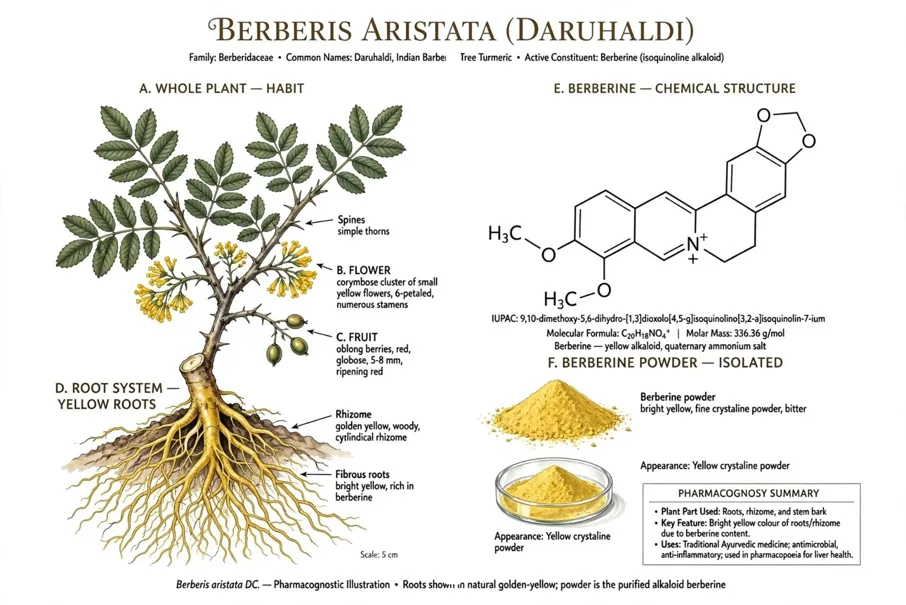
Berberis aristata DC. — Pharmacognostic Illustration. Roots shown in natural golden-yellow; powder is the purified alkaloid berberine.
9.1 Process Variables That Control Final Product Quality
The preparation method can substantially influence the properties of a nanocarrier. For lipid systems, temperature, lipid ratio, surfactant concentration, homogenization energy and cooling conditions can affect particle size, crystallinity and drug incorporation. For polymeric nanoparticles, polymer concentration, organic-to-aqueous phase ratio, emulsification energy and solvent removal can influence particle formation and encapsulation. Ionotropic gelation of polysaccharides is similarly sensitive to polymer grade, ionic strength and mixing conditions. Because these variables interact, optimization should use a planned experimental design where feasible rather than changing one variable without controlling the others. The final process should define critical material attributes and critical process parameters and connect them to measurable critical quality attributes. This approach supports reproducibility and makes later scale-up more rational. Importantly, the formulation described in a publication should be detailed enough to permit independent reproduction while distinguishing study-specific experimental settings from general formulation principles.
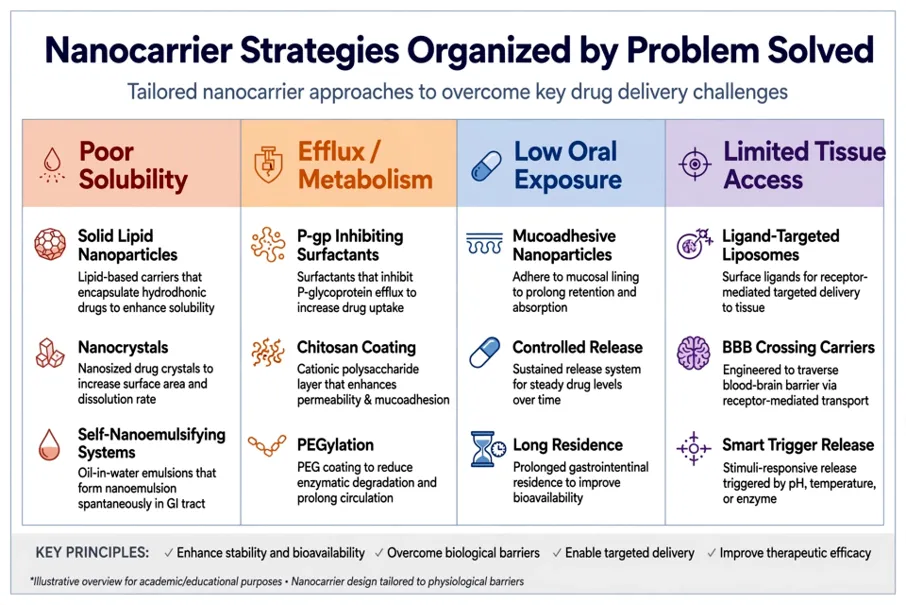
Nanocarrier Strategies Organized by Problem Solved – tailored nanocarrier approaches to overcome key drug delivery challenges. *Illustrative overview for academic/educational purposes.
10. Quality by Design and Characterization
A journal-ready formulation study should clearly define critical quality attributes (CQAs). The supplied review identifies particle-size distribution, polydispersity index, zeta potential where relevant, drug content, encapsulation efficiency, residual solvent, morphology, release profile, microbial quality and stability as important measurements.
Table 3. Recommended characterization framework for a publication-oriented formulation study.
|
Test |
Why it matters |
Interpretation |
|
Particle size / PDI |
Dispersion quality and reproducibility |
Use as a descriptor, not a universal target |
|
Zeta potential |
Surface-charge behavior and colloidal stability |
Interpret with medium and composition |
|
Encapsulation efficiency |
Payload retention |
Report method and mass balance |
|
In-vitro release |
Release mechanism and kinetics |
Medium, sink conditions and model must be stated |
|
Morphology |
Shape and structural evidence |
SEM/TEM images require scale bars |
|
Stability |
Shelf-life and aggregation risk |
Track size, PDI, assay and appearance over time |
Do not over-interpret particle size. A nanoscale size can support dispersion or uptake, but therapeutic performance depends on composition, surface chemistry, release, route, biological environment and dose.
Added characterization interpretation
Critical quality attributes should be interpreted as a linked set. Size and PDI describe dispersion quality; encapsulation and assay describe payload control; release describes delivery behavior; stability describes reproducibility. A small particle with poor loading or instability is not automatically a superior formulation.
10.1 Analytical Characterization: From Particle Size to Stability
Characterization should answer whether the formulation is reproducible, whether the active is actually incorporated, and whether the carrier remains stable during storage and use. Particle size and PDI describe dispersion quality, while zeta potential can provide supporting information about surface-charge behavior. Drug content and encapsulation efficiency establish payload control, but both should be reported with the analytical method and mass balance. Morphology from SEM or TEM can support structural interpretation when images include appropriate scale bars. Release testing should state the medium, temperature, sampling design and model used for interpretation. Stability studies should monitor particle size, PDI, assay, appearance and other relevant changes over time. These measurements are interdependent: a small particle with poor loading or rapid aggregation may be less useful than a slightly larger but stable formulation. Therefore, the final formulation should be selected using a profile of quality attributes rather than a single numerical value.
11. Release, Permeability and Pharmacokinetic Evaluation
In-vitro release is useful for comparing formulations, but a release curve in buffer should not be equated with therapeutic exposure. The supplied review specifically cautions that prolonged release in laboratory media does not necessarily mean prolonged exposure in vivo. Release should therefore be paired with permeability, stability and pharmacokinetic data. For oral Daruhaldi formulations, ex-vivo intestinal permeation can provide a bridge between formulation behavior and systemic exposure. The Arun Kumar thesis reports improved Berberis aristata permeability after SNEDDS formulation, including approximately 5.77- and 5.86-fold enhancement of the ex-vivo permeability coefficient under two surfactant conditions. The same study reported release for approximately 34 h. A robust pharmacokinetic comparison should include Cmax, Tmax, AUC, half-life and, when relevant, metabolite profiles. For targeted systems, tissue-to-plasma ratios and direct localization are more informative than plasma AUC alone. A formulation that increases AUC without increasing the desired tissue exposure should be described as exposure-enhancing rather than tissue-targeted.
Recommended comparison groups
Free berberine; standardized Daruhaldi extract; blank carrier; berberine-loaded carrier; standardized extract-loaded carrier. Keep route, dose basis, sampling schedule and analytical method consistent.
11.1 Linking In-vitro Release to In-vivo Exposure
A sustained-release profile in laboratory medium is informative but does not establish prolonged drug exposure in an animal or human subject. Gastrointestinal dilution, lipid digestion, protein binding, tissue distribution and metabolism can alter the relationship between in-vitro release and pharmacokinetics. For this reason, release data should be integrated with permeability and pharmacokinetic measurements. A suitable pharmacokinetic study should report Cmax, Tmax, AUC and half-life using a validated analytical method and matched dose conditions. Where tissue targeting is proposed, tissue concentration or tissue-to-plasma ratios provide stronger evidence than plasma AUC alone. The supplied thesis evidence for Berberis aristata SNEDDS is particularly relevant because it connects formulation behavior with an ex-vivo intestinal-permeation outcome. The next experimental step is to determine whether the increased permeability translates into reproducible systemic exposure and a corresponding pharmacodynamic benefit. This evidence chain reduces the risk of treating an in-vitro formulation signal as a clinical outcome.
12. Targeted Delivery Strategies
Targeting can be described at several levels. Route-based targeting uses administration pathways such as intranasal delivery to influence access to a particular anatomical region. Passive targeting relies on distribution patterns and tissue physiology. Active targeting adds a ligand intended to interact with a receptor or surface marker. Smart targeting adds conditional release after the carrier reaches a defined microenvironment. The supplied review discusses ligands such as folate, transferrin, peptides, antibodies and carbohydrates. It also reports chitosan-coated berberine lipid carriers for nasal delivery and a transferrin-functionalized polymer–lipid hybrid associated with increased brain exposure in an Alzheimer's model.
Active targeting has practical limitations. Protein-corona formation can mask a ligand; receptor density can vary among tissues and disease states; ligand density can change uptake; endosomal trafficking can prevent cytosolic release; and deeper tissue penetration can remain limited even when cellular uptake increases. A strong targeting claim therefore requires localization evidence plus a mechanistic and therapeutic advantage.
Added targeting validation
Active targeting should be demonstrated experimentally rather than inferred from ligand attachment. A convincing study should report receptor availability, ligand-dependent uptake or localization, intracellular trafficking where relevant, and a measurable therapeutic advantage. This makes the distinction between targeted and merely exposure-enhancing systems clearer.
12.1 Requirements for Demonstrating Active Targeting
Active targeting requires more than attaching a ligand to a nanoparticle surface. A credible targeted-delivery study should demonstrate that the intended receptor or marker is present in the target tissue, that ligand attachment changes uptake or localization, and that the resulting localization produces a measurable therapeutic advantage. The supplied review discusses folate, transferrin, peptides, antibodies and carbohydrates as possible targeting elements. It also describes transferrin-functionalized polymer–lipid systems associated with increased brain exposure in an experimental model. Such findings are promising but should not be interpreted as proof of human brain targeting. Protein-corona formation may alter ligand accessibility, receptor density can vary with disease state, and intracellular trafficking may prevent release at the desired site. Accordingly, ligand density, receptor-dependent uptake, intracellular localization and tissue distribution should be measured whenever possible. The term “targeted” should be reserved for systems supported by this evidence rather than used as a synonym for nanosized or bioavailability-enhancing formulations.
13. Smart and Stimuli-Responsive Nanoparticles
Smart nanoparticles are designed to alter behavior after exposure to a defined trigger. Internal triggers include acidic pH, redox gradients, enzymes, reactive oxygen species and ATP. External triggers include light, magnetic fields, heat and ultrasound. For berberine, the most useful conceptual role is conditional release: the carrier should remain sufficiently stable during transit and release more rapidly at the intended site. Acid-sensitive systems can exploit pH differences between compartments. Redox-sensitive systems can use intracellular reducing environments to destabilize a linker or matrix. Enzyme-responsive systems can exploit disease-associated enzymes. External triggers offer temporal control but require practical access to the target tissue and suitable equipment. The supplied smart-nanomedicine references include work on acidity-triggered ligand presentation, stimulus-responsive drug/gene delivery and ultrasound-responsive nanoparticles. These broader systems help define design principles, but they should not be presented as direct clinical evidence for Daruhaldi unless the relevant berberine formulation has actually been tested.
Smart-system validation
Measure trigger specificity, trigger-dependent release, stability without trigger, release after trigger, localization and therapeutic benefit. A stimulus-responsive label should be supported by an experimental trigger-response relationship.
Added smart-system validation
A stimulus-responsive formulation should remain sufficiently stable without the trigger and show a reproducible change after the trigger. The most informative experiments compare baseline release, trigger-specific release, stability, localization and biological effect. A pH- or redox-sensitive label should therefore be supported by a measurable trigger–response relationship.
13.1 Designing a Trigger-Responsive Berberine Carrier
Stimuli-responsive delivery is most useful when a disease-associated trigger can provide a meaningful difference between the intended site and the surrounding environment. Internal triggers discussed in the supplied evidence include acidic pH, redox conditions and enzymes, while external triggers include light, magnetic fields, heat and ultrasound. For a berberine system, the carrier should remain sufficiently stable during transport and demonstrate a reproducible change in release when the selected trigger is present. A pH-responsive design, for example, should be compared under physiologically relevant pH conditions rather than tested only at one acidic value. Likewise, a redox-responsive system should show limited release without the trigger and increased release under the intended reducing environment. Trigger response should then be connected to localization and biological activity. This staged validation prevents the label “smart nanoparticle” from becoming a purely materials-based description and instead makes it a testable delivery mechanism.
14. Therapeutic Applications
Metabolic disorders. The supplied literature contains substantial interest in improving oral berberine exposure for glucose and lipid-related models. SLNs, nanoemulsions and SNEDDS are relevant because the formulation can address dissolution and intestinal delivery. The thesis reports improved permeability and release behavior for Berberis aristata SNEDDS alongside in-vitro antidiabetic assays.
Inflammatory bowel disease. Berberine-loaded NLCs have been investigated in experimental colitis. The supplied review reports improved cellular uptake and experimental disease indices. Local intestinal exposure can be more relevant than simply increasing systemic concentration.
Neurological applications. Brain delivery is particularly challenging because the blood–brain barrier limits many compounds. Intranasal systems and transferrin-functionalized hybrids provide route- and ligand-assisted concepts. However, brain exposure should be confirmed directly, not inferred from systemic pharmacokinetics.
Antimicrobial applications. Polymeric berberine nanoparticles have been explored for endodontic and other antimicrobial applications. Encapsulation may improve local retention and reduce rapid loss from the treatment site.
Oncology and other chronic diseases. Nanocarrier studies increasingly explore berberine in cancer and chronic inflammatory settings. These areas require careful distinction between improved delivery and true combination or targeting benefits.
14.1 Therapeutic Areas and Evidence Strength
The supplied literature supports several areas for continued investigation, but the evidence strength differs between applications. Metabolic models are supported by work on berberine-loaded lipid systems and by the Berberis aristata SNEDDS study, which links formulation to permeability and in-vitro antidiabetic activity. Inflammatory bowel applications are represented by berberine NLC studies in experimental colitis, where local intestinal exposure may be important. Neurological applications require particularly careful localization studies because systemic exposure does not demonstrate blood–brain barrier passage. Antimicrobial formulations can benefit from local retention, and polymeric berberine nanoparticles have been explored in this context. Oncology research includes lipid, polymeric, gold and silver-based systems, with some studies examining enhanced cytotoxic or antitumor effects. Across all indications, the critical distinction is between a formulation that improves exposure and one that demonstrates a disease-relevant advantage. Comparative controls, appropriate dose normalization and mechanistic measurements are therefore essential for interpreting therapeutic claims.
15. Comparative Critical Analysis
Table 4. Critical comparison of major carrier classes discussed in the supplied evidence.
|
System |
Strength |
Weakness |
Best-fit question |
|
SNEDDS |
Self-emulsification; oral delivery |
High surfactant load; dilution behavior |
Can oral exposure/permeability be improved? |
|
Nanoemulsion |
Fine droplets; dissolution support |
Physical stability; surfactant dependence |
Can dissolution and intestinal transport improve? |
|
SLN/NLC |
Protection; sustained release |
Lipid polymorphism; digestion effects |
Can exposure and release be prolonged? |
|
Liposome |
Versatile encapsulation; surface modification |
Leakage/oxidation; scale-up |
Can payload and surface function be combined? |
|
Polymeric NP |
Controlled/local release |
Solvent/process complexity |
Can local retention or sustained release improve? |
|
Polysaccharide NP |
Mucoadhesion; biopolymer appeal |
Batch/process sensitivity |
Can mucosal interaction improve? |
|
Hybrid / smart |
Multiple functions |
Highest complexity and regulatory burden |
Is a specific targeting/trigger mechanism justified? |
Overall, lipid systems currently offer a strong balance between oral delivery feasibility and evidence for increased berberine exposure. Polymeric and polysaccharide systems provide useful alternatives when sustained, local or mucoadhesive delivery is the priority. Hybrid and smart systems are scientifically attractive but should be advanced only when their added complexity produces a measurable benefit.
Added decision rule for carrier selection
Carrier selection should begin with the biological barrier, not with the novelty of the material. If the problem is oral dissolution and intestinal transport, lipid systems are rational candidates; if local retention or sustained release is dominant, polymeric systems may be preferable; complex smart systems should be chosen only when their added function provides measurable benefit.
15.1 Choosing a Carrier by the Biological Barrier
A practical carrier-selection strategy begins with the dominant delivery problem. When dissolution and oral dispersion are limiting factors, SNEDDS, nanoemulsions and other lipid-based systems provide a rational starting point because they can improve solubilization and intestinal presentation. When sustained or local release is more important, polymeric systems may provide greater control over degradation and retention. Mucoadhesive polysaccharide systems are attractive when prolonged contact with mucosal surfaces is desired. Liposomes and hybrids become useful when surface modification or combined lipid–polymer behavior is needed. Smart systems should be selected only when a trigger can be measured and linked to therapeutic benefit. This barrier-first approach avoids choosing a material simply because it is novel. It also creates a clearer experimental hypothesis: the carrier is expected to correct a defined limitation, and the study should measure whether that limitation was actually corrected. Such logic strengthens both formulation development and the interpretation of comparative studies.
16. Safety, Manufacturing and Regulatory Considerations
Nanoparticle safety cannot be inferred from the safety profile of free berberine. Particle size, surface charge, composition, residual solvent, surfactant concentration, aggregation, degradation products and protein-corona formation can alter biological behavior. The supplied review recommends dose-dependent cytotoxicity, hemocompatibility, immune activation, oxidative stress, organ-distribution and repeated-dose studies. For botanical nanomedicines, the starting material is itself a critical quality attribute. Authentication, marker-based standardization, extraction reproducibility and chemical fingerprinting should be documented. The finished product then requires control of particle-size distribution, PDI, drug content, encapsulation, release, microbial quality, stability and packaging. Manufacturing complexity increases with every functional layer. A simple SNEDDS may require fewer unit operations than a ligand-functionalized stimuli-responsive hybrid. Scale-up should therefore be considered before a formulation becomes overly complicated. Quality-by-design principles can help connect material attributes and process variables to the final critical quality attributes.
Regulatory reality
A botanical active combined with a nanocarrier and a targeting ligand can create classification and analytical challenges. The manuscript should therefore avoid claiming clinical readiness unless manufacturing, toxicology, analytical validation and regulatory requirements have been addressed.
16.1 Safety Assessment Should Follow the Whole Formulation
The safety profile of free berberine cannot be assumed to predict the safety of a nanocarrier. Changes in particle size, surface chemistry, lipid or polymer composition, surfactant exposure and degradation products may alter biological interactions. Safety evaluation should therefore include the complete formulation and suitable blank-carrier controls. The supplied review highlights cytotoxicity, hemocompatibility, immune activation, oxidative stress and organ-distribution studies as relevant areas. Repeated-dose investigations are important when prolonged exposure is expected. For botanical materials, chemical variability is an additional source of risk, making authentication and marker-based standardization part of the safety strategy rather than a separate botanical issue. Manufacturing also matters: residual solvent, microbial quality, packaging compatibility and storage stability can affect the final product. A formulation intended for translation should consequently be developed with safety, reproducibility and scale-up in parallel. This reduces the possibility of selecting a high-performing laboratory formulation that later fails because of instability or unacceptable biological behavior.
17. Research Gaps and Future Scope
The largest evidence gap is the mismatch between the identity of the botanical and the evidence base for purified berberine. A future study should compare standardized B. aristata extract, purified berberine and their respective nanoformulations under matched experimental conditions. This would clarify whether the plant matrix provides a meaningful advantage or simply increases formulation variability. Second, studies should harmonize pharmacokinetic endpoints. Cmax, Tmax, AUC, half-life, tissue distribution and metabolite profiles should be reported using consistent analytical methods. For brain delivery, tissue-to-plasma ratios and localization should accompany plasma pharmacokinetics. Third, targeting should become quantitative. Studies should report receptor expression, ligand density, binding or uptake kinetics, intracellular trafficking and trigger-dependent release. Fourth, translation should include stability, sterilization, packaging, cost and scale-up rather than treating them as post-publication problems.
Finally, future manuscripts should distinguish exploratory results from validated claims. This strengthens scientific credibility and makes the review more useful to formulation scientists, pharmacologists and regulatory reviewers.
Added discussion for publication strength
The most informative next experiment would compare standardized Berberis aristata extract and purified berberine before and after nanoformulation under matched dose and analytical conditions. This design can separate the contribution of the botanical matrix from the contribution of the carrier and would reduce overinterpretation of purified-berberine evidence.
Authenticate → Standardize → Optimize → PK → Safety
Added critical appraisal
Improved AUC, permeability or release should be treated as intermediate formulation outcomes. A stronger translational claim requires a linked chain from formulation quality to exposure, target-tissue delivery, pharmacodynamic benefit and safety. This evidence hierarchy helps keep the review balanced and publication-oriented.
17.1 Research Priorities for Translational Development
Future work should prioritize studies that directly resolve the evidence gaps identified in the supplied materials. First, standardized Berberis aristata extract and purified berberine should be compared before and after nanoformulation under matched dose and analytical conditions. Second, pharmacokinetic studies should use consistent endpoints, including Cmax, Tmax, AUC and half-life, with tissue distribution added whenever targeting is claimed. Third, targeted systems should quantify receptor expression, ligand-dependent uptake and tissue localization instead of relying on ligand attachment as proof of targeting. Fourth, formulation stability, sterilization, packaging, cost and scale-up should be considered during early development. Finally, the relationship between formulation quality, exposure, pharmacodynamic effect and safety should be treated as a continuous evidence chain. A strong future manuscript should therefore separate exploratory findings from validated conclusions. This approach can make the Daruhaldi–berberine nanomedicine field more reproducible and more useful for formulation scientists, pharmacologists and regulatory assessment.
18. Proposed Publication-Oriented Formulation Development Protocol
Stage 1 — Botanical quality
Authenticate plant and plant part; record extraction conditions; establish a chemical fingerprint; quantify berberine as a marker.
Stage 2 — Preformulation
Measure extract/berberine solubility in candidate oils, surfactants and co-surfactants; check miscibility and compatibility.
Stage 3 — Screening
For SNEDDS/nanoemulsions, construct pseudo-ternary phase diagrams. For nanoparticles, screen lipid/polymer ratios, surfactant concentration and processing conditions.
Stage 4 — Optimization
Use design-of-experiments where feasible. Define CQAs including size, PDI, zeta potential, encapsulation, assay and release.
Stage 5 — Mechanistic testing
Evaluate dissolution, gastrointestinal stability, permeability and relevant efflux behavior; link each test to the intended biological barrier.
Stage 6 — In-vivo translation
Compare free and formulated material using matched doses; measure Cmax, Tmax, AUC, half-life, tissue exposure and therapeutic outcomes.
Stage 7 — Safety and scale-up
Conduct repeated-dose safety, stability, microbial quality, residual-solvent and manufacturing studies; test reproducibility at larger scale.
Publication-oriented recommendation
Use precise wording such as “preclinical evidence supports improved delivery” unless human and regulatory-quality evidence supports a stronger claim.
19. Visual Summary: From Daruhaldi to a Smart Berberine Nanocarrier
The following figures are original explanatory schematics prepared for this edition. They are not microscopy images and are not presented as experimental data.
Plant material → Standardize extract → Select carrier → Optimize CQAs → Test PK / targeting → Safety + scale-up
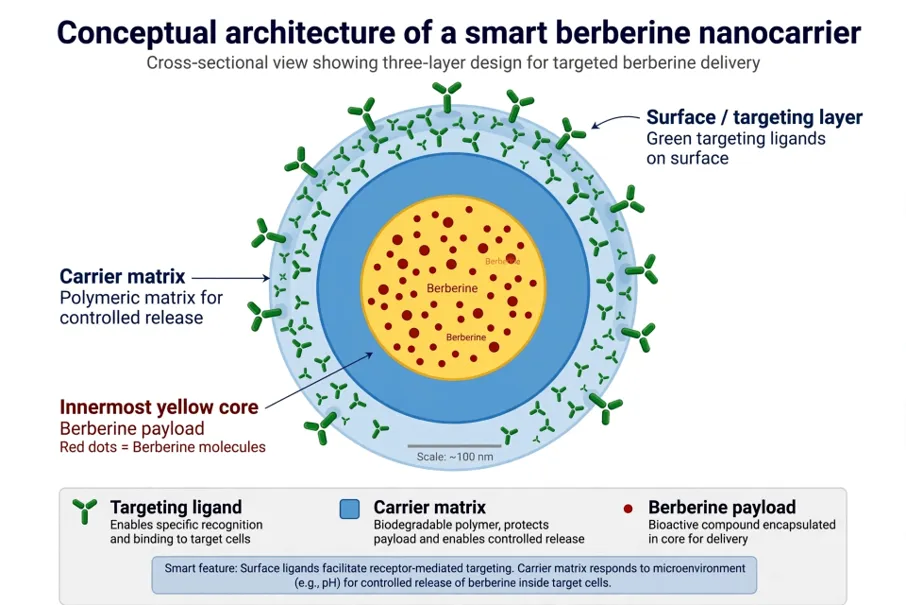
Conceptual architecture of a smart berberine nanocarrier – cross-sectional view showing three-layer design (targeting ligand, carrier matrix, berberine payload) for targeted berberine delivery.
20. Visual Summary: Carrier Classes and Their Primary Roles
|
Carrier class |
Defining feature |
Primary role |
|
SNEDDS |
Self-emulsification |
Oral solubilization / permeability |
|
Nanoemulsion |
Fine droplets |
Dissolution and intestinal presentation |
|
SLN / NLC |
Lipid matrix |
Protection and sustained release |
|
Liposome |
Phospholipid bilayer |
Encapsulation and surface modification |
|
PLGA NP |
Biodegradable polymer |
Controlled or local release |
|
Chitosan–alginate NP |
Natural polysaccharides |
Mucoadhesion and oral delivery |
|
Hybrid / smart |
Multiple functions |
Targeting or trigger-responsive delivery |
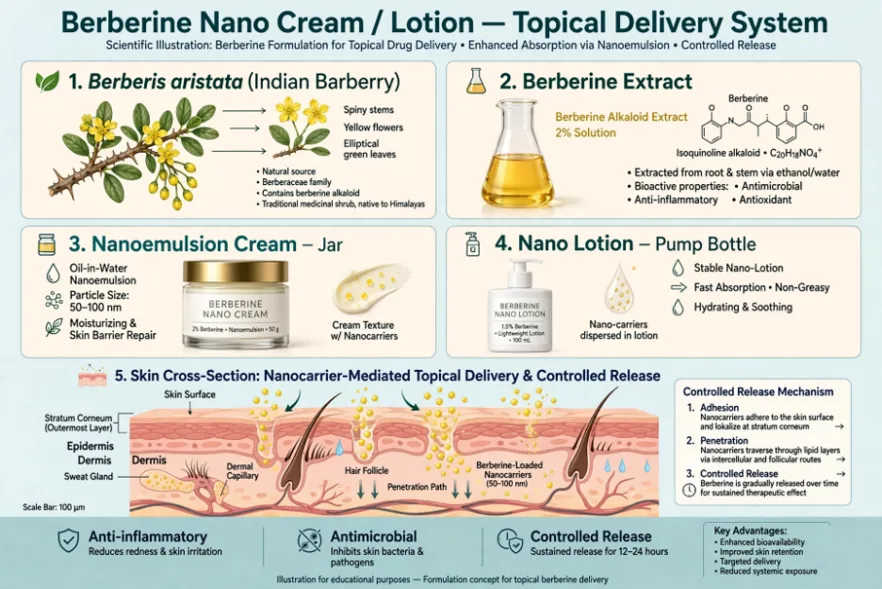
Berberine Nano Cream / Lotion — Topical Delivery System. Illustration for educational purposes — formulation concept for topical berberine delivery.
21. Visual Summary: Evidence Chain for a Publication-Ready Study
|
Critical quality attribute |
Represents |
|
Size / PDI |
Dispersion |
|
Zeta potential |
Surface behavior |
|
EE% / assay |
Payload control |
|
Release |
Delivery behavior |
|
Stability |
Reproducibility |
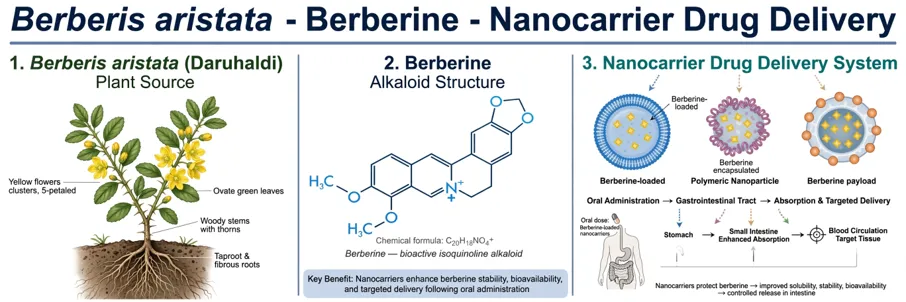
Berberis aristata – Berberine – Nanocarrier Drug Delivery: plant source, alkaloid structure and nanocarrier drug-delivery system overview.
Free berberine vs standardized Daruhaldi extract
The two materials should be distinguished analytically before nanoformulation comparisons.
Formulation evidence
Particle size, PDI, loading, release and stability describe product quality but do not by themselves establish therapeutic superiority.
Biological evidence
Permeability and pharmacokinetic studies should connect formulation properties to exposure; tissue localization is required when targeting is claimed.
Translational evidence
Repeated-dose safety, manufacturing reproducibility, packaging, stability and cost should be considered before a complex smart system is advanced.
REFERENCES




Rajeshwari Gangurde, Diksha Jadhav, Dhanashri Ghotekar, Asmita Bhosale, Smart Nano Particles for Targeted Drug Delivery of Daruhaldi-Derived Berberine, Int. J. of Pharm. Sci., 2026, Vol 4, Issue 10, 696-717. https://doi.org/10.5281/zenodo.23169936
 10.5281/zenodo.23169936