

We use cookies to ensure our website works properly and to personalise your experience. Cookies policy
1M.Pharm Scholar Department of Pharmacy Practice, National Institute of Pharmaceutical Research and Education, S A S Nagar, (Punjab).
2Associate Professor, M. Pharm., Ph.D., Department of Pharmacy Practice, National Institute of Pharmaceutical Research and Education, S A S Nagar, (Punjab)
Introduction: This study aims to study the price control mechanism in countries like Australia, Germany, France, Canada and United Kingdom for providing affordable help to the masses and documenting there experiences in providing affordable public health and there significance in Indian perspective. Method: A literature search was made in search engines like PUBMED, SCIENCE DIRECT, EPNET, HIGHWIRE PRESS etc using search terms like “drug prices”, “Pricing strategy”,” Price control mechanism”, “affordability measures” etc. the papers obtained were analyzed and there observations were recorded and results were presented in form of Table. Key Findings: Among the various price control measures adopted by various countries some prominent measures are Reference pricing, Parallel Importing, Restriction in marketing and pricing approvals and barriers related to prescribing and dispensing like restrictive formulary ,prescribing budgets are being adopted by various govt. for control of the pharmaceutical expenditures . Conclusion: This Study Provides the insight into the various price control mechanism and affordability measures adopted by various countries across the globe and there experience in implementing them.
Medicines play a crucial role in saving lives, restoring health, and preventing diseases and epidemics. In India Indian constitution directs Govt. of India to provide heath services to every citizen of India. In recent years with implementation of new patent regime after 2005 as per obligation of Indian government to the WTO, there are speculation of rise in prices of drugs post TRIPS. In this regard there is a need to study price control and affordability measures adopted across the globe to provide easy access to people to essential medicines after TRIPS failing which the access of essential drugs to common people might become difficult. National drug expenditure as a proportion to total health expenditure ranges from seven per cent to 66 per cent worldwide. The proportion is higher in developing countries (24-66 per cent) than in developed countries (8-30 per cent). In India it is Close to 35 percent. Even then 30 percent of the world’s population lacks regular access to essential medicines and in our country it is as high as 65 percent. In many high-income countries, large proportion pharmaceuticals are publicly funded or have social insurance or other reimbursement scheme. In low and middle-income countries including India, public medicine expenditure does not cover the basic medicine needs of the majority of the population. In these countries, patients pay for 50-90 per cent of the medicines from their own pockets1
So the medicine costs are born by consumer, which can dominate household’s health spending, at over 80 per cent of the total. With increase in costs of treatment for TB, HIV/AIDS, malaria, and bacterial infections, healthcare make them unaffordable. India being a socialist country, decided to control the prices of almost all medicines as early as in 1970 through the Drug Price Control Order (DPCO). With successive liberalized policy of various governments, the number of drugs under the price control has declined from all drugs in 1970 to just 73 in 1994. With implementation of new drug policy, Pharmaceutical Policy-2002, it was planned to bring down the number further, to have as low as 30 drugs under price control.
Health is a fundamental human right. Constitution of India directs the state to regard the improvement of public health as among its primary duties five year plans have been providing the framework within which the center and state have developed there health services. Since the attainment of independence considerable progress has been made in the promotion of heath status to the public-as reflected in the eradication /control of diseases like small pox, malaria etc. reduction in mortality rates rise in expectancy creating of a fairly extensive network of health care institution and the availability of large stocks of medical and health professionals .
Drug alone are not sufficient to provide healthcare. However if rationally used, they do play an important role in protecting, Maintaining and restoring the health of the people and in controlling population .The Pharmaceutical industry has therefore a vital role in serving the basic health needs of the people .
Reference price system for pharmaceutical benefit programmes have received increasing attention in recent years this mechanism controls the fraction of price of drug to be reimbursed to the patient. . Health insurance systems in various countries have experimented in recent years with this novel form of patient cost sharing called “reference pricing.” Under this approach, the insurer covers only the prices of low-cost, reference drug in therapeutic clusters that are deemed to be close substitutes for one another in treating specific illnesses. Patients who desire a higher-price substitute in a cluster must then pay the full difference between the retail price of that drug and the reference price covered by the insurer one type of reference price is employed by the Australian government i.e. Pharmaceutical benefit scheme (PBS) in Australia.2.3., Many countries, including Australia regulate the price consumer pay for pharmaceutical. The Pharmaceutical benefit scheme in Australia is a multistage game played between the to go through the drug evaluation, regulation bargaining and regulation process for a particular drug. In first stage of the game firm chooses whether or not to increase the price. In second stage the regulator evaluates the regulator and pharmaceutical firms for quality of drug submitted for evaluation. In third stage the regulator decides which firms to regulate .The fourth stage involves the bargaining between the regulator and the regulated firm over the reimbursement to be made to firms are to receive in return of selling there drug at regulated price to consumer .In fifth stage firms compete in drug market and the regulated price is with there decision. 4, 5, 6, 7.
METHODS
This study is a price composition analysis done to see the actual changes in the various components of drug price like excise duty ,VAT ,TRIPS etc. and to find out factor responsible for change in the price of the drug and to categorized drug according to the factor responsible for change in price. This study was done on 100 drugs selected from the National Essential Medicine list based on there usage data and there formulation and strength taken as given in the NEML. Three price value has been taken for each formulation a Highest Price, a lowest price and a Medium price (average of highest and lowest) and medium price is taken for the further study .Price of bulk drug and formulation has been recorded for a period of 2yrs from July 04-July 06 and there difference is recorded .The variation in the difference of price been recorded and drugs are being categorized on the basis of factor responsible for changes in price of drugs like excise duty, VAT etc. The price data of formulation is been taken from CIMS and bulk drug price is taken from Pharmapulse July04-July06 of respective month.
Literature review is collected about the various measure taken by different government to make drug affordable to there masses and price controls measures adopted in various countries.
Results
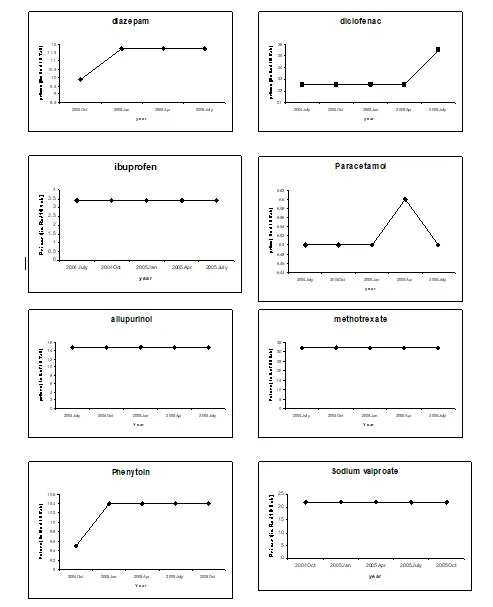
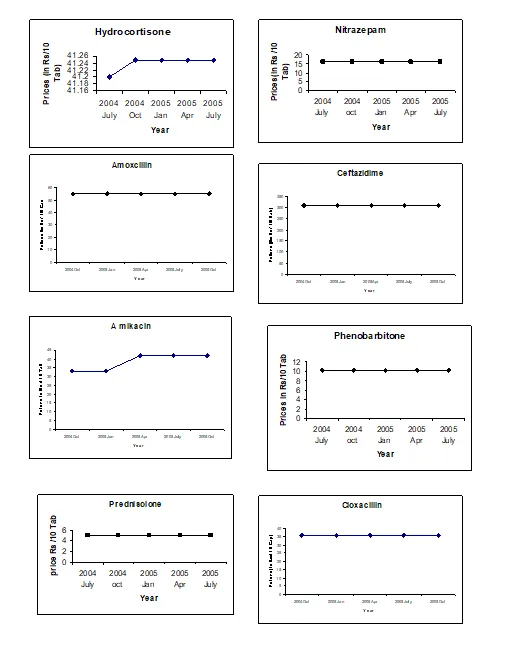
Result of the study shows a price increase in the price of following drugs Diazepam, Diclofenac, Phenytoin, Amikacin, Atenolol, Domperidone ranging from 109%-145% and a price decrease of 57 % in the Prices of Azithromycin .and the prices of other drug are found to remain same.
Table1 Reference Price how when and where?
|
SR NO |
Country |
Year Launched |
Criterion for Setting of the RP |
|
1 |
Germany |
1993 |
Statistical Average Price of Medicine in a Category |
|
2 |
Australia |
1998 |
Lowest Price Medicine |
|
3 |
Netherlands |
1991 |
Average Price of Medicine in category |
|
4 |
New Zealand |
1992 |
Lowest Price Medicine |
|
5 |
Denmark |
1993 |
Average unit price of two lowest cost drug in a group |
|
6 |
Norway |
1993 |
Lowest Priced Product +5% |
|
7 |
Sweden |
1993 |
Lowest Priced Medicine +10% |
|
8 |
Canada |
1995 |
Lowest Price Medicine |
|
9 |
Spain |
2000 |
10-50 %lower than the highest price in group |
|
10 |
Italy |
2001 |
Weighted average of all generic prices of group |
|
11 |
Portugal |
2003 |
Most Expensive Drug |
|
12 |
France |
2003 |
Generic Prices |
Table 2 Various Approaches Adopted by Various Government for Price Control.
|
S.No. |
EU Country |
Cost Effective Pricing |
Fixed Pricing |
Reference Price |
Free Pricing |
|
1 |
Austria |
- |
- |
- |
|
|
2 |
Belgium |
- |
|
- |
|
|
3 |
Denmark |
- |
- |
|
- |
|
4 |
Finland |
|
- |
- |
- |
|
5 |
France |
|
- |
- |
- |
|
6 |
Germany |
- |
|
|
- |
|
7 |
Greece |
|
- |
- |
- |
|
8 |
Ireland |
|
- |
- |
- |
|
9 |
Italy |
|
- |
- |
- |
|
10 |
Luxemburg |
|
- |
|
- |
|
11 |
Nether land |
|
- |
- |
- |
|
12 |
Portugal |
|
- |
- |
- |
|
13 |
Spain |
|
- |
|
- |
|
14 |
Sweden |
|
- |
- |
- |
|
15 |
United states |
|
- |
|
- |
Literature review regarding the approaches adopted by various countries for making drugs affordable is recorded various options taken by various government are: Reference pricing, Approval delays (delay in Marketing and Pricing approvals), Barriers to Dispensing and Prescribing (Restrictive formularies, Prescribing guidelines, Prescribing budgets , obstacle to promotion ) and Parallel import are some major methods adopted by various government for pricing controls and making drug affordable for masses .
Marketing approval is required for the sale of all pharmaceutical. The process typically involves multiple stages of approval and multiple government and regulatory bodies. The requirements delay market access and jeopardize intellectual property protection The pricing approval decision (or reimbursement decision) suffers from many of the same difficulties as the marketing approval decision. Manufacturers are typically required to submit scientific dossiers and economic reports and, in some cases, price dat The pricing decision may also be delayed by extensive negotiations, waiting periods, multiple decision-making stages, and lengthy Parallel trade occurs when a product covered by intellectual property rights sold by or with the rights holder consent in Nation A and is resold in another Nation B without the right holders authoritization The incentive for its occurrence is a sufficient difference in prices between the price paid by first purchaser and the prices charged in Nation B to cover shipping and other transaction cost and still offer gains to both the shipper and the Nation B buyer.
Parallel import is one major method for availability of medicine s to developing countries. Parallel trade in patented articles is legally Permissible under what is called the doctrine of exhaustion. This doctrine states that once the producer of patented Product or its agent has sold its product in good faith to an independent party, the patent holder’s right to determine the conditions under which the product is resold is exhausted if there is price difference among customers of the original manufacturer, any customer can engage in arbitrage transaction that exploit those differences. There is controversy over the right of patent holder to limit parallel trade in its product across national borders.
Discussion
This study determines the variations in the price of drug because of various components of the price. Price data is available for 100 drugs and rise in price is recorded in range of 109%-145% for drugs Diazepam, Diclofenac, Phenytoin, Amikacin, Propanolol, Atenolol, and Domperidone. Price decrease of 57% is found in azithromycin for rest drug the prices have remained the same. The prices of majority of other drugs have remain unchanged during this period .Regarding the various affordability measures taken by various government like Reference Pricing by Germany which has proven not successful alone other method like approval barriers ,barriers to prescribing are been successfully used . One another method of parallel import is being used by several countries under the doctrine of exhaustion of patent rights. Parallel import is being made legal by some countries in Latin America.
CONCLUSION
In the present study 100 drugs are being taken for study and there price data recorded .under the speculation of price rise in country only 7 drug out of 100 has shown price rise while rest has shown no price changes and one has shown price decrease. This study shows no significant impact on the prices of the drugs.
REFERENCES


Pankaj Pant, Dr .P.Tiwari , A Study Of Drug Price Control Mechanism In Various Countries, Int. J. of Pharm. Sci., 2026, Vol 4, Issue 8, 4197-4205. https://doi.org/ 10.5281/zenodo.22095881
 10.5281/zenodo.22095881