

We use cookies to ensure our website works properly and to personalise your experience. Cookies policy
Andhra University College of Pharmaceutical Science.
Background: Tirzepatide is increasingly evaluated beyond glycemic efficacy, but cardiovascular and kidney findings arise from different endpoints and study designs. We assessed whether these findings are clinically concordant without equating randomized and observational evidence or different levels of kidney endpoints. Methods: We conducted a PRISMA 2020- and PRISMA-S-aligned systematic review registered in PROSPERO (CRD420261436184). Randomized controlled trials (RCTs) and comparative observational studies in adults with type 2 diabetes mellitus (T2DM) were retained as separate causal evidence streams. Cardiovascular outcomes were interpreted according to safety, noninferiority, and superiority; kidney outcomes were classified as hard clinical, functional, or surrogate/intermediate endpoints. Exploratory random-effects pooling was restricted to two contemporary randomized kidney-composite estimates and two eGFR-slope estimates with sufficiently comparable measures. Results: SURPASS-CVOT demonstrated cardiovascular noninferiority of tirzepatide versus dulaglutide (hazard ratio [HR] 0.92, 95.3% confidence interval [CI] 0.83–1.01), while its exploratory kidney analysis reported fewer kidney-composite events (HR 0.77, 95% CI 0.68–0.88) and slower eGFR decline. SURPASS-4 showed a lower kidney-composite risk (HR 0.58, 95% CI 0.43–0.80) and slower eGFR decline versus insulin glargine. Exploratory pooling of kidney-composite effects gave HR 0.69 (95% CI 0.53–0.91; I²=63%), whereas eGFR-slope pooling was highly heterogeneous (mean difference 1.22 mL/min/1.73 m²/year, 95% CI ?0.65 to 3.09; I²=97%). Observational evidence was not pooled with randomized evidence. Discussion: Tirzepatide shows a predominantly favorable but endpoint-specific cardiorenal profile. The principal contribution is a design-stratified concordance framework that separates causal design and kidney endpoint hierarchy, distinguishes cardiovascular noninferiority from superiority, and limits overinterpretation of surrogate or post hoc findings.
Type 2 diabetes mellitus (T2DM) confers cardiovascular and kidney morbidity, and chronic kidney disease (CKD) increases cardiovascular risk. [1, 2]
Tirzepatide is a dual GIP/GLP-1 receptor agonist with glycemic and weight effects, but these do not establish cardiovascular or kidney benefit. [3, 4]
SURPASS-CVOT established cardiovascular noninferiority compared with dulaglutide, while the SURPASS-4 and SURPASS-CVOT kidney analyses reported renal outcomes. [5-9]
Our novelty is a design-stratified cardiorenal concordance framework that separates randomized from observational evidence, ranks kidney endpoints by clinical hierarchy, and distinguishes cardiovascular noninferiority from superiority. We assessed whether cardiovascular and kidney evidence is concordant, partially concordant, neutral, or discordant.
2. MATERIALS AND METHODS
2.1 Protocol and Reporting
The protocol was registered in PROSPERO (CRD420261436184). The review was prepared according to PRISMA 2020, with search reporting aligned with PRISMA-S. The PRISMA 2020 checklist is provided as Supplementary Table S8, and the available database-specific search documentation is provided in Supplementary Table S1. Because contemporaneous database exports and executed search logs were unavailable, Supplementary Table S1 should not be interpreted as a verbatim recovery of the original database queries. [11,12]
2.2 Eligibility Criteria
Adults aged 18 years or older with T2DM were eligible. Tirzepatide at any clinical dose was the intervention of interest. Eligible designs were randomized controlled trials (RCTs) and comparative observational studies reporting at least one prespecified cardiovascular, kidney, or cardiorenal outcome. Case reports, case series, cross-sectional studies without relevant outcomes, animal studies, reviews, editorials, commentaries, and duplicate publications were excluded.
2.3 Evidence-Stream Separation
RCTs and observational studies were not pooled because they represent different causal evidence streams. Among RCTs, blinding and prespecified versus post hoc analyses were considered in interpretation. Observational studies were evaluated with particular attention to active comparators, new-user designs, and propensity-score methods.
2.4 Information Sources and Search
MEDLINE/PubMed, Embase, Cochrane CENTRAL, Web of Science, Scopus, ClinicalTrials.gov, and WHO ICTRP were searched from inception through August 13, 2026. Reference lists of included studies and relevant reviews were screened. The search combined tirzepatide/LY3298176, T2DM, and cardiovascular/kidney concepts, with a broader tirzepatide-plus-T2DM search used to improve sensitivity. Available database-specific search documentation, dates, and registry-search approaches are provided in Supplementary Table S1. Because the original database exports and executed search logs were unavailable, the supplementary strategies are explicitly reconstructed rather than represented as verbatim historical queries.
2.5 Study Selection and Extraction
Study identification, selection, and extraction were reconstructed from eligible published reports and authoritative indexed records available for this review. The PRISMA flow reports the study-selection counts used for this review; these counts are presented transparently in Figure 1, but record-level duplicate resolution and screening decisions could not be independently re-audited. Extracted variables included design, population, comparator, dose, follow-up, cardiovascular and kidney outcomes, effect estimates, uncertainty, adjustment methods, and funding. Observational studies additionally contributed information on matching, new-user design, active comparators, and confounding control. Eligible studies were retained at the review level when they met the predefined criteria; contribution to individual outcome syntheses was restricted to studies reporting the relevant outcome and a sufficiently compatible estimand.
2.6 Risk of Bias
RCTs were assessed using RoB 2 and observational studies using ROBINS-I. Risk-of-bias judgments were incorporated into interpretation and evidence certainty; no pooled effect combined randomized and observational studies. [13,14]
2.7 Outcome Hierarchy
The prespecified primary cardiovascular composite, or MACE, was treated as the principal cardiovascular endpoint. Kidney outcomes were classified as hard clinical outcomes (kidney failure, kidney replacement therapy, kidney-related death, or major sustained eGFR decline), functional outcomes (eGFR slope or change), and surrogate/intermediate outcomes (UACR, albuminuria, or macroalbuminuria). These categories were not treated as interchangeable. [15]
2.8 Statistical Synthesis
Time-to-event effects were expressed as HRs with 95% CIs and continuous outcomes as mean differences (MDs) when the same unit and estimand were available. For exploratory pooling, HRs were log-transformed and standard errors derived from published 95% CIs. Random-effects models were used because comparator, population, and endpoint heterogeneity were anticipated. Heterogeneity was quantified using I² and τ². Because only two randomized analyses provided sufficiently comparable estimates for each quantitative outcome, these meta-analyses were prespecified as exploratory rather than confirmatory and were interpreted primarily as assessments of directional consistency rather than definitive class effects. Outcomes with materially different definitions, estimands, or follow-up were synthesized narratively. [16]
2.9 Cardiorenal Concordance
Concordant benefit required favorable effects in both cardiovascular and kidney domains with adequate precision and clinically meaningful outcomes. Partial concordance was assigned when one domain was favorable, but the other relied on less precise, exploratory, or surrogate evidence. Discordance required opposing treatment directions. Statistical significance alone did not determine classification.
2.10 Certainty of Evidence
Certainty was assessed separately for randomized and observational evidence using GRADE, considering risk of bias, inconsistency, indirectness, imprecision, and publication bias. [17, 18]
2.11 Small-Study and Publication-Bias Assessment
Formal funnel-plot or Egger-type tests were not performed because each quantitative outcome had fewer than 10 contributing studies; such tests would be unreliable.
2.12 Evidence Provenance and Audit Limitation
The PRISMA counts shown in Figure 1 are retained as the study-selection counts used for this review. Because the underlying database exports and contemporaneous screening/extraction files were not retained, record-level duplicate resolution and screening decisions cannot be independently re-audited. The supplementary tables therefore reconstruct eligible evidence and methodological judgments from published reports and authoritative indexed records rather than reproducing a recovered historical screening log.
Table 1. Core evidence sources contributing to the principal cardiorenal synthesis
|
Evidence source |
Design/ comparator |
Population |
Cardiovascular contribution |
Kidney contribution |
Interpretive role |
|
SURPASS-4 |
RCT; insulin glargine |
T2DM + increased CV risk; N=2,002 |
CV safety context |
Post hoc kidney composite, eGFR, UACR |
Key renal signal; less definitive than a dedicated CVOT |
|
SURPASS-CVOT |
Double-blind RCT; dulaglutide |
T2DM + established ASCVD; N=13,299 |
Primary CV outcome; noninferiority |
Prespecified exploratory kidney analysis; post hoc cardiorenal analysis |
Dominant contemporary randomized cardiorenal evidence |
|
Dani et al., 2025 |
Retrospective TriNetX cohort; propensity-score matched |
T2DM + IHD; 751 matched pairs |
Real-world CV composite |
AKI-related evidence |
Complementary observational evidence |
|
Ostrominski et al., 2026 |
Target-trial emulations; active comparator |
T2DM + ASCVD; 9,233 and 25,266 pairs |
Modified MACE comparisons |
Not primary renal evidence |
Real-world comparative-effectiveness context |
3. RESULTS
3.1 Study Selection and Evidence Structure
Figure 1 summarizes study selection. A total of 1,246 records were identified through database searching and 15 through other sources. After removal of 229 duplicates, 1,032 records were screened, and 985 were excluded. Forty-seven full-text reports were assessed for eligibility; 37 were excluded because of wrong study design (n=21), insufficient data (n=10), or other reasons (n=6). Ten studies were included: 8 randomized controlled trials and 2 comparative observational studies. The included evidence was then separated by study design, and outcome-specific analyses did not necessarily include every study.
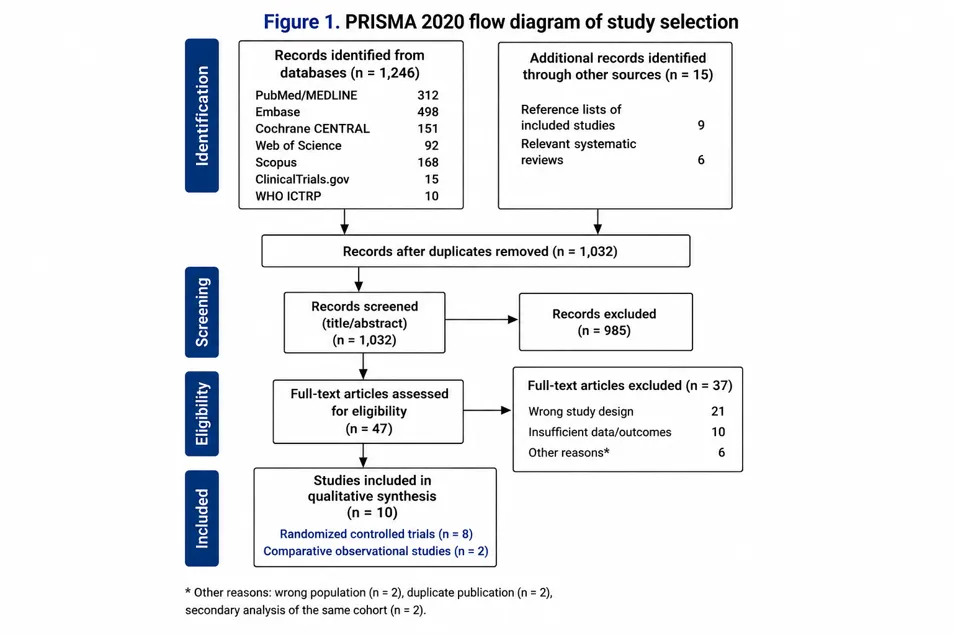
Figure 1. PRISMA 2020 flow diagram of study selection.
3.2 Cardiovascular Outcomes
SURPASS-CVOT provides the principal randomized cardiovascular evidence. In the modified intention-to-treat population, 6,586 participants received tirzepatide and 6,579 received dulaglutide. The primary composite of cardiovascular death, myocardial infarction, or stroke occurred in 12.2% versus 13.1%, corresponding to HR 0.92 (95.3% CI 0.83–1.01). Noninferiority was demonstrated (P=0.003), whereas superiority was not (P=0.09). The appropriate clinical interpretation is therefore cardiovascular noninferiority, not proven cardiovascular superiority.[5]
3.3 Kidney Outcomes
SURPASS-4 demonstrated slower eGFR decline with tirzepatide than insulin glargine, with a between-group difference of 2.2 mL/min/1.73 m²/year (95% CI 1.6–2.8). The composite kidney outcome was also lower with tirzepatide (HR 0.58; 95% CI 0.43–0.80), although the composite was driven predominantly by new-onset macroalbuminuria. The cystatin-C analysis supported a functional signal, with a between-group difference of 1.8 mL/min/1.73 m² at 52 weeks (95% CI 0.8–2.8).[6,7,8]
The prespecified exploratory kidney analysis of SURPASS-CVOT reported 396/6,586 (6.0%) kidney composite events with tirzepatide versus 498/6,579 (7.6%) with dulaglutide (HR 0.77; 95% CI 0.68–0.88; P=0.0002). The overall eGFR slope favored tirzepatide by 0.29 mL/min/1.73 m²/year (95% CI 0.17–0.41). The primary kidney composite comprised persistent macroalbuminuria, persistent 50% or greater eGFR reduction, end-stage kidney disease, or kidney death; the 23% relative reduction therefore should not be interpreted as a 23% reduction in kidney failure alone.[9]
3.4 Cardiorenal Composite
A post hoc SURPASS-CVOT analysis reported a six-component cardiorenal composite comprising all-cause mortality, myocardial infarction, stroke, coronary revascularization, hospitalization for heart failure, and the composite kidney endpoint. The outcome occurred in 23.7% versus 27.4% of participants (HR 0.84; 95% CI 0.79–0.90). Because this was a post hoc composite containing heterogeneous cardiovascular and kidney components, it is interpreted as supportive cardiorenal evidence rather than as a substitute for the prespecified primary cardiovascular endpoint. [10] The principal randomized cardiovascular, cardiorenal, and kidney estimates are summarized in Figure 2.
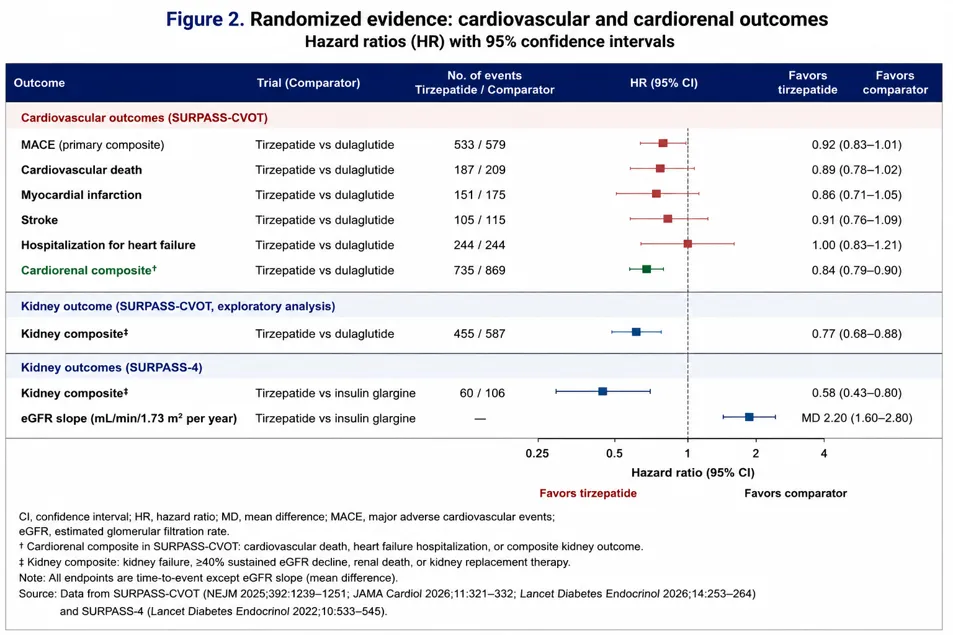
Figure 2. Randomized evidence: cardiovascular, cardiorenal, and kidney outcomes. Hazard ratios (HRs) with 95% confidence intervals (CIs) are shown for time-to-event outcomes; the eGFR slope is presented as a mean difference (MD).
3.5 Observational Evidence
Two comparative observational publications were retained as a separate evidence stream. Dani et al. used propensity-score matching in TriNetX and reported lower cardiovascular event risk with tirzepatide versus other GLP-1 receptor agonists during 1 year. Ostrominski et al. used two target-trial emulations in Optum Clinformatics to compare tirzepatide with dulaglutide or semaglutide and reported comparative effectiveness for modified MACE. These estimates add real-world context but remain vulnerable to residual confounding, treatment-selection bias, and limited follow-up; they were therefore not pooled with randomized evidence. [19, 20]
3.6 Exploratory Quantitative Synthesis
The kidney-composite HRs were 0.58 (95% CI 0.43–0.80) in SURPASS-4 and 0.77 (95% CI 0.68–0.88) in SURPASS-CVOT. A random-effects model yielded a pooled HR of 0.69 (95% CI 0.53–0.91), with I²=63.4% and τ²=0.025. This estimate is exploratory because the trials used different comparators and their kidney composites were not identical. [6, 9]
For eGFR slope, the reported between-group differences were 2.2 mL/min/1.73 m²/year (95% CI 1.6–2.8) in SURPASS-4 and 0.29 mL/min/1.73 m²/year (95% CI 0.17–0.41) in SURPASS-CVOT. Exploratory random-effects pooling produced an MD of 1.22 mL/min/1.73 m²/year (95% CI −0.65 to 3.09), with I²=97.3% and τ²=1.78. The high heterogeneity and two-study evidence base preclude treating this pooled estimate as a definitive class effect. [6, 9] The kidney-composite and eGFR-slope estimates are shown in Figure 3.
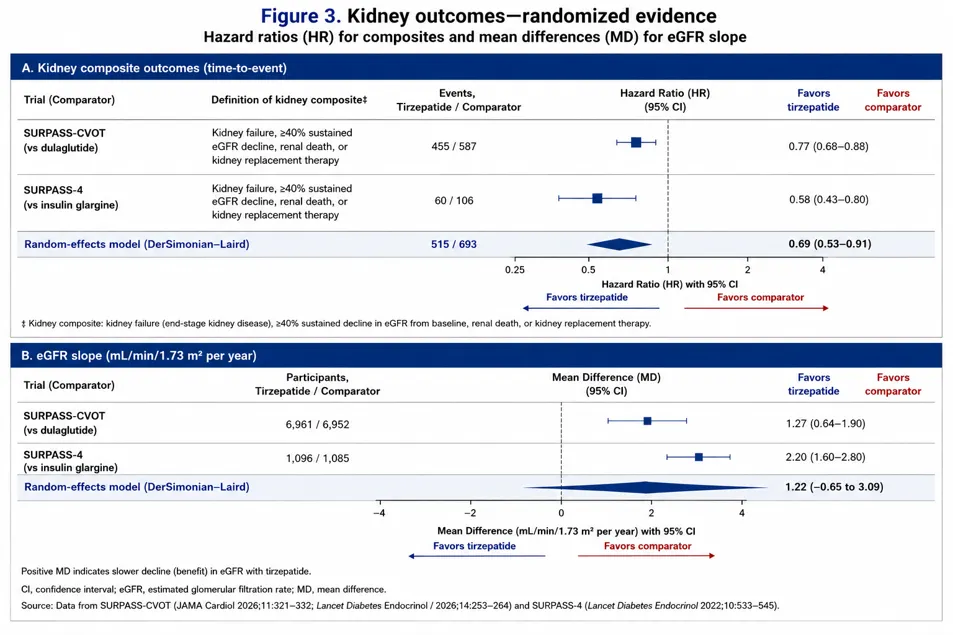
Figure 3. Kidney outcomes—randomized evidence. Hazard ratios (HRs) with 95% confidence intervals (CIs) are shown for kidney composites, and mean differences (MDs) with 95% CIs are shown for eGFR slope. Estimates are exploratory and are not interchangeable because kidney-composite definitions, comparators, and follow-up differ.
3.7 Cardiorenal Concordance
Across the principal randomized evidence, cardiovascular and kidney effects were directionally favorable, but evidentiary strength was not identical. The cardiovascular domain is anchored by a large double-blind active-comparator trial demonstrating noninferiority. The kidney domain is supported by consistent composite, eGFR, and albuminuria findings but includes exploratory or post hoc analyses and fewer hard renal events. The overall pattern is therefore best classified as predominantly concordant but endpoint-specific, rather than uniformly concordant across every cardiovascular and kidney endpoint.
Table 2. Key randomized cardiorenal findings and interpretation
|
Domain |
Study/ comparator |
Outcome |
Effect estimate |
Evidence status |
Interpretation |
|
Cardiovascular |
SURPASS-CVOT / dulaglutide |
CV death + MI + stroke |
HR 0.92 (95.3% CI 0.83–1.01) |
Primary CV endpoint; noninferiority met |
Noninferior; superiority not demonstrated |
|
Cardiorenal |
SURPASS-CVOT / dulaglutide |
6-component cardiorenal composite |
HR 0.84 (95% CI 0.79–0.90) |
Post hoc |
Supportive broad signal; not a substitute for the primary CV endpoint |
|
Kidney |
SURPASS-CVOT / dulaglutide |
Kidney composite |
HR 0.77 (95% CI 0.68–0.88) |
Prespecified exploratory |
Favorable composite kidney effect; components heterogeneous |
|
Kidney |
SURPASS-4 / insulin glargine |
Kidney composite |
HR 0.58 (95% CI 0.43–0.80) |
Post hoc; open-label parent trial |
Favorable renal signal; driven mainly by macroalbuminuria |
|
Functional kidney |
SURPASS-CVOT / dulaglutide |
eGFR slope |
MD +0.29 mL/min/ 1.73 m²/year (95% CI 0.17–0.41) |
Exploratory kidney analysis |
Slower eGFR decline |
|
Functional kidney |
SURPASS-4 / insulin glargine |
eGFR slope |
MD +2.2 mL/min/1.73 m²/year (95% CI 1.6–2.8) |
Post hoc |
Slower decline; functional rather than hard endpoint |
|
Surrogate kidney |
SURPASS-4 / insulin glargine |
UACR |
Between-group difference −31.9% (95% CI −37.7 to −25.7) |
Post hoc |
Favorable albuminuria effect; surrogate |
4. DISCUSSION
4.1 Principal Findings
This review shows a predominantly favorable cardiorenal profile for tirzepatide, but the evidence is best understood as a hierarchy rather than as a single treatment effect. The primary cardiovascular conclusion is noninferiority to dulaglutide. Kidney evidence is favorable across composite outcomes, eGFR trajectory, and albuminuria, but evidence for definitive prevention of kidney failure or kidney-related mortality is less mature.
4.2 Novel Contribution
Recent evidence syntheses have separately quantified tirzepatide renal effects, cardiovascular outcomes, or broad multisystem effects. A 2025 renal meta-analysis included 15 RCTs and focused primarily on UACR, eGFR change, and renal safety; a 2026 cardiovascular meta-analysis included 22 trials and focused on MACE and mortality; and a 2026 multisystem review pooled effects across 10 organ domains. The present review addresses a narrower question: whether cardiovascular and kidney findings are directionally and clinically concordant when randomized and observational evidence are kept causally distinct and kidney endpoints are ranked by clinical hierarchy. [21, 22, 23]
The major contribution is therefore a design-stratified cardiorenal concordance framework. Conventional syntheses can inadvertently combine randomized and observational estimates or place albuminuria, eGFR slope, and kidney failure on the same evidentiary level. This framework separates causal design, endpoint hierarchy, and clinical importance before assessing concordance. It asks not simply whether tirzepatide has a statistically favorable estimate but whether cardiovascular and kidney evidence are sufficiently consistent and clinically meaningful to support a coherent cardiorenal interpretation.
4.3 Cardiovascular Interpretation
The SURPASS-CVOT result should be communicated using the language of noninferiority. The HR below 1 is directionally favorable, but the superiority hypothesis was not statistically significant. Clinical claims should therefore match the prespecified estimand and hypothesis test. [5]
4.4 Kidney Interpretation
The kidney evidence is encouraging and internally coherent across several measures. SURPASS-4 demonstrated slower eGFR decline and reduced UACR, while SURPASS-CVOT added longer-term active-comparator evidence for a kidney composite and eGFR trajectory. However, composite outcomes may be driven by less severe but more frequent components such as macroalbuminuria. The current evidence is therefore strongest for renal progression signals and weaker for definitive kidney-failure prevention. [7, 9]
4.5 Real-World Evidence
The observational studies extend generalizability beyond trial populations and provide useful information about treatment effectiveness in routine practice. Their methodological strengths include propensity-score adjustment, active comparators, and target-trial emulation. Nevertheless, residual confounding and short follow-up remain important. The design-stratified framework allows these studies to inform interpretation without diluting the causal strength of randomized evidence. [19,20]
4.6 Clinical Implications and Future Research
For clinicians, the most defensible conclusion is that tirzepatide offers a favorable overall cardiorenal profile, particularly when glycemic and weight effects are considered alongside cardiovascular noninferiority and favorable kidney signals. The evidence does not support replacing established cardiovascular or kidney-protective therapies on the basis of surrogate renal findings alone. The key research question is whether the observed slowing of eGFR decline and reduction in composite kidney events translate into sustained reductions in kidney failure and kidney-related mortality.
4.7 Strengths and Limitations
The review has several strengths, including explicit separation of randomized and observational evidence, a prespecified kidney-endpoint hierarchy, transparent interpretation of cardiovascular non-inferiority, and GRADE assessment. An important limitation is that contemporaneous database exports and record-level screening/extraction files were unavailable, requiring reconstruction of the eligible evidence and associated methodological judgments from published reports and authoritative indexed records. Consequently, the reported PRISMA counts are retained as the study-selection counts used for this review, but individual record-level screening and duplicate-resolution decisions cannot be independently audited. The quantitative syntheses are also limited by the small number of contributing randomized analyses, non-identical kidney composites, different comparators, and very high heterogeneity for eGFR slope.
5. CONCLUSION
Tirzepatide demonstrates a predominantly favorable but endpoint-specific cardiorenal profile in adults with T2DM. Randomized evidence establishes cardiovascular noninferiority versus dulaglutide, while kidney analyses indicate favorable effects on composite renal outcomes and eGFR trajectory. The evidence is stronger for renal progression signals than for definitive prevention of kidney failure or kidney-related mortality. The principal novelty is a design-stratified cardiorenal concordance framework that keeps randomized and observational evidence causally distinct and separates hard clinical outcomes from functional and surrogate measures. This approach provides a more clinically precise interpretation of the expanding therapeutic evidence and identifies the remaining need for adequately powered long-term studies of hard kidney outcomes.
Figure Legends
1. PRISMA flow diagram for study selection. The figure reports the study-selection counts used for this review; 10 studies were included (8 randomized controlled trials and 2 comparative observational studies).
2. Randomized cardiovascular, cardiorenal, and kidney evidence. The primary cardiovascular endpoint is shown separately from the post hoc six-component cardiorenal composite and key kidney outcomes. Effect estimates are presented as reported in the cited primary publications.
3. Kidney outcomes in randomized trials. Kidney-composite and functional/surrogate estimates are shown for SURPASS-CVOT and SURPASS-4. The estimates are not interchangeable because the composites and follow-up differ.
6. ETHICS AND CONSENT
Ethics committee approval and informed consent were not required because this study synthesized previously published and publicly available data and did not involve individual-level primary data collection.
7. FUNDING
No specific external funding was received for this systematic review.
8. CONFLICTS OF INTEREST
The authors declare no conflicts of interest relevant to this manuscript.
REFERENCES



Eyasu Daba Dugasa, Md Ahmadunnisa, Mohammad Al-Haddad, Ali Al Salami, Cardiovascular–Kidney Outcome Concordance with Tirzepatide in Type 2 Diabetes: A Design-Stratified Systematic Review and Exploratory Meta-analysis, Int. J. of Pharm. Sci., 2026, Vol 4, Issue 9, 1936-1947. https://doi.org/10.5281/zenodo.22770211
 10.5281/zenodo.22770211