

We use cookies to ensure our website works properly and to personalise your experience. Cookies policy
Department of Pharmacy, Bharat Technology, Uluberia, Howrah- 711316, West Bengal.
Background- Type 2 diabetes mellitus is a complex metabolic disorder in which the glucose levels in the human body cannot be easily controlled due to insufficient insulin production by the pancreas. Canagliflozin is a widely used and effective drug for managing this condition, known for its safety and efficacy, with a half-life of approximately 10.6 hours. The primary objective of this study was to modify the drug release pattern to achieve an immediate release formulation, particularly for emergency situations where rapid therapeutic action is required. Result: To accomplish this, a comprehensive preformulation study was conducted, which included analytical techniques such as IR Spectra, UV-Spectrophotometry, solubility analysis, and melting point determination to evaluate the compatibility of the drug with excipients. Subsequently, formulation studies were performed using sodium starch glycolate as a special polymer in three consecutive batches to optimize the drug release profile. The in-vitro evaluation involved a detailed analysis of physical and chemical parameters, including disintegration time, dissolution studies, friability testing, and hardness measurements, using different polymer ratios to achieve the desired release characteristics. Based on the experimental findings, it was observed that the drug release time of Canagliflozin could be significantly reduced from 10 hours to just 15 minutes for 100 mg tablets through a polymer-based approach, demonstrating its potential for rapid onset of action. Conclusion- This study successfully establishes that Canagliflozin can be effectively formulated for immediate release, enhancing its therapeutic efficacy and providing a faster response in critical conditions, thereby improving patient outcomes in the management of type 2 diabetes mellitus.
The term "immediate release" (IR) describes how quickly a product, medication, or piece of information becomes available following administration or announcement. In medicine, it indicates that the medication dissolves rapidly for prompt effect. This term in the media refers to press releases intended for immediate publication. When timing is crucial, it guarantees quick effect or communication.
Canagliflozin is an oral antidiabetic medication that belongs to the sodium-glucose co-transporter 2 (SGLT2) inhibitor class. It is primarily used for managing type 2 diabetes mellitus by lowering blood glucose levels through a unique insulin-independent mechanism. By inhibiting SGLT2 in the kidneys, it reduces glucose reabsorption and promotes its excretion through urine, leading to improved glycemic control(1). In addition to its glucose-lowering effects, Canagliflozin also contributes to weight loss, lowers blood pressure, and provides cardiovascular and renal benefits, making it a valuable option for patients with diabetes and associated complications. However, its use is associated with potential side effects such as an increased risk of urinary tract and genital infections, dehydration, hypotension, and, in rare cases, diabetic ketoacidosis. Some studies have also linked it to an increased risk of bone fractures due to possible reductions in bone mineral density. Despite these concerns, canagliflozin remains an important therapeutic option, particularly for patients who require additional benefits beyond glucose control. Proper patient selection and monitoring are essential to minimize risks and optimize its effectiveness in diabetes management(1,2).
MARKET OVERVIEW OF THE DRUG-
In approximately 80 countries in the world, such as Australia, Japan, the USA, and Europe, patients with type 2 diabetes are managed with canagliflozin. On the other hand, canagliflozin is not approved to be used for type 1 diabetic patients. Earlier, it was highlighted that a great number of patients suffering from type 2 diabetes experience renal illness and HF. Canagliflozin and other SGLT2is are essential drugs for the management of glycemia and the mitigation of type 2 diabetes in patients in over 80 countries, such as Australia, Japan, the USA, and European countries, take canagliflozin. While canagliflozin is prohibited for use in this demographic (3). It is essential to note that canagliflozin is not suitable for use in type 1 diabetic patients. It is noteworthy that patients with type 2 diabetes often have nephropathies and HF; therefore, this statement is true. SGLT2 is, like canagliflozin, an effective drug for maintaining glycemic control and also for kidney diseases and HF (4).
MATERIAL & METHODS-
MATERIAL –
The vendor provided me with Canagliflozin (CIPLA.LTD) which I used to create tablets while sourcing the additional components such as MCC, PVP-K30, SSG, Talc and magnesium stearate at the college laboratory.
METHODS-
Initially, this study commenced with a comprehensive Preformulation analysis to evaluate both the active pharmaceutical ingredient (API) and the selected excipients. This analytical phase involved the use of several techniques, such as infrared (IR) spectroscopy to identify functional groups and potential interactions, UV spectrophotometry for drug quantification and absorbance profiling, and solubility assessments to determine the drug’s behaviour in different solvents. Additional characterization included determining the melting point to assess purity and thermal stability and thin-layer chromatography (TLC) to identify the presence of impurities and evaluate the drug’s stability profile. Following this, the formulation study was carried out for three consecutive batches to ensure consistency and reproducibility of the dosage form(5). A key aspect of the formulation development was the incorporation of a super-disintigrant, sodium starch glycolate, which was tested in varying polymer ratios to assess its impact on tablet performance. The in-vitro evaluation of the dosage form was conducted with a focus on both physical and chemical quality control parameters. These included disintegration time, to measure the speed at which the tablet breaks down in the body; dissolution testing, to evaluate the drug release profile; friability, to assess the tablet's resistance to crumbling during handling; and hardness testing, to determine the mechanical strength of the tablets(6). Through these investigations, the study aimed to optimize the formulation by balancing polymer concentrations to achieve the most effective and stable dosage form.
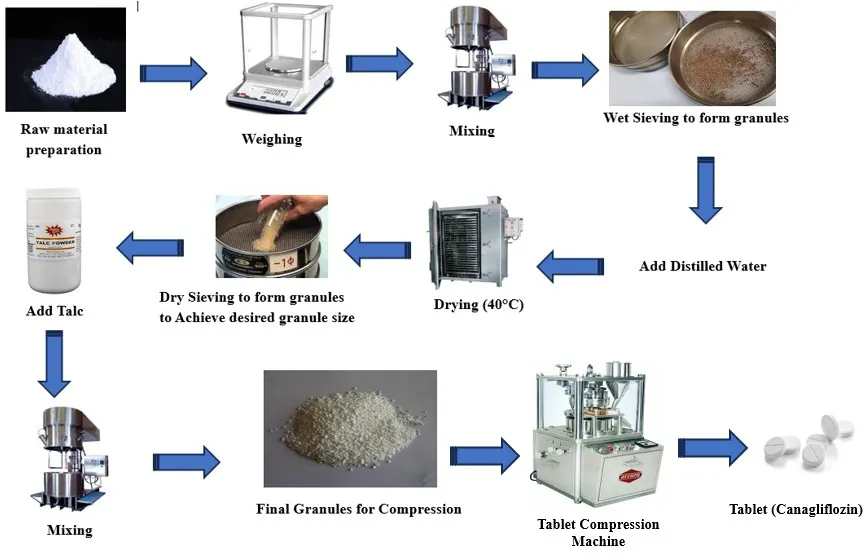
ANALYTICAL STUDY-
a) Solubility Test- How effectively a substance (typically a solid) dissolves in a specific solvent (generally a liquid like water, ethanol, or hexane) is determined by a straightforward chemical test called a solubility test. It assists in determining the substance's physical or chemical characteristics, which is helpful in forensic science, chemistry, and pharmacology (7).
Canagliflozin is soluble in ethanol and DMSO, but insoluble in water.
Melting Point- The Pharmaceutical Ingredient (API) Canagliflozin was loaded in a capillary tube and tied up with a thermometer by a rope. The whole system is placed into a Thieles tube and set with a retort base and retort stand. Tripod stand is used under the Thieles tube(8). A Bunsen burner was set under the tripod stand for heating.
TLC (Thin Layer Chromatography) is a technique used to separate and identify compounds in a mixture. It involves placing a small sample on a plate coated with a thin layer of adsorbent material and then allowing a solvent to move up the plate, carrying the compounds at different rates.
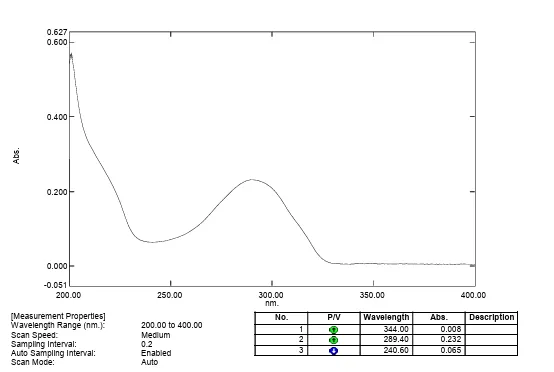
UV-VISIBLE SPECTROPHOTOMETRY-
5 mg Canagliflozin is weighted and dissolved completely in 100ml methanol in a volumetric flask. Pipette out 1 ml solution of Canagliflozin from the stock solution and transferred it in another 100 ml volumetric flask containing 100ml methanol. The last solution was ppm and observed in UV-Visible spectroscopy. The solution is taken into a cubet for analyzed the Maximum lamda with the help of a reference solution. When the absorbance is 0.008, wavelength is 344.00nm, when the absorbance is 0.232 , wavelength is 289.40nm, when the absorbance is 0.065,wavelength is 240.60nm. So when the maximum absorbance is 0.232 then the maximum wavelength is 289.40 nm.
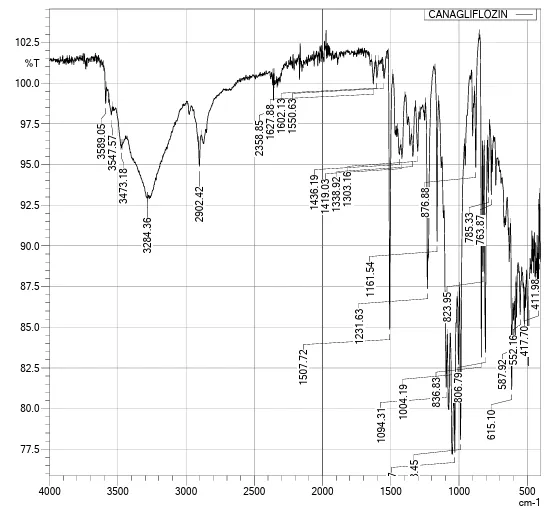
INFRARED SPECTROSCOPY-
5 mg of Canagliflozin is measured by micro spatula and analyzed under Infrared Spectroscopy. Sharp peak of each chemical group is observed.
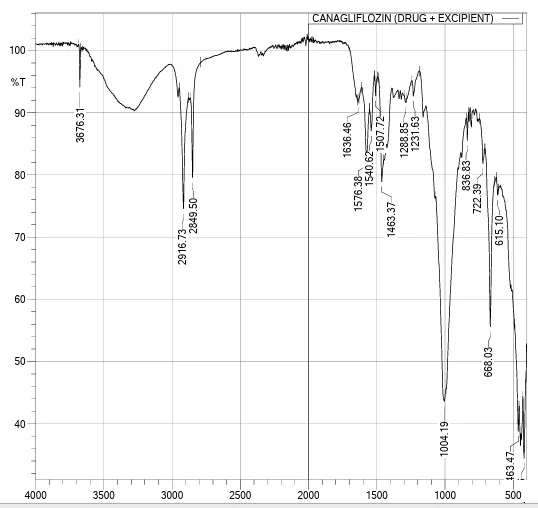
5 mg of Canagliflozin is measured by micro-spatula and the excipients are added with the drug and analyzed under Infrared Spectroscopy. Sharp peak of each chemical is observed.
STANDARD CURVE-
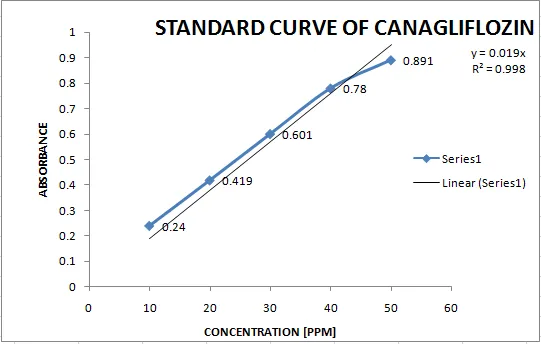
The preparation of the absorbance or signal strength of known concentrations of canagliflozin versus their respective concentrations is called a standard curve. This curve relates the absorbance or signal intensity of an unknown sample to the standard curve in order to determine the amount of canagliflozin in that sample. A standard curve is conventionally used as a tool to test the linearity and range of a developed analytical method, and both the calibration curve’s linearity and range are significant method validation parameters.
RESULTS -
FORMULATION - For the preliminary stage of research, placebo tablet formulations without including the active pharmaceutical ingredient focus on excipients to evaluate their individual and combined effects on tablet properties. The excipients used were microcrystalline cellulose (MCC) as a diluent and binder, poly-vinyl-pyrrolidone K-30 (PVP K-30) as a binder, sodium starch glycolate (SSG) as a superdisintegrant, talc as a glidant, and magnesium Stearate as a lubricant. These placebo tablets were prepared in three different formulation ratios to observe the influence of varying excipient compositions on parameters such as compressibility, flowability, disintegration, and physical integrity.
TABLE OF PLACEBO TABLETS
|
INGREDIENTS |
FORMULATION 1 |
FORMULATION 2 |
FORMULATION 3 |
|
MICRO CRYSTALLINE CELLULOSE |
111.4 Mg |
107.4 Mg |
103.4 Mg |
|
PVP K-30 |
9 mg |
9 mg |
9 mg |
|
SODIUM STARCH GLYCOLATE |
20 mg |
24 mg |
28 mg |
|
TALC |
6 mg |
6 mg |
6 mg |
|
MAGNESIUM STEARATE |
3.6 mg |
3.6 mg |
3.6 mg |
After the successful development of placebo formulations, tablets were subsequently prepared using the active pharmaceutical ingredient Canagliflozin. The same excipients used in the placebo batches—microcrystalline cellulose (MCC), polyvinylpyrrolidone K-30 (PVP K-30), sodium starch glycolate (SSG), Talc, and Magnesium Stearate were retained in the drug-loaded formulations. Three different batches were prepared with canagliflozin, each corresponding to one of the three excipient ratios used in the placebo formulations. This approach was adopted to evaluate the influence of the active drug on tablet properties and to ensure consistency in formulation development.
|
INGREDIENTS |
FORMULATION 1 |
FORMULATION 2 |
FORMULATION 3 |
|
DRUG (CANAGLIFLOZIN) |
100 mg |
100 mg |
100 mg |
|
MICRO CRYSTALLINE CELLULOSE |
111.4 mg |
107.4 mg |
103.4 mg |
|
PVP K-30 |
9 mg |
9 mg |
9 mg |
|
SODIUM STARCH GLYCOLATE |
20 mg |
24 mg |
28 mg |
|
TALC |
6 mg |
6 mg |
6 mg |
|
MAGNESIUM STEARATE |
3.6 mg |
3.6 mg |
3.6 mg |
POST FORMULATION STUDY
After the successful preparation of tablets in all three formulations containing the active pharmaceutical ingredient Canagliflozin, a series of comprehensive evaluations were carried out to assess the quality and performance of the tablets. These evaluations included the measurement of tablet size and shape to ensure uniformity and proper physical appearance across batches. Friability testing was conducted to determine the tablets’ ability to resist abrasion and maintain integrity during handling, packaging, and transportation. Hardness testing was performed to assess the mechanical strength of the tablets, ensuring they could withstand the stress of manufacturing and handling without breaking.
EVALUATIO STUDY
FORMULATION 1
|
FORMULATION-1 |
HARDNESS |
THICKNESS |
WEIGHT |
D.T. |
FRIABILITY |
|
3.1 |
3.40 |
242mg |
15 min 33 sec |
0% weight loss |
|
|
2.9 |
3.00 |
240mg |
15 min 09 sec |
0% weight loss |
|
|
3.16 |
3.41 |
246mg |
15 min 30 sec |
0% weight loss |
|
|
3.2 |
3.40 |
241mg |
15 min 45 sec |
0% weight loss |
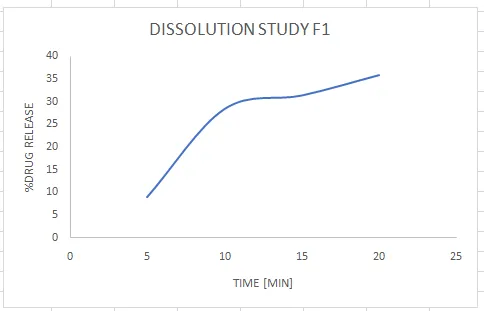
DISSOLUTION STUDY FOR FORMULATION 1
|
TIME |
% OF DRUG RELEASE |
|
5 min |
9 |
|
10 min |
28.5 |
|
15 min |
31.5 |
|
20 min |
36 |
FORMULATION – 2
|
FORMULATION- 2 |
HARDNESS |
THICKNESS |
WEIGHT |
D.T. |
FRIABILITY |
|
3.2 |
3.32 |
241.6mg |
09 min 58 sec |
0.194% weight loss |
|
|
2.9 |
3.14 |
242mg |
10 min 09 sec |
0.194% weight loss |
|
|
3.0 |
3.10 |
240mg |
09 min 50 sec |
0.194% weight loss |
|
|
3.0 |
3.19 |
242.5mg |
09 min 45 sec |
0.194% weight loss |
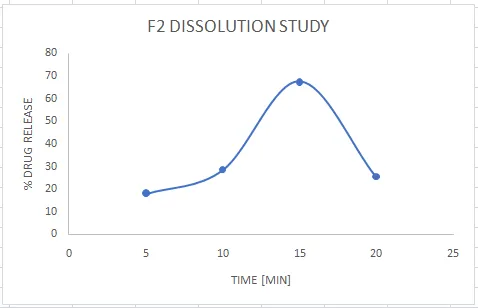
DISSOLUTION STUDY FOR FORMULATION 2
|
TIME |
% OF DRUG RELEASE |
|
5 min |
18 |
|
10 min |
28.5 |
|
15 min |
67.5 |
|
20 min |
25.5 |
FORMULATION – 3
|
FORMULATION-3 |
HARDNESS |
THICKNESS |
WEIGHT |
D.T. |
FRIABILITY |
|
3.2 |
3.47
|
241.6mg |
07 min 47 sec |
0% weight loss |
|
|
3.0 |
3.65 |
242mg |
07 min 58 sec |
0% weight loss |
|
|
2.9 |
3.56 |
240mg |
07 min 50 sec |
0% weight loss |
|
|
3.1 |
3.55 |
242mg |
08 min 10 sec |
0% weight loss |
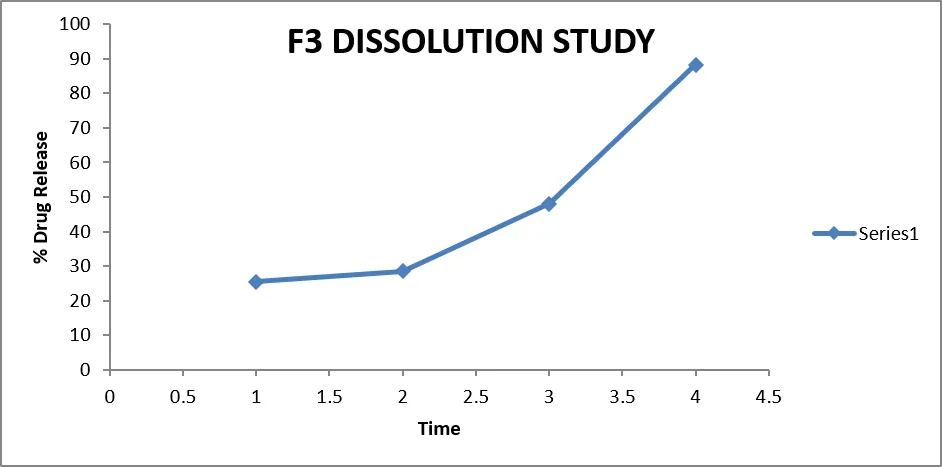
DISSOLUTION STUDY FOR FORMULATION 3
|
TIME |
% OF DRUG RELEASE |
|
5 min |
25.5 |
|
10 min |
28.5 |
|
15 min |
48 |
|
20 min |
88.2 |
DISSCUSSION
The study underscores the potential of polymer-based formulation strategies in transforming the pharmacokinetic properties of existing drugs, ultimately improving patient compliance, therapeutic outcomes, and overall disease management. Therefore, it can be concluded that Canagliflozin, when formulated as an immediate release tablet, offers a significant improvement in the treatment of type 2 diabetes mellitus, providing faster relief and more efficient control over blood glucose levels.
CONCLUSIONS
The present investigation highlights the successful development of an immediate release formulation of Canagliflozin, tailored specifically to meet the urgent therapeutic requirements in the management of type 2 diabetes mellitus. Traditionally, Canagliflozin exhibits a relatively long half-life and delayed onset of action, which, although effective for long-term glycemic control, may not be ideal in situations demanding rapid therapeutic response. This study addressed this limitation by designing a formulation capable of delivering the drug in a significantly shorter timeframe. Through a comprehensive preformulation study involving key analytical techniques such as IR Spectroscopy, UV-Spectrophotometry, solubility profiling, and melting point analysis, the compatibility of Canagliflozin with various pharmaceutical excipients was thoroughly evaluated. Sodium starch glycolate was selected as the primary disintegrating polymer due to its high swelling capacity and efficiency in promoting rapid tablet disintegration. Formulation trials were conducted in three consecutive batches with varying polymer ratios to fine-tune the drug release profile. These formulations were then subjected to in-vitro evaluation parameters, including disintegration time, dissolution studies, friability, and hardness testing. The findings revealed that the optimized formulation achieved a remarkable reduction in drug release time from approximately 10 hours to just 15 minutes for a 100 mg tablet, without compromising the physical integrity and quality of the dosage form. This advancement not only enhances the onset of Canagliflozin’s therapeutic action but also broadens its clinical applicability, especially in emergency scenarios where immediate glucose regulation is critical.
ABBREVIATIONS-
SGLT2- sodium-glucose co-transporter 2
UV- Ultra Violet
IR- Infra Red
ACKNOWLEDGMENTS
We acknowledge all of authors and co-authors.
REFERENCES


Aveek Datta, Adarsha Ganguly, Biplab Debnath, Design, Characterisation and Evaluation Study for Immediate Release Formulation of Canagliflozin, Int. J. of Pharm. Sci., 2026, Vol 4, Issue 8, 4847-4857, https://doi.org/10.5281/zenodo.22154805
 10.5281/zenodo.22154805