

We use cookies to ensure our website works properly and to personalise your experience. Cookies policy
Vijayrao Naik College of Pharmacy, Shirval.
This project focuses on the formulation and evaluation of polyherbal anthelmintic gummies utilizing seed extracts of Carica papaya and Cucurbita maxima. Motivated by the global challenge of parasitic worm infestations and rising resistance to conventional anthelmintics, as well as issues of accessibility and affordability in underdeveloped regions, this research explores the synergistic efficacy of papaya and pumpkin seeds—both well-documented in traditional medicine for their anthelmintic properties. The prepared gummies were assessed for physical, chemical, and in vitro pharmacological parameters using Pheretima Posthuma as a model organism and compared with the standard drug albendazole. Results demonstrated that the herbal gummies possess promising anthelmintic activity, offering a safe, palatable, and cost-effective alternative suited especially for paediatric use and low-resource settings. The findings support further development of these gummies as accessible nutraceuticals and lay a foundation for future clinical validation and scale-up as eco-friendly remedies for deworming therapy
Helminths
According to estimates from the World Health Organization, two billion individuals are infected with parasitic worms. Anthelmintic resistance has grown to be a major worldwide problem. Furthermore, because these drugs are expensive or unavailable, impoverished people in developing nations have little access to them. Because of these conditions, herbal remedies are now used instead of anthelmintics. In recent years, there has been an increase in interest in the assessment of medicinal herbs having anthelmintic qualities. When worms like tapeworms, roundworms, or pinworms infest a part of the body, a condition called helminthiasis develops. Although they can burrow into the liver and other organs, the worms mostly reside in the gastrointestinal tract. They harm the host by depriving him of food, causing blood loss, and discharging toxins. There are three different kinds of parasitic worms: nematodes, commonly referred to as roundworms, cestodes, sometimes called tapeworms, and trematodes, also called flukes. Anthelmintic drugs either work locally to remove parasite worms from the gastrointestinal tract or systemically to eradicate adult helminths or developing forms that infiltrate organs and tissues. [1]
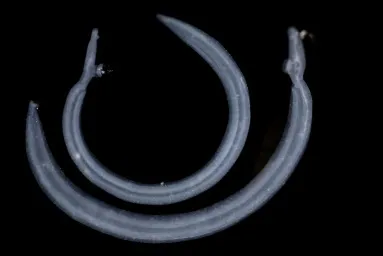

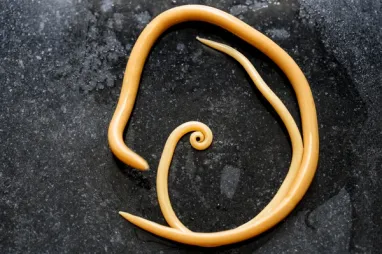
Fig no 1: Trematodes Fig no 2: Cestodes Fig no 3: Nematodes
Common symptoms of helminths are
Mechanism of action
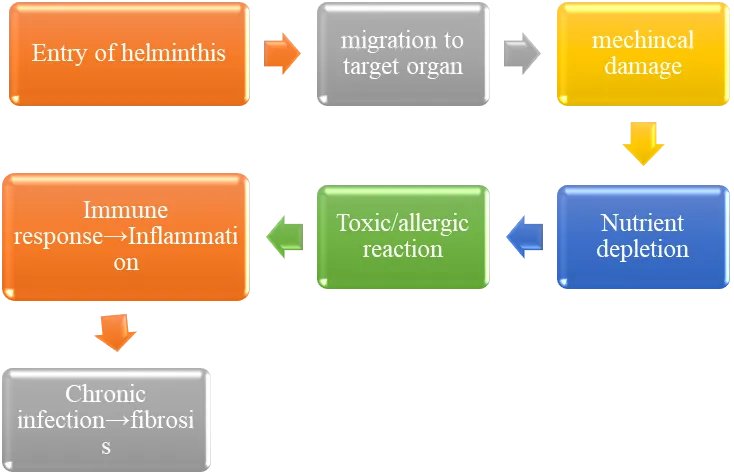
Fig no.6: Mechanism of Action
Herbal Active Ingredient
Carica papaya
Carica papaya Linn. is a tropical plant. This plant is frequently grown in tropical and subtropical regions and is a member of the Caricaceae and Brassicas families. With biological processes that include antioxidants, anti-inflammatory, anti-cancer, anti-bacterial, and anti-fungal qualities, it is an extremely nutritious fruit. Benzyl isothiocyanate (BITC), an isothiocyanate (ITC), is one of the trace elements and amino acids it includes. It is a very common fruit with antibacterial, antifungal, anti-inflammatory, anti-cancer, and antioxidant properties.[2] Papaya fruits are delicious and nutritious. Benzyl isothiocyanate decreased parasites' energy consumption and motor activity, according to in vitro studies. According to a study, the main anthelmintic agent assessed using Caenorhabditis elegans was benzyl isothiocyanate from Carica papaya Linn. seed extract. There is ample evidence that the stem, bark, blossoms, roots, and seeds can be used to treat a variety of ailments, including dengue, ulcers, and parasite infections. Their roles in treating helminth infections are particularly noteworthy.[3]
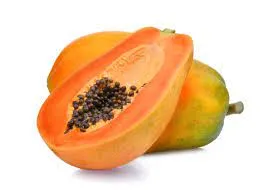
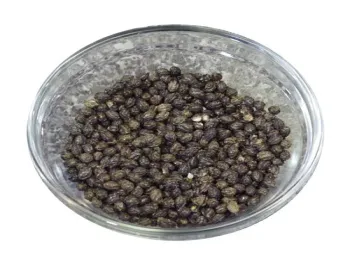
Fig No.7: Papaya Fruit Fig No.8: Papaya Seeds
Cucurbita maxima
Cucurbita maxima is a member of the Cucurbit ales order's Cucurbitaceae family. This herb either utilizes tendrils to climb or grows along the ground. Several to hundreds of flat, oval seeds that can be colored or garlanded are present in the fruit. Edible and medicinal seed oil are produced by some farmers. Due to an emphasis on the plant seeds, little research has been done on the chemical makeup of Cucurbita maxima plants. Four fatty acids—palmitic, stearic, oleic, and linoleic—as well as calories can be found in pumpkin seeds. Lipase, urease, and phytosterols are examples of enzymes. Research reveals the seeds' vermifuge, tonic, and diuretic qualities. It has been demonstrated that aqueous Cucurbita maxima seed extract is an efficient anthelmintic.[4] Tapeworms have been treated with the plant seed in Ayurvedic medicine. The efficacy of the aqueous, alcoholic, and ethereal seed extracts against trematodes, cestodes, and nematodes was assessed both in vitro and in vivo. Aqueous, alcoholic, and ether extracts showed declining efficacy in in vitro tests. According to kymographic studies, seed extract causes temporary paralysis and decreases motility. Pumpkin seeds have traditionally been used in traditional medicine around the world to treat a number of gastrointestinal parasite-related illnesses, including anthelmintic, prostate hyperplasia, urinary dysfunction and dysuria, diabetes, cardiovascular disease, and hypertension.[5]
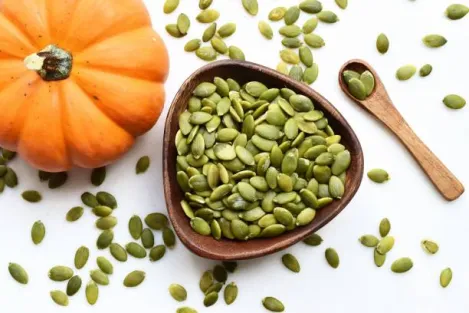

Fig no.8: Pumpkin Seeds Fig no.9: Pumpkin Tree
Combined Effect of Cucurbita Maxima and Carica Papaya
In order to treat illnesses caused by intestinal parasitic worms, a combination of papaya (Carica papaya) and pumpkin (Cucurbita maxima) seeds has emerged as a possible substitute for anthelmintic therapy. Both herbs have long been utilized in traditional medicine to treat a variety of illnesses, including helminthiasis.[6] Anthelmintic action of seeds: Research has shown that when mixed extracts of papaya and pumpkin seeds are tested in vitro against the earthworm Pheretima posthuma, a model organism similar to human intestinal roundworms, they show notable anthelmintic qualities.[7] These effects were shown to be dose dependent, with higher doses causing the worms to become paralyzed and die more quickly. The combination has great potential as an alternative herbal therapy for intestinal worm infestations, as evidenced by some tests where it performed better than the standard medication bendazole. [8]
Gummies
Among the formulations used are solutions, suspensions, emulsions, gummies, tablets, capsules, and nanoparticles. Increased patient compliance, cost effectiveness, dosage flexibility, ease of administration, and convenience are just a few advantages of oral medicine delivery systems.[9] However, challenges such as varying stomach pH and enzymes, limited bioavailability, food-drug interactions, gastrointestinal side effects, and stability and potency issues must be addressed. To solve these problems, a variety of techniques are employed, including liposomes, nanotechnology, microencapsulation, polymer-based delivery systems, and 3D printing.
These technologies enable targeted distribution, improved bioavailability, and controlled release rates. Future directions for oral drug delivery systems include personalized medicine, targeted delivery systems, combination therapies, new excipients and formulations, and digital health integration. These developments must be compliant with regulatory requirements, including FDA guidelines, Good Manufacturing Practices (GMPs), labelling and claims regulations, and bioequivalence studies. Anthelminthic candies are one type of oral medicine delivery system used to treat parasite infections. These candies, which have long been used to assist the body get rid of parasites, contain natural ingredients like wormwood, black walnut, cloves, garlic, papaya, pumpkin seed, turmeric, and Calotropis gigantea.[10]
Marketed Formulation
Table No:1.1 Marketed Formulation of Helminths
|
Brand Name |
Ingredients |
Image |
|
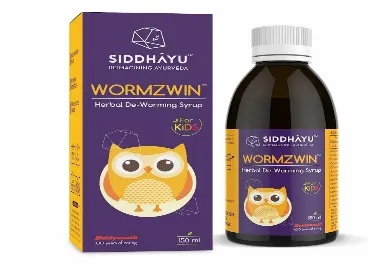
Siddhayu Wormzin Herbal deworming syrup |
Picrorhiza kurroa, Cyperus rotundus, Ocimum basilicum, Apium graveolens, Punica granatum |
|
|
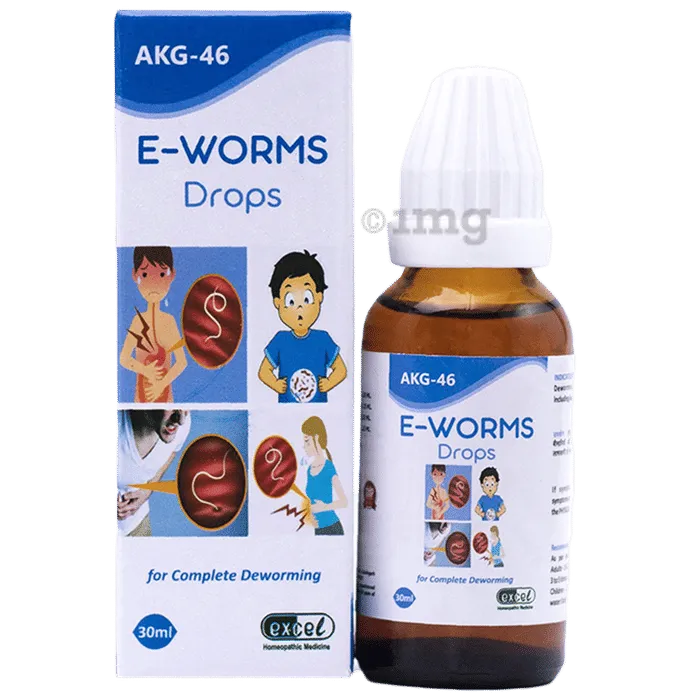
E-worms drops |
Crafted with natural ingredients such as Cina, Teucrium Marum Verum, Filix Mas, and Sabadilla
|
|
|
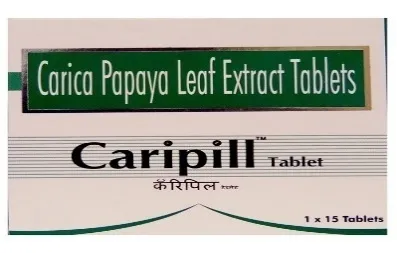
Caripill Tablet |
Extract of eranda karkati (Carica papaya Leaf) |
|
|
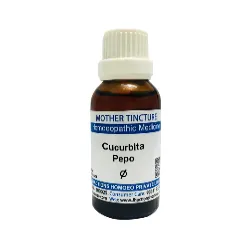
Cucurbita Pepo Homeopathy Mother Tincture Q |
Extract of the Cucurbita pepo plant (pumpkin). |
|
MATERIAL, EQUIMENTS AND INSTRUMENTS
Table no.1.2: List of Equipments
|
Sr.No |
Name Of Instrument |
|
1 |
Autoclave |
|
2 |
Magnetic Stirrer |
|
3 |
Incubator |
|
4 |
Heating Mantle |
|
5 |
IR Spectrophotometer |
|
6 |
UV Spectrophotometer |
|
7 |
pH Meter |
|
8 |
HPLC |
|
9 |
Laminar Air Flow |
Table no. 1.3: List of Materials
|
Sr.no |
Ingredients |
|
1 |
Carica Papaya Seed Extract |
|
2 |
Cucurbita Maxima Seed Extract |
|
3 |
Pectin |
|
4 |
Citric Acid |
|
5 |
Sucrose , Glucose Syrup , Honey |
|
6 |
Pineapple Syrup |
|
7 |
Sorbitol |
|
8 |
Corn Oil |
|
9 |
Potassium Sorbate |
|
10 |
Purified Water |
PLANT AND EXCIPIENT PROFILE
Plants Profile
Carica Papaya [11]
Table No.1.4: Profile of Carica Papaya
|
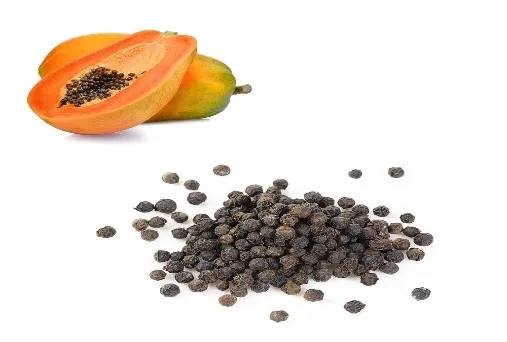
Fig No.10: Papaya fruit and seed |
|
|
Kingdom |
Plantae |
|
Family |
Caricaceae |
|
Genus |
Carica |
|
Species |
Carica papaya Linn. |
|
Common name |
Papaya/Paw Paw |
|
Biological sources |
Papaya seeds are obtained from the fruit of plant Carica papaya L. |
|
Morphology |
Plant: Single-stemmed herbaceous tree, 5–10 m tall. Leaves: Large, palmately lobed with hollow petioles. Flowers: Dioecious or hermaphroditic, ivory-white. Fruits: Large, oval, yellow-orange when ripe with central seed cavity. Seeds: Black, round. |
|
Chemical Constituents |
Active constituent: benzyl isothiocyanate, |
|
Other constituent: Caprine, glucosinolates, β-sitosterol and myosin, etc |
|
|
Distribution |
Native to Tropical America; now cultivated widely in India, Southeast Asia, Africa and tropical/subtropical regions across the world. |
Cucurbita maxima.[12]
Table no.1.5: Profile of Cucurbita maxima.
|
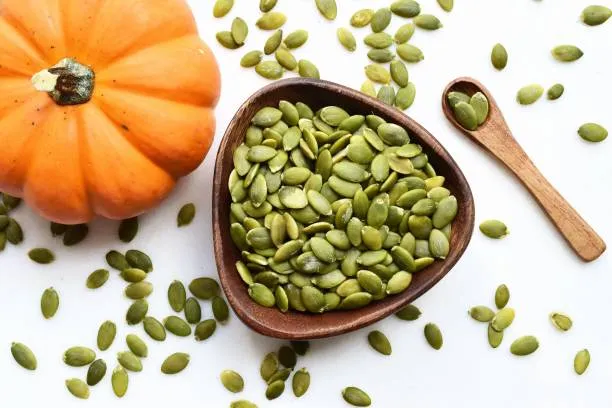
Fig No.11: Cucurbita Maxima fruit and seed |
|
|
Kingdom |
Plantae |
|
Family |
Cucurbitaceae |
|
Genus |
Cucurbita |
|
Species |
Cucurbita maxima |
|
Common name |
Pumpkin |
|
Biological sources |
Pumpkin seeds are obtained from the dried, mature fruits of Cucurbita maxima Linn. |
|
Morphology |
Plant: Trailing or climbing herb with soft, hairy stems and coiled tendrils. Fruits: Large, round to oblong berries with a thick, orange rind and fibrous pulp. Seeds: Flat, ovate, smooth, whitish seeds with oily endosperm enclosed in a thin hull. |
|
Chemical Constituents |
Active ingredient: Cucurbitacin. |
|
Other constituents: Linoleic acid, Stigmasterol, xanthin A and B, Manganese and Potassium, etc. |
|
|
Distribution |
Native to Central and South America, Cucurbita maxima is now cultivated widely across India, China and Africa. |
Excipients Profile
Honey[13]
Table No.1.6: Profile of Honey
|
Common Name |
Honey |
|
Appearance |
Clear to slightly turbid, viscous liquid |
|
Biological Source |
Natural sweet substance produced by honey bees |
|
Solubility |
Freely and completely soluble in water and partially soluble in organic solvent |
|
Storage Condition |
Stored in well closed container at cool temp. |
|
Category |
Sweetener |
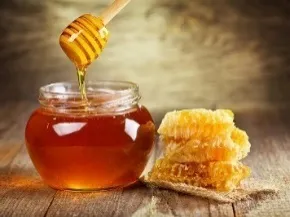
Fig No.12: Honey
Pineapple Syrup [14]
Table No.1.7: Profile of Pineapple Syrup
|
Common Name |
Pineapple Sugar Syrup |
|
Appearance |
Golden yellow with a distinct pineapple flavour. |
|
Biological Source |
Obtained from plant ananas comosus (l.) Merr. |
|
Solubility |
Highly soluble in water. |
|
Storage Condition |
Room temp, sealed; frozen for concentrate |
|
Category |
Flavouring Agent |

Fig No.13: Pineapple Syrup
Pectin[15]
Table no.1.8: Profile of Pectin
|
Common name |
Pectic polysaccharide |
|
Appearance |
White/yellowish, odourless/scented powder |
|
Molecular formula |
C6H10O7 |
|
Solubility |
Hot water: soluble cold water: lumpy |
|
Category |
Gelling Agent |
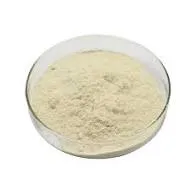
Fig No.14: Pectin
Sorbitol[15]
Table No.1.9: Profile of Sorbitol
|
Common Name |
D-Glucitol, Sorbite |
|
Appearance |
White/crystalline solid or colourless viscous syrup |
|
Molecular Formula |
C6H14O6 |
|
Solubility |
Highly soluble in water, slightly in alcohol |
|
Category |
Humectant, Softener |
|
Storage |
Room Temperature |

Fig No.15: Sorbitol Powder
Corn Oil [15]
Table No.2: Profile of Corn Oil
|
Synonyms |
Maize Oil |
|
Appearance |
A pale yellow to golden yellow, faintly characteristic oil. |
|
Biological Source |
Obtained from the germ (embryo) of the maize plant. |
|
Solubility |
Insoluble in water, soluble in organic solvent |
|
Storage Condition |
Keep in well-closed, amber-colour containers to prevent oxidation and rancidity |
|
Category |
Fixed oil; Edible vegetable oil |
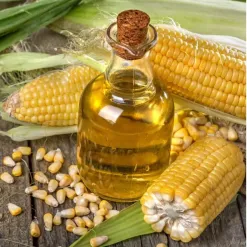
Fig No.16: Corn Oil
Citric Acid [15]
Table no.2.1: Profile of Citric Acid
|
Common Name |
Citric acid |
|
Appearance |
Colorless or white odourless powder |
|
Molecular Formula |
C6H8O7 |
|
Solubility |
Freely soluble in water, insoluble in polar solvent |
|
Category |
Stabilizer |
|
Storage |
Stored in tightly closed container, prevent moisture. |
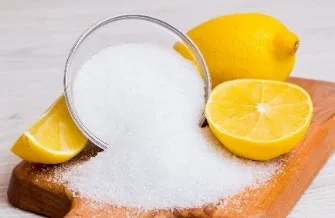
Fig no.17: Citric Acid
Potassium Sorbate[15]
Table no.2.2: Profile of Potassium Sorbate
|
Synonym |
Hexadienoic Acid |
|
Appearance |
potassium salt having sorbate as counterion |
|
Molecular Formula |
C6H7KO2 |
|
Solubility |
Soluble in water |
|
Category |
Preservative |
|
Storage |
Keep in a dry and well-ventilated place. |
Fig no.18: Potassium Sorbate
METHODOLOGY IDENTIFIED
Procedure[16,17]
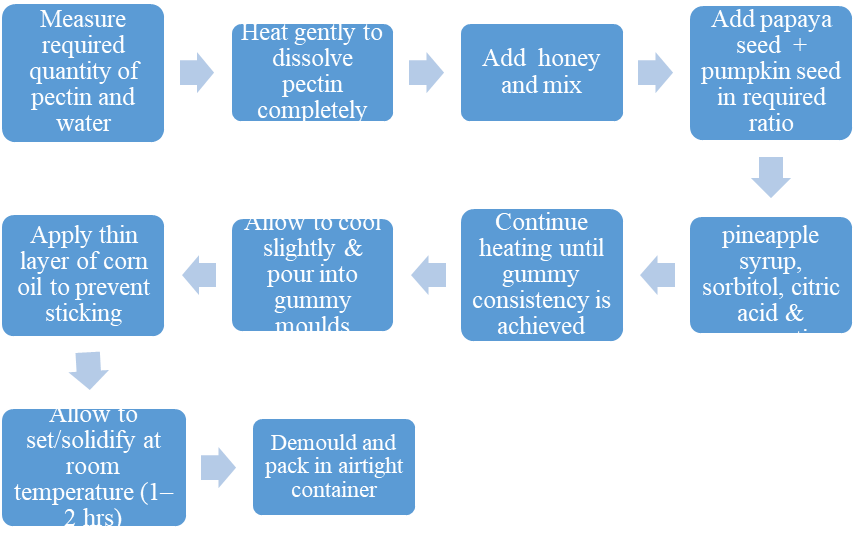
Fig no.19: Procedure of Gummies
Formulation table
Table No 2.3: Tentative formula for preparation of anthelmintic gummies. [17,18]
The formulation table is based on theoretical study and quantity may vary while practical performance.
Evaluation Parameter [19,20,21,22]
Preformulation Study
Color, odor, taste, and appearance of crude drug will be identified
2. Solubility
Checked solubility of herbal extracts using different solvents such as water, methanol and ethanol.
The herbal extract's safe storage limit is determine by measuring its melting point. The extract is put in a capillary tube and heat using the capillary method until it starts to melt, revealing its melting point.
A calibration curve will be perform using standard dilutions and measuring their absorbance at λmax. The drug concentration in dissolution samples is then ascertained using this curve.
Post formulation Study
1. Physical appearance
The gummies will be examined physically for colour, taste, shape, texture and clarity etc.
2. pH
Using a pH meter, acidic gummies should normally have a pH between 2.3 and 2.8 for appropriate gelling and microbiological stability.
3. Moisture Content
Assessed by drying and weighing samples; often found in gummies in the range of 10–16%; essential for chewiness and spoiling prevention.
4. Weight Variation
Weighing each person separately and measuring with callipers guarantees precise dosage and uniformity among customers.
5. Uniformity Studies
Quantify uses analytical techniques like spectrophotometry or chromatography to quantify the distribution of the anthelmintic drug or agents in each dose.
6. Hardness
Measured using a texture analyser to determine bite, chew, and feel properties of gummies.
7. Swelling Ratio
A straightforward technique for figuring out a gel structure's ability to absorb water is the swelling ratio test. The final formulation's gummies were weighed before being submerged in 100 milliliters of purified water for half an hour. Any extra water on the gummy surface was then wiped away with filter paper. The weight difference before and after immersion was divided by the initial weight of the gummy tablet to get the swelling ratio. The gummies were weighed again.
8. Dissolution Test
To assess the gummies' active compounds' dissolving properties and guarantee a steady and efficient release under simulated gastrointestinal circumstances. Jelly was successfully drug-dissolved in vitro using a USP paddle device type 2 and 900 ml of phosphate buffer 6.8 as the dissolution media at 50 rpm. The temperature was kept at 37 degrees Celsius, plus or minus 0.5 degrees. 5 milliliters of the sample were taken out of the dissolving apparatus and replaced with fresh dissolving medium at prearranged intervals of 5, 10, 15, 20, 25, 30, 35, 40, 45, 50, 55 and 60 minutes. The release mechanism was determined using a UV spectrophotometer, and kinetic models were employed to calculate the release research.
9. In-Vitro Anthelmintic Activity
Selection of the test organism Pheretima after death. Make a solution of gummy extract in various quantities. Put the worms in Petri dishes with the mixture in them. Note the paralysis time (P). Note the death time (D). Compare the outcomes to the norm.
10. Stability Study
Anthelmintic gummies that have just been made are packed in airtight containers and kept at various temperatures, including room temperature (25°C/60% RH) and accelerated (40°C/75% RH). Samples are assessed for physical changes (texture, odor, appearance), physicochemical characteristics (pH, moisture content, weight variation, hardness, drug content), microbiological growth, and functional activity at intervals of 0, 15, 30, 60, and 90 days. To determine whether the gummies continue to be stable, safe, and effective over the course of the trial, all observations are documented.
Expected results
The result is based on theoretical study and outcome may change after practical performance.
Table No.9.1 Expected Result
|
Sr No. |
Evaluation Parameter |
Expected Results |
|
1 |
Physical Appearance 1: Colour 2: Flavour 3: Shape 4: Texture |
Light Yellow Sweet Uniform, Rounded or Oval Shaped Non- Sticky |
|
2 |
pH |
Slightly Acidic |
|
3 |
Moisture Content |
10 – 16% |
|
4 |
Weight Variation |
±5% |
|
5 |
Hardness |
Moderate, Reproducible Firmness |
|
6 |
Dissolution Test |
60 minutes |
|
7 |
Swelling Ratio |
79% |
|
8 |
In-Vitro Anthelmintic Activity |
~110-120 Min |
|
9 |
Stability study |
Will be stable at room temperature |
FUTURE PROSPECTS
The prospects for developing anthelmintic gummies from Carica papaya seeds and Cucurbita maxima seeds are quite attractive. Ongoing research confirms the effectiveness of these seeds against intestinal parasites and they are a safe, child-friendly and cost-effective alternative to traditional medications. Improvements may include improved delivery mechanisms, increased clinical validation and large-scale manufacture, making them viable as low-cost, environmentally friendly nutraceuticals or therapies, particularly in areas with limited access to commercial anthelmintics.
CONCLUSION
In this project, papaya and pumpkin seed extracts will be used to create polyherbal anthelmintic gummies. Pectin will be used as a gelling agent, along with appropriate sweetners, flavoring agents and stabilizers. The gummies are supposed to have optimal properties such as consistent shape, pleasant taste, suitable hardness, acceptable moisture content, and stability. Overall quality will be determined using evaluation parameters such as weight variation, pH, hardness, and in-vitro anthelmintic activity. Thus, the study will provide evidence that herbal gummies containing Carica papaya and Cucurbita maxima extracts can be a safe, cost-effective, and efficient natural parasite management option. This formulation has significant potential for nutraceutical applications and future clinical validation as an accessible herbal deworming medication.
REFERENCES





Namita Sagavekar, Mrunmayi Bhise, Sangram Dahiphale, Yuvraj Chavan, Deepak Bhujbhal Development And Evaluation of Polyherbal Anthelminthic Gummy Candies Containing Carica Papaya and Cucurbita Maxima Seeds, Int. J. of Pharm. Sci., 2026, Vol 4, Issue 5, 7898-7912, https://doi.org/10.5281/zenodo.20444334
 10.5281/zenodo.20444334