

We use cookies to ensure our website works properly and to personalise your experience. Cookies policy
S.C.S.M.S.S., Institute of Pharmacy and Research, Maregaon, India 445303
The present study focuses on the formulation and evaluation of a herbal topical balm containing Illicium verum extract/oil for analgesic and anti-inflammatory applications. Herbal formulations have gained considerable importance due to their safety, effectiveness, biocompatibility, and reduced side effects compared to conventional synthetic preparations. Star anise is well known for its rich phytochemical constituents such as trans-anethole, flavonoids, and essential oils, which exhibit antimicrobial, antioxidant, analgesic, and anti-inflammatory properties. In this study, star anise fruits were collected, dried, powdered, and subjected to Soxhlet extraction using ethanol. Identification tests and Thin Layer Chromatography (TLC) were performed for confirmation of anethole, the major active constituent. The balm was prepared using beeswax, petroleum jelly, menthol, camphor, and eucalyptus oil as formulation ingredients. Three different formulations (F1, F2, and F3) were developed and evaluated for various physicochemical parameters including colour, odour, texture, homogeneity, pH, viscosity, spreadability, washability, and skin irritation. The evaluation results showed that all formulations possessed acceptable physicochemical characteristics with good stability and non-irritant nature. Among all batches, formulation F2 exhibited optimum properties with suitable pH, good spreadability, smooth texture, and satisfactory viscosity. The prepared balm demonstrated promising analgesic and anti-inflammatory potential for topical application. The study concludes that star anise balm can be considered an effective and safe herbal topical formulation for pain relief and anti-inflammatory therapy with improved patient compliance and therapeutic benefits.
A traditional or Ayurvedic topical semi-solid anhydrous preparation, balm is frequently used to treat body aches and pains. For the balm to be effective, you typically need to rub or massage it into your skin. Compared to ointments, they are typically more viscous. Because balms are moisture-resistant, occlusive, and water-resistant, they are better suited for topical application. Additionally, because they are absorbed gradually, they are longer-lasting and chemically and physically durable without the use of preservatives. Because herbal medication is more effective, less expensive, easier to use, better for the body, and has less side effects, more people are requesting it. People practice personal hygiene to maintain their cleanliness and well-being.[1]
After being cleared of contaminants, star anise was dried thoroughly to eliminate moisture. Fresh Illicium verum fruit was gathered from a Maregaon local store. After that, it was broken up into tiny pieces and processed into a coarse powder using a grinder. The larger particles that were retained on the screen after the powder was run through a 40-mesh screen were ground again. The finished coarse powder was stored for later usage in an airtight container.
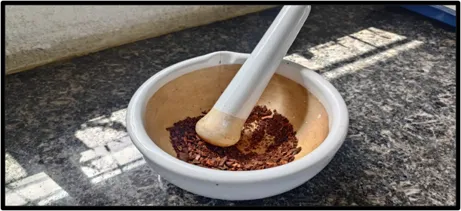
Fig.No. 3: Coarse Powder of Illicium verum
About 10 g of powdered Illicium verum fruit material was collected, extracted with 100 ml of ethanol, and let to go through the Soxhlet Extraction procedure for four to six hours. Following extraction, the extract was chilled and filtered. To obtain a concentrated extract, the solvent was evaporated in a water bath at a regulated temperature.
The concentrated extract was further dried to produce a semisolid mass, weighed to determine the yield percentage, and kept in an airtight container in a dry, cool environment for future research.[2]
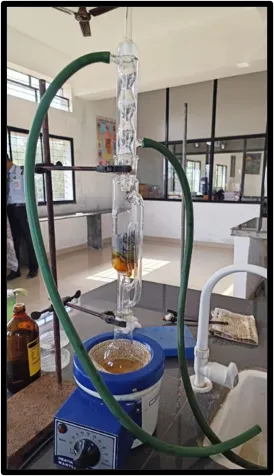
Fig. No. 4: Illicium Verum Extract
3. EXPERIMENTAL WORK
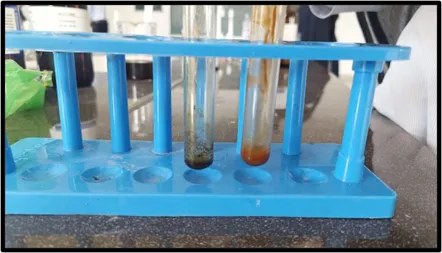
Fig. No. 5: Identification Test for Anethole
Table No. 1. Identification Test for Anethole
|
Sr. No. |
Tests |
Observation |
Inference |
|
1. |
Ferric Chloride Test: 1. Dissolve a small amount of sample in ethanol 2. Add a few drops of ferric chloride solution |
Yellowish or Brown colour |
Present |
|
2. |
Potassium permanganate Test:
|
Purple colour disappears |
Present |
To verify that star anise oil contains active phytoconstituents, identification tests are carried out. Chemical assays like the ferric chloride test and the potassium permanganate test are frequently used to identify phenolic compounds and unsaturated components in essential oils. Before using star anise oil in medicinal compositions, these tests are helpful in determining its purity and chemical characteristics.[3]
Anethole, the primary component of Star Anise oil, was identified by comparing the sample's Rf value and spot characteristics with those of the standard anethole reference chemical using thin-layer chromatography (TLC).
Preparation of Sample Solution.
Approximately 1 mL of star anise oil was dissolved in 5 mL ethanol to prepare the test solution. A little amount of pure anethole was dissolved in ethanol to create a separate standard anethole solution.
To eliminate moisture and increase adsorption capacity, the silica gel TLC plate was activated by placing it for half an hour at 105°C in a hot air oven. The activated plate was allowed to cool to room temperature before to use.
Toluene and ethyl acetate were combined in a 9:1 v/v ratio to create the mobile phase. The TLC chamber was filled with the solvent system, sealed, and given 15 to 20 minutes to saturate using filter paper lining.
On the TLC plate, tiny dots of the sample solution and standard anethole solution were carefully put using clean capillary tubes around one centimeter away from the plate's lower edge. To prevent overlapping during development, there was enough space between each place.
Inside the saturated TLC chamber with the mobile phase, the spotted TLC plate was positioned vertically. The spots were kept above the solvent level with great care. The plate was let to grow until the solvent front moved around 8 to 10 cm away from the starting point. Following development, the plate was carefully removed, and a pencil was used right away to mark the solvent front. At room temperature, the plate was dried.
In order to see the spots, the produced TLC plate was examined under UV light at 254 nm. Vanillin-sulfuric acid reagent was sprayed and then gently heated to form colored spots that corresponded to anethole for further detection. Spot visualization can also be achieved with an iodine vapor chamber.[4]
Calculation of Rf Value
The Rf value was calculated using the following formula:
Rf=Distance traveled by compound Distance traveled by solvent frontRf=Distance traveled by compound Distance traveled by solvent front

Table No.2: Observation table
|
Thin layer chromatography Observation |
|||
|
Solute front |
Solvent front |
Rf value |
Spot Colour |
|
3.4 |
5.2 |
0.65 |
Bluish purple |
3.3 PREPARATION OF BALM:
Beeswax and petroleum jelly were melted in a water bath at 70–75°C while being constantly stirred to create the balm basis. To get the right consistency, soft paraffin was added to the molten liquid. Camphor and menthol were gradually added to the base until they were entirely dissolved. To guarantee even dispersion throughout the formulation, the concentrated ethanolic extract of star anise was then added gradually while being continuously stirred. After allowing the produced balm to cool to room temperature, it was moved into sterile, airtight containers for additional assessment tests, including pH, spreadability, viscosity, and stability tests.[5]
Table No. 3: Formulation of Star anise balm
|
Sr. No. |
Ingredients |
Functions |
F1 |
F2 |
F3 |
|
1 |
Extract (Illicium Verum) |
Analgesic, anti-inflammatory |
0.2 g (2%) |
1 g |
2.5 g |
|
2 |
Bees wax |
Thickening and Emulsifying agent |
2.0 g |
4 g |
10 g |
|
3 |
Petroleum jelly |
Base material, Moisturizing agent, Provides smooth texture |
6.0 g |
13 g |
32.5 g |
|
4 |
Menthol |
Cooling agent; reduce pain and inflammation |
0.2 g |
0.2 g |
0.5 g |
|
5 |
Camphor |
Rubefacient; enhances local blood flow, warming effects |
0.1 g |
0.2 g |
0.5 g |
|
6 |
Sodium benzoate |
Preservative |
0.01 g |
0.02 g |
0.05 g |
|
7 |
Perfume (Eucalyptus oil) |
Aroma and added therapeutic value |
0.2 g |
0.4 g |
1 g |
|
|
|
|
10 g |
20 g |
50 g |
3.3.1 Balm Preparation:[6]
1. Weigh the petroleum jelly and beeswax precisely in a clean beaker.
2. Melt the materials entirely by heating the beaker in a water bath at 70 to 75 degrees Celsius.
3. To create a smooth base, gradually add liquid paraffin while stirring constantly.
4. Turn off the heat and let the mixture cool a little.
5. Stir constantly as you add the menthol and star anise oil.
6. Gently stir until a uniform, semisolid balm is created.
7. Pour the prepared balm into the appropriate receptacles.
8. Let the balm cool to room temperature so it solidifies.
9. Label and keep in a dry, cool location.
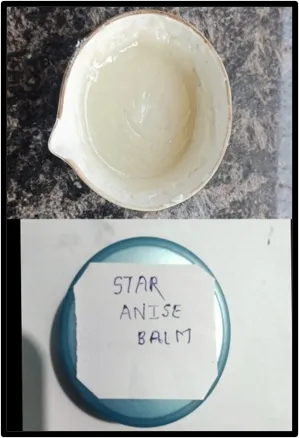
Fig. No. 7: Balm preparation
4. EVALUATION PARAMETER:-
4.2 pH Determination:-
A small quantity of star anise balm (1 g) was dispersed in To get a homogenous solution, thoroughly combine 10 milliliters of distilled water. A calibrated digital pH meter was used to measure the prepared solution's pH by submerging the electrode in the sample. and the pH value was recorded.[11]
4.3 Viscosity Determination:-
A tiny amount of star anise balm was combined with liquid paraffin and heated gently to obtain a uniform flowable liquid. The prepared sample was transferred into the Ostwald viscometer, the flow time between the marked points was recorded, and the viscosity was determined.[12]
4.4 Spreadability Test:-
A small quantity of star anise balm was sandwiched between two pristine glass slides, and a predetermined weight was positioned over the slides to create a consistent balm film. The upper slide was then pulled with the help of a weight, and The spreadability of the balm was assessed by timing how long it took the slide to go a predetermined distance.[13]
Formula
S=M×LT

Where:
4.5 Washability Test:
A small quantity of star anise balm was applied on the skin surface and washed with tap water after a few minutes. The ease of removal of the balm from the skin was observed and recorded to determine the washability of the formulation.[14]
4.6 Skin Irritation:
A small quantity of star anise balm was applied on a tiny portion of the skin and watched for a full day. for any signs of redness, itching, swelling, or irritation. The absence of these reactions indicated that the formulation was non-irritant and safe for topical application.[15]
Spreadability Calculation:
Formula
S=M×LT
Where:
Calculation
S=20×510.2
S=9.8 g⋅cm/sec
Therefore, the spreadability of the prepared balm was found to be 9.8 g·cm/sec.
Viscosity Calculation:
Formula η2=η1×ρ2t2ρ1t1
Calculation
η2=1×0.95×601×0.02
η2=2850 cP
Hence, the viscosity of the prepared star anise balm was determined to be 2850 cP.
Table No. 4: Evaluation Result
|
Sr. No. |
Evaluation Parameter |
F1 |
F2 |
F3 |
|
1. |
Colour |
White |
White |
White |
|
2. |
Odour |
Aromatic |
Aromatic |
Aromatic |
|
3. |
Texture |
Hard |
Smooth |
Smooth |
|
4. |
Homogeneity |
Homogeneous |
Homogeneous |
Homogeneous |
|
5. |
pH |
6.2 ± 0.1 |
6.5 ± 0.2 |
6.8 ± 0.1 |
|
6. |
Viscosity |
2450 ± 10 cP |
2850 ± 15 cP |
3400 ± 12 cP |
|
7. |
Spreadability |
8.5 ± 0.2 g·cm/sec |
9.8 ± 0.3 g·cm/sec |
7.2 ± 0.2 g·cm/sec |
|
8. |
Washability |
Good |
Good |
Moderate |
|
9. |
Skin irritation |
No irritation |
No irritation |
No irritation |
The physicochemical properties of the created star anise balm formulations, such as uniform appearance, smooth consistency, appropriate pH, and adequate spreadability, were satisfactory. The viscosity and texture of the formulations were affected by variations in the concentration of base materials; of all the batches, F2 showed the most balanced characteristics. During examination, it was discovered that the created balm was stable, simple to use, washable, and did not cause any symptoms of skin irritation. The formulation including star anise extract demonstrated good potential as a topical herbal treatment for pain relief and anti-inflammatory use, according to the overall results.
Three batches of star anise balm were successfully prepared and assessed in the current investigation (F1, F2, and F3). F2 demonstrated the best physicochemical characteristics of all the formulations, including a reasonable pH, good spreadability, acceptable viscosity, smooth texture, and good stability. It was discovered that the prepared balm was non-irritating and appropriate for topical use. For analgesic and anti-inflammatory purposes, star anise balm can therefore be regarded as a promising herbal preparation.
REFERENCES


Saniya Khamankar, Disha Turankar, Gaurav Meshram, Dr. Nilesh Chachda, Formulation and Evaluation of Star Anise Balm, Int. J. of Pharm. Sci., 2026, Vol 4, Issue 7, 1631-1638. https://doi.org/10.5281/zenodo.21261909
 10.5281/zenodo.21261909
Severity: 8192
Message: substr(): Passing null to parameter #1 ($string) of type string is deprecated
Filename: frontend/article.php
Line Number: 890