

We use cookies to ensure our website works properly and to personalise your experience. Cookies policy
Rajarambapu College of Pharmacy, Kasegaon, Walwa, Sangli, Maharashtra 415404
Typical liquid mouthwashes usually have high alcohol content, causing mucosal irritation, and are highly dependent on single-use plastic materials. The objective of this work is to develop and characterize an environmentally friendly, solidbased, alcohol-free effervescent mouthwash tablet based on raw herbal powders of Ocimum sanctum (Tulsi) and Syzygium aromaticum (clove). Tablets were prepared by direct compression technique, targeting a dosage of 200 mg. Three batch optimizations (F1, F2, F3) were performed to investigate the impact of different binder (PVP K-30) and water-soluble lubricant (PEG 6000) concentrations on the physical strength and effervescent nature of raw herbal fibers. Batch F2 with 5% PVP K-30 and 2% PEG 6000 was selected as the optimal formula. It possessed outstanding flowability before compression, satisfactory hardness (3.6 kg/cm²), low friability (0.62%), and fast effervescence (88 s) at a physiological pH of 6.45. This study shows that the optimized formula effectively addresses the challenges associated with poor compaction of raw herbs, resulting in a mechanically robust, handy, and environmentally friendly mouth cleaning system.
Good oral hygiene practice is essential for avoiding dental caries, gingivitis, and periodontal disease. Despite their clinical effectiveness, liquid-based mouthwashes exhibit certain pharmacologic and environmental limitations. The common commercial formulation for liquid mouthwash contains ethanol in a percentage of up to 25%, which has been known to cause xerostomia, mucosal desquamation, and burning sensation [19]. In addition, the need for liquid aqueous solution globally leads to high plastic use, leading to environmental pollution.Effervescent solid tablets represent an extremely novel approach [12]. Effervescent compounds involve a chemical interaction between soluble organic acids like citric and tartaric acids and alkali metal carbonate salts, such as sodium bicarbonate[13].The rapid formation of carbon dioxide gas occurs through a stoichiometric process in the presence of water.
The instant breakdown eliminates any necessity for mechanical mixing and ensures that a freshly prepared solution is available for use [17].
Crude powder formulations of Ocimum sanctum (tulsi) and Syzygium aromaticum (clove) were considered for their therapeutic value. Tulsi contains a significant quantity of ursolic acid and eugenol that possess a wide spectrum of antibacterial activity for oral plaque biofilms, without the staining effect caused by chlorhexidine [1,5,15]. Cloves exhibit excellent anesthetic and antifungal properties [7,9].
The current research work is concerned with improving the physicochemical properties of the raw plant powders through the modification of binders and water soluble lubricants. The purpose of this is to make raw plant fibers suitable for tablet compression by controlling the inherent elastic nature of plant fibers, thereby formulating an oral rinse preparation [2,11].
3. MATERIALS AND METHODS
3.1 Materials
The plant powder of Ocimum sanctum and Syzygium aromaticum was obtained from a botanical material vendor and sieved using mesh no. 120. The chemical compounds used included sodium bicarbonate, citric acid anhydrous, tartaric acid, polyvinylpyrrolidone K-30, PEG 6000, sorbitol, and peppermint flavoring agent [20].
3.2 Formulation Design and Optimization Strategy
A series of three experimental batches (F1–F3) were optimized to overcome the capping and sticking tendencies associated with elastic botanical fibers. Formulations were compressed using 200 mg tooling on a rotary press, with batch sizes fixed at 15 tablets (3000 mg total). The study prioritized varying the ratios of PVP K-30 and PEG 6000, utilizing sorbitol as a filler to ensure consistent weight across all variables [11].
3.3 Formulation Table
Target Tablet Weight: 200 mg | Batch Size: 15 Tablets | Method: Direct
Compression
|
Ingredients (mg/tablet) |
Role in Formulation |
Batch F1 |
Batch F2 (Optimized) |
Batch F3 |
|
Tulsi Crude Powder |
Active Botanical |
15 mg |
15 mg |
15 mg |
|
Clove Crude Powder |
Active Botanical |
15 mg |
15 mg |
15 mg |
|
Sodium Bicarbonate |
Effervescent Base |
75 mg |
75 mg |
75 mg |
|
Citric Acid (Anhydrous) |
Effervescent Acid |
35 mg |
35 mg |
35 mg |
|
Tartaric Acid |
Effervescent Acid/ Stabilizer |
15 mg |
15 mg |
15 mg |
|
PVP K-30 (Variable) |
Polymeric Binder |
4 mg (2%) |
10 mg (5%) |
16 mg (8%) |
|
PEG 6000 (Variable) |
Water-Soluble Lubricant |
2 mg (1%) |
4 mg (2%) |
8 mg (4%) |
|
Peppermint Flavor |
Flavoring Agent |
2 mg |
2 mg |
2 mg |
|
Sorbitol (Variable) |
Sweetener / Diluent |
52 mg |
44 mg |
34 mg |
|
Total Weight (per tablet) |
|
200 mg |
200 mg |
200 mg |
|
Total Batch Weight (15 tabs) |
|
3000 mg (3g) |
3000 mg (3g) |
3000 mg (3g) |
3.4 Manufacturing Procedure (Direct Compression)
4. EVALUATION PARAMETERS
4.1 Pre-Compression Evaluation
4.2 Post-Compression Physicochemical Evaluation
5. RESULTS AND DISCUSSION
5.1 Pre-Compression Results
The pre-compression analysis revealed that the optimization of excipients significantly impacted powder flow. Batch F3 exhibited sticky, cohesive properties (Angle of Repose: 33.2°) due to excessive PEG 6000 and PVP. Batch F2 demonstrated superior flow characteristics, an essential prerequisite for uniform die filling.
Table 1: Pre-Compression Parameters of Batches F1 - F3
|
Parameter |
F1 (Low Binder/ Lube) |
F2 (Standard/ Optimized) |
F3 (High Binder/ Lube) |
|
Angle of Repose (θ) |
29.4° (Good) |
27.8° (Excellent) |
33.2° (Passable/ Sticky) |
|
Bulk Density (g/mL) |
0.52 |
0.55 |
0.48 |
|
Tapped Density (g/mL) |
0.62 |
0.64 |
0.6 |
|
Carr's Index (%) |
16.12% |
14.06% |
20.00% |
|
Hausner Ratio |
1.19 |
1.16 |
1.25 |
5.2 Post-Compression Physicochemical Properties
Table 2: Comparative Post-Compression Evaluation
|
Parameter |
Limit/ Ideal |
F1 |
F2 (Optimized) |
F3 |
|
Average Weight (mg) |
200 mg |
198.5 mg |
201.2 mg |
197.8 mg |
|
Weight Variation (%) |
± 7.5% |
3.1% |
1.8% |
4.2% |
|
Hardness (kg/cm²) |
3.0 - 4.0 |
2.2 |
3.6 |
5.4 |
|
Friability (%) |
< 1.0% |
1.85% |
0.62% |
0.28% |
|
Effervescence Time (sec) |
< 180 sec |
32 sec |
88 sec |
92 sec |
|
Solution pH |
6.0 - 7.0 |
6.42 |
6.45 |
6.51 |
|
Visual Solution Clarity |
Suspension |
Rapid dispersion |
Uniform fine suspension |
Slow, clumpy |
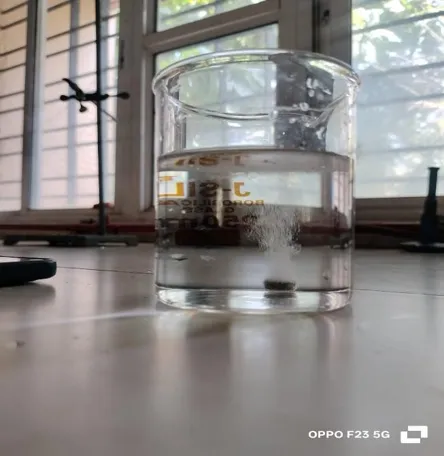
Fig 1: effervescence time testing of the optimized tablet (batch F2) in 15ml of purified water
Discussion of Physicochemical Optimization:
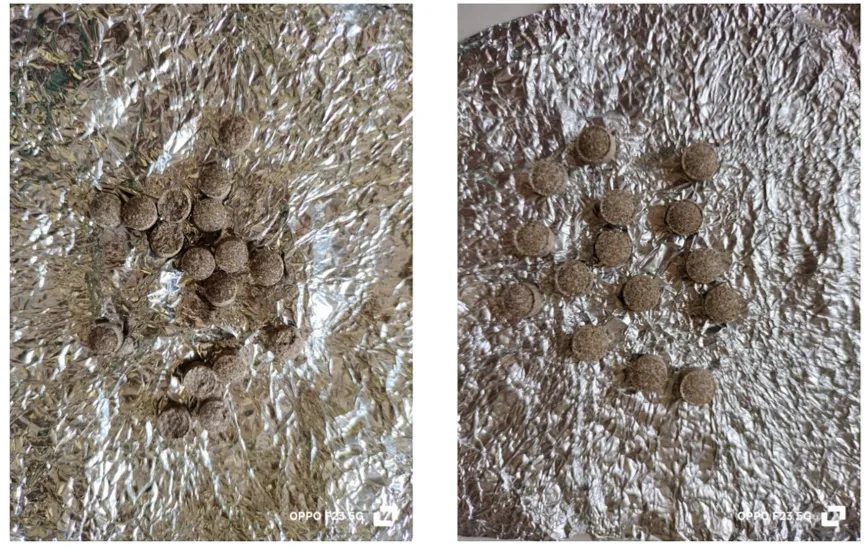
Fig (A) Fig (B)
Figure 2. Physical characteristics of directly compressed herbal effervescent tablets. (Left) Batch F1 prepared with low amount of binder (2% PVP K-30), exhibiting surface capping and edge degradation due to the stiff elasticity of the raw botanical fibers. (Right) The optimized Batch F2, prepared with higher binder content (5% PVP K-30), showed excellent structural integrity with smooth edges and no capping defects.
The variable study successfully established the mechanical boundaries of the effervescent system containing raw botanical fibers. Batch F1 (2% PVP K-30) failed friability testing (1.85%) and exhibited insufficient hardness (2.2 kg/cm²), demonstrating that elastic plant fibers require a robust polymeric binder to prevent capping and structural failure [2]. Batch F3 the high concentration of PEG 6000 created a hydrophobic barrier that prevented the aqueous medium from penetrating the tablet and reacting with the effervescent base [11].
Batch F2 was the scientifically optimized formulation. The 5% binder concentration was able to trap the elastic plant fibers in a stable matrix (0.62% friability) and the 2% PEG 6000 prevented the eugenol rich clove powder from sticking to the punches of the machine. The generation of a physiologically compatible pH of 6.45 yielded an ideal effervescence time of 88 s.
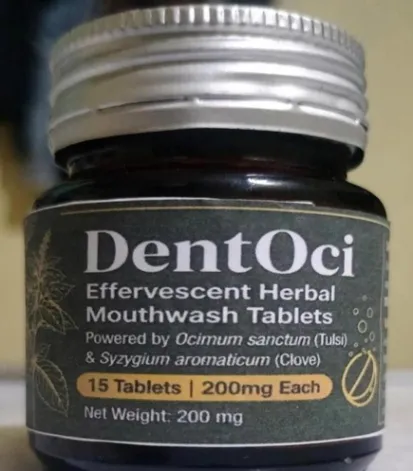
Figure 3: Final packaging of optimized herbal effervescent mouthwash formulation (Batch F2) in moisture resistant amber glass bottle
6. CONCLUSION
In this study, alcohol free solid dosage herbal effervescent mouthwash has been successfully prepared by direct compression. Critical structure requirement for compression of elastic botanical crude powders without capping or punchsticking was revealed by factorial optimization as 5% PVP K-30 and 2% PEG 6000 matrix (Batch F2). The optimized formulation exhibited excellent precompression flowability, ideal post-compression mechanical strength and fast effervescence time (88 s). Batch F2 shows a very stable, green and physically robust solid-dose alternative to conventional liquid oral rinses by substituting liquid ethanol with an anhydrous stoichiometric effervescent mix.
ACKNOWLEDGEMENT
We express our sincere gratitude to our respected guide, Dr. M. M. Nitalikar, for their invaluable guidance, constant encouragement, and insightful suggestions throughout the course of this project. Their expertise and support played a crucial role in the successful completion of this research work.
We would also like to extend my heartfelt thanks to our respected Principal , Dr. S. K. Mohite, for providing the necessary facilities, resources, and a conducive academic environment at Rajarambapu College of Pharmacy that enabled us to carry out this study effectively.
We are deeply thankful to all the teaching and non-teaching staff of the institution for their cooperation and assistance whenever required.
Finally, we would like to acknowledge our family and friends for their continuous motivation and support throughout this work.
REFERENCES



Sagar Khatal, Shravani Hanmane, Manojkumar Nitalikar, Formulation and Physicochemical Evaluation of an Alcohol-Free Effervescent Herbal Mouthwash Tablet Incorporating Ocimum sanctum and Syzygium aromaticum, Int. J. of Pharm. Sci., 2026, Vol 4, Issue 7, 1562-1568. https://doi.org/10.5281/zenodo.21260885
 10.5281/zenodo.21260885