

We use cookies to ensure our website works properly and to personalise your experience. Cookies policy
Sri Vasavi Institute of Pharmaceutical Sciences, Tadepalligudem,Andhara Pradesh, India.
A novel oral drug delivery technique, fast dissolving tablets (FDTs) dissolve rapidly in the mouth without the need for water. This increases patient compliance, especially in groups like children, the elderly, and psychiatric patients who have difficulty swallowing. Olanzapine, an atypical antipsychotic, often has issues with patient adherence due to the nature of bipolar disorder and schizophrenia. This review's goal is to draw attention to the formulation strategies—such as the use of taste-masking methods, superdisintegrants, and cutting-edge manufacturing technologies—that were employed in the creation of olanzapine FDTs.Significant findings demonstrate that techniques including direct compression, sublimation, and lyophilization, along with excipients like crospovidone and croscarmellose sodium, significantly enhance tablet disintegration and drug release characteristics. Finally, olanzapine FDTs offer a viable therapeutic option that is particularly useful in psychiatric treatment by improving medication adherence and maintaining a rapid onset of action
(2-Methyl-4-(4-methyl-1 piperazinyl)-10H-thieno [2,3-b] [1,5]benzodiazepine) Tardive dyskinesia is one of the extrapyramidal and therapeutic consequences associated with dopamine receptor antagonism. Antagonistic effects at H1 histamine receptors induce drowsiness and may lead to weight gain, although antagonistic actions at 5-HT2C receptors have also been connected to weight gain. Olanzapine has a higher affinity for 5-HT2 serotonin receptors than D2 dopamine receptors. Olanzapine's affinity for histamine, cholinergic muscarinic, and alpha-adrenergic receptors is lower than that of the earlier typical antipsychotics, as is the case with most atypical ones. Additionally, it exhibits a low affinity for the GABA receptor location, which could account for some of its sedative effects.1
Because oral drug delivery is convenient, affordable, and well-liked by patients, it remains the most popular method of administering medication. However, not everyone will benefit from standard dosage forms like pills and capsules, particularly young children, the elderly, and people with mental health conditions who frequently have difficulty swallowing. The need for simpler dose forms that facilitate administration and improve treatment outcomes has grown as a result of this circumstance.
Orodispersible tablets (ODTs), also known as fast dissolving tablets (FDTs), dissolve rapidly in the mouth without the need for water. However, there are still issues, such as taste masking, moisture sensitivity, handling strength, and formulation complexity. For development to be successful, these problems must be resolved.2
MATERIALS AND METHODS
Table No.1: Excipients and their category
|
Excipients |
Category |
|
Sodium starch glycolate |
Super disintegrant |
|
Cross povidone |
Super disintegrant |
|
Cross caramellose |
Super disintegrant |
|
Avicel |
Diluent/binder |
|
Talc |
Glidant/anti-adherent |
|
Mannitol |
Diluents/sweetening agent |
|
Magnesium sterate |
Lubricant |
Table No.2: Formulation of Olanzapine fast dissolving tablets
|
INGREDIENTS |
F1 (mg) |
F2 (mg) |
F3 (mg) |
F4 (mg) |
F5 (mg) |
F6 (mg) |
|
Olanzapine |
10 |
10 |
10 |
10 |
10 |
10 |
|
Sodium starch glycolate |
5 |
7.5 |
- |
- |
- |
- |
|
Cross povidone |
- |
- |
5 |
7.5 |
- |
- |
|
Cross caramellose sodium |
- |
- |
- |
- |
5 |
7.5 |
|
Mannitol |
65 |
65 |
65 |
65 |
65 |
65 |
|
Avicel |
65 |
65 |
65 |
65 |
65 |
65 |
|
Talc |
2.5 |
2.5 |
2.5 |
2.5 |
2.5 |
2.5 |
|
Magnesium sterate |
2.5 |
2.5 |
2.5 |
2.5 |
2.5 |
2.5 |
|
Total weight |
150 |
150 |
150 |
150 |
150 |
150 |
METHOD USED
Formulation Procedure:
1) All the ingredients were passed through mesh no.60 separately and collected.
2) The drug, mannitol, Avicel, were mixed uniformly with gentle trituration using motor and pestle to get a uniform mixture.
3) Required quantity of super disintegrant was weighed and mixed with above mixture.
4) Finally magnesium stearate and Talc were added and mixed well.
5) Finally the blend should be compressed in to tablets in rotary tablet punching machine.3.4
Direct Compression:
Easiest way to manufacture tablets is direct compression and advantages of direct compression is,
• Cost Effectiveness
• Faster Dissolution
• Less wear & tear of punches.
However, disintegration and dissolution of directly compressed tablets depend on single or combined effect of superdisintegrant, water soluble excipient. It is essential to choose a suitable and an optimum concentration of superdisintegrant to ensure quick disintegration.
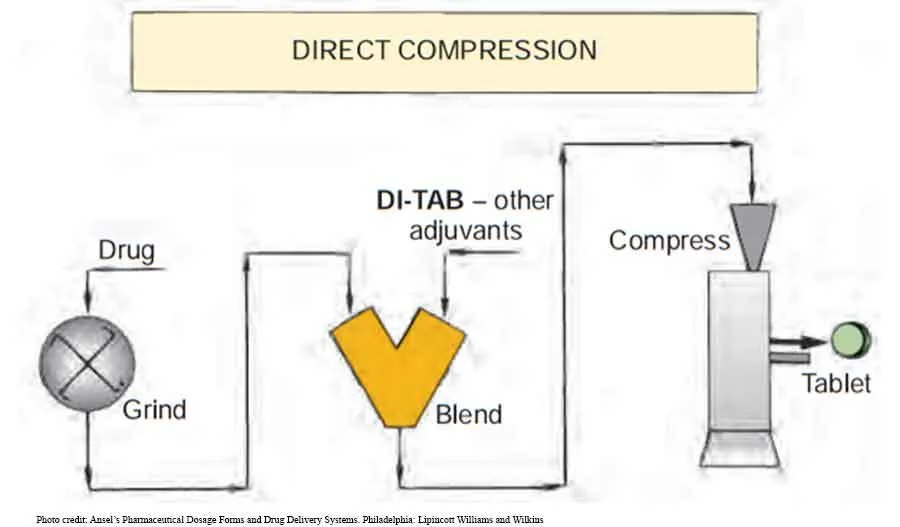
Figure no.1: Direct compression
PRECOMPRESSION PARAMETERS:
Bulk Density: Bulk density is defined as the mass of powder divided by bulk volume; it is calculated using the following equation:
Bulk density = weight of sample/volume
Tapped Density: An accurately weighed quantity of the powder (W) was carefully poured into the graduated cylinder and the volume (Vo) was measured. Then the surface was carefully smoothed and the volume was measured. Tapped density was calculated by measuring final volume (Vf) after 50 taps on wooden surface from 6 inch height and was expressed in g/cm3.
Tapped density = W/Vf
Where,
Vo= initial volume,
Vf = final volume
Compressibility Index & Hausner Ratio: The Compressibility index and Hausner ratio are measures of the propensity of a powder to be compressed. As such, they are measures of the relative importance of inter particulate interactions in a free-flowing powder, such interactions are generally less significant, and the bulk and tapped in a free-flowing powder, such interactions are generally less significant, and the bulk and tapped densities will be closer in value. For poorer flowing materials, there are frequently greater inter particle interactions and a greater difference between the bulk and tapped densities will be observed. These differences are reflected in the Compressibility Index and the Hausner Ratio.
Angle of Repose: The flow characteristics are measured by angle of repose. Improper flow of powder is due to frictional forces between the particles. These frictional forces are quantified by angle of repose. Angle of repose is defined as the maximum angle possible between the surface of a pile of the powder and the horizontal plane.
Tan Ө = h/r Ө = tan-1(h/r)
where,
Ө is the angle of repose
h is the height,
r is the radius. 5,6
EVALUATION OF TABLETS:
Weight Variation: Twenty tablets were randomly selected from each batch and individually weighed. The average weight and standard deviation of 20 tablets was calculated. The batch passes the test for weight variation test if not more than two of the individual tablet weight deviates from the average weight by more than the percentage shown in Table No. 8 and none deviate by more than twice the percentage shown
Table No.3: USP limits for weight variation
|
Average weight of tablet (mg) |
Percentage deviation (%) |
|
<130 |
10 |
|
130to 324 |
7.5 |
|
>324 |
5 |
Thickness: Three tablets were randomly selected from each batch and there thickness was measured by using vernier calipers. Thickness of three tablets from each batch was measured and mean was calculated.
Hardness: Hardness indicates the ability of a tablet to withstand mechanical shocks while handling. The hardness of the tablets was determined using Monsanto hardness tester. It is expressed in kp. Three tablets were randomly picked and hardness of the tablets was determined.
Friability: Friability test is performed to assess the effect of friction and shocks, which may often cause tablet to chip, cap or break. Roche friabilator was used for the purpose. This device subjects a number of tablets to the combined effect of abrasion and shock by utilizing a plastic chamber that revolves at 25 rpm dropping the tablets at distance of 6 inches with each revolution. Five tablets were weighed and placed in the Roche friabilator, which was then operated for 100rpm for 4 min. After revolution Tablets were de dusted and reweighed. Compressed tablets should not lose more than 1% of their weight.
The percentage friability was measured using the formula,
%F = {1-(Wo/W)}×100
Where,
%F = Weight of Friability in Percentage
Wo = Initial weight of tablet,
W= Weight of tablets after revolution. 7,8
In-Vitro disintegration time: The test was carried out in a disintegration apparatus using distilled water as disintegration medium (at 370 C±0.50C). A tablet was placed in each of six tubes of the apparatus and one disc was added to each tube. The time taken for completed is integration of the tablet with no mass remaining in the apparatus was measured in seconds.
Wetting time and water absorption ratio: A piece of tissue paper, folded double, was placed in a Petri plate containing 6ml of distilled water. A pre-weighed tablet was placed on the paper and the time for complete wetting of the tablet was measured in seconds. The wetted tablet was then weighed, Water absorption ratio was determined using the formula:
R = (Wa-Wb)/WaX100
Where,
R=Water absorption ratio,
Wa=Weight of tablet after wetting.
Wb= Weight of tablet before wetting.
Estimation of drug content: Five tablets from each formulation were weighed individually and powdered. The Powder was dissolved in10ml of Hcl and volume was adjusted to 100ml with Hcl. From this solution 1ml was taken and made upto 100ml using 0.1 Hcl and the solution was analyzed at 259nm by UV–visible spectrophotometer using buffer as the blank.
In Vitro drug release: In-vitro dissolution studies for all the formulated tablets of Olanzapine was carried out using USP II paddle method at 50 rpm in 900 ml 0.1N Hcl solution as a dissolution medium. The dissolution medium was maintained at 37±0.50C. 5ml of sample was withdrawn at 05 minutes intervals of time up to 30minutes. 5 ml of buffer solution (0.1N Hcl) was replaced to maintain the constant volume throughout the experiment. The samples were suitably diluted and the percentage of drug released from each formulation was measured using UV–visible spectrophotometer.9, 10
RESULTS AND DISCUSSIONS
Construction of calibration curve: To make the stock solution, a precisely weighed 100 mg of olanzapine was put into a 100 ml volumetric flask and dissolved in 0.1N HCl. The volume was then raised to the necessary level using 0.1N HCl. To get concentrations between 0 and 15 µg/ml, this stock solution was diluted as necessary. The standard graphs for olanzapine were created by plotting the absorbance of each test solution at λmax, or 259 nm, using a UV/visible spectrophotometer and 0.1N HCl as a blank.
Table No.4: Standard calibration curve values of olanzapine
|
S. No. |
Concentration(µg/ml) |
Absorbance(nm) |
|
1 |
0 |
0.000 |
|
2 |
1.0000 |
0.138 |
|
3 |
2.0000 |
0.226 |
|
4 |
3.0000 |
0.368 |
|
5 |
4.0000 |
0.411 |
|
6 |
5.0000 |
0.506 |
|
7 |
6.0000 |
0.627 |
|
8 |
7.0000 |
0.690 |
Table no. 5: Evaluation of Powder Blend
|
Formulation |
Bulk density (g/cm3) |
Tapped density (g/cm3) |
Carr’s index |
Hausner’s ratio |
Angle of repose |
|
F1 |
0.44 |
0.5 |
12 |
1.136 |
16.1 |
|
F2 |
0.36 |
0.5 |
28 |
1.38 |
23.7 |
|
F3 |
0.30 |
0.4 |
25 |
1.33 |
20.3 |
|
F4 |
0.26 |
0.33 |
21 |
1.26 |
14.0 |
|
F5 |
0.4 |
0.5 |
20 |
1.25 |
19.2 |
|
F6 |
0.4 |
0.5 |
20 |
1.25 |
9.6 |
rom the above precompression parameters the blend above showed are within pharmacopeial limits.
Table no.6: Evaluation of Olanzapine Fast Dissolving Tablets
|
Formulation |
Weight Variation (mg) |
Thickness (cm)±SD |
Hardness (Kg/m3) ±SD |
Friability (%) ±SD |
Disintegration time (sec) ±SD |
Drug content (%) ± SD |
Wetting Time(sec) ± SD |
Water absorption ratio (%) ±SD |
|
F1 |
150±8.4 |
0.8±0.02 |
4.0±0.01 |
0.03±0.02 |
125±0.29 |
98.42±0.15 |
110±0.45 |
62.4±1.20 |
|
F2 |
150±6.5 |
0.7±0.01 |
5.0±0.01 |
0.07±0.03 |
120±0.35 |
97.85±0.24 |
105±0.62 |
65.8±0.85 |
|
F3 |
150±4.0 |
0.8±0.01 |
5.0±0.02 |
0.03±0.02 |
14±0.23 |
99.05±0.14 |
13±0.44 |
85.0±1.30 |
|
F4 |
150±8.0 |
0.8±0.02 |
6.0±0.02 |
0.03±0.02 |
11±0.57 |
99.54±0.08 |
10±0.50 |
88.6±1.15 |
|
F5 |
150±5.8 |
0.8±0.01 |
7.0±0.01 |
0.07±0.04 |
11±0.19 |
98.90±0.12 |
09±0.25 |
92.5±1.45 |
|
F6 |
150±7.2 |
0.8±0.10 |
6.0±0.01 |
0.07±0.02 |
10±0.29 |
99.74±0.25 |
08±0.18 |
94.2±2.10 |
The hardness, thickness, and weight variation of all formulations were within the pharmacopeial specifications. The disintegration time, water absorption ratio and In-vitro dissolution rate shows the formulation F6 was good when compared with other formulations.
Table no.7: comparative dissolution studies for F1-F6
|
Time (Min) |
%Drug release |
|||||
|
F1 |
F2 |
F3 |
F4 |
F5 |
F6 |
|
|
0 |
0.0000 |
0.0000 |
0.0000 |
0.0000 |
0.0000 |
0.0000 |
|
5 |
21.21212121 |
21.96969 |
23.86363 |
23.86363 |
29.35606 |
29.35606 |
|
10 |
33.71212121 |
35.60606 |
41.28787 |
43.18181 |
48.86363 |
48.86363 |
|
15 |
50.0000 |
52.6515 |
58.33333 |
60.22727 |
67.23484 |
67.23484 |
|
20 |
63.82575758 |
65.90909 |
71.78030 |
75.37878 |
78.40909 |
78.40909 |
|
25 |
65.15151515 |
70.07575 |
75.18939 |
79.54545 |
84.65909 |
84.65909 |
|
30 |
67.61363636 |
73.67424 |
78.03030 |
84.28030 |
88.82575 |
97.85858 |
The present study successfully achieved the formulation of fast dissolving tablets of Olanzapine using the direct compression method. All prepared formulations demonstrated satisfactory pre-compression and post-compression characteristics, indicating that the chosen method is suitable for developing such dosage forms.
Among the different formulations, variations in the type and concentration of superdisintegrants had a significant influence on tablet performance, particularly in terms of disintegration time, wetting behavior, and drug release. Formulations containing higher concentrations of effective superdisintegrants exhibited faster disintegration and improved dissolution profiles.
Based on overall evaluation parameters, formulation F6 was identified as the optimized formulation, showing rapid disintegration, efficient drug release, and acceptable physicochemical properties. The results confirm that the use of appropriate superdisintegrants plays a crucial role in enhancing the performance of fast dissolving tablets.
In conclusion, the developed Olanzapine fast dissolving tablets offer a promising alternative to conventional oral dosage forms by providing rapid onset of action, improved drug release, and enhanced patient convenience, thereby making them suitable for patients requiring quick therapeutic response and ease of administration.
REFERENCES

Nirmala Devi L, Suchitra Kumari B, Hema Likitha M, Ruvaida MD, Sai Teja P, Manish B, B.Manjulatha Y, Bhaskara Raju V, Formulation Strategies for Olanzapine Fast Dissolving Tablets, Int. J. of Pharm. Sci., 2026, Vol 4, Issue 7, 5578-5384, https://doi.org/10.5281/zenodo.21672291
 10.5281/zenodo.21672291