

We use cookies to ensure our website works properly and to personalise your experience. Cookies policy
1Department of Pharmaceutics, VDF School Of Pharmacy Latur,
2Department Of Pharmacognosy, Latur College Of Pharmacy Hasegaon,
3Department of Pharmaceutical Chemistry, Channabasweshwar College Of Pharmacy Latur.
Nano-based drug delivery systems (NDDS) have emerged as one of the most promising innovations in pharmaceutical sciences. Conventional drug delivery systems often face challenges such as poor aqueous solubility, low bioavailability, non-specific distribution, rapid metabolism, and undesirable side effects. Nanotechnology has revolutionized drug delivery by enabling the development of nanoscale carriers capable of targeted, controlled, and sustained drug release. Various nanocarriers, including liposomes, polymeric nanoparticles, dendrimers, solid lipid nanoparticles, nanostructured lipid carriers, and nanoemulsions, have demonstrated significant potential in enhancing therapeutic efficacy while minimizing toxicity. Recent advances focus on stimuli-responsive systems, targeted delivery, gene therapy applications, and artificial intelligence-assisted nanomedicine. This review discusses the fundamentals of nano-based drug delivery systems, their classifications, advantages, and recent developments, highlighting their future prospects in modern healthcare. NDDS are expected to play a crucial role in precision medicine and personalized therapeutics.
Drug delivery systems are essential components of pharmaceutical therapy because they determine the rate, extent, and site of drug release. Conventional dosage forms such as tablets, capsules, injections, and suspensions often fail to achieve optimal therapeutic outcomes due to poor drug solubility, rapid elimination, instability, and lack of tissue specificity. These limitations can lead to frequent dosing, reduced patient compliance, and increased systemic toxicity.
Nanotechnology has emerged as a revolutionary field that manipulates materials at the nanometer scale, typically ranging from 1 to 1000 nm. The application of nanotechnology in drug delivery has enabled the development of sophisticated carriers capable of delivering therapeutic agents directly to target tissues while minimizing adverse effects. Nano-based drug delivery systems have attracted considerable attention due to their ability to improve pharmacokinetic and pharmacodynamic properties of drugs.
The unique physicochemical properties of nanoparticles, including high surface-area-to-volume ratio, tunable surface characteristics, and enhanced permeability, facilitate improved drug loading, prolonged circulation time, and targeted delivery. These advantages have led to extensive applications in cancer therapy, infectious diseases, neurological disorders, cardiovascular diseases, and gene therapy.
Recent developments in nanotechnology have further expanded the scope of drug delivery systems through the incorporation of stimuli-responsive materials, ligand-mediated targeting, theranostic platforms, and artificial intelligence-assisted formulation design. Such advancements are expected to transform conventional therapeutic approaches and pave the way for personalized medicine.
2. Need For Nano-Based Drug Delivery Systems
Several pharmaceutical compounds exhibit poor therapeutic efficacy despite possessing potent pharmacological activity. This discrepancy is often attributed to limitations associated with conventional drug delivery systems.
The major challenges include
2.1 Poor Solubility
Approximately 40–70% of newly discovered drug molecules exhibit poor aqueous solubility, resulting in inadequate absorption and low bioavailability. Nanocarriers enhance dissolution rates by increasing surface area and improving drug dispersion.
2.2 Low Bioavailability
Many drugs undergo extensive first-pass metabolism and degradation before reaching systemic circulation. Nanoformulations protect drug molecules from degradation and enhance absorption.
2.3 Lack of Target Specificity
Traditional dosage forms distribute drugs throughout the body, affecting healthy tissues and causing adverse effects. Nanoparticles facilitate site-specific drug delivery through passive and active targeting mechanisms.
2.4 Frequent Dosing
Rapid drug elimination often necessitates frequent administration. Controlled-release nanocarriers prolong therapeutic action and improve patient compliance.
2.5 Toxicity and Side Effects
Targeted nanocarriers reduce exposure of healthy tissues to therapeutic agents, thereby minimizing systemic toxicity.
3.Advantages of Nano-Based Drug Delivery Systems
Nano-based drug delivery systems offer several advantages over conventional formulations:
4.Classification of Nano-Based Drug Delivery Systems
Nano-based drug delivery systems can be broadly classified into:
A. Lipid-Based Nanocarriers
B. Polymeric Nanocarriers
C. Dendrimer-Based Systems
D. Inorganic Nanocarriers
E. Biological Nanocarriers
These systems differ in composition, preparation techniques, drug-loading capacity, and therapeutic applications.
5.Types of Nano-Based Drug Delivery Systems
5.1 Liposomes
Liposomes are spherical vesicles composed of phospholipid bilayers enclosing an aqueous core. They are among the earliest and most extensively studied nanocarriers.
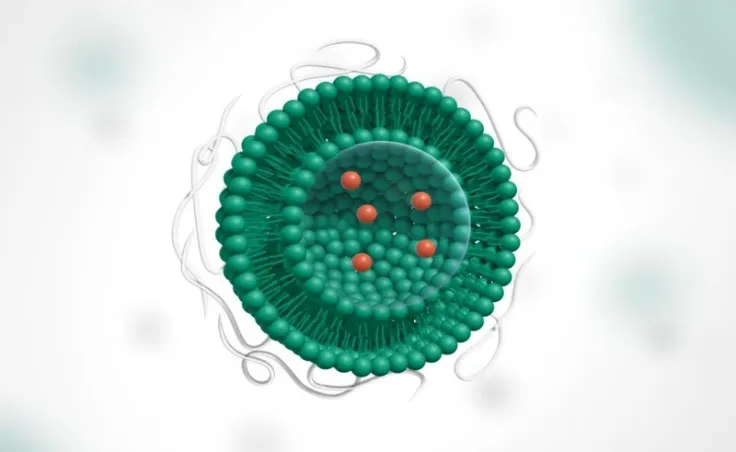
Fig No.1 LIPOSOMES
Characteristics
Advantages
Applications
Several liposomal formulations have received regulatory approval for clinical use, demonstrating the translational potential of nanotechnology in medicine.
5.2 Polymeric Nanoparticles
Polymeric nanoparticles are colloidal systems prepared using biodegradable polymers such as PLGA, chitosan, polylactic acid, and polycaprolactone.
Types
Advantages
Applications
Polymeric nanoparticles are widely investigated because they can be engineered to achieve precise control over drug release kinetics and biodistribution.
5.3 Solid Lipid Nanoparticles (SLNs)
Solid Lipid Nanoparticles (SLNs) are submicron colloidal carriers composed of physiologically compatible lipids that remain solid at both room and body temperatures. They were developed as an alternative to traditional colloidal systems such as emulsions, liposomes, and polymeric nanoparticles.
Composition
SLNs typically consist of:
Advantages
Limitations
Applications
Recent investigations have demonstrated the utility of SLNs in enhancing the bioavailability of poorly soluble drugs and improving therapeutic outcomes.
5.4 Nanostructured Lipid Carriers (NLCs)
Nanostructured Lipid Carriers (NLCs) are second-generation lipid nanoparticles developed to overcome the limitations of SLNs. They are composed of a mixture of solid and liquid lipids, resulting in an imperfect lipid matrix that accommodates greater amounts of drug molecules.
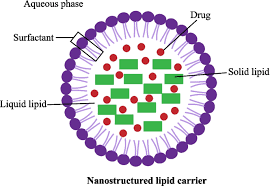
Fig No.2 Nanostructured Lipid Carriers (NLCs)
Advantages
Applications
NLCs have gained considerable attention because of their superior drug-loading capacity and long-term stability compared with conventional SLNs.
5.5 Dendrimers
Dendrimers are highly branched, three-dimensional macromolecules with a well-defined structure consisting of a central core, repeated branching units, and multiple terminal functional groups.
Characteristics
Common Types
Advantages
Applications
Surface modification of dendrimers with targeting ligands significantly improves therapeutic efficacy and reduces systemic toxicity.
5.7 Metallic Nanoparticles
Metallic nanoparticles are inorganic nanocarriers synthesized from metals such as gold, silver, iron oxide, and platinum.
Types
Gold Nanoparticles (AuNPs)
Silver Nanoparticles (AgNPs)
Magnetic Nanoparticles
Applications
The multifunctional nature of metallic nanoparticles has expanded their role in theranostics and personalized medicine.
5.8 Nanoemulsions
Nanoemulsions are thermodynamically stable dispersions consisting of oil, water, surfactants, and co-surfactants, with droplet sizes typically ranging from 20 to 200 nm.
Advantages
Applications
Nanoemulsions are particularly useful for delivering hydrophobic therapeutic agents with poor aqueous solubility.
6. Recent Advances in Nano-Based Drug Delivery Systems
The last few years have witnessed significant advancements in nano-based drug delivery technologies. Researchers are focusing on developing intelligent nanocarriers capable of responding to physiological stimuli, improving targeting efficiency, and integrating digital technologies.
6.1 Targeted Drug Delivery
Targeted drug delivery aims to selectively deliver drugs to diseased tissues while minimizing exposure to healthy organs.
Passive Targeting
Passive targeting relies on the Enhanced Permeability and Retention (EPR) effect, particularly in tumor tissues.
Active Targeting
Active targeting involves surface modification of nanoparticles with:
These ligands recognize specific receptors expressed on target cells, thereby enhancing therapeutic efficacy.
Advantages
6.2 Stimuli-Responsive Nanocarriers
Stimuli-responsive or smart nanoparticles release drugs in response to specific internal or external stimuli.
Internal Stimuli
External Stimuli
Benefits
Smart nanocarriers represent one of the fastest-growing areas in nanomedicine.
6.3 Lipid Nanoparticles for Gene and mRNA Delivery
The success of mRNA-based therapeutics has highlighted the importance of lipid nanoparticles (LNPs) as efficient nucleic acid delivery systems.
Functions of LNPs
Applications
Lipid nanoparticles are expected to dominate future developments in nucleic acid therapeutics.
6.4 Artificial Intelligence in Nanomedicine
Artificial Intelligence (AI) is increasingly being integrated into pharmaceutical nanotechnology.
Applications
Machine learning algorithms can significantly reduce formulation development time while improving accuracy and reproducibility.
6.5 Theranostic Nanoparticles
Theranostics combines therapeutic and diagnostic functions within a single nanoparticle platform.
Benefits
Applications
Theranostic systems represent a major advancement toward precision medicine.
REFERENCES



Rakshita Suryawanshi, Mayuri Bembde, Namrata Shivankar, Nano-Based Drug Delivery Systems: Recent Advances And Future Perspectives, Int. J. of Pharm. Sci., 2026, Vol 4, Issue 6, 4152-4159, https://doi.org/10.5281/zenodo.20730042
 10.5281/zenodo.20730042