View Article

  • Nano Herbal Transferosomal Serum –A Dual Functional Approach For Anti-Aging And Skin Brightening Treatment

  • 1Department of Pharmaceutics, Spurthy College of Pharmacy, Rajiv Gandhi University of Health Sciences, Bengaluru, Karnataka.
    2Assistant Professor, Spurthy College of Pharmacy, Rajiv Gandhi University of Health Sciences, Bengaluru, Karnataka.
     

Abstract

The growing demand for multifunctional, plant-based cosmeceuticals has driven the exploration of advanced drug delivery systems that enhance efficacy and safety. This review focuses on a dual-functional approach employing herbal transferosomal-loaded serum for simultaneous anti-aging and skin brightening therapy using Hibiscus rosa-sinensis and Camellia sinensis (green tea) extracts as bioactive agents. Despite their therapeutic potential, the clinical application of these phytoconstituents is limited by poor skin penetration and stability. Transferosomes, ultra-deformable vesicular carriers, offer a promising solution by enhancing transdermal delivery, improving bioavailability, and enabling targeted release of active compounds into deeper skin layers. This review systematically discusses the formulation strategies, physicochemical characterization, and evaluation parameters of transferosomal systems incorporated into serum-based topical formulations. Additionally, it highlights the synergistic benefits of combining anti-aging and skin brightening activities in a single nano herbal transferosomal serum formulation.

Keywords

Tranferosomal serum, ethanol injection method, Hibiscus rosa-sinensis, Camellia sinensis, anti-aging, skin brightening serum

Introduction

× Popup Image

The skin is the largest organ of the human body and serves as the primary protective barrier against environmental, physical, chemical, and microbial insults. Healthy skin is not only for physiological functions such as thermoregulation, sensation and immune defence but also for maintaining an individual’s appearance and confidence and overall quality of life. Among various dermatological concerns, skin aging and hyperpigmentation are the most common problems affecting individuals of all ages. To overcome these limitations, nano technology-based drug delivery systems have emerged as a promising approach for improving topical drug delivery. Among these systems, transferosomes have gained considerable attention.

Transferosomes even called as ultra-deformable vesicles for applying to skin holding a lipid bilayer with phospholipids and edge activator along with aqueous layer. Based on the lipophilicity the active substance is enclosed with in core or amongst the bilayer. In comparison to liposomes, transferosomes are having a great capacity to touch whole deeper areas of skin once applied topically.

Structure of Transferosomes


FIG 1 – Structure of transferosome

Table 1. Classification Of Materials Used In Transferosomal Preparation

No.

Example

Class

Use

1

Egg phosphatidyl choline soya phosphatidyl choline, dipalamitoylphosphatidyl choline

Phospholipids

Vesicles forming component

2

Ethanol, Methanol, isopropyl alcohol, chloroform

Solvents

As a solvent

3

Sodium cholate, sodium deoxycholate, Tween-80, Span-80, Tween-20

surfactants

Vesicles forming compound (Edge activators)

4

Saline phosphate buffer (PH 6.4), Phosphate buffer PH 7.4

Buffering agent

As a hydrating medium

5

Rhodamine-123 Rhodamine-DHPE Fluorescein-DHPE Nile-red

Dye

For CSLM Study

Mechanism of Action of Transferosomes

According to current research, are drug delivery systems that can pass through undamaged skin. The lipid's interaction with water causes the lipid to attract water molecules, causing hydration, and the lipid vesicles to migrate to the water-rich concentration part. This change in water content across the stratum and epidermis of the skin increases the Transdermal osmotic gradient, allowing transferosomes to penetrate the skin. As a result of its self-optimizing deformability, once a transferosome reaches a pore, it can reversibly change its membrane role. If transferosomes are applied to the skin under non-occlusive conditions, they can easily permeate the skin. To establish the trans-epidermal osmotic gradient across the skin, the skin must be non-occlusive. According to the literature, the Transferosomes' penetration mechanism is its moisture-seeking proclivity for deeper skin layers, also known as xerophobia (hydrotaxis). The moisture loss from the transferosomal formulation upon application to the skin causes this moisture seeking behaviour (non-occlusive state).

Formation of transferosomes using Ethanol Injection Method

This method is more beneficial than others. The medication and water solution are warmed up at a consistent temperature with continuous agitation in this procedure. Phospholipids and edge activators are combined with an ethanolic solution in aqueous media and then reacted.


Fig 2. Ethanol Injection Method

Since both skin brightening and Skin aging involve inflammation and oxidative stress, there is growing interest in developing multifunctional cosmetic formulations capable of addressing both conditions simultaneously.

SKIN AGING


Fig 3. Skin Aging

Skin Aging is a complete biological process influenced by,

  • Intrinsic factors: - such as genetics and hormonal changes.
  • Extrinsic factors: - UV radiation, pollution, smoking, and poor lifestyle habits.


Fig 4. Schematic Illustration Comparing Intrinsic And Extrinsic Aging Mechanisms.

It is characterised by reduced collagen and elastin synthesis, increased oxidative stress, loss of skin elasticity, wrinkles, fine lines, dryness, and uneven pigmentation.

Step-by-Step Development of Skin Aging

  • Exposure to internal/external stress.
  • Formation of reactive oxygen species (ROS).
  • Damage to DNA, proteins, lipids.
  • Reduced collagen & elastin production Skin loses firmness and elasticity.
  • Wrinkles, pigmentation, and sagging appearance.

SKIN PIGMENTATION

Hyper pigmentation is a common dermatological condition characterized by the darkening of certain areas of skin due to excessive production or uneven distribution of melanin, the natural pigment responsible for skin colour. It is one of the most visible and prominent signs associated with the skin aging and environmental damage.

Uneven skin tone refers to irregularities in skin coloration, where patches of skin appear darker or lighter compared to the surrounding areas. This condition results from localized variations in melanin synthesis, vascular changes, and skin damage. Both hyperpigmentation and uneven skin tone significantly affect aesthetic appearance and are key targets in cosmeceutical and dermatological treatments.


Fig 5. Types Of Pigmentation

Since both skin brightening and Skin aging involve inflammation and oxidative stress, there is growing interest in developing multifunctional cosmetic formulations capable of addressing both conditions simultaneously. Herbal bioactive compounds rich in anti-oxidants and anti- inflammatory phytochemicals have gained considerable attention because of their efficacy, safety, and reduced risks of adverse effects compared with many synthetic agents.

A typical skin care routine consists of cleanser, serum, a moisturiser and a sunscreen. Among these, it has been seen that the serums are the new go to when it comes to building an excellent skin routine. Serums are made for a variety of skin types, including dry, oily, and combination skin. The focus on serums, known for their concentrated ingredients and deep skin penetration, aligns with the demand for effective skincare products. The growing emphasis on skincare reflects a societal shift towards prioritizing personal appearance and beauty standards. Unlike the conventional serums the novel drug delivery system-based formulation i.e. transferosomes are ultra-deformable lipid vesicles that can penetrate the stratum corneum more effectively. This enhances the delivery of hibiscus and green tea phytoconstituents into deeper skin layers, potentially improving the therapeutic efficacy. Polyphenols, flavonoids and catechins are susceptible to degradation by light, oxygen and heat. Encapsulation with transferosomes can help protect these compounds improving formulation stability.

The contemporary cosmeceutical industry is rapidly evolving toward the development of multifunctional skincare systems that not only enhance aesthetic appeal but also deliver therapeutic benefits. In order to bring out the novelty in cosmetic science, advanced delivery systems such as transferosomes further enhance the penetration and bioavailability of these natural actives, improving their therapeutic and cosmetic performance. Therefore, the development of transferosome-loaded herbal serum represents a promising approach for the effective management of acne while simultaneously preventing premature skin aging, offering improved skin health and enhanced cosmetic benefits.
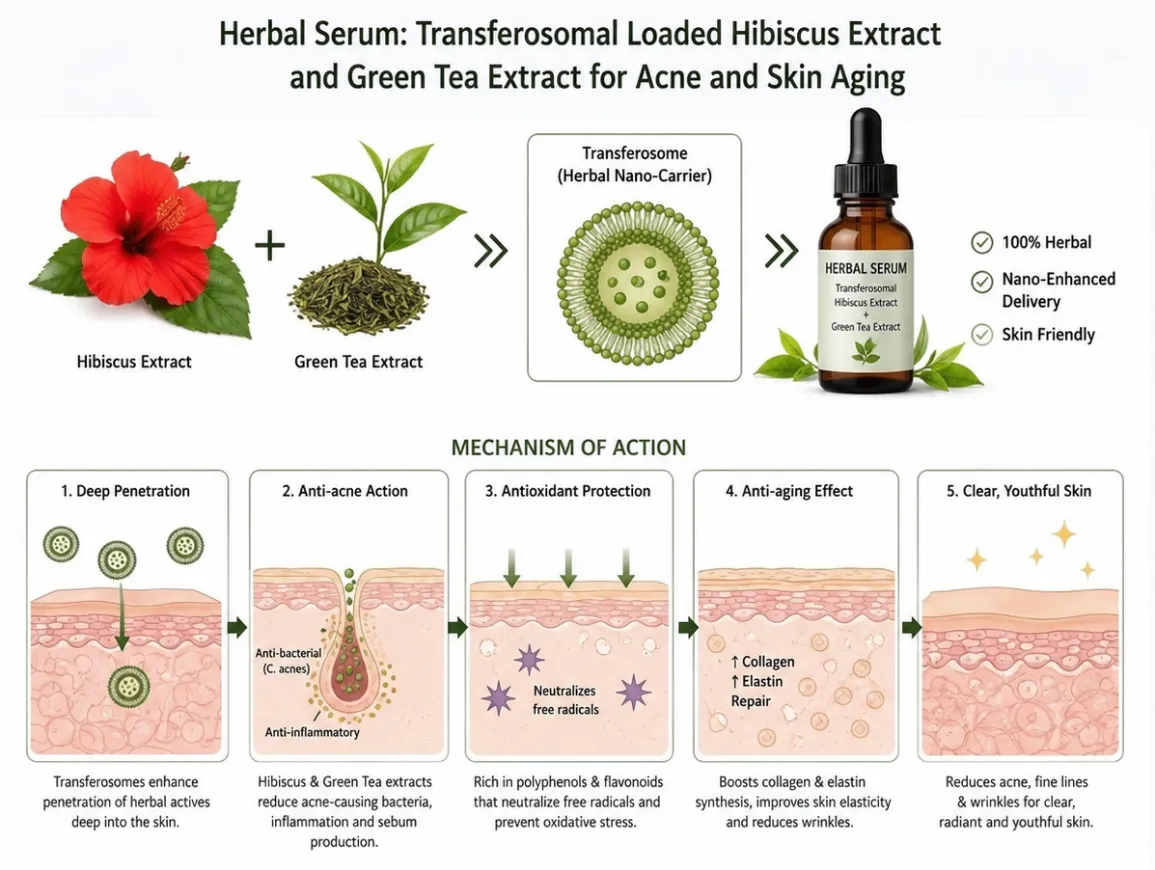
 

Fig 5. Mechanism of formulation

 Hibiscus + green tea transferosomal serum targets these mechanisms:

  • Green tea → antioxidant → neutralizes ROS
  • Hibiscus → promotes exfoliation + collagen support
  • Transferosomes → enhance deep skin delivery

Herbal Active constituents:

  1. HIBISCUS

Synonyms: - Red hibiscus, Chinese hibiscus, Gurhal, Semparutti, Rudrapuspa, shoe flower plant

Biological Source: - Hibiscus rosa-sinensis Linn.

Family: - Malvaceae.

Chemical Constituents: - Tannins, flavonoids, Steroids, Alkaloids, Saponins, Total phenols, Total proanthocyanidin, Anthocyanin, Riboflavin, Ascorbic acid and Thiamine.

Uses of Hibiscus: -

  • The roots of Hibiscus rosa-sinensis Linn can be used as a cough suppressant.
  • Leaves and flowers can be used as a hair growth promoter
  • Leaves possess emollient properties, and it can be used in the treatment of Dysentery and Diarrhoea.

Benefits of hibiscus for skin: -

  • It is used as an anti-acne agent
  • It is used as an anti-aging agent
  • It is used in maintaining moisture of the skin
  • It is used in treating uneven skin tone and hyperpigmentation


Fig 6. Hibiscus

  1. GREEN TEA

SYNONYM: - Chinese tea and green tea extract.

Biological Source: - Camellia sinensis

Family: Theaceae.

Chemical constituents: - Polyphenols, Epicatechin, Epigallocatechin, glutamic acid and theophylline.

Uses of Green Tea

  • Lowers cholesterol.
  • Relief anxiety.
  • Weight loss.

Benefits for skin: -

  • Anti-oxidant.
  • Protect skin from harmful UV radiation.
  • Reduce skin inflammation and Acne.
  • Soothing effect


Fig 7. Green Tea Leaves

Excepients: -

TABLE 2. List of excipients

NAME OF INGREDIENTS

FUNCTION / USE

Tween 80 (polysorbate 80)

Edge Activator, increases flexibility of transferosomes. Improve skin penetration.

Benzyl alcohol

Gelling agent – provides the serum with suitable viscosity and consistency.

Propylene glycol

Co-solvent, humectant, penetration enhancer

Glycerine

Humectant, prevent dryness

Trichloroacetic Acid

pH adjuster and neutralizing agent.

Rose water

Perfume

Ethanol

Solvent

Soya Lecithin

Vesicle forming compound

Phosphate buffer

pH adjuster

Methods Extraction of Materials:

1. Hibiscus: For hibiscus petal extraction, two weeks shadowed dried flowers (petal) where taken and soaked in 80% ethanol for 48 hours. Water bath was heated up to 40 degree for 10 minutes with the soaked petals. Extract was obtained. 

2. Green Tea: Hot water extraction is a commonly used extraction method. In this method, dried green tea leaves were soaked in 96% ethanol and sealed in glass jar tightly, store in cool and dark place for one week. After one week the extract was filtered out and stored in amber colour bottle. 

Evaluation parameters of Hibiscus:

1. Organoleptic Properties: colour, odour, texture was determined.

2. pH Determination: Use a calibrated digital pH meter to ensure the extract falls between 4.5 and 6.0 to prevent skin damage.

3. Phenols Test and Tannins test: The extracts were mixed with three to four drops of the ferric chloride test. The presence of phenols and tannins is indicated if a blue-black colour develops.

4. Flavonoids Test: Some drops of lead acetate solution were added to the extracts. The presence of flavonoids would be indicated by the production of yellow precipitate.

5. Alkaloids Test: Adding dragendroff’s reagent to the extract yields an orange-coloured precipitate.

Evaluation parameters of Green Tea:

1) Organoleptic properties: colour, odour, texture.

2) pH Determination: Essential to match skin physiology. Use a calibrated digital pH meter to ensure the extract falls between 4.5 and 6.0 to prevent barrier damage.

3) Viscosity: Assessed using a Brookfield or falling-sphere viscometer to ensure the extract has a lightweight consistency that facilitates deep skin penetration.

4) Heavy Metal Limit Test:

The test is performed in Nessler cylinders by comparing the colour of sample with standard lead solution.1g of green tea extract is dissolved in water, filtered, and 25ml of filtrate is taken in a 50ml Nessler cylinder. pH is adjusted to 3.0–4.0 using dilute acetic acid or dilute ammonia and volume made up to 40ml with water. To this, 2ml of sulphide reagent is added and mixed.20 ppm standard lead solution is treated similarly as reference. The brownish-black colour of the sample should not be more intense than the standard, confirming heavy metals are within permissible limit.

5) TLC method for catechin:

Thin Layer Chromatography was performed for the identification of catechins using Silica gel 60 F254 pre-coated plates as the stationary phase. The standard and sample solutions were spotted on the plate and developed in a saturated chamber using Chloroform: Ethyl acetate: Glacial acetic acid (4:4:2 v/v) as the mobile phase. The plate was sprayed with 5% Ferric chloride (FeCl3) solution. Catechins appeared as green to bluish-black spots due to the formation of complexes with phenolic hydroxyl groups. The Rf values were calculated and compared with the standard catechin for confirmation of identity.  

Evaluation parameter of transferosomes:

1) Zeta potential and particle size determination: The particle size and zeta potential will be assessed at 250 C using a dynamic light scattering instrument. The sample is diluted with water and then measured using Malvern zeta seizer.

2) Vesicle morphology: Transmission Electron Microscopy and Phase Contrast Microscopy are used to visualize transferosome vesicles. The size and shape of vesicles are observed to determine structural integrity and stability over time.

3) Entrapment efficiency: Unentrapped drug is separated by micro-column centrifugation. Vesicles are disrupted using 0.1% Triton X-100 or 50% n-propanol.

% EE = (Amount entrapped / Total amount) × 100

Procedure:

Accurately weigh phospholipid (Soya Lecithin) and edge activator (Tween 80). Dissolve both in ethanol and stir until a clear solution is obtained in beaker A. In beaker B dissolve the herbal extract in phosphate buffer of pH 6.4 to 7.4. Heat both the beakers, beaker A (organic phase) and beaker B (aqueous phase) separately in a water bath at 45 degree C – 50-degree C. In beaker C benzyl alcohol, propylene glycol and rose water are added and stirred. 

Now inject the warm ethanolic lipid solution drop wise into the warm aqueous solution using a syringe with continuous high-speed stirring. Lipid self-assembles into Bi-layered vesicles entrapping the extract. Continue stirring at 45 degree C – 50-degree C for 30-60 min to evaporate ethanol. To the above mixture add beaker C.

The size is reduced by homogenizer method. The obtained product is stored in a sterilized (at 250 degree C for 30 min in hot air oven) airtight amber coloured glass bottle at 2 degree C -8-degree C.

Evaluation parameters of face serum:

1) Physical evaluation: The formulation is evaluated based on visual appearance and touch. Colour texture, and other qualities are assessed based on their appearance.

2) pH: Using a standard buffer solution, a pH meter was calibrated. The pH of the combination was determined by accurately measuring and blending almost 1 mL of face serum with 10 mL of clean water. The skin has an acidic pH, and skin serums should have a pH between 4.1 to 6.7.

3) Spread ability: The serum spreads over the filter paper, indicating the area to which it was delivered. For each of the filter paper sizes selected, the total area (A1) and weight (W1) are measured.  The correct entry for this measurement is A2 [18]. % Spread by Area = (A2/A1)100.

4) Absorbance time: After applying the serum to the skin and timing how long it takes it to absorb, note the time.

5) Viscosity: Using a spindle type model S64, the viscosity of the formulation was measured at 100 rpm using a Brookfield viscometer. After dipping the spindle in 5 ml of the serum in a beaker for approximately 5 minutes, readings were obtained.

6) Stability Testing: Monitored for 30 days at room temperature at 40°C; observed for changes in colour, pH, viscosity and odour- criteria for shelf life

7) Wash ability test: Few drops of prepared serum is exposed to the skin surface and then wash ability is determined manually.

8) Irritancy Test: Patch testing confirmed non-irritant nature, validating safety for daily use.

9) Redox titration: The assay is based on redox titration. 10ml of extract was taken with 10ml of 2N H2SO4 in a conical flask. It was titrated against 0.1N KMnO4 until a permanent pale pink endpoint appeared. A blank was also titrated similarly. The difference in volume corresponds to polyphenols present.

% Polyphenols and Catechin = [(Blank - Sample) × N × 0.02904 × 100] / Weight of sample

Catechins and anthocyanin’s reduce KMnO4 in acidic medium, thus % content is calculated.

CONCLUSION

The brightening and anti- aging serum using hibiscus, green tea extract by using transferosomes. This preparation gives moisturizing and glowing activity on skin, reduce the signs of aging, and improve overall skin health. The use of transferosomes as a drug delivery system further enhances the effectiveness of these herbal ingredients by improving their penetration into the deeper layers of the skin and increasing their stability. Herbal face serums address many different skincare needs, from nourishing and hydrating to relaxing and revitalizing.

They improve the stability, controlled release, and bioavailability of active compounds, allowing better delivery of herbal ingredients to the target site. This makes transferosomes a promising carrier for developing advanced herbal skincare products.

Overall, the combination of hibiscus and green tea extracts with transferosomal technology represents an innovative and effective approach in cosmeceutical research. It combines the therapeutic benefits of natural plant extracts with an advanced drug delivery system to improve skin health and reduce the signs of aging.

REFERENCES

  1. Kadu P, More H, Shaikh T, Kakad S, & Mahajan J. Formulation and Evaluation of Herbal Cosmetics Serum. Int J Pharm Sci Rev Res. 2015; 31(2):17.
  2. Ghosh A, & Ghosh T. Phytochemical composition and pharmacological activities of Hibiscus rosa-sinesis. J Nat Prod. 2018; 50(1): 50-6.
  3. Chatterjee P, Pradhan D, & Gupta S. Hibiscus rosa-sinensis: A Review of Phytochemistry and Pharmacological Aspects. Int J Pharm Sci. 2018; 10(3): 45-52.
  4. Jadhav N, & Patil S. Preparation and Evaluation of Herbal Serum for Face Brightening. J   Drug Deliv Ther. 2020; 10(3): 125-30.
  5. Ashish Tawar, Thormote Dipak, Bhojane Ankita, et al. From Tradition to Innovation Hibiscus in Modern Anti-Aging Skincare. Int J Adv Res Sci Commun Technol. 2025; 5(7):  662.
  6. Singh, R., & Kaur, N. Hibiscus as a Natural Source of Antioxidants. J Med Plants Stud. 2014; 2(3): 55-9.
  7. Komal Gadekar, Vaishali Kailas Gaikwad, et al. Formulation and Evaluation of Herbal Anti-Acne Serum using Hibiscus rosa-sinesis. Int Res J. 2026; 13(4): 5-11.
  8. Nahid Anjum Hafizuddin Chishti, ZohebZaheer Shaikh, Patil Nikita Dnyaneshwar, & Saundarkar Aditi Gajanan. Formulation Development and Evaluation of Anti-Aging Vitamin E Serum. Int J Pharm Appl. 2025; 10(1): 3-4.
  9. Lim J.T, Tham, S.N, & Lui K. F. Glycolic acid and Kojic acid combination in the treatment of melasma. Dermatol Surg. 1999; 25(4): 282-84.
  10.  Sharma V, & Tripathi A. Formulation and Evaluation of Herbal Face Serum. Int J Drug Dev Res. 2020; 9(2): 46-54.
  11. Desai K, & Mehta D. Stability and Safety Assessment of Herbal Cosmetic Products. Int   J Pharm Sci Res. 2018; 9(7): 2800–05.
  12. Shalini K. Development and evaluation of herbal face serum using Hibiscus rosa-sinensis extract. Int J Mod Pharm Res. 2024; 8(2): 120–26.
  13. Vincenta Khristi, & V. H. Patel. Therapeutic potential of Hibiscus rosa-sinensis: a review. Int J Nutr Diet. 2016; 4(2): 105-23.
  14. Singh M, & Kaur N. Evaluation of flavonoids and phenolic compounds in Hibiscus rosa-sinensis flowers. J Pharmacogn Phytochem. 2017; 6(5): 120–12.
  15. Tushali Khanna, & Swati Joshi. Formulation and Evaluation of Anti Acne Face Serum. J Med Plants Stud. 2024; 12(3):  2-4.
  16. Bhowmik D, Chiranjib K.P, & Sampath K.P. Pharmacological properties of Hibiscus rosa-sinensis and its role in skin disorders. Int J Pharm Sci Rev Res. 2012; 3(2): 534–38.
  17. Thorat PS, Bhadane HB, Wagh SS, Gaikwad MS, Chhajed SS. General review on face serum. World J Pharm Res. 2023; 12(6): 445.
  18. Khabiya, K, & Somani S. A Review on Skin, Skin Cosmetic and Relative Herbal Ingredients. Int J Innov Sci Res Technol. 2023; 12(8): 867-73.
  19. P. Kranthi Kumar, & R. Santosh Kumar. Review on Transferosomal and Transferosomal Gels. J Pharm Res Int. 2021; 33(43B): 115-20.
  20.  Jain S, Jain V, & Mahajan SC. Lipid Based Vesicular Drug Delivery Systems. Adv Pharm. Hindawi. 2014; 1-12
  21. Bhaskar A, Nithya V, & Vidhya V. G. Phytochemical screening and in vitro antioxidant activities of the ethanolic extract of Hibiscus rosa- sinensis L. Ann Biol Res. 2011;2(5): 653-61.
  22. Sivaraman CM, & Sanju F. Medicinal value of Hibiscus rosa-sinensis: a review. Int J Pharmacogn Chem. 2021; 2(1): 1-11.
  23. Jena J, Maurya N, Rai J. K, et al. Evaluation on Pharmacognostical and Phytochemical Parameters of Hibiscus rosa- sinensis. YMER. 2023; 22(07):  228.
  24. Bijauliya RK, Alok S, Kumar M, Chanchal DK, Yadav S. a Comprehensive Review on Herbal Cosmetics. Int J Pharm Sci Res. 2017; 8(12): 4930-49.
  25. Khristi V, & Patel V. H. Therapeutic Potential OF Hibiscus rosa-sinesis: A Review. Int J Nutr Diet. 2017; 4(2): 105–23.
  26. Sharma P, Patel P, & Mehta T. Formulation and Evaluation of Herbal Face Serum for Treatment of Hyperpigmentation. Res J Top Cosmet Sci. 2024; 15(2): 113-20.
  27. Missoum A. An Update Review on Hibiscus rosa -sinensis Phytochemistry and Medicinal Uses. J Ayurvedic Herb Med. 2018; 4(3): 135-46.
  28. Mishra D, & Sharma N. Innovative Herbal Face Serum: An Ayurvedic and Modern Fusion Approach. Int J Adv Res. 2025; 12(3): 305-15.
  29. SAĞLAM A, AŞAN ÖZÜSAĞLAM M, & ÇELİK İ. Determination of Antimicrobial Activity of Cream Formulation Developed with Hibiscus rosa-sinensis Extract and Probiotic. Manas J Agric Vet Life Sci. 2023; 13(2): 126–32.
  30. Ashawat M.S, & Saraf S. Formulation and Development of Botanicals-Based Herbal Serum. ISFCP PharmAspire. 2009; 11(1): 27-36.
  31. Wasnik V, Bhude P, Ajane P, Dharmale P, & Gadekar P. Formulation and Evaluation of Herbal Face Serum for Treatment of Hyperpigmentation. Res J Top Cosmet Sci. 2024; 15(1).
  32. Cabrera C, Artacho R, & Giménez R. Beneficial Effects of Green Tea - A Review. J Am Coll Nutr. 2006; 25(2): 79-99.
  33. Reddy K. Evaluation of Stability and Safety of Herbal Cosmetic Formulations. Int J Pharm Res. 2021; 13(3): 300–05.
  34. Mehta P, & Jain R. Development and Optimization of Polyherbal Cosmetic Formulations. J Cosmet Dermatol. 2019: 18(3); 850–56.
  35. Sharma V. Safety and Dermatological Evaluation of Herbal Topical Preparations. Clin Cosmet Investig Dermatol. 2022; 15: 120–26.
  36. Sharma P. Standardization of Extraction Process for Hibiscus rosa-sinensis. J Pharmacogn Phytochem. 2018; 7(3): 1012–16.
  37. Verma S, & Singh R. Preparation and Evaluation of Herbal Extracts from Hibiscus rosa-sinensis. Asian J Pharm Clin Res. 2020; 13(4): 85–90.
  38. Pavithra T, Akash Gowda, Monika Chavan, Nagaveni A. P, Nagushree K. C, & Neha P. Herbal Face Serum in Modern Dermatology: A Natural Alternative for Skin Health. Int J Pharm Sci. 2025; 3(09): 2-9.
  39. Devi N, Kumar A, Garg A, Hussain A, & Khathuriya R. A Review on Herbal Cosmetics. World J Pharm Res. 2018; 7(8): 298-10.
  40. Arsha Mathew Puthanmadathil, Mohammed Bilal R, Sivadethu M G, & Anuroop U P.  Formulation And Evaluation of Herbal Face Serum Using Clitoria Ternatea. IJNRD ORG. 2024; 9(8): 104-18.
  41. Kaveri Sonawane. Innovative Herbal Face Serum: Synergistic Approach to Skincare. Int J Adv Res (IJAR). 2025; 13(10): 1711-15.
  42. Vaishali Wasnik, Pratiksha Bhude, Priya Ajane, Punam Dharmale, & Purvaja Gadekar.  Formulation and Evaluation of Herbal Face Serum for Treatment of Hyperpigmentation. Res J Topic Cosmet Sci. 2024; 17(1): 4-10.
  43. Sakshi Dhotre, T.K Kedar, & Sanjay K. Standardization of Green Tea Extract: An Overview of HPLC-Based Approaches. Int J Pharm Sci. 2025; 3(12): 1335-54.
  44. Chen Z.M, & Lin Z. Tea and Human Health: Biomedical Functions of Tea Active Components and Current Issues. J Zhejiang Univ Sci B. 2015; 16(2): 87 - 102.
  45. Rekha Bharat Maske, & Kalyani Patil.  Formulation and Evaluation of Herbal Face Cream with Green Tea Extract. Int J Sci Dev Res. 2025; 10(6): 100-05.
  46. Sreya T.C, Reshmi K.S, & P Sudharsan. Review Article on: Herbal Anti-Aging Face Serum. World J Pharm Pharm Sci. 2024; 12(6): 57-62.
  47. Dr. Gyati Shilakari Asthana, G. Viswas Chowdary, & R. Sai Yasvitha. Natural Synergy in Skincare: Polyherbal Face Serum Composition and its Application. World J Pharm Res. 2025; 14(10): 398-04.
  48. Gite AV, Udapurkar P, & Sanap AS. Formulation and Development of Face Serum. Int J Creat Res Thoughts. 2023; 11(6).
  49. Sahil S shaikh, Sayali A Deshmukh, Rohit B Satpute, Vijay V Parwar, & Hemant H Gangurde. Formulation and Evaluation of Green Tea-Based Herbal Anti-Aging Cream for Effective Skincare. J Pharm Sci Comput Chem. 2025; 1(2): 73-8.
  50. Singh K, Chauhan V, & Deshmukh S. Accelerated Stability Testing of Herbal Cosmetic Products: A Case Study on Face Serum. Int J Cosmet Sci. 2021; 43(5): 402–8

Reference

  1. Kadu P, More H, Shaikh T, Kakad S, & Mahajan J. Formulation and Evaluation of Herbal Cosmetics Serum. Int J Pharm Sci Rev Res. 2015; 31(2):17.
  2. Ghosh A, & Ghosh T. Phytochemical composition and pharmacological activities of Hibiscus rosa-sinesis. J Nat Prod. 2018; 50(1): 50-6.
  3. Chatterjee P, Pradhan D, & Gupta S. Hibiscus rosa-sinensis: A Review of Phytochemistry and Pharmacological Aspects. Int J Pharm Sci. 2018; 10(3): 45-52.
  4. Jadhav N, & Patil S. Preparation and Evaluation of Herbal Serum for Face Brightening. J   Drug Deliv Ther. 2020; 10(3): 125-30.
  5. Ashish Tawar, Thormote Dipak, Bhojane Ankita, et al. From Tradition to Innovation Hibiscus in Modern Anti-Aging Skincare. Int J Adv Res Sci Commun Technol. 2025; 5(7):  662.
  6. Singh, R., & Kaur, N. Hibiscus as a Natural Source of Antioxidants. J Med Plants Stud. 2014; 2(3): 55-9.
  7. Komal Gadekar, Vaishali Kailas Gaikwad, et al. Formulation and Evaluation of Herbal Anti-Acne Serum using Hibiscus rosa-sinesis. Int Res J. 2026; 13(4): 5-11.
  8. Nahid Anjum Hafizuddin Chishti, ZohebZaheer Shaikh, Patil Nikita Dnyaneshwar, & Saundarkar Aditi Gajanan. Formulation Development and Evaluation of Anti-Aging Vitamin E Serum. Int J Pharm Appl. 2025; 10(1): 3-4.
  9. Lim J.T, Tham, S.N, & Lui K. F. Glycolic acid and Kojic acid combination in the treatment of melasma. Dermatol Surg. 1999; 25(4): 282-84.
  10.  Sharma V, & Tripathi A. Formulation and Evaluation of Herbal Face Serum. Int J Drug Dev Res. 2020; 9(2): 46-54.
  11. Desai K, & Mehta D. Stability and Safety Assessment of Herbal Cosmetic Products. Int   J Pharm Sci Res. 2018; 9(7): 2800–05.
  12. Shalini K. Development and evaluation of herbal face serum using Hibiscus rosa-sinensis extract. Int J Mod Pharm Res. 2024; 8(2): 120–26.
  13. Vincenta Khristi, & V. H. Patel. Therapeutic potential of Hibiscus rosa-sinensis: a review. Int J Nutr Diet. 2016; 4(2): 105-23.
  14. Singh M, & Kaur N. Evaluation of flavonoids and phenolic compounds in Hibiscus rosa-sinensis flowers. J Pharmacogn Phytochem. 2017; 6(5): 120–12.
  15. Tushali Khanna, & Swati Joshi. Formulation and Evaluation of Anti Acne Face Serum. J Med Plants Stud. 2024; 12(3):  2-4.
  16. Bhowmik D, Chiranjib K.P, & Sampath K.P. Pharmacological properties of Hibiscus rosa-sinensis and its role in skin disorders. Int J Pharm Sci Rev Res. 2012; 3(2): 534–38.
  17. Thorat PS, Bhadane HB, Wagh SS, Gaikwad MS, Chhajed SS. General review on face serum. World J Pharm Res. 2023; 12(6): 445.
  18. Khabiya, K, & Somani S. A Review on Skin, Skin Cosmetic and Relative Herbal Ingredients. Int J Innov Sci Res Technol. 2023; 12(8): 867-73.
  19. P. Kranthi Kumar, & R. Santosh Kumar. Review on Transferosomal and Transferosomal Gels. J Pharm Res Int. 2021; 33(43B): 115-20.
  20.  Jain S, Jain V, & Mahajan SC. Lipid Based Vesicular Drug Delivery Systems. Adv Pharm. Hindawi. 2014; 1-12
  21. Bhaskar A, Nithya V, & Vidhya V. G. Phytochemical screening and in vitro antioxidant activities of the ethanolic extract of Hibiscus rosa- sinensis L. Ann Biol Res. 2011;2(5): 653-61.
  22. Sivaraman CM, & Sanju F. Medicinal value of Hibiscus rosa-sinensis: a review. Int J Pharmacogn Chem. 2021; 2(1): 1-11.
  23. Jena J, Maurya N, Rai J. K, et al. Evaluation on Pharmacognostical and Phytochemical Parameters of Hibiscus rosa- sinensis. YMER. 2023; 22(07):  228.
  24. Bijauliya RK, Alok S, Kumar M, Chanchal DK, Yadav S. a Comprehensive Review on Herbal Cosmetics. Int J Pharm Sci Res. 2017; 8(12): 4930-49.
  25. Khristi V, & Patel V. H. Therapeutic Potential OF Hibiscus rosa-sinesis: A Review. Int J Nutr Diet. 2017; 4(2): 105–23.
  26. Sharma P, Patel P, & Mehta T. Formulation and Evaluation of Herbal Face Serum for Treatment of Hyperpigmentation. Res J Top Cosmet Sci. 2024; 15(2): 113-20.
  27. Missoum A. An Update Review on Hibiscus rosa -sinensis Phytochemistry and Medicinal Uses. J Ayurvedic Herb Med. 2018; 4(3): 135-46.
  28. Mishra D, & Sharma N. Innovative Herbal Face Serum: An Ayurvedic and Modern Fusion Approach. Int J Adv Res. 2025; 12(3): 305-15.
  29. SA?LAM A, A?AN ÖZÜSA?LAM M, & ÇEL?K ?. Determination of Antimicrobial Activity of Cream Formulation Developed with Hibiscus rosa-sinensis Extract and Probiotic. Manas J Agric Vet Life Sci. 2023; 13(2): 126–32.
  30. Ashawat M.S, & Saraf S. Formulation and Development of Botanicals-Based Herbal Serum. ISFCP PharmAspire. 2009; 11(1): 27-36.
  31. Wasnik V, Bhude P, Ajane P, Dharmale P, & Gadekar P. Formulation and Evaluation of Herbal Face Serum for Treatment of Hyperpigmentation. Res J Top Cosmet Sci. 2024; 15(1).
  32. Cabrera C, Artacho R, & Giménez R. Beneficial Effects of Green Tea - A Review. J Am Coll Nutr. 2006; 25(2): 79-99.
  33. Reddy K. Evaluation of Stability and Safety of Herbal Cosmetic Formulations. Int J Pharm Res. 2021; 13(3): 300–05.
  34. Mehta P, & Jain R. Development and Optimization of Polyherbal Cosmetic Formulations. J Cosmet Dermatol. 2019: 18(3); 850–56.
  35. Sharma V. Safety and Dermatological Evaluation of Herbal Topical Preparations. Clin Cosmet Investig Dermatol. 2022; 15: 120–26.
  36. Sharma P. Standardization of Extraction Process for Hibiscus rosa-sinensis. J Pharmacogn Phytochem. 2018; 7(3): 1012–16.
  37. Verma S, & Singh R. Preparation and Evaluation of Herbal Extracts from Hibiscus rosa-sinensis. Asian J Pharm Clin Res. 2020; 13(4): 85–90.
  38. Pavithra T, Akash Gowda, Monika Chavan, Nagaveni A. P, Nagushree K. C, & Neha P. Herbal Face Serum in Modern Dermatology: A Natural Alternative for Skin Health. Int J Pharm Sci. 2025; 3(09): 2-9.
  39. Devi N, Kumar A, Garg A, Hussain A, & Khathuriya R. A Review on Herbal Cosmetics. World J Pharm Res. 2018; 7(8): 298-10.
  40. Arsha Mathew Puthanmadathil, Mohammed Bilal R, Sivadethu M G, & Anuroop U P.  Formulation And Evaluation of Herbal Face Serum Using Clitoria Ternatea. IJNRD ORG. 2024; 9(8): 104-18.
  41. Kaveri Sonawane. Innovative Herbal Face Serum: Synergistic Approach to Skincare. Int J Adv Res (IJAR). 2025; 13(10): 1711-15.
  42. Vaishali Wasnik, Pratiksha Bhude, Priya Ajane, Punam Dharmale, & Purvaja Gadekar.  Formulation and Evaluation of Herbal Face Serum for Treatment of Hyperpigmentation. Res J Topic Cosmet Sci. 2024; 17(1): 4-10.
  43. Sakshi Dhotre, T.K Kedar, & Sanjay K. Standardization of Green Tea Extract: An Overview of HPLC-Based Approaches. Int J Pharm Sci. 2025; 3(12): 1335-54.
  44. Chen Z.M, & Lin Z. Tea and Human Health: Biomedical Functions of Tea Active Components and Current Issues. J Zhejiang Univ Sci B. 2015; 16(2): 87 - 102.
  45. Rekha Bharat Maske, & Kalyani Patil.  Formulation and Evaluation of Herbal Face Cream with Green Tea Extract. Int J Sci Dev Res. 2025; 10(6): 100-05.
  46. Sreya T.C, Reshmi K.S, & P Sudharsan. Review Article on: Herbal Anti-Aging Face Serum. World J Pharm Pharm Sci. 2024; 12(6): 57-62.
  47. Dr. Gyati Shilakari Asthana, G. Viswas Chowdary, & R. Sai Yasvitha. Natural Synergy in Skincare: Polyherbal Face Serum Composition and its Application. World J Pharm Res. 2025; 14(10): 398-04.
  48. Gite AV, Udapurkar P, & Sanap AS. Formulation and Development of Face Serum. Int J Creat Res Thoughts. 2023; 11(6).
  49. Sahil S shaikh, Sayali A Deshmukh, Rohit B Satpute, Vijay V Parwar, & Hemant H Gangurde. Formulation and Evaluation of Green Tea-Based Herbal Anti-Aging Cream for Effective Skincare. J Pharm Sci Comput Chem. 2025; 1(2): 73-8.
  50. Singh K, Chauhan V, & Deshmukh S. Accelerated Stability Testing of Herbal Cosmetic Products: A Case Study on Face Serum. Int J Cosmet Sci. 2021; 43(5): 402–8.

Photo
Rubicashree S
Corresponding author

Department of Pharmaceutics, Spurthy College of Pharmacy, Rajiv Gandhi University of Health Sciences, Bengaluru, Karnataka

Photo
Chaya P
Co-author

Department of Pharmaceutics, Spurthy College of Pharmacy, Rajiv Gandhi University of Health Sciences, Bengaluru, Karnataka

Photo
Srinidhi C
Co-author

Department of Pharmaceutics, Spurthy College of Pharmacy, Rajiv Gandhi University of Health Sciences, Bengaluru, Karnataka

Photo
Murali R
Co-author

Department of Pharmaceutics, Spurthy College of Pharmacy, Rajiv Gandhi University of Health Sciences, Bengaluru, Karnataka

Photo
Anju K.P.
Co-author

Assistant Professor, Spurthy College of Pharmacy, Rajiv Gandhi University of Health Sciences, Bengaluru, Karnataka

Rubicashree S, Chaya P, Srinidhi C, Murali R, Anju K.P., Nano Nano Herbal Transferosomal Serum –A Dual Functional Approach For Anti-Aging And Skin Brightening Treatment, Int. J. of Pharm. Sci., 2026, Vol 4, Issue 7, 5296-5308. https://doi.org/10.5281/zenodo.21642958

More related articles
Formulation And Evaluation O Herbal Neem Face Wash...
Bansode Disha, Hemant H.Gangurde, Hemant Gangurde, Somnath Davkha...
Herbal Extract- Based Peel-Off Face Mask Gels for ...
Dhanyashree K, Rakshith K J, Chaithra M P, Hemavathi N...
Pharmacological Innovations in Alzheimer's Disease...
Rajratan Thorat, Rajani Athawale, Vijay Kadam, Madhuri Dhure, Pre...
A Review on Nanomedicine in Oral Healthcare: Beyond Toothpaste and Mouthwash...
Nehere Ishika , Swapnil Kale, Maid Dipali , Sanghavi Kanchi , Darode Tejaswi , Jadhav Shraddha ...
Artificial Intelligence and Machine Learning in Adverse Drug Events and Precisio...
Mohamed Adil N, Jayalakshmi Venugopal, Srinivas S.K. , Renupriya J...
Formulation And Evaluation Of A De-Tan Face Wash Tablet...
Kumbhar Bhaganna Gundappa , G. B. Gajeli, Giram Aarti Kashinath , Alamad Abhishek Lokanna, Narayane ...
Related Articles
Nitrosamine Impurities: Analytical Detection and Risk Assessment...
Gopal Gawhale, Dr. Shirish Jain, Dr. Ashish Gawai, Ganesh Gore...
Enhancement of Solubility and Dissolution Rate of Poorly Water-Soluble Antifung...
Ranjit Sakhare, Dr. Vishal Babar, Dr Sudarshan Nagrale...
Emerging Hydrogel-Based Topical Delivery Systems: A Review of Salicylic Acid and...
Ganesh Shinde, Kanchan Upadhye, Anup Thakre, Prachi Karadbhajane...
Formulation And Evaluation O Herbal Neem Face Wash Powder...
Bansode Disha, Hemant H.Gangurde, Hemant Gangurde, Somnath Davkhar, Bandgar Sakshi...
More related articles
Formulation And Evaluation O Herbal Neem Face Wash Powder...
Bansode Disha, Hemant H.Gangurde, Hemant Gangurde, Somnath Davkhar, Bandgar Sakshi...
Herbal Extract- Based Peel-Off Face Mask Gels for Skin Rejuvenation and Anti-Age...
Dhanyashree K, Rakshith K J, Chaithra M P, Hemavathi N...
Pharmacological Innovations in Alzheimer's Disease: Recent Progress and Future P...
Rajratan Thorat, Rajani Athawale, Vijay Kadam, Madhuri Dhure, Prerana Bambale...
Formulation And Evaluation O Herbal Neem Face Wash Powder...
Bansode Disha, Hemant H.Gangurde, Hemant Gangurde, Somnath Davkhar, Bandgar Sakshi...
Herbal Extract- Based Peel-Off Face Mask Gels for Skin Rejuvenation and Anti-Age...
Dhanyashree K, Rakshith K J, Chaithra M P, Hemavathi N...
Pharmacological Innovations in Alzheimer's Disease: Recent Progress and Future P...
Rajratan Thorat, Rajani Athawale, Vijay Kadam, Madhuri Dhure, Prerana Bambale...