

We use cookies to ensure our website works properly and to personalise your experience. Cookies policy
Department of Pharmaceutics, Srinivas College of Pharmacy, Mangalore, Karnataka
Orodispersible films (ODFs) have emerged as an innovative and patient-friendly oral drug delivery system designed to rapidly disintegrate in the oral cavity without the need for water. These thin polymeric films offer significant advantages over conventional dosage forms, particularly for paediatric, geriatric, and dysphagic patients who experience difficulty swallowing tablets and capsules. ODFs are typically composed of hydrophilic polymers along with plasticizers, sweetening agents, saliva-stimulating agents, flavoring agents, and surfactants that contribute to rapid disintegration, improved palatability, and enhanced drug release. This review provides an overview of the formulation aspects, manufacturing approaches, and characterization parameters of orodispersible films. It also discusses the suitability of ODFs as carriers for various therapeutic agents including chemical drugs, vaccines, probiotics, and herbal extracts. Various formulation strategies such as particle size reduction, solid dispersion, and nanotechnology-based approaches used to improve the solubility and bioavailability of poorly water-soluble drugs in ODFs are highlighted. In addition, the applications of ODFs in drug delivery systems and their potential therapeutic benefits are explored. Despite certain limitations such as restricted drug loading capacity and stability challenges, ODFs remain a promising platform for future pharmaceutical development due to their ease of administration, rapid onset of action, and improved patient compliance. Continuous advancements in formulation technologies are expected to further expand the clinical and commercial potential of this novel drug delivery system...
Personalised medications are becoming a new paradigm in the pharmaceutical and clinical research sectors. Small-scale extemporaneous formulations in pharmacy settings now have more potential because to this. To meet the needs of unique patient populations, novel drug delivery platforms are becoming more and more necessary. [1] Orodispersible films (ODFs) are ideal for meeting the demands of specific groups, including children, the elderly, and patients with dysphagia, nausea, vomiting, or limited fluid intake. Because solid preparations resemble tablets, many elderly and paediatric patients are reluctant to take them for fear of choking. Due to their inability to take conventional solid dosage forms, certain patient groups frequently need specially compounded medications. [2] For juvenile and elderly patients who have difficulty swallowing conventional oral solid dosage forms, fast-dissolving drug delivery systems were developed in the late 1970s as an alternative to tablets, capsules, and syrup. Although the oral film dosage form is referred to by a number of names, including thin strip, oral film, orally dissolving film, quick dissolve film, melt-away film, and wafer, the European Medicines Agency formally names it an orodispersible film (ODF), or soluble films as the US Food and Drug Administration (FDA) commonly refers to them. [3] Oro dispersible films (ODFs) are a new type of oral medication delivery technology made of hydrophilic polymers and designed as incredibly thin strips. When placed on the tongue or in the buccal cavity, these films are made to dissolve quickly; they usually do so in 30 seconds without the need for water or swallowing. [4] The choking hazard associated with traditional tablets or capsules is eliminated with this dosage form. The films are roughly the size of a postage stamp and typically have a thickness of 10 to 100 microns. [5] (Figure 1). Currently, there are a few industrially made ODFs available for adult usage; however, due to the set dose of these formulations, the majority of these ODFs are less or not suited for the pediatric and elderly patient populations, so further research in this area is necessary. ODFs can be used for oral delivery after the dissolved substance has been ingested, but they may also be approaching a rapid onset of action because some of the active pharmaceutical ingredient directly absorbed through the oral or buccal mucosa. [6,7]

Fig.1 Example of Oro-dispersible film
Table 1: ODFs as Potential Carriers for Various Ingredients [8,9,10,11]
|
Ingredient Category |
Challenges |
Role of ODF |
Key Strategies / Examples |
|
Chemical Drugs |
Poor solubility, first-pass metabolism, short half-life |
Rapid disintegration, buccal absorption, improved patient compliance |
Solid dispersions, nanoparticles, lipid-based systems, solubility enhancers |
|
Vaccines |
Instability, enzymatic degradation, need for cold chain |
Non-invasive delivery, improved stability, easy transport |
Trehalose/pullulan-based films for influenza vaccines; potential oral COVID-19 ODFs |
|
Probiotics |
Loss of viability in GI tract |
Local oral delivery, protection from gastric conditions |
ODFs with Enterococcus faecium and Lactobacillus fermentum; xylitol-based films; inkjet-printed ODFs |
|
Herbal Extracts |
Poor solubility, instability, lack of suitable dosage forms |
Improved stability, rapid disintegration, patient-friendly delivery |
Herbal ODFs such as Panax notoginseng formulations |
Formulation Aspects Of Orodispersible Films
The following components were utilized in the development of the orodispersible film:
Table 2: The general formulation of ODF film [12]
|
Component |
Drug |
Polymer |
Plasticizers |
Saliva stimulants |
Super disintegrant |
Flavouring agents |
Sweeteners |
Colouring agents |
|
Concentration (w/w) |
1-25% |
40-50% |
0-20% |
2%-6% |
0%-8% |
Q.s |
3%-6% |
Q.s |
Table 3: List of common natural and synthetic polymers
|
Natural polymers |
Gelatin, pectin, sodium alginate, polymerized resin, pullulan, xanthane gum, maltodextrin, starch. |
|
Synthetic polymers |
Hydroxyl propyl methyl cellulose (HPMC), methyl cellulose (MC), sodium carboxy methyl cellulose (SCMC), polyvinyl alchol (PVA), polyvinyl pyrrolidine (PVP) |
Active Pharmaceutical Ingredients: [13,14]
API can be supplied by any type of medicine that's taken orally or through the buccal mucosa. The active pharmaceutical component (API) in orodispersible films is typically present in attention between 1 to 50 w/ w; still, in order for the expression to serve duly, the API needs to be micronized to enhance its texture, unity, and rate of dissolving. Orodispersible films can be made from a variety of medicine classes, including antiemetics, neuroleptics, anaesthetics, antihistamines, anodynes, soporifics, diuretics, antimicrobial agents, cardiovascular medicines, and erectile dysfunction treatments.
The optimum features for medicines employed in orodispersible films are
• The drug ought to taste good.
• The drug used should be in a modest cure.
• The drug needs to be stable in both slaver and water.
• The drug needs to partially unite at the pH of the oral depression.
• The drug should be suitable to access the oral mucosa.
• Drug should leave little to no residue in the mouth after ingestion and should be less sensitive to environmental factors.
• Drug should have an adequacy of taste masking properties.
Film Forming Polymer:[15]
The tensile strength of mouth- dissolving films is largely told by the type of polymer used; thus, polymer selection represents the most critical factor for the successful development of these flicks. Mouth- dissolving film ( MDF) phrasings are primarily polymer- grounded. The polymers employed are generally water-answerable, enabling rapid-fire decomposition while furnishing acceptable mechanical strength and a affable mouth feel. To gain the asked film characteristics, polymers of either synthetic or natural origin may be used collectively or in combination.
The polymers suitable for use in mouth- dispersing oral films include:
• No leachable lead adulterations
• retain good moistening and extending rates
• Are not toxic or irritating
• retain acceptable shear and tensile strengths.
• Excellent film forming capacity
• Long shelf life
Plasticizers:[16]
In order to increase automated film holding features like tensile strength and expansion of the mouth- dissolving film plasticizers are employed to make materials more elastic or flexible. Plasticizers reduce the brittleness of mouth dissolving films ( MDFs) by adding the strength of the polymer. How well plasticizers interact with polymers, medicines, and other excipients determines which ones are used. Plasticizers strengthen polymers' continuity and enhance their inflow parcels. Mouth- dissolving films( MDFs) are made using a variety of plasticizers, similar as polyethylene glycol( cut), low molecular cut, polypropylene glycol, glycerol, diethyl phthalate, and dibutyl castor oil painting. Glycerol is a better plasticizer for films made using PVA. Polyethylene glycol is present in both HPC and PVA films.
Saliva-Stimulating Agents: [17]
The primary purpose of incorporating saliva-stimulating agents is to increase salivary flow, which in turn promotes faster disintegration of mouth-dissolving films within the oral cavity. In general, food-grade acids can be effectively used as salivary stimulants.
Sweetening Agents:
Pharmaceutical medications that are intended to dissolve or break apart in the mouth now include a sweetener as a key component similar to food items. Sweetening agents mitigate the harsh flavor of the medications.
Flavoring Agents:
The type of medication, the user's age, and their personal preferences are taken into consideration when selecting a flavoring component. Flavor transporting vehicles can operate alone or in tandem with other vehicles. The ideal ratio for adding flavors to the formulation is 10% w/w.
Coloring Agents:[18]
Food Drug and Cosmetic (FD&C) has given its approval for the use of colouring agents for creating mouth-dispersing films. The amount of colour used should not be more than 1% weight-per-weight of the preparation, for example. Titanium dioxide is the most frequently used colouring agent.
Surfactant:
Surfactants are used to enhance the films' wettability, solubility, and dispersibility so that they dissolve quickly and release the active medicinal ingredient. Sodium lauryl sulphate, Tween 80, Polaxamer 407, and other surfactants are the most commonly used.
MANUFACTURING METHODS
The manufacturing of orally dissolving films is done by various methods such as:
1. Solvent Casting Method
2. Hot Melt Extrusion Method
3. Semisolid Casting Method
4. Rolling Method
5. Solid Dispersion Extrusion
One or a combination of the following process can be used in the manufacturing of ODFs.
Solvent Casting Method [19,20]
Solvent casting is the long-established film making process. It is a commonly utilized technique for preparing orodispersible films. This method is employed to produce films of size 2x2 cm2 and 3x2 cm2. Polymers that are soluble in aqueous media are dissolved in appropriate vehicle and the drug along with the other necessary excipients are dissolved either in aqueous or organic solvent. Finally, both solutions are combined and mixed uniformly. It is then carefully poured onto a petri dish or plate made up of glass, Teflon or other appropriate materials are allowed to dry. Specific types of equipment which is used at large scale production with the appropriate rollers are utilized to spread the solution on an inert surface. Air bubbles are removed by applying vacuum. The final step concludes by drying the films and eliminates residual solvent to obtain the end product. After drying, the films are cut, stripped and packaged.
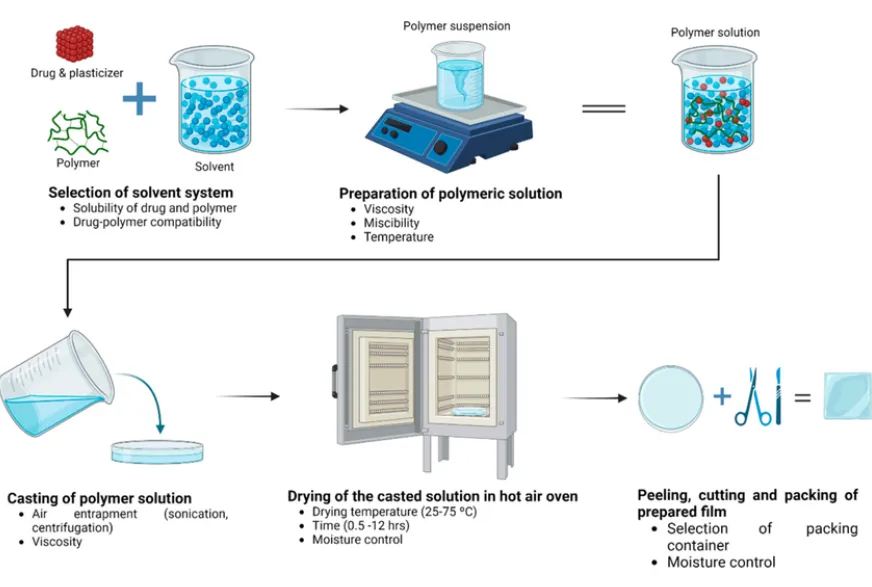
Fig 2. Solvent casting method [21]
Semi-Solid Casting Method[22,23]
Initially a solution of hydrophyllic film forming polymer is formulated. This solution is then subsequently combined with acid insoluble polymer solution which can be prepared using either cellulose acetate butyrate or cellulose acetate phthalate in sodium or ammonium hydroxide solution in a ratio of about 1:4. Then carefully plasticizer is incorporated to get a gel mass which is casted into thin films using temperature controlled drums.
Solid Dispersion Extrusion[24]
In this method the immiscible components are extruded along with the drug, and then solid dispersions are prepared. Solid dispersions are molded into suitable thin sized films using dies.
Hot-Melt Extrusion[25,26]
This method can be utilized based on knowledge from the plastics industry where formulators can extrude the combinations of drugs, polymers, and other suitable excipients into targeted dosage forms to achieve appropriate drug-release characteristics. In pharmaceutical formulations twin screw extruder has has been shown effective due to homogenous and consistent mixing of various formulation components leading to enhanced dissolution rate and bioavailability. The API and other ingredients are mixed in dry state, exposed to the heating process where the mixture melts and then extruded to form thin films. The solvent is completely eliminated by suitable technique. The resulting films are further cooled and cut to the desired sizes.

.Fig 3. Hot-melt extrusion technique.
Rolling method [27]
In this method drug containing suspension or a solution is rolled on a carrier. The primary solvent used is water or a mixture of water and alcohol. The films are dried using heated rollers and cut into required shapes and sizes. Other ingredients such as API, polymer, plasticizer and other required ingredients are dissolved in a small quantities of aqueous solvent utilizing the high-shear mixer.
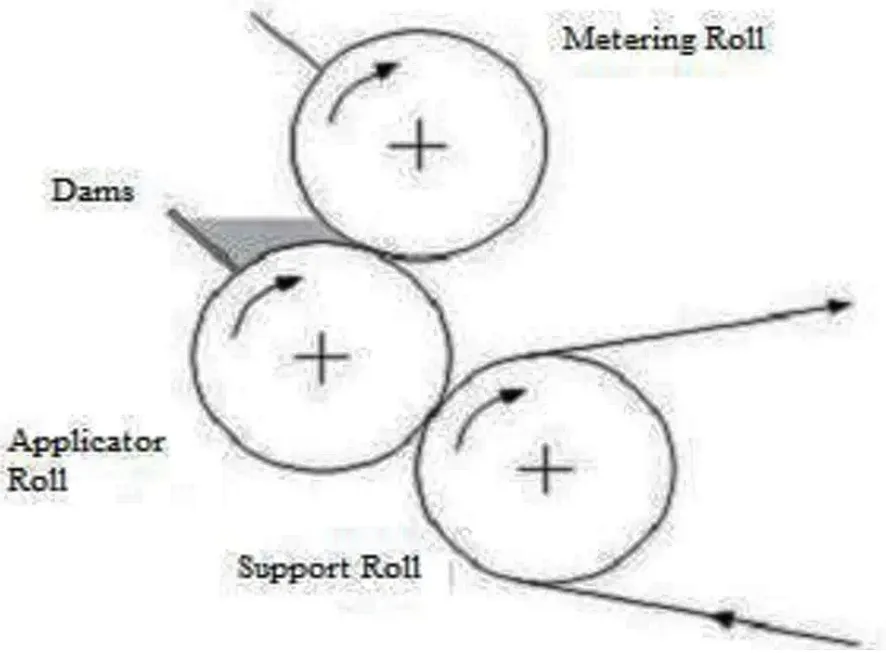
Fig 4. Rolling method
Evaluation Parameters
Mechanical properties [28]
The mechanical features of the film can be described based on its thickness, tackiness, tensile strength, and Young’s Modulus. Research suggests that soft and weak polymers typically have low tensile strength, low Young’s modulus, and low elongation at break, whereas hard and rigid polymers usually display high tensile strength, high Young’s modulus, and high elongation at break.
Thickness test
To measure the thickness of the film, tools such as a micrometer screw gauge, Vernier callipers, electronic digital micrometer, or SEM images can be used. It has been observed that the amount of plasticizer added tends to increase the thickness of the film. The thickness of the produced film is measured five times to ensure consistency. Ideally, the thickness should be less than 5%.
Tack test
Tack refers to how well the film sticks to a surface after being rubbed. This test also helps determine the dryness of the film.
Tensile strength
Tensile strength is the maximum stress a film strip can withstand before it breaks. It is calculated using the following formula:
Tensile strength=Load at failureStrip thickness ×Strip width

× 100
Percentage elongation [29]
When subjected to tensile stress, the film can stretch or lengthen. This measurement helps estimate how ductile a polymer is. The percentage elongation can be calculated using a specific formula.
Young's modulus
Young’s modulus measures the stiffness or elasticity of the film. It is determined by plotting the stress–strain curve and calculating the slope of the elastic deformation region using the following formula:
Young's Modulus=SlopeStrip thickness ×Cross head speed

× 100
Tear resistance [30]
Tear resistance indicates how well the film resists tearing and ultimate rupture. It is measured as the maximum stress or force required to tear the specimen, usually close to the start of tearing, and is expressed in Newtons.
Folding endurance
To determine folding endurance, a portion of the film is folded repeatedly at the same spot until it breaks. The number of times the film can be folded without breaking is used to calculate the folding endurance. Typically, the folding endurance of a film ranges between 100 and 150.
Swelling index [31]
The swelling index of the film is evaluated in simulated salivary fluid at a suitable pH. The film is first precisely weighed and placed in a pre-weighed stainless steel wire strainer. It is then immersed in 50 ml of pH 6.8 simulated salivary medium using a pestle. The weight of the film is measured at regular intervals until a consistent weight is achieved. The swelling index is calculated using the following formula:
SI=Wt-WoWo

Where,
SI= Swelling index
Wt =weight of the film at time “t”
Wo = weight of the film at t = 0 5.10.
Organoleptic evaluation
In-vitro methods such as taste sensors and specialized equipment are used to evaluate the organoleptic properties of orodispersible films. These in-vitro taste evaluation techniques are employed for high-throughput testing of oral pharmaceutical formulations.
Surface pH [32]
To measure the surface pH of the film, it is placed on a layer of 1.5% w/v agar gel.A pH paper with a range of 1 to 11 is then placed on the film. The change in color of the pH paper is recorded and reported.
Contact angle
At room temperature, the contact angle is measured using a goniometer. A drop of distilled water is placed on the surface of the dried film. A digital camera captures images of the water droplets within 10 seconds of their application. The contact angle is calculated as the average of the angles on both sides of the droplet.
Uniformity of drug content [33]
To assess the uniformity of drug content, a known weight of the film is dissolved in 100 ml of simulated saliva with a pH of 6.8 for 30 minutes while shaking the container vigorously. The drug content of each film is then evaluated to ensure content consistency. The maximum acceptable level of uniformity is 85-115%.
Moisture content [34]
The films are first weighed and placed in desiccators containing cadmium chloride or another appropriate desiccant. After three days, the films are reweighed to calculate the percentage of moisture loss using the following formula:
% Moisture content=Initial weight-Final weightInitial weight

× 100
Disintegration test
The disintegration time of a film is the time, in seconds, it takes to disintegrate when exposed to moisture or saliva. According to CDER guidance for orally disintegrating films (ODFs), the disintegration time should be 30 seconds or less. This test can be conducted using pharmacopoeial disintegration apparatus. The average disintegration time for the film is between 5 and 30 seconds.
In-vitro dissolution studies [35]
These studies calculate the cumulative drug retained and the cumulative drug release. They are performed using USP paddle-type equipment. The studies are carried out in 900 cc of simulated saliva at 37°C with a stirring speed of 75 rpm. At predetermined intervals of 2, 4, 6, or 10 minutes, samples are withdrawn and replaced with the same volume of buffer. The concentration of the samples is analyzed using a UV-visible spectrophotometer at a suitable wavelength to confirm the dissolution of ODFs.
Packaging And Storage Of Orodispersible Film: [36,37]
The orodispersible film (ODF) requires specialized and costly packaging materials because of its tendency to disintegrate quickly during production and storage. The aluminium pouch is commonly used as the primary packaging material. A specific packaging method called the fast card was developed by APR-Labtec for ODF films. The packaging material should be approved by the Food and Drug Administration (FDA). The packaging system should have strong security features to prevent unauthorized access or tampering. It is important that the packaging material does not contain any substances that could damage the ODF film. The following materials were used for packaging the ODF film.
Plastic Pouches And Paper Foil: Lightweight pouches offer good tamper resistance but raise environmental concerns. During the filling process, a sealed pouch is created using machinery.
Single Pouch And Aluminium Pouch: Aluminium is the most commonly used type of pouch for packaging ODF films. This pouch helps protect the pharmaceutical product in the ODF film from environmental factors.
Blister Card With Multiple Units: Thermoplastic resin is used for blister packing. It is an effective material that prevents moisture from entering the ODF film.
Barrier Films: Some drug formulations are sensitive to moisture, making the use of high barrier films essential. Moisture protection can be achieved through various materials, such as polychlorotrifluoroethylene and polypropylene film. Under certain conditions, polypropylene may also resist stress-induced fractures.
Odf’s Applications In Medication Delivery Systems [38,39,40]
ODFs have mainly been introduced in over-the-counter (OTC) medications for therapeutic uses such as coughs and colds, antacids for gas relief, sore throat treatments, and mouth fresheners, along with some nutritional supplement applications. The development of a thin, dissolvable strip for delivering the rotavirus vaccine to infants could help combat the leading cause of severe vomiting and diarrhea in children, which results in the deaths of approximately 600,000 individuals each year.
Vomiting and Nausea: A number of antiemetic drugs, including granisetron, metoclopromide, and domeperidone, have been formulated as ODFs.
Transdermal application: Active ingredients such as antibiotics or pain relievers can be used in wound care and other applications due to the ease of use and good appearance of ODFs, making them a promising area for innovation.
Gastroretentive drug delivery: Water-soluble medications and poorly soluble compounds can be delivered through dispersible films. These films can release the medication in the gastrointestinal tract when triggered by changes in pH or the presence of digestive enzymes, helping in the treatment of gastrointestinal disorders.
Asthma: During an asthma attack, the bronchi of an asthmatic person constrict, making it difficult to swallow solid foods.
CONCLUSION
Orodispersible films (ODFs) represent a promising and innovative approach in oral drug delivery systems, offering significant advantages over conventional dosage forms. Their rapid disintegration in the oral cavity without the need for water makes them particularly beneficial for paediatric, geriatric, and dysphagic patients who experience difficulty swallowing tablets or capsules. The versatility of ODFs allows incorporation of a wide range of therapeutic agents, including chemical drugs, vaccines, probiotics, and herbal extracts, thereby expanding their pharmaceutical applications.The successful development of ODFs largely depends on careful selection of formulation components such as film-forming polymers, plasticizers, sweeteners, saliva-stimulating agents, and surfactants, which collectively influence the mechanical strength, disintegration time, and drug release characteristics of the films. Additionally, advanced formulation strategies such as solid dispersion, nanotechnology, and solubility-enhancement techniques have further improved the bioavailability of poorly soluble drugs in ODF systems. Despite their numerous advantages, challenges such as limited drug loading capacity, stability concerns, and taste masking still require further research and optimization. Continued advancements in formulation technology and manufacturing processes are expected to overcome these limitations and promote wider commercialization of ODF products. Overall, orodispersible films hold great potential as a patient-friendly and effective drug delivery platform, contributing significantly to the future development of personalized and convenient pharmaceutical therapies.
REFERENCES


Rithvika Biju*, Viresh Chandur, Orodispersible Films as An Innovative Oral Drug Delivery System: Formulation, Manufacturing and Evaluation, Int. J. of Pharm. Sci., 2026, Vol 4, Issue 6, 404-415. https://doi.org/10.5281/zenodo.20501315
 10.5281/zenodo.20501315