

We use cookies to ensure our website works properly and to personalise your experience. Cookies policy
Dayanand Institute Of Pharmacy, Latur.
Colchicine is an established anti-inflammatory drug widely used in the management of acute gout and other inflammatory disorders. Pharmaceutical cocrystallization has emerged as a promising crystal-engineering approach for modifying the physicochemical properties of active pharmaceutical ingredients without altering their covalent structure. In this approach, colchicine is combined with a suitable pharmaceutically acceptable coformer through non-covalent interactions, such as hydrogen bonding, to form a new crystalline solid phase with potentially improved physicochemical characteristics. Colchicine cocrystals with different coformers have been investigated, including systems based on organic acids such as L-malic acid and tartaric acid. Such systems provide an opportunity to modify crystal packing, lattice energy, aqueous solubility, dissolution rate, stability, and potentially oral absorption. This review summarizes the physicochemical and biopharmaceutical limitations associated with colchicine, the fundamental principles of pharmaceutical cocrystal formation, coformer selection, preparation techniques, and characterization methods Pharmaceutical cocrystallization may therefore represent a promising formulation strategy for optimizing the delivery of colchicine and potentially improving its therapeutic performance in gout therapy.
1.1 Gout
Gout is a common form of inflammatory arthritis caused by the accumulation of uric acid crystals in the joints. It usually develops when the level of uric acid in the blood becomes abnormally high, a condition known as hyperuricemia. Gout commonly affects the big toe but can also involve the ankles, knees, wrists, and other joints. It typically presents with sudden, severe joint pain, swelling, redness, and tenderness. Recurrent attacks may lead to chronic joint damage and the formation of tophi. Early diagnosis, appropriate treatment, and lifestyle modifications can help control symptoms and prevent complications.
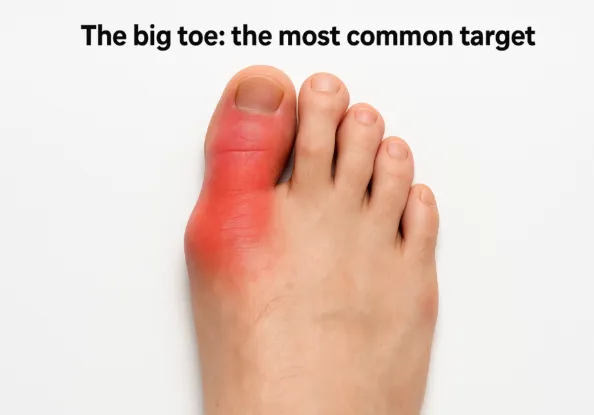
Figure 1: Gout Associated Inflammation of the Big Toe
1.2 Etiology
The main cause of gout is hyperuricemia, which results from an imbalance between uric acid production and its elimination from the body. The major etiological factors include:
1. Reduced renal excretion of uric acid – The kidneys may not remove sufficient uric acid from the blood. This is the most common mechanism.
2. Increased production of uric acid – Excessive breakdown of purines in the body can increase uric acid formation.
3. Dietary factors – Frequent consumption of purine-rich foods such as red meat, organ meats, and certain seafood may increase uric acid levels. Excessive alcohol intake, particularly beer, can also contribute.
4. Obesity and metabolic disorders – Obesity, insulin resistance, hypertension, and metabolic syndrome are associated with an increased risk of gout.
5. Genetic factors – Certain inherited differences in uric acid transport and kidney function can increase susceptibility to gout.
6. Medications – Some medicines, particularly thiazide and loop diuretics, may reduce uric acid excretion and increase the risk of gout.
7. Medical conditions – Chronic kidney disease, certain blood disorders, and conditions involving rapid cell breakdown can increase uric acid levels.
8. Dehydration and lifestyle factors – Inadequate fluid intake and certain lifestyle patterns may contribute to increased uric acid concentration and gout attacks.
1.3 Risk Factors of Gout
1. Male sex and increasing age – Gout is more common in men and in older adults. 2. Family history – A family history of gout increases susceptibility 3. Obesity – Excess body weight is associated with increased uric acid levels. 4. High-purine diet – Frequent consumption of red meat, organ meats, and some seafood can increase uric acid levels. 5. Alcohol consumption – Particularly beer and spirits, which can increase the risk of gout attacks. 6 Kidney disease –– These conditions are Reduced kidney function can decrease uric acid excretion.. 7. Certain medications – Diuretics and some other medicines can raise uric acid levels. 8. Dehydration – Inadequate fluid intake may contribute to uric acid crystal formation. 9. Certain medical conditions – Conditions causing increased cell breakdown or rapid turnover can increase uric acid production.
1.4 Pathophysiology of Gout
Gout develops mainly due to hyperuricemia, which leads to the formation and deposition of monosodium urate crystals in the joints and surrounding tissues.
Pathophysiology sequence:
Increased uric acid production / decreased renal excretion ↓ Hyperuricemia ↓ Uric acid reaches a high concentration in body fluids ↓ Formation of monosodium urate crystals ↓ Deposition of crystals in joints and tissues ↓ Activation of the immune system ↓ Release of inflammatory mediators (especially IL-1β) ↓ Recruitment of neutrophils and other inflammatory cells ↓ Acute inflammation ↓ Intense joint pain accompanied by redness, increased warmth, swelling, and tenderness.
Repeated episodes of inflammation can lead to chronic gout, characterized by the formation of tophi, joint destruction, and reduced joint function.
1.5 Diagnosis of Gout
1. Clinical history and physical examination
2. Serum uric acid test
3. Synovial fluid examination
4. Complete blood count (CBC) and inflammatory markers
5. Kidney function tests
6. X-ray
7. Ultrasound
8. Dual-energy CT (DECT)
2. Colchicine in Gout
2.1 Introduction to Colchicine
Colchicine is an anti-inflammatory medication commonly used in the treatment and prevention of acute gout attacks. It works by reducing the activity and movement of neutrophils, which are involved in the inflammatory response caused by monosodium urate crystals. Colchicine does not lower uric acid levels; instead, it helps relieve the inflammation and pain associated with gout. It is most effective when started early during an acute gout attack. Common adverse effects are diarrhea, nausea, vomiting, and abdominal pain and headache.
2.2 Mechanism of Action of Colchicine
Colchicine acts mainly by binding to tubulin, a protein needed to form microtubules.
Mechanism:
Colchicine ↓ Binds to tubulin ↓ Inhibits microtubule formation and polymerization ↓ Reduces neutrophil migration and activation ↓ Decreases release of inflammatory mediators ↓ Reduces inflammation caused by monosodium urate crystals ↓ Relief of pain, swelling, and inflammation in acute gout
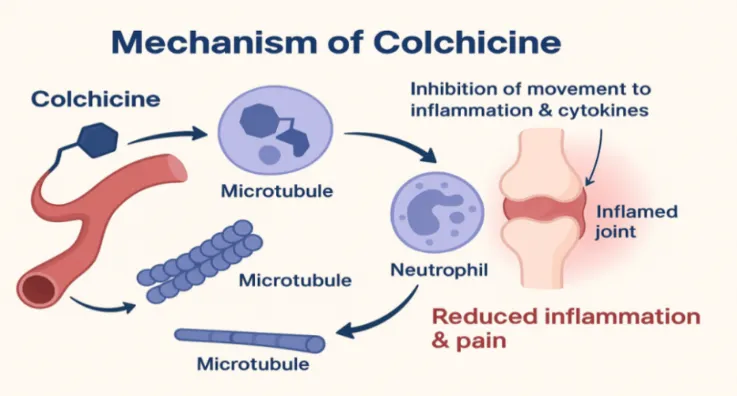
Figure 2: Mechanism of Colchicine
2.3 Role of Colchicine in Gout
1. Treatment of acute gout attacks – Colchicine reduces inflammation and helps relieve pain, swelling, redness, and tenderness during an acute gout attack.
2. Prevention of gout flares – It can be used in low doses to prevent acute attacks, especially when starting urate-lowering medicines such as allopurinol.
3. Reduces inflammation – It inhibits neutrophil migration and activation in response to monosodium urate crystals.
4. Does not lower uric acid – Colchicine treats the inflammation caused by urate crystals but does not remove or reduce the underlying uric acid level.
3. Dose and Administration of Colchicine in Gout
3.1. Acute gout attack
Figure 3: Colchicine Tablet
3.2. Prevention of gout attacks
3.3 Adverse Drug Reactions (ADR) of Colchicine
Common ADRs
1 .Diarrhea – most common adverse effect.
2.Nausea and vomiting.
3.Abdominal pain and cramps.
4.Loss of appetite.
Serious ADRs, especially with overdose or prolonged use: 5. Bone marrow suppression – may cause anemia, leukopenia, or thrombocytopenia. 6. Muscle weakness or myopathy. 7. Peripheral neuropathy. 8. Hair loss (alopecia). 9. Severe toxicity can lead to multiple-organ failure and can be fatal.
4. Pharmaceutical Cocrystals
4.1 Definition
A pharmaceutical cocrystal is a crystalline solid containing an active pharmaceutical ingredient (API) and one or more coformers in a definite stoichiometric ratio. The components are held together by non-covalent interactions such as hydrogen bonding, π–π interactions, and van der Waals forces.
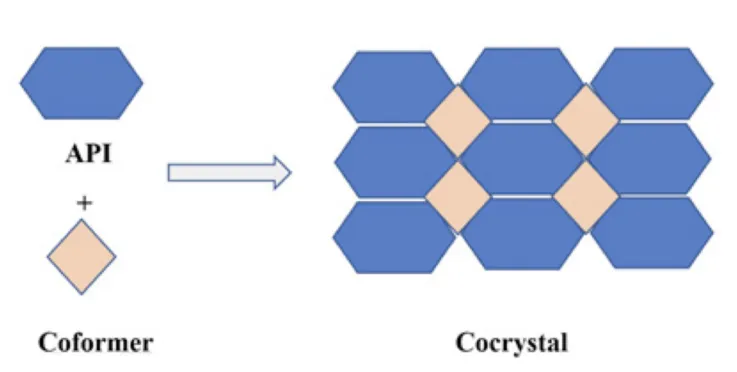
Figure 4: Pharmaceutical Cocrystal Formation
4.2 Components
4.3 Principle
Cocrystal formation modifies the crystal packing and intermolecular interactions of the drug without chemically changing its covalent structure. This can alter properties such as solubility, dissolution, stability, melting point, and mechanical behavior.
4.4 Objectives of Pharmaceutical Cocrystallization
1. Increase drug solubility.
2. Improve dissolution rate.
3. Enhance bioavailability.
4. Improve physical and chemical stability.
5. Modify melting point.
6. Improve flowability and compressibility.
7. Reduce undesirable taste or odor.
8. Improve the manufacturability of poorly soluble drugs.
4.5 Advantages
4.6 Limitations
5. Colchicine Cocrystal
Colchicine cocrystal refers to a crystalline solid in which colchicine, the active pharmaceutical ingredient (API), is combined with a suitable coformer in a defined crystal structure. Cocrystallization is investigated to modify the physicochemical properties of colchicine while keeping its chemical structure unchanged.
5.1 Rational Development of Colchicine Cocrystal
The rational development of a colchicine cocrystal involves selecting an appropriate coformer, predicting favorable intermolecular interactions, preparing the cocrystal, and evaluating whether the resulting crystal provides useful pharmaceutical properties.
5.1.1 Selection of Coformer
The coformer should be pharmaceutically acceptable, non-toxic, chemically stable, and capable of forming strong and predictable intermolecular interactions with colchicine.
Possible coformer categories include:
5.1.2 Types of Coformer
Coformers can broadly be classified according to their chemical functionality:
1. Carboxylic acid coformers – contain one or more –COOH groups and can participate in hydrogen bonding.
2. Amino acid coformers – contain amino and carboxyl groups and may provide multiple interaction sites.
3. Amide coformers – contain carbonyl and/or amide groups that can participate in hydrogen bonding.
4. Polyfunctional coformers – contain several hydrogen-bond donors and acceptors, allowing multiple interactions with colchicine.
5.2 Preparation Techniques of Colchicine Cocrystals
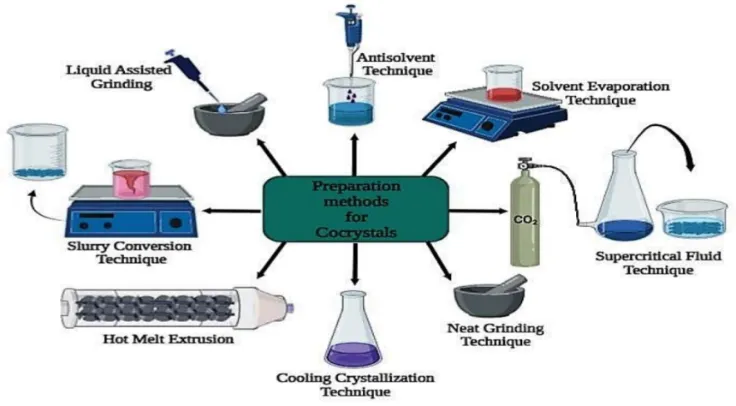
Figure 5: Various Preparation Techniques of Colchicine Cocrystal
1. Solvent Evaporation Method
Advantage: Simple and useful for obtaining well-developed crystals.
2. Liquid-Assisted Grinding (LAG)
Advantage: Requires little solvent and can promote cocrystal formation efficiently.
3. Neat Grinding / Dry Grinding
4. Slurry Conversion Method
5. Cooling Crystallization
6. Spray-Drying Method
5.3 Characterization of Colchicine Cocrystals
Characterization is performed to confirm cocrystal formation, determine its crystal structure, and evaluate its pharmaceutical properties.
1. PXRD (Powder X-ray Diffraction): Confirms the formation of a new crystalline phase by showing a diffraction pattern different from those of colchicine and the coformer.
2. DSC (Differential Scanning Calorimetry): Determines the melting point and evaluates the thermal behavior and stability of the cocrystal.
3. FTIR Spectroscopy (Fourier Transform Infrared Spectroscopy): Identifies changes in characteristic functional-group vibrations and provides evidence of intermolecular interactions.
4. Raman Spectroscopy: Detects changes in molecular vibrations and helps confirm interactions within the crystal lattice.
5. TGA (Thermogravimetric Analysis): Determines weight loss and helps identify the presence of moisture or residual solvent in the crystal.
6. SEM (Scanning Electron Microscopy): Examines crystal morphology, particle shape, and surface characteristics.
7. Solid-State NMR (Nuclear Magnetic Resonance): Provides information about the molecular environment and intermolecular interactions in the solid state.
8. Single-Crystal XRD (Single-Crystal X-ray Diffraction): Provides detailed information about the three-dimensional arrangement of colchicine and the coformer when suitable single crystals can be obtained.
9. Solubility Study: Determines whether cocrystallization has changed the apparent solubility of colchicine.
10. Dissolution Study: Compares the dissolution behavior of the cocrystal with that of pure colchicine.
11. Stability Study: Evaluates the physical and chemical stability of the cocrystal under defined temperature and humidity conditions.
5.4 Effect of Cocrystallization on Pharmaceutical Properties
Cocrystallization can modify the solid-state properties of colchicine and may improve its pharmaceutical performance. The effect depends strongly on the selected coformer and the resulting crystal structure.
1. Effect on Solubility
Cocrystallization can increase or modify the apparent solubility of a poorly soluble drug by changing its crystal lattice and intermolecular interactions.
Colchicine + coformer ↓ Modified crystal lattice ↓ Altered lattice energy and drug–solvent interactions ↓ Potentially increased apparent solubility
However, cocrystallization does not always increase solubility; some cocrystals may show lower solubility depending on their lattice stability .
2. Effect on Dissolution
Dissolution is the process by which a solid drug dissolves in a liquid medium, such as gastrointestinal fluid, and becomes available in solution for absorption..For a colchicine cocrystal, the process can be understood as:
Colchicine cocrystal ↓ Contact with gastrointestinal fluid ↓ Water/fluids interact with the crystal surface ↓ Colchicine molecules leave the crystal lattice ↓ Colchicine dissolves in the surrounding fluid ↓ Dissolved colchicine becomes available for absorption
3. Effect on Stability
Cocrystallization can modify the physical and chemical stability of colchicine.
However, stability must be experimentally evaluated because some cocrystals can undergo phase conversion or dissociation under moisture or temperature stress.
4. Effect on Bioavailability
If cocrystallization improves solubility and dissolution, it may increase the amount of colchicine available for absorption and therefore potentially improve oral bioavailability.
Cocrystal formation ↓ Improved solubility/dissolution ↓ More drug available for absorption
↓ Potential increase in bioavailability
This effect cannot be assumed from improved dissolution alone and must be demonstrated through appropriate pharmacokinetic studies.
5. Effect on Drug Performance
Cocrystallization may improve the overall drug-product performance by modifying:
4.5 Application of Colchicine Cocrystals in Gout Therapy
Colchicine is used in gout therapy mainly because it reduces inflammation caused by monosodium urate crystals. A colchicine cocrystal would be developed primarily to modify the drug's pharmaceutical properties, rather than to change its mechanism of action.
Potential applications
1. Improved dissolution
A suitable cocrystal may increase the dissolution rate of colchicine.
This could potentially make the drug available for absorption more efficiently.
2. Improved solubility
Cocrystallization may modify the apparent solubility of colchicine.
This may be useful for developing an optimized oral dosage form.
3. Potential improvement in bioavailability
If dissolution is a limiting factor, improved dissolution may increase drug availability for absorption.
This requires confirmation through pharmacokinetic studies.
4. Improved formulation properties
Cocrystallization may modify crystal morphology, flowability, compressibility, and stability, potentially facilitating tablet or capsule development.
5. Improved stability
A suitable cocrystal may provide better physical or chemical stability during storage.
6. Optimization of gout treatment
The therapeutic action remains that of colchicine: inhibition of neutrophil-mediated inflammation associated with urate crystals.
The cocrystal approach is therefore intended to optimize the delivery and pharmaceutical performance of colchicine.
6.Challenges and Future Perspectives
The development of colchicine cocrystals presents several challenges, including the selection of a suitable and pharmaceutically acceptable coformer, prediction of crystal formation, optimization of the preparation method, and maintenance of crystal stability during storage. Cocrystal formation is influenced by factors such as molecular interactions, stoichiometric ratio, solvent, temperature, and crystallization conditions. Therefore, obtaining a reproducible and stable cocrystal can require extensive formulation and analytical studies. Another important challenge is that cocrystallization does not always improve solubility or dissolution, and an improvement in dissolution does not necessarily result in increased bioavailability. Scale-up from laboratory preparation to industrial manufacturing and regulatory evaluation are also important considerations.The future of colchicine cocrystal development is promising because advanced techniques such as computational modeling, crystal-structure prediction, molecular simulation, and high-throughput coformer screening may facilitate the identification of suitable cocrystals. Further research may focus on developing stable cocrystals with improved dissolution, solubility, and formulation properties. Pharmacokinetic and clinical studies will be necessary to determine whether these improvements provide meaningful benefits in gout therapy. Advanced manufacturing technologies and combination with modern drug-delivery systems may also provide opportunities for optimized colchicine formulations. Overall, future research should focus on establishing a clear relationship between cocrystal structure, pharmaceutical properties, drug performance, safety, and clinical outcomes.
7.Limitations of Pharmaceutical Cocrystals of Colchicine
1. Limited Solubility Improvement: Cocrystal formation may not significantly improve the solubility of colchicine, as the outcome depends on the coformer and crystal structure.
2. Cocrystal Dissociation: Cocrystals may dissociate in gastrointestinal fluids, reducing their ability to maintain improved solubility.
3. Drug Precipitation: Colchicine may precipitate or recrystallize after dissolution, which can reduce its availability for absorption.
4. Coformer Toxicity: The selected coformer must be safe, non-toxic at the intended exposure, and compatible with colchicine.
5. Stability Issues: Colchicine cocrystals may undergo physical or chemical changes under conditions of high humidity, temperature, or prolonged storage.
6. Uncertain Bioavailability Improvement: Increased solubility and dissolution do not necessarily improve oral bioavailability, because absorption, metabolism, and drug transport mechanisms also influence colchicine exposure. Furthermore, colchicine has a narrow therapeutic index, so increased exposure may raise the risk of toxicity.
8.Regulatory Aspects
The regulatory approval of colchicine cocrystals requires sufficient evidence of their quality, safety, and efficacy before they can be used in pharmaceutical formulations. The selected coformer must have an acceptable safety profile and be suitable for pharmaceutical use at the intended dose. Detailed characterization of the cocrystal, including its crystal structure, drug-to-coformer ratio, purity, and solid-state properties, is necessary to ensure product quality. Stability studies must be conducted to confirm that the cocrystal maintains its quality and performance throughout its shelf life. Dissolution testing and pharmacokinetic studies may be required to evaluate changes in colchicine absorption and bioavailability compared with the approved formulation. Manufacturing processes must comply with Good Manufacturing Practices (GMP) to ensure consistent quality and reproducibility. Since colchicine has a narrow therapeutic index, any potential changes in systemic drug exposure must be carefully evaluated to minimize the risk of toxicity.
CONCLUSION
Gout is a common inflammatory arthritis caused by the deposition of monosodium urate crystals in joints, resulting in severe pain, swelling, redness, and inflammation. Colchicine is an important anti-inflammatory drug used for the treatment of acute gout attacks and prevention of recurrent gout flares. It acts mainly by inhibiting microtubule formation and reducing neutrophil migration and activation. Although colchicine is effective in controlling gout-associated inflammation, its narrow therapeutic range and physicochemical properties make formulation optimization important.Pharmaceutical cocrystallization is a promising crystal-engineering technique that combines colchicine with a suitable pharmaceutically acceptable coformer to form a new crystalline solid without changing the covalent structure of the drug. Cocrystallization can potentially modify the solubility, dissolution rate, stability, and other pharmaceutical properties of colchicine. Improved dissolution may increase the amount of drug available for absorption and may potentially improve bioavailability, although this must be confirmed experimentally.Therefore, the development of colchicine cocrystals represents a promising area of pharmaceutical research for optimizing drug performance in gout therapy. Further studies involving coformer selection, preparation, characterization, stability, dissolution, pharmacokinetics, safety, and clinical evaluation are required to establish their practical therapeutic value.
REFERENCES



Todkar Ganesh, Bhoge Amarja, Marlapalle Dnyaneshwari, Kale Nikita, Katte Anvirappa, Khandare Ramprasad, Shetkar Shredatta, Pharmaceutical Cocrystals of Colchicine: A Potential Strategy for Improving Solubility and Dissolution in Gout Therapy, Int. J. of Pharm. Sci., 2026, Vol 4, Issue 11, 468-478. https://doi.org/10.5281/zenodo.23923860
 10.5281/zenodo.23923860