

We use cookies to ensure our website works properly and to personalise your experience. Cookies policy
Siddharth College of Pharmacy & Research Center, Badlapur.
The present study was carried out in order to develop bi-layer tablet to achieve immediate and the sustain release were prepared by direct compression method. The Immediate release layer prepared by using superdisintegrant Sodium starch glycolate, Cross povidone, and Cross carmellose sodium with three different concentrations. Cross carmillose sodium was selected for preparation of bi-layer tablet. The sustained release layer prepared by using polymers Sodium alginate, HPMCK15, Carbapol 940, Xanthum gum in three different concentrations. HPMCK15 was selected for preparation of bi-layer tablet. APIs, blends were performed preformulation studies such as incompatibility studies, solubility, bulk density, tapped density, Carr’s index, Hausner’s ratio and angle of repose which would really support to formulate efficient bilayer tablets. The bilayer tablet were investigated such as weight uniformity, hardness, drug content, in vitro dissolution study, In vitro buoyancy study, Kinetic data analysis Batch F13 optimized by using 32 factorial designs for the % drug release and floating lag time. From the post optimization analysis of the bi-layer tablet, the optimized batch showed 76.40% release of Captopril as a sustained release within 8hrs and 96.7% release of Amlodipine Besylate as Immediate release after 1hr. Floating lag time was found to be 110sec. From drug release kinetics, optimized F4 Captopril layer follows Higuchi Matrix Model. having higher correlation coefficient r2 0.9594.
Captopril is an angiotensin receptor antagonist. It suppresses the effects of angiotensin II at its receptors, thereby blocking the rennin‐ angiotensin system. Captopril is used to treat high BP (Hyepertention), congestive heart failure, kidney problem caused by diabetics & to improve survival after the heart attack. Captopril after oral dose produces antihypertensive action for the period of 6 – 8 h, The half life of Captopril is 1.9 hours, it requires a daily dose of 37.5–75 mg to be taken three times, most stable at pH 1.2 and as the pH increases becomes unstable and undergoes a degradation reaction. These drawbacks can be overcome by developing a floating dosage form to be remained buoyant in the stomach. Floating drug delivery system increases the gastric residence time, stability, patient’s compliance and sustains the release of the drug hence increases the bioavailability. [1, 2, 3]
Amlodipine is a prototype second generation dihydropyridine calcium channel blocker that inhibits the transmembrane influx of calcium ions into vascular smooth muscle and cardiac muscle. It has a longer duration of action (i.e.) half life of 40 hours and the initial effects are cumulative over many days. Amlodipine can be used in the treatment of mild to moderate hypertention, chronic stable angina pectoris or vasopastic angina. In these conditions it may be employed as monotherapy or in combination with other antihypertensive or antianginals. Amlodipine can be safely combined with β blockers, ACE inhibitors, thiazides and nitrates (Eric G. et. al., 2005). More over for patient compliance in case of anti-angina patients, a rapid onset of action is necessary for immediate pain relief. Hence Amlodipine can be given as a single immediate release dose.
The combination of an ACE inhibitor and a dihydropyridine Ca-channel blocker is in established clinical use for hypertension and although only certain combinations have been studied, no clinical significant pharmacokinetics interaction appear to occur between the dihydropyridine- type Ca-channel blockers and ACE inhibitor. No important pharmacokinetics interactions have been demonstrated. The combination of an ACE inhibitor & a dihydropyridine Ca-Channel blocker is clinically useful in the treatment of hypertention. [4,5]
MATERIALS AND METHODS
MATERIALS
Captopril received from Wockhardt Ltd.,Aurangabad, Amlodipine Besylate from Emcure pharmaceutical, Bhosari. HPMCK15, Guar Gum, Sodium Alginate, Carbopol940, Xanthum Gum, Microcrystalline cellulose, Sodium bicarbonate, Lactose, Croscarmellose Sodium, Magnesium sterate, Talc from Loba Chemical Pvt.Ltd.,Mumbai. All the other chemicals were used with analytical grades.
METHODS
Preformulation Study
Preformulation studies were carried out in order to find out the drug excipients interactions and its flow property during the formulation process. The objective of the preformulation studies is to generate information useful to the formulator in developing stable and bioavailable dosage forms that can be mass produced. The drug-polymer and polymer-polymer interactions were studied by FTIR spectrometer, DSC Thermogram. The characteristic peaks were recorded. Compatibility studies of Captopril with its excipients and Amlodipine besylate with its additives were done for one month.
Preparation of Bi-layer Tablets
Preparation of Captopril Layer
All the ingredient were weighed and dispensed accurately. Captopril, HPMCK15, Talc, Sodium bicarbonate, Lactose were passed through 40 # sieve. Lubricant Magnesium sterate was passed through 60 # sieve. The sifted material was mixed for few minutes.
Preparation of Amlodipine Besylate Layer
All the ingredient were weighed and dispensed accurately. Captopril, HPMCK15, Cross Carmillose Sodium, Lactose, Microcrystalline cellulose, Talc were passed through 40 # sieve. The sifted material was mixed for few minutes.
Composition for Amlodipine besylate layer
Table: Amlodipine Besylate Layer Formulation:
| Sr. No. | Ingredients | F1 |
|---|---|---|
| 1 | Amlodipine besylate | 10 |
| 2 | HPMCK15 | 10 |
| 3 | Cross Carmilose Sodium | 10 |
| 4 | Talc | 5 |
| 5 | Lactose | 70 |
| 6 | Microcrystaline cellulose | 45 |
| 7 | TOTAL Layer Weight (Mg) | 150 |
Amlodipine Besylate Immediate release was kept constant for all the batches of Bi-layer tablet.
Composition for Captopril layer
Table: Captopril Layer Formulation:
| Sr. No. | Ingredients | F1 | F2 | F3 | F4 | F5 | F6 | F7 | F8 | F9 |
|---|---|---|---|---|---|---|---|---|---|---|
| 1 | Captopril | 25 | 25 | 25 | 25 | 25 | 25 | 25 | 25 | 25 |
| 2 | HPMCK15 | 100 | 100 | 100 | 125 | 125 | 125 | 150 | 150 | 150 |
| 3 | Magnesium state | 3.5 | 3.5 | 3.5 | 3.5 | 3.5 | 3.5 | 3.5 | 3.5 | 3.5 |
| 4 | Talc | 3.5 | 3.5 | 3.5 | 3.5 | 3.5 | 3.5 | 3.5 | 3.5 | 3.5 |
| 5 | Sodium bicarbonate | 20 | 40 | 60 | 20 | 40 | 60 | 20 | 40 | 60 |
| 6 | Lactose | 98 | 78 | 58 | 73 | 53 | 33 | 48 | 28 | 08 |
| 7 | TOTAL Layer Weight(Mg) | 250 | 250 | 250 | 250 | 250 | 250 | 250 | 250 | 250 |
Evaluation of Pre-compression parameter of Tablet
Flow Property
Flow properties of the API were determined by calculating parameters such as bulk density, tapped density, compressibility index, Hausner’s ratio and angle of repose.
Evaluation of Post-compression parameter [6,7, 8]
Hardness
The hardness of tablet of each formulation was measured by Monsanto hardness tester. The hardness was measured in terms of kg/cm2.
Friability
Tablets were weighed accurately and placed in the tumbling apparatus that revolves at 25 rpm dropping the tablets through a distance of six inches with each revolution. After 4 min., the tablets were weighed and the percentage loss in tablet weight was determined.

Weight Variation
The tablet was checked to ensure the proper weight of tablets is being made. Twenty tablets were selected as a random from batch, weigh individually and the average weight was calculated. Then percent variation is determined.
Drug Content [9]
3 tablets of each formulation were weighed and powdered. The quantity of powder equivalent to 100 mg was transferred in to a 100 ml volumetric flask and the volume was made up with 0.1N HCl. Further 1ml of the above solution was diluted to 10 ml with 0.1N HCl and absorbance of the resulting solution was observed at respective wavelength.
In vitro dissolution studies [10]
The release rate of Captopril and Amlodipine Besylate from bi-layer tablets was determined up to 8 hours using USP-type II dissolution testing apparatus (paddle type). The dissolution test was performed using the dissolution medium (900ml) consisted of the 0.1N HCL from 8 hours, maintained and at 50 rpm. A sample (5mL) of the solution was withdrawn from the dissolution apparatus at specific time intervals throughout the dissolution study of 8 hours for analysis and replaced with fresh dissolution medium. The samples were analyzed for Captopril and Amlodipine Besylate at 207, 239 nm respectively using a Shimadzu UV-1800 UV/V is double-beam spectrophotometer (Japan).
In vitro Buoyancy studies [11]
The tablets were placed in a 100ml beaker containing 0.1N HCl. The time required for the tablet to rise to the surface and float was determined as the floating lag time (FLT) and the duration of time the tablet constantly floats on the dissolution medium was noted as Total Floating Time respectively (TFT).
Full Factorial Design [12,13]
A 32 randomized full factorial design was adopted to optimize the variable.
Table: Layout of Factorial Design
| Batch code | X1 | X2 |
|---|---|---|
| F1 | -1 | -1 |
| F2 | -1 | 0 |
| F3 | -1 | 1 |
| F4 | 0 | -1 |
| F5 | 0 | 0 |
| F6 | 0 | 1 |
| F7 | 1 | -1 |
| F8 | 1 | 0 |
| F9 | 1 | 1 |
| Coded Values | Amount of Binder (HPMC K15) X1 |
Amount of Floating Agent (Sodium Bicarbonate) X2 |
|---|---|---|
| -1 | 100 | 20 |
| 0 | 125 | 40 |
| 1 | 150 | 60 |
RESULT AND DISCUSSION
Evaluation of Pre-compression parameter of Formulation F1-F9
Table: Evaluation of Pre-compression Parameter of Formulation F1-F9
| Batch No. | Bulk density | Tapped density | Carr’s Index | Hausner’s ratio | Angle of repose |
|---|---|---|---|---|---|
| F1 | 0.49 | 0.52 | 6. 92 | 1.06 | 33.75 |
| F2 | 0.5 | 0.53 | 5.6 | 1.05 | 36.5 |
| F3 | 0.49 | 0.54 | 7.9 | 1.1 | 31.38 |
| F4 | 0.47 | 0.48 | 13.4 | 1.03 | 35.9 |
| F5 | 0.43 | 0.49 | 10.28 | 1.02 | 35.53 |
| F6 | 0.42 | 0.48 | 12.37 | 1.03 | 37.18 |
| F7 | 0.48 | 0.55 | 12.72 | 1.14 | 37.23 |
| F8 | 0.49 | 0.56 | 13.27 | 1.15 | 39.21 |
| F9 | 0.49 | 0.54 | 10.69 | 1.1 | 36.5 |
| For IR Layer | 0.4 | 0.47 | 10.96 | 1.01 | 30.67 |
The powder flow properties of the optimized batches were also studied and from the observations it was concluded that the optimized batches showed good powder flow properties with good compressibility.
Evaluation of Post-compression parameter of Formulation F1-F9
Table: Evaluation of Post-compression Parameter of Formulation F1-F9
| Batch No. | Weight Variation (n=3) |
Thickness (mm) (n=3) | Hardness (kg/cm2) (n=3) |
Friabiliy (%) |
Drug Content (%) |
|
|---|---|---|---|---|---|---|
| captopril | Amlodipine | |||||
| F1 | 392 ± 2.7 | 5.24± 0.01 | 4.26 ± 0.11 | 0.62 | 96.20 ± 1.0 | 96.12 ± 0.59 |
| F2 | 393 ± 3.6 | 5.21± 0.01 | 4.13 ± 0.23 | 0.21 | 90.20 ± 0.4 | 91.80 ± 0.91 |
| F3 | 393 ± 3.3 | 5.14± 0.01 | 4.3 ± 0.10 | 0.37 | 92.14 ± 0.9 | 95.37 ± 0.53 |
| F4 | 395 ± 2.5 | 5.24± 0.01 | 3.8 ± 0.28 | 0.01 | 97.79± 0.7 | 96.83± 0.68 |
| F5 | 394 ± 3.8 | 5.45± 0.02 | 4.0 ± 0.5 | 1.00 | 95.91 ± 0.3 | 95.92± 0.16 |
| F6 | 395 ± 3.4 | 5.54± 0.02 | 3.8 ± 0.10 | 0.25 | 95.91 ± 0.8 | 96.51 ± 0.03 |
| F7 | 392 ± 3.7 | 5.62± 0.04 | 4.4 ± 0.40 | 0.07 | 97.15 ± 0.5 | 95.48 ± 1.38 |
| F8 | 392 ± 3.8 | 5.5± 0.02 | 4.1 ± 0.28 | 0.11 | 94.97 ± 0.5 | 95.03 ± 1.37 |
| F9 | 392 ± 3.9 | 5.71± 0.01 | 4.3 ± 0.41 | 0.88 | 970.7 ± 0.2 | 95.60 ± 0.20 |
Bi-layer tablet prepared by direct compression method. A total nine optimized formulations were prepared using three different levels of HPMC K15 and Sodium Bicarbonate. All the formulations passed weight variation test, uniformity of content test. The hardness of all the tablets was found to be 3.8-4.4 Kg/cm2. Friability was found to be below 1% which was indication of good resistance of tablets.
In Vitro Drug Release for IR Layer Optimized Formulation F1-F3
Figure: In Vitro Drug Release for IR Layer Optimized Formulation F1-F3
In Vitro Drug Release for IR Layer Optimized Formulation F4 - F6
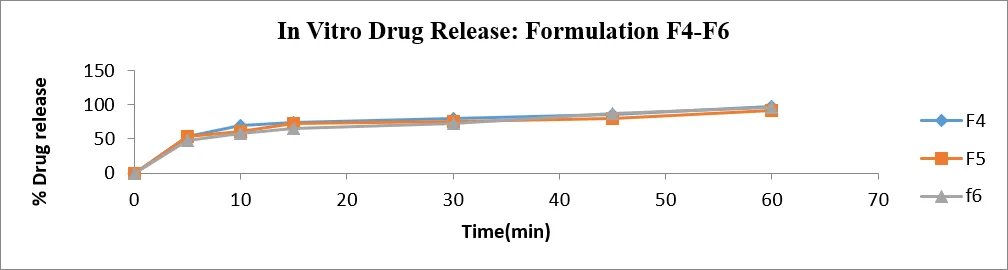
Figure: In Vitro Drug Release for IR Layer Optimized Formulation F4-F6
In Vitro Drug Release for IR Layer Optimized Formulation F7 - F9
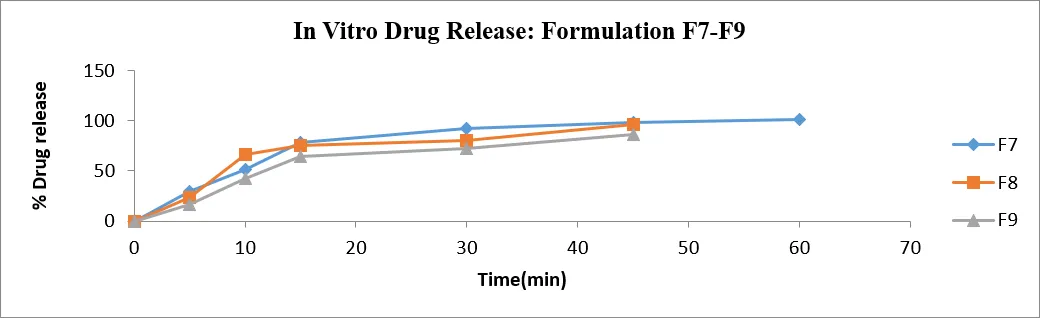
Figure: In Vitro Drug Release for IR Layer Optimized Formulation F7-F9
In Vitro Drug Release for SR Layer Optimized Formulation F1-F3
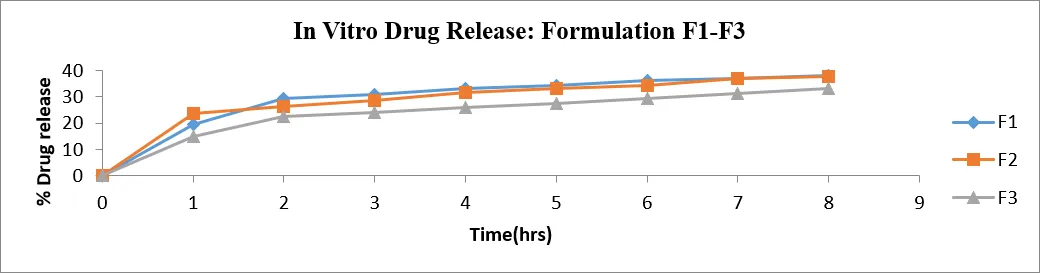
Figure: In Vitro Drug Release for SR Layer Optimized Formulation F1-F3
In Vitro Drug Release for SR Layer Optimized Formulation F4-F6:
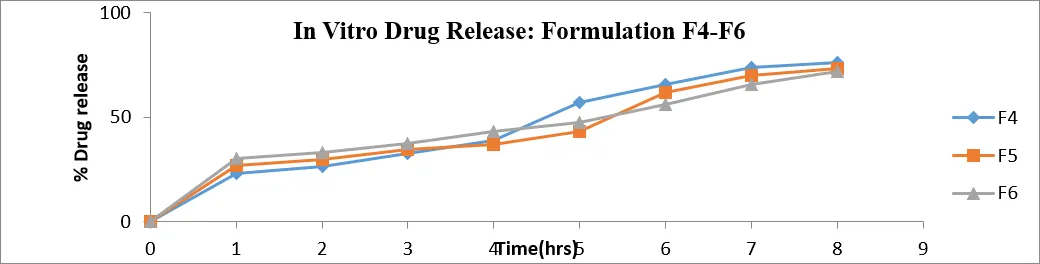
Figure: In Vitro Drug Release for SR Layer Optimized Formulation F4-F6
In Vitro Drug Release for SR Layer Optimized Formulation F7-F9:
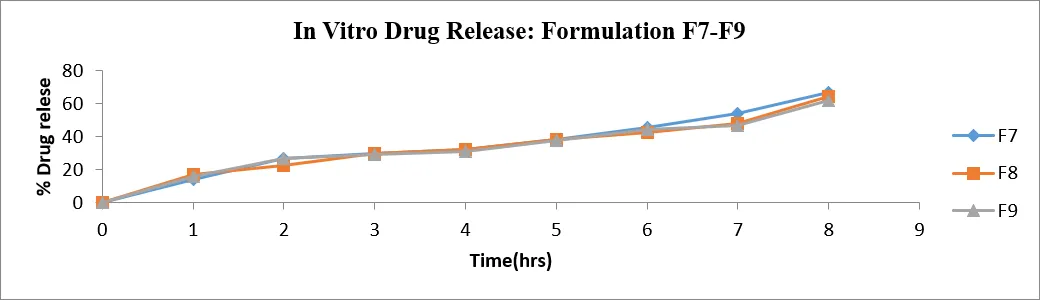
Figure: In Vitro Drug Release for SR Layer Optimized Formulation F7-F9
In-Vitro Dissolution Studies: All the batches showed 100% drug release of the Immediate Release layer (Amlodipine Besylate) within the 60mins. Whereas Sustained Release layer (Captopril) showed 38.03, 37.76, 33.29 % drug release for the F1,F2, F3; 76.40, 73.4, 71.77 for F4,F5,F6; and 66.55 , 64.17, 61.85 for the F7,F8, F9 . It was observed that as the concentration of HPMC K15 increased the drug release rate was decreased. This is possibility due to different diffusion and swelling behavior of the polymer with decreasing macromolecular weight, the degree of entanglement of the polymer chains decreases. It was observed that batch F4 was optimized formulation which showed 76% drug release after 8hrs.
In vitro Buoyancy Studies:
Table: In Vitro Buoyancy Study of Formulation F1-F9
| Batch | Buoyancy Lag Time (Sec.) | Total Floatation Time (Hrs) |
|---|---|---|
| F1 | 110 | ˃8 |
| F2 | 90 | ˃8 |
| F3 | 80 | ˃8 |
| F4 | 60 | ˃8 |
| F5 | 50 | ˃8 |
| F6 | 40 | ˃8 |
| F7 | 80 | ˃8 |
| F8 | 75 | ˃8 |
| F9 | 60 | ˃8 |
Response 1: Buoyancy lag time
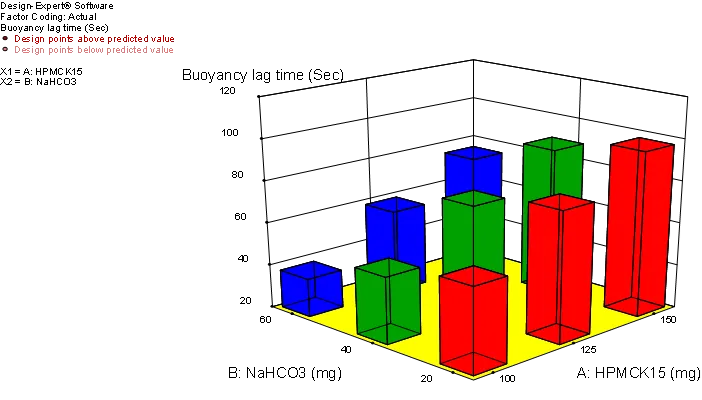
Figure: 3 –D Surface Response Plot for Buoyancy Lag Time (Response 1)
Response 2: Drug release
3 –D surface response Plots for drug Release
[Figure - see the formatted PDF]
Figure: 3 –D Surface Response Plots for Drug Release (Response 2)
Post Analysis
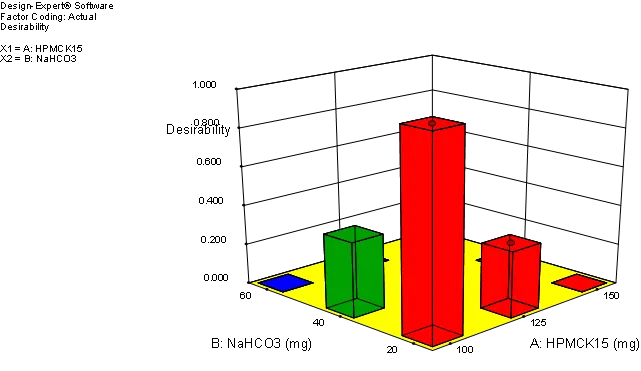
Figure: 3 –D Surface Response Plots for Post Analysis
From the post optimization analysis, we have selected F4 batch as optimized one to get % release of 72.78 % in 8 hrs and floating lag time 65 sec.
Release kinetics study for optimized bilayer tablet:
Table: Release Kinetics Study for Immediate Release Layer
| Batch | Zero Order R2 |
First Order R2 |
Higuchi R2 |
Hixon Crowel R2 |
Peppas R2 |
Peppas n |
Best Fit Model |
|---|---|---|---|---|---|---|---|
| F1 | 0.8280 | 0.8950 | 0.8097 | 0.9016 | 0.9565 | 0.7625 | Peppas |
| F2 | 0.9321 | 0.8010 | 0.9235 | 0.9382 | 0.9006 | 0.5810 | Hixon crowel |
| F3 | 0.9888 | 0.9174 | 0.9621 | 0.9768 | 0.9186 | 0.2673 | Zero Order |
| F4 | 0.8827 | 0.8756 | 0.9182 | 0.9254 | 0.9447 | 0.2140 | Peppas |
| F5 | 0.9004 | 0.9137 | 0.9273 | 0.9381 | 0.9436 | 0.2241 | Peppas |
| F6 | 0.9697 | 0.9486 | 0.9782 | 0.9856 | 0.9582 | 0.3550 | Hixon crowel |
| F7 | 0.7486 | 0.9901 | 0.9994 | 0.8583 | 0.9465 | 0.5212 | Higuchi |
| F8 | 0.7049 | 0.9021 | 0.9362 | 0.8017 | 0.8937 | 0.6124 | Higuchi |
| F9 | 0.8579 | 0.95500 | 0.8958 | 0.9295 | 0.9752 | 0.6352 | Peppas |
The release kinetic data for all Amlodipie Besylate formulations is as shown in table 8.32
The kinetics data of F1, F4, F5, F9 shows good fit in Peppas Kinetic Release Model.F1 (Diffusion exponent ‘n’= 0.76) and F9 (‘n’= 0.63) shows anomalous (non-fickian) diffusion. F4 (‘n’= 0.21) and F5 (‘n’= 0.22) indicates that Fickian diffusion mechanism. The kinetics data of F2, F6 shows good fit in Hixon Crowel Kinetic Release Model. The kinetics data of F3 shows good fit in Zero Order Kinetic Release Model. The kinetics data of F7, F8 shows good fit in Higuchi Kinetic Release Model.
Drug release kinetics from optimized F4 Amlodipine layer follows Peppas Kinetic Release Model having higher correlation coefficient R2 0.9447 and batch having mean diffusional exponent value (n) 0.21 that indicates that Fickian diffusion mechanism.
Captopril Sustained release layer
Table: Release Kinetics Study for Sustained Release Layer
| Batch | Zero Order R2 |
First Order R2 |
Higuchi R2 |
Hixon Crowel R2 |
Peppas R2 |
Peppas n |
Best Fit Model |
|---|---|---|---|---|---|---|---|
| F1 | 0.8235 | 0.8463 | 0.8364 | 0.9004 | 0.9636 | 0.2750 | Peppas |
| F2 | 0.9778 | 0.9853 | 0.9838 | 0.9930 | 0.9628 | 0.2313 | Hixon crowel |
| F3 | 0.8728 | 0.9375 | 0.9315 | 0.9631 | 0.9780 | 0.3538 | Peppas |
| F4 | 0.9393 | 0.9512 | 0.9594 | 0.9309 | 0.8485 | 0.6451 | Higuchi |
| F5 | 0.8541 | 0.8951 | 0.9086 | 0.8657 | 0.7612 | 0.5138 | Higuchi |
| F6 | 0.9721 | 0.9278 | 0.9452 | 0.9130 | 0.8140 | 0.4231 | Zero Order |
| F7 | 0.9399 | 0.9034 | 0.9258 | 0.9184 | 0.8484 | 0.6300 | Zero Order |
| F8 | 0.9870 | 0.8800 | 0.9071 | 0.9055 | 0.8277 | 0.5923 | Zero Order |
| F9 | 0.9477 | 0.8964 | 0.9165 | 0.9099 | 0.8412 | 0.5733 | Zero Order |
The release kinetic data for all the Captopril formulations is shown in table 8.33
The kinetics data of F1, F3 formulation shown good fit in Peppas Kinetic Release Model. Model.F1 (‘n’= 0.27) and F3 (‘n’= 0.35) shows Fickian diffusion mechanism. The kinetics data of F2 shown good fit in Hixon Crowel Kinetic Release Model. The kinetics data of F4, F5 shown good fit in Higuchi Kinetic Release Model. The kinetic data of F6, F7, F8, F9 formulation shown good fit in Zero Order Kinetic Release Model.
Drug release kinetics from optimized F4 Captopril layer follows Higuchi Matrix Model. having higher correlation coefficient R2 0.9594. This indicates that the drug release is controlled by diffusion of drug through the pores matrix form by HPMC K15.
CONCLUSION
The bi-layer tablet of Amlodipine Besylate as IR and Captopril as SR successfully developed.
Cross carmellose sodium gave lesser disintegration time i.e. 12sec. and faster % drug release i.e. 98% within 1 hr. Formulation containing HPMC K15 showed 75% drug release within 8hrs.
Hence selected batch optimization by using 32 factorial designs for the % drug release and floating lag time, it shows 72 % drug release within 8hrs and floating lag time 60 sec. From the study it can be concluded that the dosage form can control the release, avoid dose dumping, and extend the duration of action of a drug with prolonged floating time.
REFERENCES

Supriya Rajguru, Pratiksha Ghoderao, Preparation and Evaluation of Bi-layer Captopril as Sustained Release and Amlodipine Besylate as Immediate Release Tablet, Int. J. of Pharm. Sci., 2026, Vol 4, Issue 10, 3805-3814. https://doi.org/10.5281/zenodo.23657591
 10.5281/zenodo.23657591