

We use cookies to ensure our website works properly and to personalise your experience. Cookies policy
Srinivas College of Pharmacy, Valachil, Farangipete Post, Mangalore, Karnataka, India – 574143.
Equipment qualification is a critical process in ensuring the reliability and consistency of machinery used in pharmaceuticals manufacturing. Equipment qualification involves rigorous testing and documentation to verify that equipment functions as intended and meets predefined specifications. This process not only safeguards product quality but also ensures compliance with regulatory standards, such as current Good Manufacturing Practices (cGMP). Study focusses on the qualification and validation of the Spray Dryer SPD D-111. Spray dryer is an equipment used to convert liquid solutions or suspensions into dry powder form through a process of atomization and rapid evaporation of the solvent. All the critical components of equipment was qualified i.e. Feed Pump, Atomizer, Drying Chamber, Cyclone Separator, and Exhaust System. The qualification followed the 4Q model, which consists of Design Qualification (DQ), Installation Qualification (IQ), Operational Qualification (OQ), and Performance Qualification (PQ). The SPD D-111 spray dryer, manufactured by Techno Search Instruments, The dryer is equipped with advanced control systems for regulating inlet temperature, atomization rates, and airflow, making it suitable for a wide range of pharmaceutical formulations. This study highlighted SPD D-111’s capable in delivering uniform particle size distribution which are essential for achieving optimal product quality. Quality attributes such as moisture content, particle size, yield, and uniformity have been tested, and results meet the predefined specifications. The spray dryer has successfully passed all qualification stages, confirming that it meets qualification requirements, has been installed correctly, operates within specified limits, and consistently delivers the desired product quality
In the pharmaceutical industry, equipment qualification is not just a regulatory obligation but also a cornerstone of quality assurance and risk management. By systematically verifying that equipment performs within specified limits and operates reliably, pharmaceutical companies can prevent costly production errors, reduce downtime, and avoid product recalls.1 Moreover, thorough documentation of the qualification process provides a transparent record of compliance, which is essential during audits and inspections. Ultimately, robust equipment qualification practices contribute to the overall efficacy, safety, and reliability of pharmaceutical products, reinforcing trust in the industry.2 Equipment qualification is a critical process in ensuring the reliability and consistency of machinery used in various industries, from pharmaceuticals to manufacturing.3 At its core, equipment qualification involves rigorous testing and documentation to verify that equipment functions as intended and meets predefined specifications. This process not only safeguards product quality but also ensures compliance with regulatory standards, such as Good Manufacturing Practices (GMP).4 The Quality Assurance department plays an important role in managing and coordinating qualification and validation processes. The qualification and validation technique has been studied because of its critical role within a productive process in terms of product quality qualities such as purity, safety, and efficacy.5,6 Validation consists of a sequence of criteria that include tests, system verifications, and crucial process parameters that serve as regulating keys that can fluctuate within an acceptable range.7-9
QUALIFICATION OF EQUIPMENT:
Instrument qualification is not a single continuous process, but instead results from several discrete activities. For convenience, these activities can be grouped into four phases as per figure No. 01. Design qualification (DQ), installation qualification (IQ), operational qualification (OQ), and performance qualification (PQ).9-13
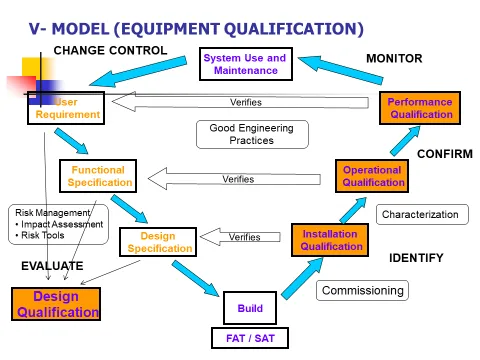
Fig 01 “V” model for Qualification of equipment’s
Spray drying technology
This technology of continuously converting feed from a fluid condition into dried particle form through spraying the feed into a hot drying medium is known as spray drying. As long as it can be pumped and atomized, the feed can be a solution, slurry, emulsion, or gel. It entails combining a highly dispersed liquid with an adequate amount of hot air to cause liquid droplet evaporation and drying.14 Spray dryer should operate successfully and meet powder specifications, sprays with the necessary droplet size distribution must form.
A spray nozzle atomizer produces atomization. The fluid bed's placement inside the drying chamber allows for drying at lower temperatures. Higher thermal efficiency and colder handling conditions for powder are the outcomes. Particle size is directly influenced by the mass flow of the liquid, its viscosity, solids content, and surface tension. 15-20
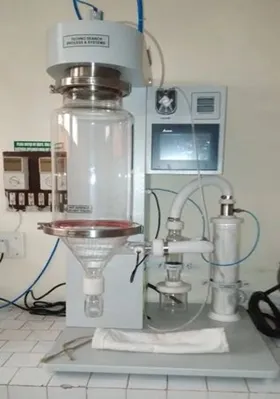
Fig 2 Spray dryer
The qualification of a spray dryer is critical to ensure that the equipment is functioning correctly and consistently produces high-quality products in compliance with industry standards. The following points outline the key reasons why spray dryer qualification is necessary. The Performance Qualification (PQ) ensured that the Spray Dryer consistently performed according to the specifications and intended use. PQ evaluates the performance of the spray dryer using actual production conditions and product formulations to ensure it consistently produces the desired product quality.21-23
The PQ included: 24-29
In order to obtain a product with appropriate morphology, firstly, the parameters of spray drying were determined.
Formulations of microspheres 30


So, 6 formulations (F1, F2, F3, F4, F5 and F6) of microspheres were made with the same procedure.
EVALUATION OF MICROSPHERES 31-37
Quality Testing: Test the dried powder product for critical quality attributes (CQA) such as particle size, moisture content, and uniformity.
Percent Yield = Weight of microsphere *100 Total expected weight of drug and polymer
Re-Qualification Criteria 38
Re-qualification of the Instrument shall be carried out through the change control procedure in case of Modification or change in the main component. The magnitude of re-qualification shall depend on the nature of change(s) and its impact on the quality/functions.
RESULTS AND DISCUSSION
The qualification of a spray dryer ensures that the equipment operates according to specified standards and consistently produces the desired product quality. This process typically involves the following stages:
Design Qualification (DQ): The design of the spray dryer has been reviewed and confirmed to meet the specified user requirements and Current Good Manufacturing Practices (cGMP) standards. The design aligns with the necessary operational conditions, including temperature, airflow, and atomization technology to achieve the desired product characteristics as per design specifications.
Installation qualification study: Flow diagrams, isometric drawings, electrical & mechanical drawings, and P&ID Drawing were verified with the DQ and it was found to be meeting with the actual installation. Installation of all the major and minor components was verified and found to be properly installed. Utility connection (compressed air, electrical connections) were found to be properly connected. The instruments which require calibration were identified. Material of construction for all the product contact parts was found to be Borosilicate Glass (Pyrex equivalent), all the gaskets and tubing were found to be constructed with the food grade material which meets specified acceptance criteria.
Operational Qualification study: All the measuring instruments which requires calibration were calibrated and it was found to be working as per the design specifications. The instrument was operated at worst-case conditions. The alarms verification, power failure, control panels, interlocks and emergency switch operations were verified and found to be satisfactory.
Performance Qualification Study:
Operation of Spray Dryer
The performance qualification was done to qualify the Spray Dryer SPD-D-111 installed in the PG Pharmaceutics Lab. by preparing 6 formulations (F1, F2, F3, F4, F5 and F6) of microsphere from the instrument. The results obtained are as follows.
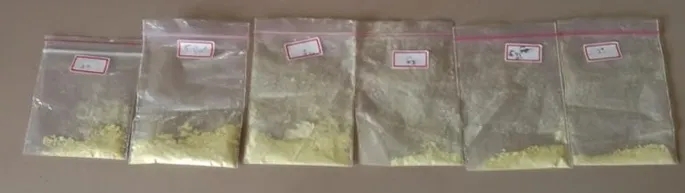
Fig No.3: Formulations F1 to F6
Table No.01: Parameters for operating spray drying
|
Formulation Code |
Inlet Temperature |
Outlet Temperature |
Feed Rate |
|
F1 |
43± 2 º C |
33± 2 º C |
4ml/min |
|
F2 |
44± 2 º C |
32± 2 º C |
4ml/min |
|
F3 |
45± 2 º C |
33± 2 º C |
4ml/min |
|
F4 |
43± 2 º C |
32± 2 º C |
4ml/min |
|
F5 |
45± 2 º C |
34± 2 º C |
4ml/min |
|
F6 |
43± 2 º C |
33± 2 º C |
4ml/min |
EVALUATION OF MICROSPHERES:
1. Percentage yield
Table No.02: Percentage yield
|
Sl. No |
Formulation code |
Percent Yield (%w/w) |
|
1 |
F1 |
28.56±0.29 |
|
2 |
F2 |
31.01±0.53 |
|
3 |
F3 |
35.96±0.10 |
|
4 |
F4 |
45.35±0,25 |
|
5 |
F5 |
60.39±0.19 |
|
6 |
F6 |
53.00±0.20 |
Table No.03: Average particle size of Microsphere
|
Sl. No |
Formulation code |
Particle Size (µm) |
Moisture content (%w/w) |
|
1 |
F1 |
5.041±0.014 |
2.30 |
|
2 |
F2 |
5.205±0.041 |
1.83 |
|
3 |
F3 |
4.368±0.002 |
2.05 |
|
4 |
F4 |
3.901±0.053 |
2.22 |
|
5 |
F5 |
3.558±0.022 |
2.51 |
|
6 |
F6 |
3.643±0.036 |
2.3 |
The spray dryer has successfully passed all qualification stages, confirming that it meets design requirements, has been installed correctly, operates within specified limits, and consistently delivers the desired product quality. The equipment is now approved for commercial use, and regular monitoring and maintenance plans have been established to ensure ongoing compliance and performance.
CONCLUSION
The Qualification of Spray Dryer (SPD D-111) was performed with respect its design specification, installation, operational and performance criteria. All the major and minor components have been installed as per the design specifications. P&ID drawing, user manual, certificates of material of construction are available. Material of construction of all the product contact parts meets the specified acceptance criteria. Utility connections are done as per the requirement. Instruments which require calibration are identified and calibrated. Alarm verification, verification of safety interlocks, Verification of control panels and other operational parameters are verified and found to be satisfactory. The performance of spray dryer (SPD D-111) is evaluated which meets the acceptance criteria. The system is efficient to produce a product which meets to the required quality attributes consistently. The equipment can be used for the routine purpose.
ACKNOWLEDGEMENTS Thanks to Principal and Director, Srinivas College of Pharmacy, and Shamarao Foundation Mangalore for providing facilities.
CONFLICT OF INTEREST: None.
REFERENCES
Chan CC, Lam H, Zhang XM, Jansen S, Larson P, Manfredi CT, et al. Overview of risk-based approach to validation and instrument qualification. In: Practical approaches to method validation and essential instrument qualification. 2010


Padmavathi Prabhu, Krishnananda Kamath K, Kajishma, Abinash Sharma, A R Shabarya, Qualification And Validation of Spray Dryer (SPD D-111), Int. J. of Pharm. Sci., 2026, Vol 4, Issue 7, 1684-1691, https://doi.org/10.5281/zenodo.21264703
 10.5281/zenodo.21264703