

We use cookies to ensure our website works properly and to personalise your experience. Cookies policy
Dr. D Y Patil College Of Pharmacy, Akurdi, Pune, Maharashtra – 411044, India.
Protein binding is a key determinant of drug pharmacokinetics and pharmacodynamics. The interaction between drugs and plasma proteins regulates the proportion of free (active) drug available for distribution, receptor binding, metabolism, and elimination. Variations in protein binding can significantly influence drug efficacy, toxicity, and therapeutic outcomes.
Drug distribution describes the reversible transfer of drugs between systemic circulation and tissues. In plasma, drugs exist in equilibrium between bound and unbound forms.
Bound drug → Pharmacologically inactive reservoir
Free drug → Active, diffusible, and eliminable
Protein binding acts as a dynamic buffer system, stabilizing plasma drug concentration.
Plasma Proteins Involved in Drug Binding
|
Protein |
Binding Preference |
Examples of Drugs |
Key Features |
|
Albumin |
Acidic, neutral drugs |
Warfarin, Phenytoin, NSAIDs |
High capacity, low affinity |
|
α1-acid glycoprotein |
Basic drugs |
Lidocaine, Propranolol |
Low capacity, high affinity |
|
Lipoproteins |
Lipophilic drugs |
Cyclosporine |
Increased in hyperlipidemia |
|
Globulins |
Specific compounds |
Steroid hormones |
Selective binding |
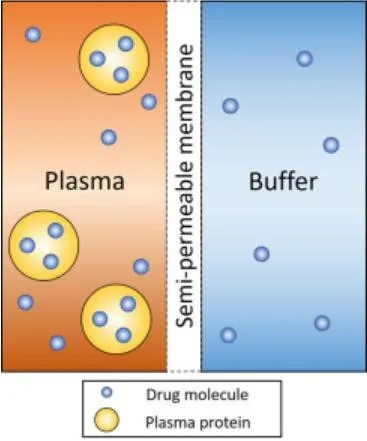
Plasma Protein Binding.
Mechanism of Drug Binding
Drug binding is reversible and non-covalent, involving hydrogen bonding, ionic interactions, Van der Waals forces, and hydrophobic interactions.
Equilibrium: D (free) + P (protein) ⇌ DP (bound)
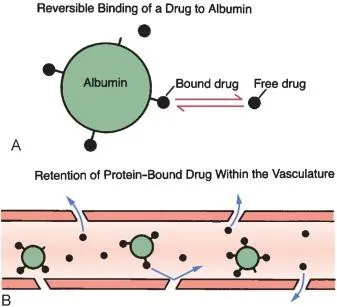
Reversible Binding of a Drug to Albumin.
Factors Affecting Protein Binding
Drug-Related Factors
|
Factor |
Effect |
|
Lipophilicity |
Increases binding with lipoproteins |
|
Ionization (pKa) |
Influences affinity to proteins |
|
Drug concentration 4.2 Patient-Related Factors |
Saturation at high doses |
|
Factor |
Impact on Binding |
|
Age |
Neonates/elderly → altered binding |
|
Liver disease |
Decreased albumin synthesis |
|
Renal failure |
Accumulation of competing substances |
|
Malnutrition |
Reduced protein levels |
4.3 External Factors
Drug–drug interactions and competition for binding sites affect protein binding.
Role in Drug Distribution
Volume of Distribution (Vd)
Extent of Binding Effect on Vd
High plasma binding Low Vd (confined to plasma)
Low plasma binding High Vd (greater tissue uptake)
Tissue Penetration
Only free drug can cross biological barriers such as blood-brain barrier, placental barrier, and cellular membranes.
Clinical Implications
Pharmacological Activity
Only free drug produces therapeutic effects. Protein binding prolongs drug action by acting as a reservoir.
Drug Interactions
|
Drug A |
Drug B |
Clinical Effect |
|
Warfarin |
Aspirin |
Increased bleeding risk |
|
Phenytoin |
Valproate |
Increased CNS toxicity |
|
Sulfonamides |
Bilirubin |
Kernicterus (neonates) |
Toxicity
Highly protein-bound drugs are sensitive to small changes. Example: Warfarin (~99% bound). Small displacement leads to increased free drug and toxicity.
Impact of Disease States
|
Condition |
Binding Change |
Clinical Outcome |
|
Liver disease |
Decreased albumin |
Increased free drug → toxicity |
|
Renal failure |
Uremic toxin competition |
Altered drug response |
|
Inflammation |
Increased α1-acid glycoprotein |
Decreased free basic drugs |
|
Malnutrition |
Decreased proteins |
Enhanced drug effects |
Special Populations
Neonates: Low albumin, increased free drug, immature metabolism.
Elderly: Altered binding and increased sensitivity. Therapeutic Drug Monitoring
Drug Reason
|
Phenytoin |
Nonlinear kinetics, high binding |
|
Digoxin |
Narrow therapeutic index |
|
Valproic acid |
Saturable protein binding |
Integrated Clinical Flow
↓ Plasma Protein Levels → ↓ Drug Binding → ↑ Free Drug Fraction → ↑ Pharmacological Effect → ↑ Risk of Toxicity
PBPK modeling, AI prediction, personalized dosing.
CONCLUSION
Protein binding plays a central role in drug distribution, efficacy, and safety.
REFERENCES



Parth Gaikwad, Pranav Mahakaliwar*, Paritosh Patel, Role of Protein Binding in Drug Distribution and Clinical Outcomes, Int. J. of Pharm. Sci., 2026, Vol 4, Issue 5, 7490-7493. https://doi.org/10.5281/zenodo.20420614
 10.5281/zenodo.20420614