

We use cookies to ensure our website works properly and to personalise your experience. Cookies policy
1,2 Department of Pharmacy, Usha Martin University, Ranchi, Jharkhand, India 835103
3 Department of Pharmacy, Gayatri College of Pharmacy, Jamadarpali, Sason, Odisha, India 768200
Many new drug candidates, especially those in Classes II and IV of the Bio-pharmaceutics Classification System (BCS), have limited bioavailability and therapeutic efficacy due to poor aqueous solubility, which continues to be one of the biggest obstacles in oral drug delivery. In order to get around this restriction, Self-Micro Emulsifying Drug Delivery Systems (SMEDDS) have become a viable and successful formulation. SMEDDS are isotropic blends of oils, co-surfactants, and surfactants that, when the gastrointestinal tract is gently shaken, spontaneously create tiny oil-in-water micro emulsions. Drug solubilisation, dissolving rate, and absorption are all improved by this spontaneous emulsification, which raises bioavailability. The formulation's ingredients and proportions, especially the kind of oil, surfactant, and co-surfactant, are crucial in influencing the stability, droplet size, and self-emulsification effectiveness. A number of pharmacological benefits are also provided by SMEDDS, such as enhancing permeability across the gastrointestinal membrane, avoiding first-pass metabolism, and promoting lymphatic transport. They are thermodynamically robust, as demonstrated by stability investigations like centrifugation and temperature testing. Additionally, the system can be easily administered to patients by being encapsulated in either hard or soft gelatine capsules. SMEDDS offer new possibilities in formulation creation and pharmaceutical innovation, and they are an all-around flexible, scalable, and effective method for improving the oral distribution of poorly soluble medications.
Addressing a wide range of pathological conditions, oral ingestion remains the most popular method of medicine administration for both patients and the pharmaceutical sector. A lack of amount proportionality, significant intra- and inter subject variability, and inadequate bioavailability are often linked to oral delivery of novel drug candidates, of which over 40% have poor water solubility. Many formulation techniques are used to get around these issues, such as cyclodextrins, solid dispersions, lipids, surfactants, salt formation, permeation enhancers, and nanoparticles.1,2 Permeability and solubility are often the two key determinants of medication absorption. Based on these two criteria, Amidon et al. developed the Bio-pharmaceutics Classification System (BCS) in 1995, which divided medications into four groups, as seen in Figure 1. 3,4Out of the four BCS courses Class II and IV medications have minimal bioavailability and poor water solubility. Therefore, one of the biggest challenges for researchers working on oral delivery of BCS Class II and IV medications is to improve their dissolving profile.5 Because of its safety, patient compliance, and ability to be self-administered, the oral administration method is still the most effective way to deliver medications. The many obstacles at the gastro-intestinal (GI) tract have hampered oral delivery, despite the fact that it is the most convenient method of administration. 6,7When given with foods high in lipids, oral absorption of poorly water-soluble medications can be enhanced. This has led to the usage of lipid-based formulations as a way to enhance drug solubility and absorption after oral delivery.8
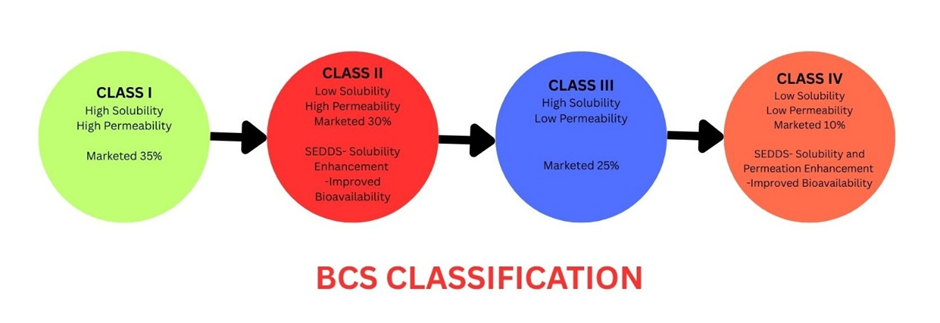
FIGURE 1
Specific approaches have been used in the formulation process to increase the oral bioavailability of certain medications. Among these, oral lipid-based drug-delivery systems (DDS) have demonstrated enormous promise in enhancing the inconsistent and poor drug absorption of numerous weakly water-soluble medications, particularly when administered after meals.9,10 Despite having poor absorption characteristics, emulsions are used as drug carriers in pharmaceutical preparations, even though they might probably increase the medicine's oral bioavailability.11 One of the most common methods for improving the stability of APIs that are taken orally is to use lipid-based drug delivery vehicles. The terminology used for lipid-based treatments is hotly contested, according to the literature. The main determinant of micro and nano emulsions (SMEDDS and SNEDDS) is not the initial droplet size.Self-emulsifying oil formulations, or SMEDDS, are isotropic blends of liquid or solid surfactants, natural or synthetic oils, or, alternatively, one or more hydrophilic solvents and co-solvents/surfactants. In recent years, SMEDDS have drawn a lot of attention as potential carriers for the administration of proteins and peptides orally.12 The kind and quality of the surfactant concentration, the oil/surfactant combination, the oil/surfactant ratio, and the physiological conditions—such as pH and temperature—all affect self-emulsification. SMEDDSs differ from traditional oral drug delivery systems in that the excipients in the formulation are drastically altered by the digestion of enzymes.13To tackle this problem, a variety of strategies have been employed, such as structural drug modifications, the addition of auxiliary agents, and the creation of SEDDS nanocarriers, which are a popular term for self-nano- and self-micro emulsifying drug delivery systems (SNEDDS/SMEDDS) in numerous studies and have proven to be an effective technique for oral medications.14 As seen in Figure 2, SMEDDSs spontaneously generate fine oil-in-water nano-emulsions with droplet sizes of 200 nm or less. This occurs after aqueous dispersion and slight agitation (as in the GI tract).15
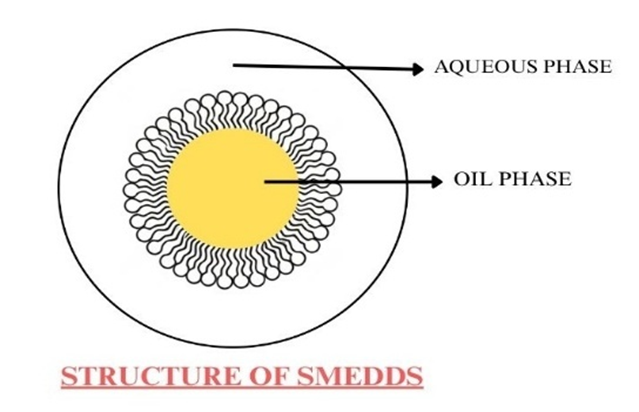
FIGURE 2
MEDDS:
Solid-lipid nanoparticles (SLN), liposomes, lipoplexes, macroemulsion (coarse emulsion), microemulsion, and self-micro emulsifying drug delivery systems (SMEDDS) are the primary components of lipid-based formulations. Lipid-based formulations have received a lot of attention lately, with SMEDDS receiving special attention.16 The most effective and preferred technique for increasing oral bioavailability is SMEDDS. SMEDDS are a type of emulsion that has received particular attention as a way to improve the oral bioavailability of medications that are poorly soluble.17 SMEDDS and other lipid-based formulations are emulsions with strong thermodynamic stability and smaller globule sizes.18, 19, 20
Emulsions are often defined as the dispersion of macroscopic droplets of one liquid (usually water, oil, and emulsifier) in another liquid, with a droplet size of 1–10 mm. They are a viscous, semi-transparent to hazy liquid with a strong interfacial layer that is thermodynamically unstable. There are three types of emulsions: water-in-oil (w/o), oil-in-water (o/w), and multiple emulsions.21 A dispersion of oil in water, known as an oil-in-water (o/w) emulsion, is particularly useful for medicinal applications. It necessitates that the emulsifying agent be more soluble in the aqueous phase. Water-in-oil (w/o), the opposite emulsion, is stabilised by surfactants that persist in the oil phase. Conversely, ternary systems of the w/o/w or o/w/o type are known as double emulsions, in which the scattered droplets contain smaller droplets of a separate phase.
Although SMEDDS's microemulsion droplets have 100% entrapment capacity.22 and shield the drug from gastrointestinal degradation, they may be able to deliver medications that are poorly soluble in water. Significantly more drug is absorbed when the drug substance is transported through the unstirred water layer to the gastrointestinal membrane thanks to the increased surface area and tiny droplets.23,24 The lymphatic drug transport can also circumvent the first-pass effect.26 and the droplets can spread quickly in both blood and lymph.25 Furthermore, the SMEDDS formulation can be packed into gelatine capsules for use as a unit dosage container and kept at room temperature.
An isotropic, thermodynamically stable mixture of water, oil, surfactant (S), and co-surfactants (CoS) or co-solvents is called a micro emulsion. The ultra-low interfacial tension, often attained by combining two or more emulsifiers (S/CoS), is the primary factor that propels the creation of micro emulsions. One emulsifier, known as a surfactant, is primarily soluble in water, whilst the other, known as a co-surfactant, is primarily soluble in oil. For the generation of micro emulsions, co-surfactants lower the interfacial tension to an extremely low value.27,28
MECHANISM OF SELF -EMULSIFICATION:
The precise mechanism underlying self-emulsification is yet unknown. It has been suggested that self-emulsification occurs when the energy needed to increase the dispersion's surface region above its favoured level is known as the entropy change. A basic emulsion preparation's free energy is directly related to the energy needed to create the most recent surface between the oil and water phases. The emulsion's two phases will gradually split in order to reduce the interfacial area, which is how the system's free energy is achieved.29
COMPOSTION OF SMEDDS:
Oil/surfactant and co-surfactant physical mixtures of the formulation of SMEDDS in various ratios are employed in a variety of literature surveys. The SMEDDS preparation is made using the majority of the literature, which uses surfactant and co-surfactant mixtures (Smix) with oil in various ratios. The formulation of SMEDDS uses a number of components. is displayed in the following table.
TABLE: Classification of excipients used in formulation of SMEDDS
|
No. |
Oil |
Surfactant |
Co-Surfactant |
|
1. |
Capmul MCM C8 |
Cremophor EL |
Transcutol HP |
|
2. |
castor oil |
Tween-20 |
Propylene glycol |
|
3. |
Triacetin |
Triton-X100 |
Carbitol |
|
4. |
Castor oil |
Capmul MCM, Kolliphor |
EL Kolliphor RH 40 |
|
5. |
Capryol 90 |
Gelucire 44/14 |
Tween 80 |
|
6. |
Isopropyl myristate (IPM) |
Tween 80 |
propylene glycol |
STABILITY:
(a) Temperature stability: the shelf life as a function of time and storage temperature is determined by visual inspection of the SMEDDS system at various intervals [29]. In order to verify the temperature soundness of tests, preparations are diluted using distilled water and maintained at a varied temperature range (room temperature, 2–8°C, or lower). Additionally, flocculation or precipitation is typically observed for any indications of phase separation.30,31
(b) Centrifugation: the enhanced SMEDDS system is diluted with distilled water in order to evaluate the metastable system.29. In order to check for any changes in the homogeneity of small-scale emulsions, the micro-emulsion is now centrifuged at 1000 rpm for 15 minutes at 0°C.32, 33, 34
BIOPHARMACEUTICAL ASPECTS OF SMEDDS:
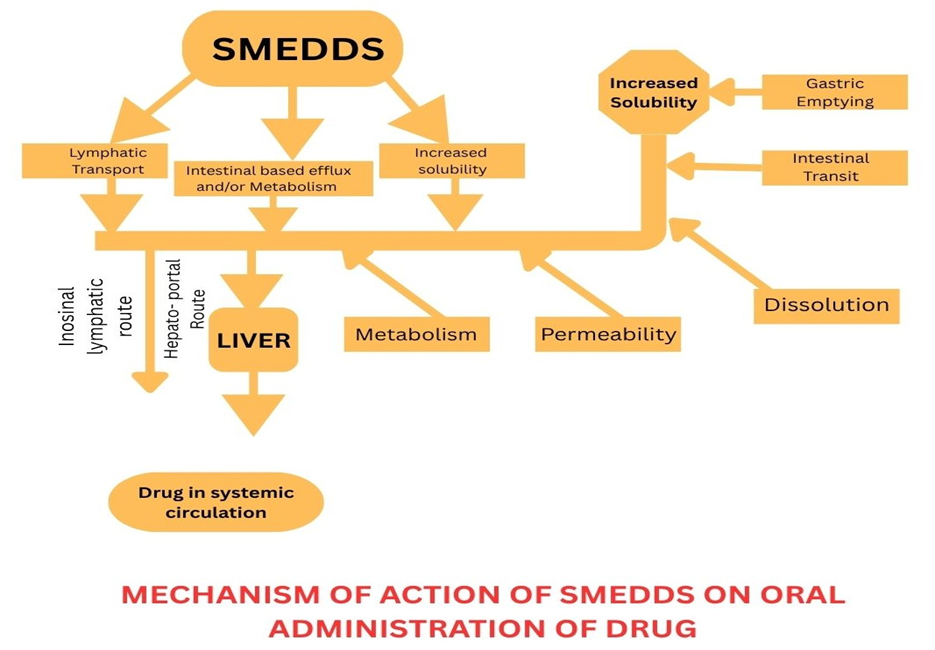
The widely held belief that lipids may improve bioavailability through a number of possible mechanisms, despite the fact that the biopharmaceutical elements of SMEDDS are still poorly understood is as follows: Changes (decrease) in gastric transit: -which slows transport to the absorption site and lengthens the dissolving time.
The enhancement in the solubility of effective luminal drugs: When lipids are present in the GI tract, the secretion of bile salts (BS) and endogenous billiard lipids, such as cholesterol (CH) and phospholipids (PL), increases. This results in the formation of intestinal mixed micelles, which increases the GI tract's capacity for solubilisation. But when supplied (exogenous) lipids are intercalated into these structures, either directly (if sufficiently polar) or indirectly (via digestion), the micellar structures inflate and their solubilisation capacity increases.
Lipids may either directly or indirectly boost bioavailability by reducing first-pass metabolism or by increasing the extent of intestinal lymphatic transport for highly lipophilic medicines.
Alteration to the GI tract's biochemical barrier function: -It is evident that some lipids and surfactants may decrease the amount of enterocyte-based metabolism and hence inhibit the activity of intestinal efflux transporters, as demonstrated by the p-glycoprotein efflux pump.
Shifts in the GI tract's physical barrier function: It has been demonstrated that a variety of lipid combinations, lipid digestion products, and surfactants boost permeability. To a large extent, however, passive intestinal permeability is not considered a significant obstacle to the bioavailability of most poorly water-soluble medications, especially those that are lipophilic.35,36
DRUG PROPERTIES SUITABLE FOR SMEDDS
CONCLUSION
Self-Micro Emulsifying Drug Delivery Systems (SMEDDS) have become a strong and promising method for improving the oral bioavailability of medications that are not very water soluble, especially those that are classified as BCS Class II and IV. SMEDDS greatly enhance medication solubilisation, absorption, and bioavailability by promoting spontaneous emulsification in the gastrointestinal environment and generating fine oil-in-water emulsions.
SMEDDS can overcome a number of biopharmaceutical obstacles, such as enzymatic degradation, first-pass metabolism, and poor solubility, by using appropriate oils, surfactants, and co-surfactants. Lipid-based drug delivery systems prefer SMEDDS because of their scalability for industrial manufacture, thermodynamic stability, and formulation diversity.
SMEDDS have a lot of potential for use in pharmaceutical applications in the future, especially as there are more and more lipophilic drug candidates in the development pipeline. SMEDDS-based formulations will be more rationally designed and accepted by regulators with the support of additional research centred on mechanistic knowledge, excipient optimisation, and clinical evaluation.
ACKNOWLEDGEMENT
Authors acknowledge the immense help received from the scholars whose articles are cited and included in references of this manuscript. The authors are also grateful to authors and editors of all those articles, journals and books from where the literature for this article has been reviewed and discussed.
SOURCE OF FUNDING
This research received no external funding.
CONFLICT OF INTEREST
The authors deny any conflict of interest.
AUTHOR’S CONTRIBUTION
Conceptualization: Mrs.Sucheta Moharana
Investigation: Sanjeeb Kar
Supervision: Prasanta Kumar Biswal
REFERENCES



Sucheta Moharana, Sanjeeb Kar, Prasanta Kumar Biswal, Self-Micro Emulsifying Drug Delivery Systems (SMEDDS): An Emerging Strategy to Improve Oral Bioavailability of Poorly Soluble Drugs, Int. J. of Pharm. Sci., 2026, Vol 4, Issue 1, 2652-2660. https://doi.org/10.5281/zenodo.18351532
 10.5281/zenodo.18351532