

We use cookies to ensure our website works properly and to personalise your experience. Cookies policy
1,2 Shri Pandit Baburao Chaughuke College of Pharmacy, Bhiwandi-421302.
3,4,5 Shivlingeshwar College of Pharmacy, Almala-413520
Simple, fast, and reliable methods were developed for the simultaneous estimation of Drotaverine hydrochloride and Omeprazole in combined dosage form. The analysis was performed using Reverse Phase High Performance Liquid Chromatography (RP-HPLC) and UV spectrophotometric methods. In the RP-HPLC method, both drugs were separated using a C18 column with a suitable mobile phase and detected at a selected wavelength. The UV method was based on measuring the absorbance of both drugs at their respective wavelengths. The developed methods were validated according to ICH guidelines for accuracy, precision, linearity, and specificity. Both drugs showed good linearity in the selected concentration range, with acceptable recovery and low variation in results. The proposed methods were successfully used for routine analysis and quality control of Drotaverine and Omeprazole in combined pharmaceutical dosage forms.
Analytical Chemistry is a measurement of science consisting of a set of powerful ideas and methods that are useful in all fields of science and medicine. It seeks ever-improved means of measuring the chemical composition of natural and artificial materials. This branch of chemistry, which is both theoretical and practical science, is practiced in many laboratories in many diverse ways while the analytical method is a specific application of a technique to solve an analytical problem. Methods of analysis are routinely developed, improved, validated, collaboratively studied, and applied. The discipline of analytical chemistry consists of qualitative and quantitative analysis.1
CHROMATOGRAPHY:2
The term ‘Chromatography’ covers those processes aimed at the separation of the various species of a mixture based on their distribution characteristics between a stationary and a mobile phase.
This may be regarded as an analytical technique employed for the purification and separation of organic and inorganic substances. There are various advanced chromatographic techniques, widely used for the estimation of multi component drugs in their formulations. The various chromatographic techniques are.
DRUG PROFILE
Drotaverine:27
|
Name |
Drotaverine |
|
Description |
Drotaverine (INN, also known as drotaverin) is an antispasmodic drug, structurally related to papaverine. Drotaverine is a selective inhibitor of phosphodiesterase 4 and has no anticholinergic effects. Drotaverine has been shown to possess dose-dependent analgesic effects in animal models. One small study has shown drotaverine tobe eliminated mainly non-renally. |
|
Structure |

|
|
Synonyms |
Drotaverin |
|
Salts |
Not Available |
|
International/ Other Brands |
Drotin / No-Spa(Sanofi-Aventis)/Taverin |
|
Chemical Formula |
C24H31NO4 |
|
IUPAC Name |
(1Z)-1-[(3,4-diethoxyphenyl)methylidene]-6,7-diethoxy-1,2,3,4- tetrahydroisoquinoline |
|
Pharmacology |
|
|
Indication |
Used in the treatment of functional bowel disorders and alleviating pain in renal colic. |
|
Pharmacodynamics |
Drotaverine is a spasmolytic agent by inhibiting PDE4 in smooth muscle cells. |
|
Half life |
7 to 12 hours |
Omeprazole:38
|
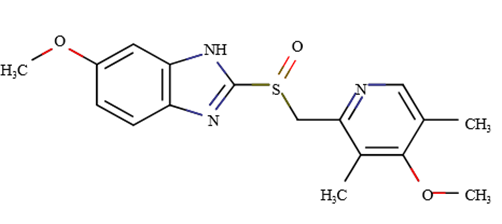
Chemical structure |
|
|
Chemical name |
(RS)-6-methoxy-2-((4-methoxy-3,5-dimethylpyridin-2-yl) methylsulfinyl)-1H-benzo[d] imidazole |
|
Molecular formula |
C17H19N3O3S |
|
Molecular weight |
345.4 g/mol |
|
Drug type |
Approved drug |
|
Therapeutic category |
Proton pump inhibitor |
|
Indications |
For the treatment of acid-reflux disorders (GERD), peptic ulcer disease, H. pylori eradication, and prevention of gastrointestinal bleeds with NSAID use. |
|
Half life |
1-12hrs. |
CHARACTERIZATION OF DROTAVERINE & OMEPRAZOLE39,40
RESULT AND DISCUSSION:
Drotaverine was found to be insoluble in water and soluble in acetonitrile & methanol. Omeprazole was found to be soluble in water and freely frsoluble in methanol & acetonitrile.
Method Development and Its Validation for Simultaneous Estimation of Drotaverine & Omeprazole by Rp-HPLC In Combination Tablet Dosage Form
The λmax of the two ingredients i.e. Drotaverine & Omeprazole, were found to be 277 nm and 307 nm respectively in methanol as solvent system. The isosbestic point for the drugs were found at 284 nm.
10 mg of Drotaverine was weighed accurately and transferred into a 100 ml volumetric flask. About 10 ml of HPLC- grade methanol was added and sonicated to dissolve. The volume was made up to the mark with the same solvent. The final solution contained about 100 μg/ml of Drotaverine.
10 mg of Omeprazole was weighed accurately and transferred into a 100 ml volumetric flask. About 10 ml of HPLC- grade methanol was added and sonicated to dissolve. The volume was made up to the mark with the same solvent. The final solution contained about 100 μg/ml of Omeprazole.
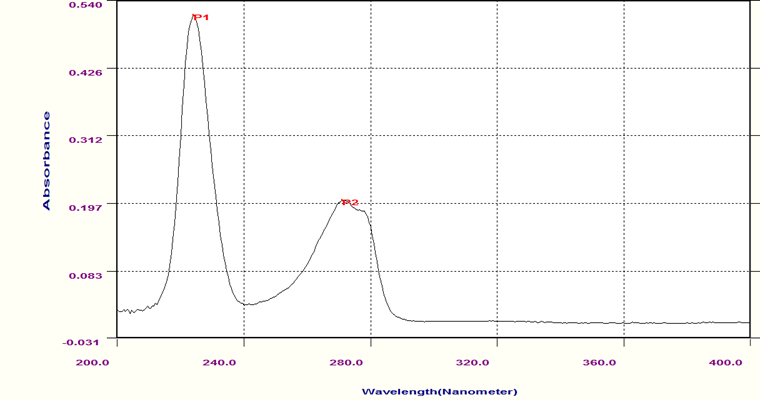
Fig: 3 Drotaverine
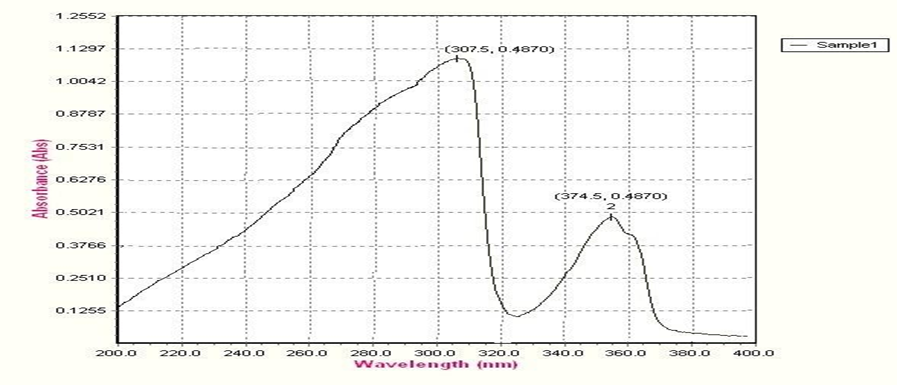
Fig: 4 Omeprazole
Preparation of mix Standard solution of Drotaverine & Omeprazole:
Accurately weighed 100 mg of Drotaverine and 100 mg of Omeprazole were transferred to 100 ml volumetric flask. About 40 ml of mobile phase was added and sonicated to dissolve. The volume was made up to mark with same solvent. Then 2 ml of the above solution was diluted to 100 ml with the solvent system. The resultant solution was filtered through a 0.45 ?m membrane filter and degassed under an ultrasonic bath before use. Several working standard solutions are prepared from the above standard solution by serial dilution technique.
Initialization of the instrument:
The HPLC instrument was switched on. The column was washed with HPLC water for45 minutes. The column was then saturated with mobile phase for 45 min. The mobile phase was run to find the peaks. After 20 minutes the standard drug solution was injected in HPLC.
Different chromatographic conditions used and their Optimizations.
The different HPLC chromatographic conditions were used to find out the optimum chromatographic condition for best elution of drugs.
Trial -1
Table: 7 Chromatographic conditions1 (Trial-1)
|
Mobile phase |
Water: CAN (20:80) |
|
Wavelength |
273nm |
|
Flowrate |
1.0 ml/ min. |
|
Run time |
10 min. |
|
Column |
Develosil ODS HG-5 RP C18, 5?m, 15cmx4.6mm i.d. |
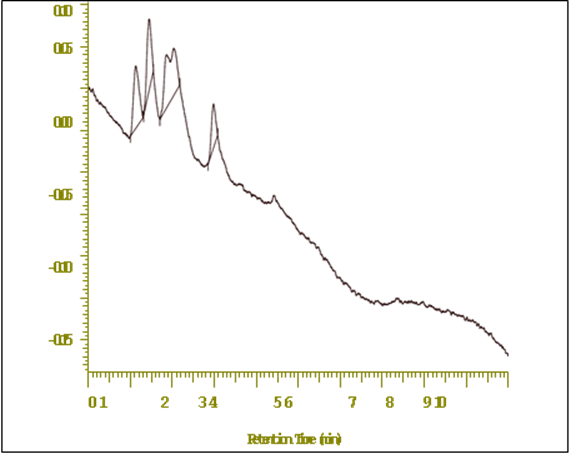
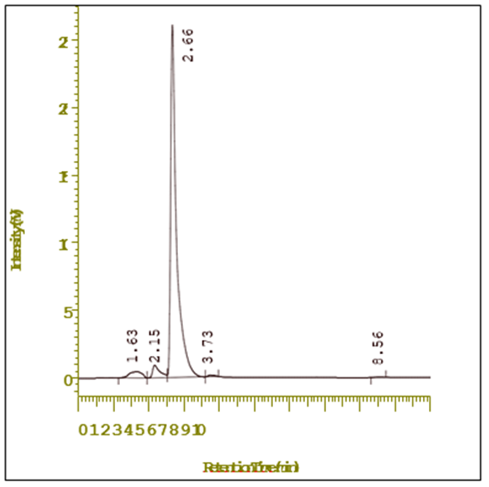
Trial-2
No peaks were found. Hence chromatogram was not acceptable.
Table: 8 Chromatographic conditions 2 (Trial-2)
|
Mobile phase |
Water : Methanol (20:80) |
|
Wavelength |
307 nm |
|
Flowrate |
1.0 ml/ min. |
|
Run time |
10 min. |
|
Column |
Develosil ODS HG-5 RP C18, 5?m, 15cmx4.6mmi.d. |
Trial-3
Only one peak was observed, resolution were not there. Hence chromatogram was not acceptable.
Table: 9 Chromatographic conditions 3 (Trial-3)
|
Mobile phase |
Buffer : acetonitrile (40:60) |
|
Wavelength |
307 nm |
|
Flowrate |
1.0 ml/ min. |
|
Run time |
10 min. |
|
Column |
Develosil ODS HG-5 RP C18, 5?m, 15cmx4.6mmi.d. |
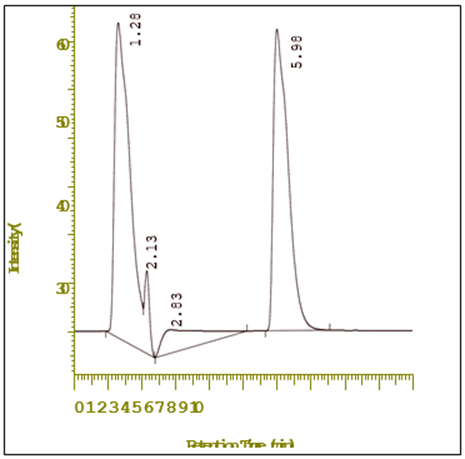
Trial-4
Peak separation was not good, and a third peak was found. Hence chromatogram was not acceptable.
Table: 10 Chromatographic conditions 4 (Trial-4)
|
Mobile phase |
Potassium dihydrogen phosphate buffer + Dipotassium hydrogen phosphate (0.02M,pH3.0) : acetonitrile (45:55) |
|
Wavelength |
307 nm |
|
Flowrate |
1.0 ml/ min. |
|
Run time |
10 min. |
|
Column |
Develosil ODS HG -5RP C18,5?m, 15cmx4.6mmi.d. |
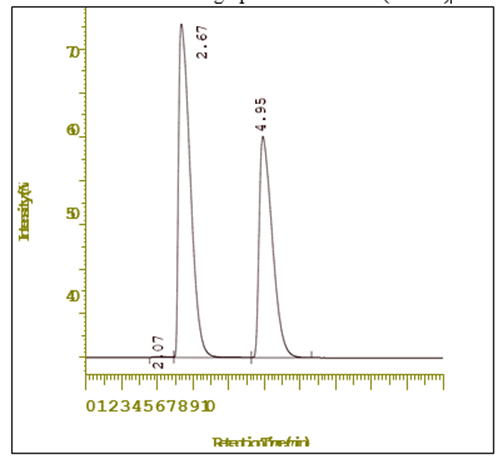
The chromatogram obtained after condition 4, Typical chromatogram of DROTAVERINE (RT=2.67 min) and OMEPRAZOLE (RT= 4.95 min).
RESULT AND DISCUSSION:
Here resolution was good, theoretical plate count and symmetry was appropriate. Also, no unwanted little peaks were seen between two peaks. Hence it was acceptable.
Optimized Method:
The selected and optimized mobile phase was acetonitrile : potassium dihydrogen phosphate buffer (0.02M, pH 3.0) (55:45v/v) and conditions optimized were : flow rate (1.0 ml/minute), wavelength (273 nm), Run time was 20 min. Here the peaks were separated and showed better resolution, theoretical plate count and symmetry. The proposed chromatographic conditions were found appropriate for the quantitative determination of the drugs.
Preparation of mobile phase:
Mobile phase was prepared by taking acetonitrile: potassium dihydrogen phosphate buffer (0.02M, pH 3.0) (55:45v/v). Mobile phase was filtered through 0.45 ?m membrane filter and degassed under ultrasonic bath prior to use. The mobile phase was pumped through the column at a flow rate of 1.0 ml/min.
Running the standard solution of Drotaverine:
2 ml of stock solution prepared as mentioned under section 4.5.2was pipette out into a 10 ml volumetric flask. The volume was made up to the mark with mobile phase. The solution was filtered through the 0.45 ?m membrane filter and degassed under ultrasonic bath prior to use. The solution was injected into the HPLC system.
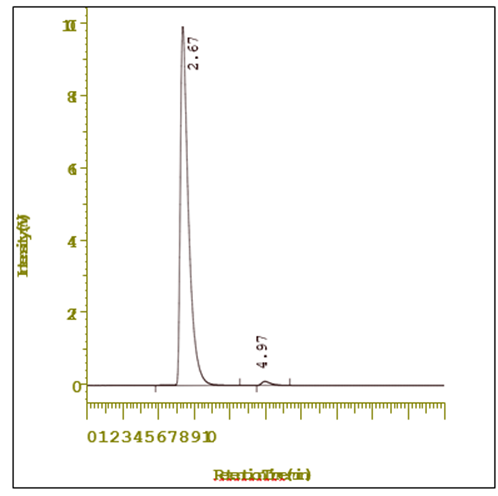
Fig: 6 Chromatogram of Drotaverine
Result & Discussion: Retention time was found to be 2.67 min.
Running the standard solution of Omeprazole:
4 ml of stock solution prepared as mentioned under section 4.5.3 was pipetted into a 10 ml volumetric flask. The volume was made up to the mark with methanol. The solution was filtered through the 0.45 ?m membrane filter and degassed under ultrasonic bath prior to use. The solution was injected into the HPLC system. The chromatogram obtained is shown in figure 7.
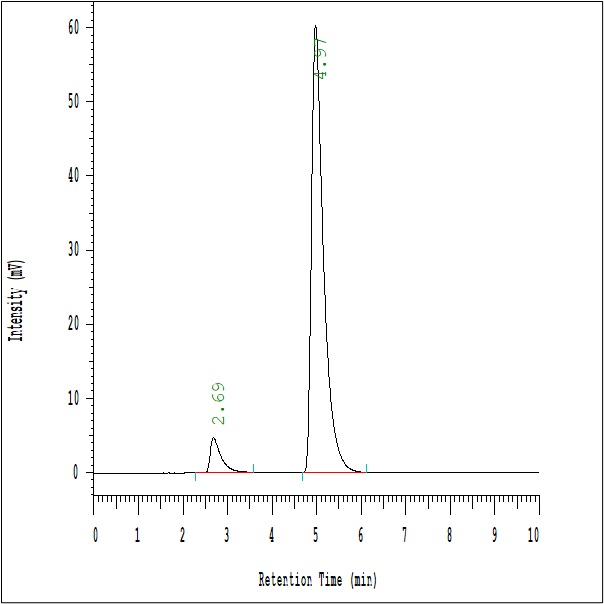
Fig:7 Chromatogram of Omeprazole
Result & Discussion: Retention time was found to be 4.97 min.
Result & Discussion: The HPLC system was set with the optimized chromatographic conditions to run the standard solution of Drotaverine and Omeprazole for 10 min. The retention time were found to be2.69 min and 4.97 min respectively.
Result & Discussion: Linearity range was found to be 0-140 µg/ml for Drotaverine. The correlation coefficient was found to be 0.995, the slope was found to be 8031 and intercept was found to be 10243 for Drotaverine.
Linearity range was found to be 5-100 µg/ml for Omeprazole. The correlation coefficient was found to be 0.998, the slope was found to be 38873 and intercept was found to be 13606 for Omeprrazole.
Result & Discussion: The mean recoveries were found to be 98.976, 99.54, 99.57 % for Omeprazole and 98.94, 99.76, 99.31% for Drotaverine The limit for mean % recovery is 95-105% and as both the values are within the limit, hence it can be said that the proposed method was accurate.
Result & Discussion: The repeatability study which was conducted on the solution having the concentration of about 20mg/ml for Drotaverine and 40mg/ml for Omeprazole (n =5) showed a RSD of 0.07684% for Drotaverine and 1.203503% for Omeprazole. It was concluded that the analytical technique showed good repeatability.
Result and discussion: Intraday and interday studies show that the mean RSD (%) was found to be within acceptance limit (≤2%), so it was concluded that there was no significant difference for the assay, which was tested within day and between days. Hence, method at selected wavelength was found to be precise.
Limit of detection and limit of quantification
The detection limit (LOD) and quantitation limit (LOQ) may be expressed as:
L.O.D. = 3.3(SD/S).
L.O.Q. = 10(SD/S)
Where, SD = Standard deviation of the response
S = Slope of the calibration curve
Result & Discussion
The LOD was found to be 0.32mg/ml and 1.44mg/ml and LOQ was found to be 0.96mg/ml and 4.32mg/ml for Drotaverine & Omeprazole respectively which represents that sensitivity of the method is high.
ASSAY OF DROTAVERINE & OMEPRAZOLE INDOSAGE FORM:
Assay was performed as described in previous chapter. Results obtained are tabulated below:
Table :17 Assay ofDrotaverine &Omeprazole Tablets
|
Brand name of tablets |
Labelled amount of Drug (mg) Drotaverine &Omeprazole |
Mean (±SD) amount (mg) found by the proposed method (n=6) |
Mean (± SD) Assay (n = 6) |
|
Ranispas – DV (Mankind Pharmaceuticals Pvt. Ltd.) |
10, 40 |
10.04 (±0.13) 40.53 (±0.09) |
100.40 (±0.39) 101.325 (±0.42) |
The assay of Synasmaaxtablets containing Drotaverine was found to be 101.325% Omeprazole was found to be 100.40%.
SUMMARY
To develop a precise, linear, specific RP-HPLC method for analysis of Drotaverine & Omeprazole different chromatographic conditions were applied & the results observed are presented in the thesis.
Isocratic elution is simple, requires only one pump & flat baseline separation for easy and reproducible results. So, it was preferred for the current study over gradient elution.
In case of RP-HPLC various columns are available, but here develo Sil, C-18, V size (150mm*4.6mmØ) column was preferred because using this column peak shape, resolution and absorbance were good.
Mobile phase & diluent for preparation of various samples were finalized after studying the solubility of API in different solvents of our disposal (methanol, acetonitrile, dichloromethane, water, 0.1N NaOH, 0.1NHCl). Drotaverine was found to be insoluble in water and soluble in acetonitrile & methanol. Omeprazole was found to be soluble in water and freely soluble in methanol & acetonitrile.
Detection wavelength was selected after scanning the standard solution of drug over 200 to 800nm. From the U.V spectrum of Drotaverine & Omeprazole it is evident that most of the HPLC work can be accomplished in the wavelength range of 215-290 nm conveniently. Further, a flow rate of 1.0 ml/min & an injection volume of 20 µl were found to be the best analysis.
The result shows the developed method is yet another suitable method for assay which can help in the analysis of Drotaverine&Omeprazole in different formulations.
Final Result & Discussion: The selected and optimized mobile phase was acetonitrile: potassium dihydrogen phosphate buffer (0.02M, pH 3.0) (55:45v/v) and conditions optimized were: flow rate (1.0 ml/minute), wavelength (273 nm), Run time was 20 min. Here the peaks were separated and showed better resolution, theoretical plate count and symmetry. The proposed chromatographic conditions were found appropriate for the quantitative determination of the drugs.
CONCLUSION
A sensitive & selective stability indicting RP-HPLC method has been developed & validated for the analysis of Drotaverine & Omeprazole API.
Based on peak purity results, obtained from the analysis of samples using described method, it can be concluded that the absence of co-eluting peak along with the main peak of Drotaverine & Omeprazole indicated that the developed method is specific for the estimation of Drotaverine & Omeprazole.
Further the proposed RP-HPLC method has excellent sensitivity, precision and reproducibility.
Here resolution was good, theoretical plate count and symmetry were appropriate. Also, no unwanted little peaks were seen between two peaks. Hence it was acceptable.
REFERENCES

Shaikh Sabiya, Suraj Malpani, Huzaifa Ansari, Namra Momin, Ilsa Momin, Simultaneous Determination of Drotaverine and Omeprazole in Combine Dosage Form by RP-HPLC Method, Int. J. of Pharm. Sci., 2026, Vol 4, Issue 1, 2462-2571. https://doi.org/10.5281/zenodo.18350602
 10.5281/zenodo.18350602