

We use cookies to ensure our website works properly and to personalise your experience. Cookies policy
1Department of Pharmacy Faculty of Medical Paramedical and Allied Health Science, Jagannath University, Jaipur, Rajasthan, 303901, India
2Assistant professor, Department of Pharmacy Faculty of Medical Paramedical and Allied Health Science, Jagannath University, Jaipur, Rajasthan, 303901, India
Progressive neuronal degradation and functional decline are hallmarks of neurodegenerative illnesses like Alzheimer's, Parkinson's, Huntington's, and Amyotrophic Lateral Sclerosis. Disease progression is significantly influenced by oxidative stress, mitochondrial dysfunction, neuroinflammation, and aberrant protein aggregation. Because of their capacity to neutralize reactive oxygen species, lessen neuronal damage, and strengthen cellular defense mechanisms, antioxidants have become attractive therapeutic agents. This study addresses antioxidant-based treatment approaches and provides an overview of the molecular pathways behind neurodegeneratio, The pathophysiology of neurodegenerative disorders involves a complex interaction of general and disease-specific mechanisms that ultimately result in progressive neuronal damage, loss, and corresponding clinical symptoms. Neurodegenerative disorders, including Alzheimer's disease, Parkinson's disease, Huntington's disease, and amyotrophic lateral sclerosis, are characterized by progressive neuronal loss, cognitive impairment, motor dysfunction, and reduced quality of life.One important class of neurological diseases that has a big influence on public health is neurodegenerative disorders. A complicated interplay between general and disease-specific pathways underlies their pathophysiology, which eventually leads to progressive neuronal loss, damage, and associated clinical manifestations.
disorders are chronic progressive diseases affecting the structure and function of neurons. Antioxidant therapies and nanotechnology-based delivery systems are being investigated to reduce oxidative stress and improve neuroprotection. Given the established important roles that oxidative stress plays in neuronal cell damage and death, it is prudent to assume that strengthening the endogenous antioxidant systems and mechanisms may play a crucial protective role against the development of various neurodegenerative disorders, including Alzheimer's disease (AD), Parkinson's disease (PD), lipid peroxidant defense mechanisms. Mitochondrial malfunction, lipid peroxidation, DNA damage, neuroinflammation, and neuronal death are all brought on by excessive ROS generation. Oxidative damage is closely linked to major neurodegenerative diseases such as Parkinson's disease (PD), Alzheimer's disease (AD), Huntington's disease (HD), and Amyotrophic Lateral Sclerosis (ALS). To lessen oxidative stress and enhance neuroprotection, antioxidant treatments and nanotechnology-based delivery methods are being investigated.It is reasonable to anticipate that strengthening the endogenous antioxidant systems and pathways may play a critical protective function against the development of many neurodegenerative illnesses, given the documented significant roles that oxidative stress plays in neuronal cell damage and death.
2. Oxidative Stress and Neurodegeneration
Strengthening the endogenous antioxidant systems and mechanisms may play a crucial protective role against the development of various neurodegenerative disorders, including Alzheimer's disease (AD), Parkinson's disease (PD), and lipid peroxidant defense mechanisms. Oxidative damage is closely linked to major neurodegenerative diseases like Parkinson's disease (PD), Alzheimer's disease (AD), Huntington's disease (HD), and Amyotrophic Lateral Sclerosis. Strengthening the endogenous antioxidant systems and mechanisms may play a critical protective role against the development of various neurodegenerative disorders, such as Alzheimer's disease (AD), Parkinson's disease (PD), and lipid peroxidant defense mechanisms, given the established significant roles that oxidative stress plays in neuronal cell damage and death. Excessive ROS production causes DNA damage, lipid peroxidation, mitochondrial dysfunction, neuroinflammation, and neuronal death. Major neurodegenerative illnesses like Parkinson's disease (PD), Alzheimer's disease (AD), Huntington's disease (HD), and amyotrophic lateral sclerosis (ALS) are intimately associated with oxidative damage. Antioxidant therapies and nanotechnology-based delivery were used to reduce oxidative stress and improve neuroprotection.
3. Alzheimer’s Disease
Amyloid-β plaque development, tau hyperphosphorylation, synaptic dysfunction, and neuronal death are the hallmarks of Alzheimer's disease. Antioxidants like vitamin E, curcumin, resveratrol, and coenzyme Q10 have neuroprotective benefits by lowering oxidative stress and inflammation. By lowering oxidative stress and inflammation, antioxidants like vitamin E, curcumin, resveratrol, and coenzyme Q10 exhibit neuroprotective benefits. The roles of mitochondria in ROS/RNS generation have been discussed above. There is growing evidence that aging is frequently accompanied by mitochondrial dysfunction, which is usually characterized by a reduction in the α subunit of the F1 component of ATP synthase, resulting in impaired ATP generation and increased production of free radicals, with associated consequences.
4. Parkinson’s Disease
Parkinson's disease is characterized by the loss of dopaminergic neurons in the substantia nigra. The main pathogenic pathways include oxidative stress, mitochondrial dysfunction, dopamine oxidation, and α-synuclein aggregation. The main pathogenic pathways include oxidative stress, mitochondrial failure, dopamine oxidation, and α-synuclein aggregation.
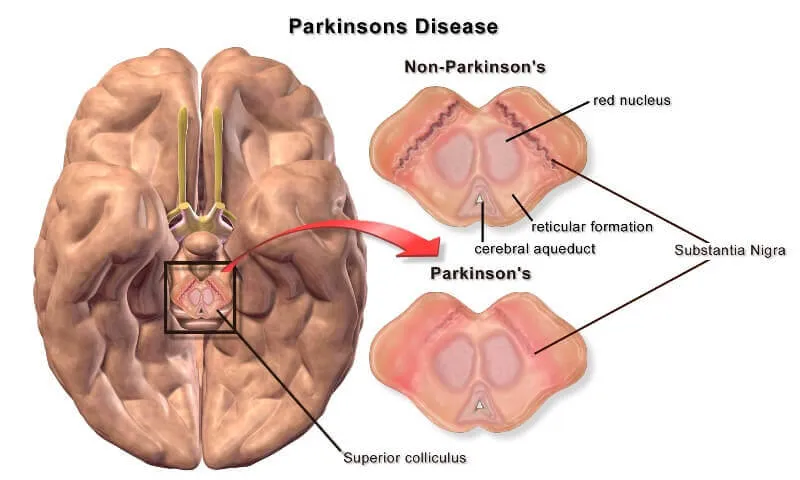
Figure 1. Parkinsons disease
5. Huntington’s Disease
Similar to how oxidative stress and mitochondrial dysfunction contribute to neuronal degeneration, many of these antioxidant substances have been shown to have potentially therapeutic effects in Huntington's disease (HD). Ferulic acid, vitamins E, EGCG, and naturally occurring components like lycopene and grape seed extracts in food products have all been shown to have potent antioxidant effects that may slow the course of the disease. Novel synthetic compounds have also been studied for potential therapeutic potential in HD [46]. Neuronal degeneration is influenced by oxidative stress and mitochondrial malfunction. Similarly, it has been demonstrated that many of these antioxidants may have therapeutic benefits for HD. It has been demonstrated that ferulic acid, vitamin E, EGCG, and naturally occurring ingredients like lycopene and grape seed extracts in food products have strong antioxidant properties that may decrease the progression of the illness. Additionally, new synthetic chemicals have been studied for potential therapeutic use in HD [46]. The neuroprotective benefits of BN82451, a brain-penetrable substance, are achieved by shielding the mitochondria from oxidative damage.
6. Amyotrophic Lateral Sclerosis
ALS is characterized by progressive degeneration of motor neurons. Oxidative damage, excitotoxicity, inflammation, and protein aggregation are involved in disease progression. Antioxidants such as edaravone and N‑acetyl cysteine have shown therapeutic potential. Multiple studies have also demonstrated the efficacy of antioxidant substances in the management of ALS. Higher plasma vitamin E levels via supplementation has been shown to be somewhat protective against ALS onset. Patients on combined riluzole and alpha-tocopherol (vitamin E) therapy had predominantly mild disease courses, with elevated glutathione and reduced TBARs (thiobarbituric acid reactive species—a by-product of lipid peroxidation). The administration of riluzole has been shown to possess antioxidant properties, mediated by the inhibition of protein kinase C, with an increase in glutathione synthesis, which occurs by the increase in intrace Disease progression is influenced by oxidative damage, excitotoxicity, inflammation, and protein aggregation.
7. Nanocarrier‑Based Antioxidant Therapy
Conventional antioxidants frequently exhibit poor solubility, rapid degradation, low absorption, and limited ability to cross biological barriers like the blood–brain barrier (BBB). Nanotechnology improves antioxidant drug delivery across the blood–brain barrier. Liposomes, chitosan nanoparticles, dendrimers, and lipid nanoparticles enhance bioavailability and neuronal targeting. Bioavailability and neural targeting are improved by liposomes, chitosan nanoparticles, dendrimers, and lipid nanoparticles. Reactive oxygen species (ROS) and the body's antioxidant defense system are out of balance, which leads to oxidative stress. Proteins, lipids, DNA, and neurons are all harmed by excess ROS, which causes cellular malfunction and the advancement of disease. Conventional antioxidants frequently exhibit inadequate absorption, fast breakdown, poor solubility, and restricted capacity to traverse biological barriers including the blood–brain barrier (BBB). Nanocarrier systems assist in getting over these restrictions.
8. Current Challenges and Future Prospects
Poor bioavailability, scant clinical evidence, toxicity issues, and challenges with targeted distribution are some of the main drawbacks. Future studies should concentrate on combination therapy, improved nanocarriers, and personalized medicine. Combination therapy, tailored medicine, and improved nanocarriers should be the main topics of future study.
Table 1 Current Challenges in Neurodegenerative Diseases
|
|
|
CONCLUSION:
By lowering oxidative damage, enhancing mitochondrial activity, and safeguarding brain cells, antioxidant-based therapy approaches are crucial in the treatment of neurodegenerative illnesses. To determine the safety and effectiveness of antioxidant therapy in neurodegenerative illnesses, more clinical research is required, despite the encouraging results of preclinical trials. This study supports the use of dietary and supplemental antioxidants in cognitive health, but more long-term, randomized controlled trials (RCTs) are required to determine optimal dosages, duration, and efficacy across varied groups. Over a 12-month period, antioxidant intake improved MMSE and MoCA scores, indicating cognitive enhancement, and reduced oxidative stress biomarkers like MDA, TAC, and SOD. Antioxidant consumption decreased oxidative stress biomarkers like MDA, TAC, and SOD and increased MMSE and MoCA scores during a 12-month period, indicating cognitive improvement. These results corroborate the neuroprotective properties of antioxidants and their capacity to stop oxidative damage, which is a primary cause of Parkinson's, Alzheimer's, and other neurodegenerative illnesses. Although further long-term, randomized controlled trials (RCTs) are required to ascertain the ideal dosages, duration.
REFERENCES


Ravi Sahu*, Praveen Kumar, Study on Antioxidants in Neurodegenerative Disorder A Review, Int. J. of Pharm. Sci., 2026, Vol 4, Issue 6, 200-204. https://doi.org/10.5281/zenodo.20486660
 10.5281/zenodo.20486660