

We use cookies to ensure our website works properly and to personalise your experience. Cookies policy
Dr. J.J . Magdum Pharmacy College Jaysingpur, Shirol, Kolhapur
This research focuses on creating and testing a Synergistic effect of Herbal hair dye and hair mask that employs a combination of nourishing natural oils and conventional medicinal herbs. Lawsonia inermis L. (Heena), Phyllanthus emblica (Amla), Indigofera tinctoria (Indigo), Hibiscus rosa-sinensis (Hibiscus), Azadirachta indica (Neem), Linum usitatissimum Linn (Flaxseed), Aloe barbadensis Miller (Aloevera) and, which are known for their Hair coloring, antifungal, anti-inflammatory, and Hair smoothening and hair nourishing qualities, are among the active herbal ingredients. A synergistic blend of Cocos nucifera (coconut oil), castor oil, and Sesamum indicum (Sesame oil) makes up the base. These improve absorption, supply vital nutrients, and have hair coloring properties. The findings indicate that the Herbal hair dye & hair mask effectively prevents greying of hair while also providing other advantages including hair strengthening, smoothening, and decreased hair damage. According to the research, natural formulations derived from plants have the potential to be secure and efficient substitutes for synthetic hair dying and masking medications.
Herbal Medicine:
Hair coloring has been practiced for centuries, with synthetic dyes becoming popular because of their wide range of shades and strong coloring effect. However, growing awareness about the harmful effects of chemical-based hair dyes—such as scalp irritation, allergies, and possible long-term health risks—has increased interest in herbal alternatives.
Herbal hair dyes are made from natural plant-based ingredients like henna (Lawsonia inermis), amla (Phyllanthus emblica), and other botanical extracts known for their coloring and conditioning properties. Unlike synthetic dyes, herbal dyes are free from harsh chemicals such as ammonia, peroxide, and para-phenylenediamine (PPD), making them a safer and more eco-friendly option.
The formulation of herbal hair dye involves selecting suitable plant extracts and combining them in the right proportions to achieve the desired color, stability, and effectiveness. The evaluation process includes checking properties such as pH, particle size, coloring performance, safety, and durability on different hair types. This research focuses on developing a natural and long-lasting herbal hair dye while minimizing harmful side effects. It also studies extraction methods, formulation techniques, and scientific evaluation to determine the potential of herbal ingredients as effective alternatives to synthetic dyes.
Compared to synthetic hair dyes, natural hair tints are considered safer for both human health and the environment. Synthetic dyes may cause skin problems, health hazards during manufacturing, environmental pollution, and side effects for consumers. Due to these concerns, people around the world are increasingly choosing herbal hair dyes despite certain market and acceptance challenges.
Herbal hair dye is a natural, plant-based substitute for chemical hair dyes. It provides a safer and environmentally friendly way to color hair while also offering conditioning and nourishing benefits. These dyes are usually prepared from dried and powdered plant materials that naturally contain coloring compounds. Herbal hair dyes are becoming popular because they reduce the risk of allergic reactions and damage caused by synthetic chemicals.[1]
Nowadays, maintaining a clean scalp and healthy hair has become an important part of personal care. Hair plays a major role in enhancing our overall appearance and also reflects good health. To take proper care of hair naturally, we developed an herbal hair mask recipe using beneficial natural ingredients.
This herbal hair mask is made with nourishing oils such as castor oil, coconut oil, and bhringraj oil, which help in improving hair health and scalp condition. The main purpose of the hair mask is to remove dirt, excess oil, and impurities that build up on the scalp and hair over time.
Since the mask is prepared only with natural ingredients, no harmful chemicals are used in the process. As a result, it is gentle on the hair and does not cause damage. Herbal hair masks help to deeply hydrate and moisturize the hair, making them especially useful for dry, damaged, or thin hair.
Regular use of this hair mask can strengthen the hair roots, improve scalp health, and make hair softer and healthier. Another advantage is that these masks can easily be prepared at home and have very few or no side effects. Different natural ingredients can also be added depending on individual hair needs.
Although many hair masks are available in the market, most of them contain chemicals that may harm the hair in the long run. Therefore, we chose to prepare a safe and natural herbal product using herbs. This homemade hair mask is simple to make, effective, and beneficial for maintaining healthy and beautiful hair.[2]
1.1 Pharmaceutical Profile of Core Ingredients:
For Herbal Hair Dye: -
Synonyms: Mehendi, Hina, Madayantika.
Biological Source: Heena is derived from the dried leaves of Lawsonia inermis L.
Chemical Constituents: Naphthoquinones, Phenolic glycosides, Tannins, Flavonoids.
Uses: Natural hair coloring, Strengthening & conditioning. [3]
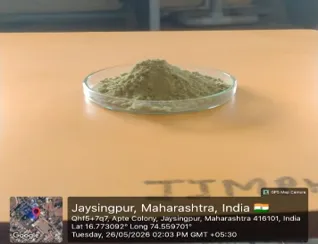
Fig.01.Heena Powder
Synonyms: True indigo, Dyer’s indigo.
Biological Source: It is obtained from leaves and stems of shrubs belonging to Indigofera tinctoria
Chemical Constituents: Indican, Indigotin, Indirubin.
Uses: Cosmetics & hair care, Darkening of hair.[4]
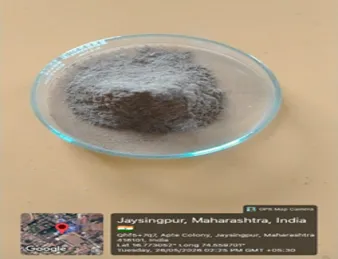
Fig.02 Indigo Powder
Synonym: China Rose, Shoe Flower
Biological Source: Consist of dried and pulverized flowers of Hibiscus rosa-sinensis
Chemical Constituents: Anthocyanins, Flavonoids, Mucilage.
Uses: Hair care, skin care, dietary, and medicinal[5]
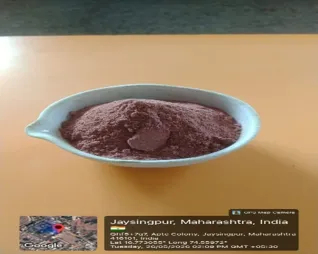
Fig.03.Hibiscus Powder
Synonyms: Kattha, Khair, Black cutch
Biological Source: It is dried aqueous extract prepared from the heartwood of Acacia catechu
Chemical Constituents: Acacatechin, catechu tannic Acid, Quercetin, catechin
Uses: Oral Hygiene, Astringent.[6]
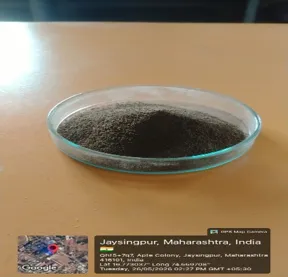
Fig.04.Black Catechu
Synonyms: Tea plant, Tea shrub.
Biological Source: It is obtained from dried leaves of Thea sinensis.
Chemical Constituents: Polyphenols, Amino acids, Vitamins & Minerals.
Uses: Health and medicines, Food and beverages.[7]
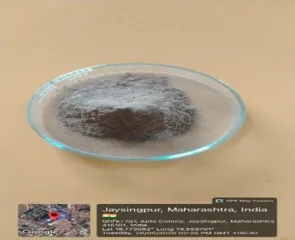
Fig.05.Tea Powder
Synonyms: Muskroot, Balchar, Nardin. Nardostachys jatamansi plant.
Chemical Constituents: Sesquiterpenes, Coumarins, Volatile essential oils.
Uses: Mental and neurological health, sleep aid, skin, and hair care.[8]
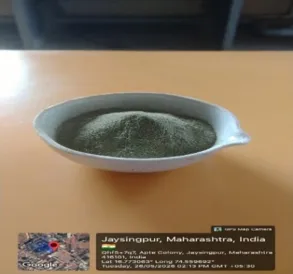
Fig.06.Jatamansi Powder
Synonyms: Indian lilac, Margosa tree,
Biological Source: Leaves, Bark, and oil from Azadirachta indica.
Chemical Constituents: Azadirachtin, nimbim, nimbidim.
Uses: Anti-Bacterial, Anti-Fungal, skin care, hair care.[9]
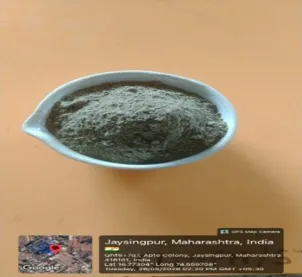
Fig.07.Neem Powder
Synonyms: Kadi patta, sweet neem, curry patro.
Biological Source: Curry leaves are derived from fresh or dried aromatic leaves of Murraya koeingii (L)
Chemical Constituents: Carbazole alkaloids, essential oils, vitamins, and minerals.
Uses: Hair and scalp care, medicinal applications, metabolic health.[10]
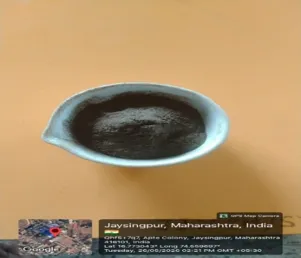
Fig.08.Curry leaves
Synonyms: Indian gooseberry, amla, aonla, amalaki
Biological Source: It is derived from dried, ripe or semi-ripe fruits of plant Phyllanthus emblica.
Chemical Constituents: Vitamins, tannins, minerals and amino acids, alkaloids, flavonoids.
Uses: Immunity and digestion, hair and scalp care, skin care, etc.[11]
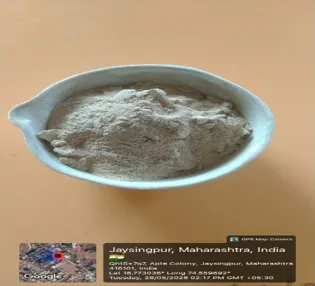
Fig.09.Amla Powder
Synonyms: Ink plant, bhringraja, markava, kesharajana.
Biological Source: The dried powder is made from the whole plant of Eclipta prostrata.
Chemical Constituents: Alkaloids, flavonoids, terpenoids, sterols, steroids.
Uses: Hair care, skin care, digestive system.
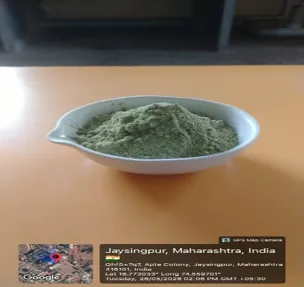
Fig.10.Bhringraj Powder
For herbal hair mask:
Synonyms: Linseed, common flax.
Biological Source: derived from Linum usitatissimum plant.
Chemical Constituents: fixed oils, omega –3 Lignans, proteins and amino acids, mucilage.
Uses: cosmetic and skin care, industrial applications, hair care.[12]
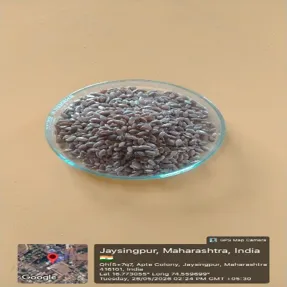
Fig.11.Falxseeds
Synonyms: Ghrit kumari, barbados aloe, medicinal aloe.
Biological Source: The fresh clear mucilaginous inner leaf gel obtained from Aloe barbadensis Miller
Chemical Constituents: Carbohydrates, vitamins, minerals, amino acids, organic acids.
Uses: skin care and wound healing, moisturizing and cosmetics, hair care.
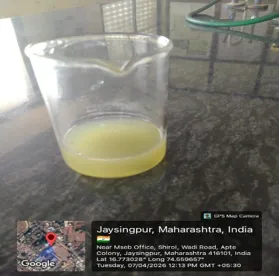
Fig.12.Aloe Vera gel
Synonyms: Foenugreek, methi, methika.
Biological Source: It consists of dried seeds from plant Trigonella foenum-greacum.
Chemical Constituents: Alkaloids, saponins, mucilage, fibers, amino acids, and volatile oils.
Uses: Anti-inflammatory, antioxidants, reduce hair fall, conditions and add luster.
Synonyms: Rusmari, dew of the sea, rosmarinus oil.
Biological Source: It is obtained by steam distillation of the fresh flowering tops and leaves of Salvia rosmarinus.
Chemical Constituents: 1,8-cineole, camphor, a-pinene, borneol, carnosic acid, rosmarinic acid.
Uses: promote hair growth, combats dandruff, reduce hair fall.[13]
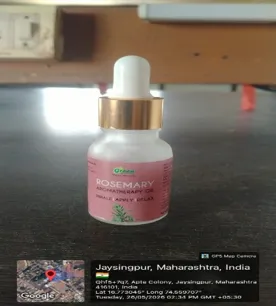
Fig.13.Rosemary Oil
Synonyms: coconut fat, copra oil, coconut butter
Biological Source: Obtained by extraction from dried kernel of coconut from the fruit Cocos nucifera.
Chemical Constituents: Lauric acid, myristic acid, palmitic acid, caprylic acid, oleic acid.
Uses: Deep conditioning, reduce protein loss, scalp health, hair moisturizer.[14]
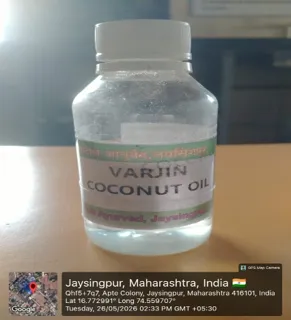
Fig.14.Coconut oil
Synonyms: Castor bean oil, ricinus oil, oleum ricini.
Biological Source: Obtained from the seeds of Ricinus communis.
Chemical Constituents: Ricinolic acid, linoleic acid, stearic acid, dihydroxystearic acid.
Uses: promote hair growth, deep conditioning, scalp health, shine and protection.[15]
2. LITERATURE REVIEW
Paolo Scartezzini, et al (2000)
A lot of medicinal plants, Traditionally used for thousands of years, are present in a group of herbal preparations of the Indian traditional health care system (Ayurveda) named Rasayana proposed for their interesting antioxidant activities. Among the medicinal plants used in ayurvedic Rasayana for their therapeutic action, some of these have been thoroughly investigated. In the present paper, Heena, Neem, Indigo, Amala, flaxseeds, alovera, the plants described contain dying and smoothening principles, that can explain and justify their use in traditional medicine in the past as well as the present. In order to identify the plants with dying and smoothening activity in Ayurveda, a formulation of some rasayanas with well-defined antioxidant properties has been exanimated. For this purpose, we have considered Shama's work on the preparation MAK4, MAKS, MA631, MA 471, MA Raja's Cup, MA Student Rasayana, MA Ladies Rasayan[16]
Abhishek Verma, et al (2024)
This review briefly discusses herbal medication, i.e., Murray koenigii, also known as curry leaves, that have been useful in traditional medicine for centuries and natural products with different pharmacological activities. It might lead to a Beter knowledge of natural products 'potential therapeutic effects and the creation of promising pharmaceuticals with minimal toxicity and great effectiveness for treating different ailments. The Chinese Biomedical Database (CBM). Technological Periodical Database (VIP), China National Knowledge Infrastructure (CNKI), Google Scholar, Elsevier, ScienceDirect, Sci Finder, and PubMed were used to compile the content of this review. From 1975 through 2020, data were collected. More than 23 components of M koenigii have been discovered so far, with sterols, carbohydrates, flavonoids, and alkaloids causing the most concern. Due to its multicomponent nature, M. koenigii has a wide range of beneficial biological activities, including analgesic, anticancer, antioxidative, antimicrobial, antihypertensive, antidiabetic activities, antibacterial, and anti-inflammatory properties. This review discusses the vast details of M. koenigii (Curry leaves) and its possible medicinal use for different therapeutic purposes. The plant incorporates other essential substances, as discussed, are beneficial to remedy and deal with several ailment cures that exhibit different pharmacological actions. The accumulated ethnopharmacological details of that plant may be further helpful for the upcoming research about the said properties and use of M. koenigii[17]
V. M. Jadhav, et al (2009)
"World Health Organization" has recommended that traditional health and folk medicine systems have proved to be more effective in health problems worldwide. Hibiscus rosa sinensis Linn. is certain to emerge in the near future as a major player in the growing field of herbal health supplements and medicines both in daily self-care and in professionally managed health care systems. The principal constituents of Hibiscus rosa sinensis Linn. are flavones. Flavones contain quercetin-3-diglucoside, quercetin-3,7-diglucoside, cyaniding-3,5-diglucoside, quercetin-3-sophorotrioside, kaempferol-3xylosylglucoside, cyaniding-3-sophoroside-5-glucoside and other constituent are cyclopeptide alkaloid, cyanidin chloride, hentriacontane, riboflavin, ascorbic acid, thiamine, taraxeryl acetate, B-sitosterol, cyclic acids and malvalic acids. All the parts of Hibiscus rosa sinensis Linn and chemical constituents are used as anti-tumor, antifertility, anti-implantation, anti-inflammatory, analgesic, antiestrogenic, antipyretic, antispasmodic, antiviral, antifungal, antibacterial, hypoglycemic, spasmolytic, CNS depressant, hypotensive and juvenoid activity. This article compiles all the information related to Hibiscus rosa sinensis Linn.[18]
Kausik Biswas, et al. (2002)
Neem (Azadirachta indica A. Juss) is perhaps the most useful traditional medicinal plant in India. Each part of the neem tree has some medicinal property and is thus commercially exploitable. During the last five decades, apart from the chemistry of the neem compounds, considerable progress has been achieved regarding the biological activity and medicinal applications of neem. It is now considered a valuable source of unique natural products for the development of medicines against various diseases and for the development of industrial products. This review gives a bird's eye view mainly on the biological activities of some of the neem compounds isolated, pharmacological actions of the neem extracts, clinical studies, and plausible medicinal applications of neem along with their safety evaluation.[19]
3. OBJECTIVE
3.1 Need of the study
4. PLAN OF WORK
Literature review
↓
Selection and collection of powder and plant material
↓
Preparing the material for the formulation
↓
Phytochemical introduction of core material
↓
Formulation of herbal hair dye & herbal hair mask
↓
Evaluation test, result & discussion of herbal hair dye & herbal hair mask
↓
Procedure for application of herbal hair dye & herbal hair mask
↓
Synergistic effects of herbal hair dye followed by herbal hair mask
↓
Conclusion
5. MATERIALS & METHODOLOGY
Table 5.1: Materials used
|
Sr. No. |
Materials used for Herbal Hair Dye |
Material Used for Herbal Mask |
|
1. |
Heena powder |
Flaxseeds |
|
2. |
Indigo powder |
Aloe Vera gel |
|
3. |
Brahmi powder |
Fenugreek seeds |
|
4. |
Hibiscus powder |
Vitamin E |
|
5. |
Black catechu |
Coconut oil |
|
6. |
Tea powder |
Castor oil |
|
7. |
Jatamansi powder |
Rosemary oil |
|
8. |
Triphala powder |
Lavender oil |
|
9. |
Neem powder |
Emulsifying wax |
|
10. |
Carry leaves powder |
Sodium benzoate |
|
11. |
Amala powder |
|
|
12. |
Bhringraj powder |
- |
|
13. |
Beetroot powder |
- |
|
14. |
Kalonji seed powder |
- |
Table No. 5.2: Equipment Used
|
Sr. No. |
Equipment used for Herbal hair dye |
Make & model |
|
1. |
Weighing balance |
Wensar |
|
2. |
Sieve (no.40) |
Ordinary |
|
3. |
Bowls |
J-SIL |
|
4. |
Spatula / Glass rod |
J-SIL |
|
5. |
Test tubes |
J-SIL |
|
6. |
Glass beakers |
J-SIL |
|
7. |
Glass rod |
J-SIL |
|
8. |
Measuring cylinders |
J-SIL |
|
9. |
Thermometer |
J-SIL |
5.3 FORMULATION
5.3.1 Formulation table For Herbal Hair Dye
|
Sr. No |
Ingredient |
Quantity (gm) |
Role of ingredient |
|
1 |
Heena powder |
20gm |
Natural coloring agent; gives reddish-brown shade and conditions hair |
|
2 |
Indigo powder |
10gm |
Provides dark brown to black color when combined with henna |
|
3 |
Brahmi powder |
2gm |
Nourishes scalp and strengthens hair roots |
|
4 |
Hibiscus powder |
2gm |
Promotes hair growth and adds softness |
|
5 |
Black catechu |
5gm |
Enhances dark color intensity and improves dye fixation |
|
6 |
Tea powder |
2gm |
Gives natural dark tint and improves shine |
|
7 |
Jatamansi powder |
0.5gm |
Helps in hair nourishment and scalp calming |
|
8 |
Triphala powder |
1gm |
Acts as antioxidant and supports scalp health |
|
9 |
Neem powder |
1gm |
Provides anti-dandruff and antimicrobial effect |
|
10 |
Carry leaves powder |
0.5gm |
Helps reduce premature greying and nourishes hair |
|
11 |
Amala powder |
2gm |
Enhances color retention and strengthens hair |
|
12 |
Bhringraj powder |
1gm |
Promotes hair growth and reduces hair fall |
|
13 |
Beetroot powder |
0.5gm |
Adds natural reddish tone and improves hair texture |
|
14 |
Kalonji seed powder |
0.5gm |
Strengthens hair follicles and improves scalp health |
|
15 |
Loha Bhasma |
2gm |
Enhances dark coloration and supports hair strengthening |
|
|
Total |
50gm |
|
5.3.2 Formulation table for Herbal Hair Mask
|
Sr. No |
Ingredient |
Quantity (gm, ml) |
Role of Ingredient |
|
1 |
Flaxseeds |
10ml |
Provides gel texture and conditions hair |
|
2 |
Aloe Vera gel |
8ml |
Moisturizes scalp and soothes irritation |
|
3 |
Vitamin E |
2-3drops |
Acts as antioxidant and nourishes hair |
|
4 |
Fenugreek Seeds |
2ml |
Strengthens hair and reduces hair fall |
|
5 |
Coconut oil |
1.25ml |
Deeply nourishes and softens hair |
|
6 |
Castor oil |
0.5ml |
Promotes hair growth and thickness |
|
7 |
Rosemary oil |
2-3drops |
Stimulates scalp circulation and hair growth |
|
8 |
Lavender oil |
2-3drops |
Provides soothing effect and pleasant fragrance |
|
9 |
Emulsifying wax |
1.25gm |
Helps mix oil and water phases to form creamy texture |
|
10 |
Sodium benzoate |
2gm |
Acts as preservative and prevents microbial growth |
|
|
Total |
25gm |
|
5.4 PROCEDURE
5.4.1 For herbal hair Dye
5.3.2 For herbal hair Mask
5.5 Evaluation Test:
5.5.1 For herbal hair dye
A. Organoleptic evaluation of hair dye
B. Physio - chemical evaluation
C. Phytochemical evaluation
D. Rheological evaluation
E. Patch test
F. Stability test
A. Organoleptic evaluation of hair dye:
1. Color of formulation
2. Oduor of Formulation
3. Appearance
4. Texture
B. Physio - chemical evaluation:
The physical and chemical features of the herbal hair dye were evaluated to determine the pH, its moisture content for the purpose of stability, compatibility, and the amount of inorganic matter present in it.
C. Phytochemical evaluation:
a. Molisch’s test
b. Volatile oil test:
c. Mayer’s test (For alkaloid):
D. Rheological evaluation:
a) Bulk Density:
Bulk density= Bulk mass/Bulk volume
b) Tapped Density:
Tapped Density = Mass/Tapped volume
c) % Carr’s index=
(Tapped density- Bulk density)/ tapped density*100
d) Housner’s Ratio =
Tapped density/Bulk density
e) Angle of repose=
It is defined as the maximum angle possible in between the surface of pile of powder to the horizontal flow. It required amount of dried powder is placed in a cylindrical tube open at both ends is placed on a horizontal surface. Then the funnel should be raised to form a heap. The height and radius of the heap is noted and recorded. For the above method, the angle of repose (θ) can be calculated by using the formula. [22]
θ = tan-1 (h/r)
Where θ – Angle of repose, h – Height of the heap, r– Radius of the base
E. Patch test:
This normally includes spotting the limited quantity of watery arrangement of hair color behind the ear on or internal elbow in a space 1sq.cm and passing it to dry. The indication of disturbance or feeing of non-health is noted, if any. Estimated and little amounts of the pre-arranged hair International Journal of Innovative Science and Research Technology ISSN No: -2456-2165 pack were applied to the region for the proper time. Irritancy, redness, and enlarging were checked and noticed for standard stretch as long as 24 hours if any.
F. Stability test:
Solidness testing for the pre-arranged plan was performed by putting away at various temperature conditions for an hour of one month. The pressed glass vials of definition were put away at various temperature conditions for the actual boundaries like smell, pH, surface and smoothness.[23]
5.5.2 For herbal hair mask
1. Physical appearance
2. Homogenicity
3. pH
4. Washability
5. Spreadability
6. Skin irritation test
7. Patch test
1. Physical appearance: The mask formulation was evaluated in terms of physical character like phase separation and change in color, Oduor and rheological parameters.
2. Homogenicity: Formulated mask was tested for homogeneity by visual inspection after the mask was placed in the container. Formulated hair mask was tested for the appearance, presence of any aggregates and flocculates.
3. pH: The pH of the mask was determined by using a digital pH meter. Take one gram of mask and dissolve in 100 ml distilled water and measure the pH for three times and the average value was calculated.
4. Washability: The formulated hair mask was applied on the skin and then ease and extent of washing with water is checked normally.[24]
5. Spreadability: Take (2g) of formulated mask sandwiched between two glass slides 500g of weight was placed on the slides. The weight was placed for specific period of time for 5 minutes. The weight was removed and the diameter of the spread circle was measured at different points. Finally, spreadability was calculated by using the formula.
5. Spreadability: Take (2g) of formulated mask sandwiched between two glass slides.
500g of weight was placed on the slides. The weight was placed for specific period of
time for 5 minutes. The weight was removed and the diameter of the spread circle was
measured at different points. Finally, spreadability was calculated by using the formula.
S=M.L/T
Where,
S= Spreadability
M= Weight placed on the slide
L=diameter of circle in cm
T=time in seconds.[25]
6. Skin irritation test: Apply the herbal hair mask formulation on the skin and observe for irritation, redness or rashes (if any).
7. Patch test: Apply the prepared formulation to a quarter-sized patch on the skin. A person should apply the formulation as thickly as they would when using it regularly. Leave the formulation on the patch of skin for as long as it would normally be on the skin.[26]
6. RESULT OF EVALUATION TEST
6.1 For herbal hair dye-
A. Organoleptic evaluation:
|
Sr. No. |
Parameters |
Observations |
|
1 |
Color |
Brownish green |
|
2 |
Oduor |
Characteristic |
|
3 |
Texture |
Fine |
|
4 |
Appearance |
Smooth |
B. Phytochemical Evaluation:
a. Molisch’s Test
Appearance of purple color indicates the presence of carbohydrates.
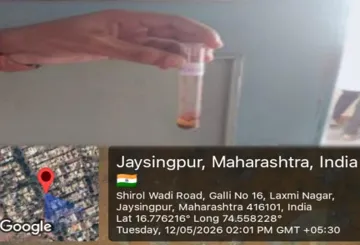
Fig.15. Molisch’s Test
b. Volatile Oil Test:
It gives red color. Indicates Volatile oils are present.
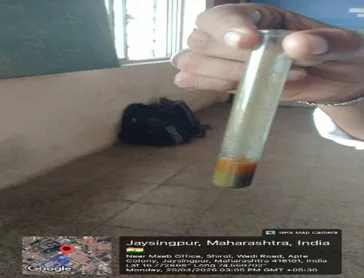
Fig.16.Volatile Oil Test
c. Mayer’s Test:
It gives yellow precipitation, indicating alkaloids are present.
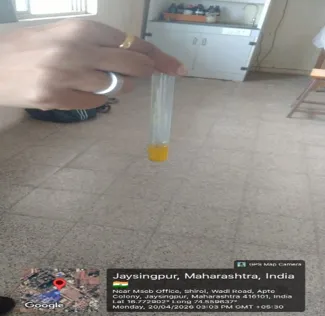
Fig.17. Mayer’s test.
C. Phytochemical test results
Table no:04
|
Sr. No |
Parameters |
Results |
|
1 |
Molisch’s Test |
Carbohydrates are present |
|
2 |
Volatile Oil Test |
Volatile oils are present |
|
3 |
Mayer’s Test |
Alkaloids are present |
D. Rheological test results-
Table no:05
|
Sr. No |
Parameters |
Results |
|
1 |
Bulk density |
0.334 |
|
2 |
Tapped density |
0.5 |
|
3 |
Angle of repose |
1.03 |
|
4 |
%Carr’s index |
34% (poor flow) |
|
5 |
Housener’s ratio |
1.5(poor flow) |
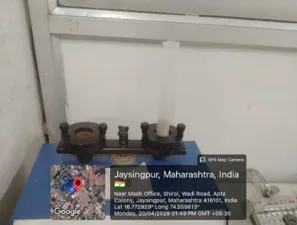
Fig.18.Tapped Density
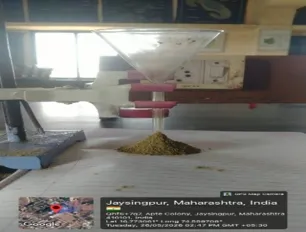
Fig.19.Angle of Repose
E. Patch test results-
Table no:06
|
Sr. No |
Parameters |
Results |
|
1 |
Swelling |
Negative |
|
2 |
Redness |
Negative |
|
3 |
Irritation |
Negative |
F. Stability test results-
Table no:07
|
Sr. No |
Parameters |
Room Temperature |
350C |
|
1 |
Color |
No change |
No change |
|
2 |
Oduor |
No change |
No change |
|
3 |
Texture |
Fine |
Fine |
|
4 |
Smoothness |
Smooth |
Smooth |
6.2 For herbal hair mask-
A) Physical appearance test result-
Table no:08
|
Sr. No |
Parameter |
Results |
|
1 |
Color |
Greenish White |
|
2 |
Oduor |
Aromatic |
|
3 |
Texture |
Creamy |
B) Homogenicity:
After the mask formulations have been set in the container, all developed masks were tested for homogeneity by visual inspection. They were tested for their appearance and presence of any lambs, flocculates or aggregates are not formed.
C) pH results-
Table no:09
|
Sr. No |
Parameter |
Results |
|
1 |
pH |
4.5 |
D) Washability test result-
Table no:10
|
Sr. No |
Parameter |
Results |
|
1 |
Washability |
Easily washable |
E) Spreadability test result-
Table no:11
|
Sr. No |
Parameter |
Results |
|
1 |
Spreadability |
21.66 |
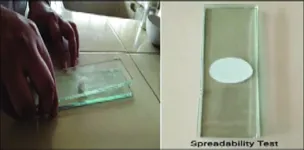
Fig.20 Spreadability Test
F) Skin Irritation test results-
Table no:12
|
Sr. No |
Parameter |
Results |
|
1 |
Irritancy |
No irritancy |
|
2 |
Erythema |
No erythema |
|
3 |
Edema |
No Edema |
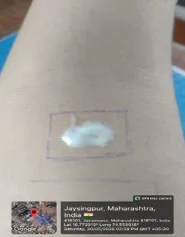
Fig.21.Skin Irritation Test
6.3 Material Procedure of application: -
6.3.1 For herbal hair dye-
6.4 Synergistic effects of herbal hair dye followed by herbal hair mask
|
Sr. No |
Herbal Hair Dye Effect |
Herbal Hair Mask Effect |
Synergistic (Combined) Effect |
|
1 |
Provides natural hair coloring |
Nourishes and moisturize the hairs |
Maintain healthy colored hairs with softness |
|
2 |
Covers gray hair naturally |
Repairs dry and damaged Strands |
Reduce the roughness caused after the dye application |
|
3 |
Strengthens hair roots through herbal powders |
Improves scalp hydration and nutrition |
Enhance overall scalp and hair health |
|
4 |
Cleanses scalp impurities |
Soothes irritation and dryness |
Prevents scalp discomfort after dyeing |
|
5 |
Adda temporary shine and texture |
Deep conditioning effect |
Improves long-lasting shine and smoothness |
|
6 |
May causes slight dryness due to tannins/ tea powder |
Restores moisture balance using oils and aloe vera |
Maintains proper moisture balance in hair |
|
7 |
Improves hair appearance naturally |
Reduce frizz and breakage |
Gives manageable healthy-looking hair |
|
8 |
Herbal actives improve hair strength |
Protein and mucilage support hair shaft |
Enhance hair elasticity and reduce hair fall |
|
9 |
Promotes natural hair care routine |
Provides post-dye nourishment |
Produce a complete herbal hair care treatment |
6.5 Discussion
This project was designed to prepare and evaluate a synergistic herbal hair dye and hair mask using natural ingredients. The main aim was to develop a safe, effective, and plant-based alternative to synthetic hair products, which may cause irritation, allergies, and other harmful effects.
The herbal hair dye was prepared using ingredients such as henna, indigo, amla, hibiscus, neem, bhringraj, etc. These ingredients are traditionally known for their coloring, strengthening, anti-dandruff, and hair nourishing properties. The herbal hair mask was formulated with flaxseeds, aloe vera gel, fenugreek etc. These materials help to moisturize the scalp, reduce dryness, improve hair texture, and promote healthy hair growth.
The results of the study showed that the herbal hair dye had a fine texture, smooth appearance, and brownish-green color. Phytochemical tests confirmed the presence of carbohydrates, volatile oils, and alkaloids, which support the therapeutic value of the formulation. The rheological evaluation showed poor flow properties, but this is acceptable for a powdered herbal product that is meant to be mixed before application. The patch test and skin irritation test showed no redness, swelling, or irritation, indicating that the formulation is safe for topical use under the tested conditions.
The stability study also showed that the dye remained unchanged in color, odor, texture, and smoothness at different storage conditions. This suggests that the formulation has good storage stability and can retain its quality over time. The herbal hair mask also showed good physical properties, including a creamy texture, aromatic smell, and greenish-white color. Its pH was 4.5, which is suitable for hair and scalp because mildly acidic products help maintain natural scalp balance.
The hair mask showed good washability and spreadability, and no irritation was observed after application. This means the formulation is user-friendly and comfortable for regular use. One of the most important findings of this project is the synergistic effect of using the hair mask after the herbal hair dye. they provide a more complete hair care treatment by coloring the hair and at the same time improving its health and text.
CONCLUSION
The present study successfully formulated and evaluated a herbal hair dye and herbal hair mask using natural plant-based ingredients. The herbal hair dye showed satisfactory coloring ability along with beneficial properties such as scalp nourishment, hair strengthening, and reduction of premature greying. The herbal hair mask provided conditioning, moisturization, smoothening, and improved overall scalp health.
Evaluation studies confirmed that both formulations possessed acceptable physical appearance, stability, spreadability, washability, suitable pH, and were free from irritation or adverse skin reactions. The phytochemical tests also confirmed the presence of beneficial plant constituents such as carbohydrates, volatile oils, and alkaloids, which contribute to the therapeutic activity of the formulations.
The combined application of herbal hair dye followed by herbal hair mask demonstrated a significant synergistic effect by reducing dryness, roughness, and hair damage usually associated with hair coloring. The hair mask enhanced softness, shine, hydration, and manageability of the hair after dye application, resulting in healthier and naturally nourished hair.
Therefore, the study concludes that the developed herbal formulations can serve as a safe, economical, eco-friendly, and effective alternative to synthetic hair care products while promoting healthy hair care through natural ingredients.
REFERENCES






Pallavi Patil, Kulsum Bandar, Kartika Gavade, Junaid Mulla, Jahir Mujawar, Kartik Varude, Synergistic Effect of Herbal Hair Dye followed by Hair Mask to Avoid Hair Damage, Int. J. of Pharm. Sci., 2026, Vol 4, Issue 9, 1948-1965. https://doi.org/10.5281/zenodo.22783034
 10.5281/zenodo.22783034