

We use cookies to ensure our website works properly and to personalise your experience. Cookies policy
Jagadambha Institute of Pharmacy and Research College, Kalamb
Herbal cosmetics are gaining wide popularity due to their natural origin, safety, and therapeutic benefits. The present study aimed to formulate and evaluate a herbal body scrub using natural ingredients possessing exfoliating, cleansing, moisturizing, and antioxidant properties. The herbal scrub was prepared using ingredients such as Aloe vera gel, neem powder, orange peel powder, coffee powder, beetroot powder, chia seeds, walnut shell powder, glycerin, rose water, lavender oil, and phenoxyethanol as preservative. The formulation was designed to remove dead skin cells, improve skin texture, and provide nourishment to the skin without causing irritation. The prepared formulation was evaluated for various physicochemical parameters including appearance, color, odor, texture, pH, spread ability, wash ability, consistency, grittiness, homogeneity, and stability. The pH of the formulation was found to be compatible with skin pH, indicating its suitability for topical application. The scrub showed good spread ability, adequate exfoliating action, and satisfactory cleansing properties. Stability studies revealed no significant changes in color, odor, or consistency during the storage period.
The body scrub is one of the most popular skin cosmetics for men and women. This product is mainly used to exfoliate dead skin and open pores, resulting in clearer & more healthy skin. [1] Skin is the one of the largest organs of body. It serves as a major protective organ for other body parts. Skin functions as a protective wrapper, keeping everything beneath it and keep safe from daily threats such as the harsh effects of sun, wind and pollution germ filled grime. [2,3] The skin supports its own ecosystem of microorganism, including yeast and bacteria, which cannot be removes by any amount of cleaning. Skin is also a sensoryorgan, which indicates the health of individual. It is consisting of material such as amino acid, lipid and carbohydrate etc. so that a balanced nutrition is required for skin to keep it glossy, clean and clear and healthy [4,5]. Cosmetics are defined as the products used for the purposes of cleansing, beautifying, promoting attractiveness or alternating the appearance. [6] The demand for herbal cosmetics is high nowadays due to its ability to act as cosmetics and drugs. Skin care products are important factor to improve the confidence in individuals. Women were thought to be the larger consumer of skin care products but in the present scenario men are equally concern about their look. [7] This concept about the beauty, look and attractiveness leads to the boom in this field. The cosmeceutical companies produce their product based on the skin texture like men require special type of products due to the roughness of their skin than women. [8]
1.1 Ideal Properties of Scrub.
1.Non-toxic
2.Possess small gritty particles
3.Mild abrasive
4.Non-irritating
5.Non-sticky
6.Able to remove dead skin cells. [9]
1.2 Anatomy of the Skin

Fig.No.1Structure Of Human Skin [10]
The skin is the largest organ of the human body, serving as a protective barrier against environmental damage, pathogens, and water loss. It is composed of three main layers: the epidermis, dermis, and hypodermis (subcutaneous tissue). The epidermis is the outermost layer made mainly of keratinocytes, providing waterproofing and protection. It also contains melanocytes, responsible for skin pigmentation. [10] Beneath the epidermis lies the dermis, a thicker layer containing connective tissue, blood vessels, nerves, sweat glands, and hair follicles. This layer provides elasticity, strength, and thermoregulation. The hypodermis consists mostly of fat and connective tissue, cushioning internal organs and aiding temperature control. Together, these layers maintain body integrity and play vital roles in sensation, temperature regulation, and immune defence.
1.3 Types of skin layer
1. Epidermis:
Function: Serves as a protective waterproof barrier against pathogens, UV radiation, and fluid loss.
Structure: The thinnest layer, composed of multiple sub-layers (strata), including the outermost stratum conium and the deepest stratum basal where cell division occurs.
2. Dermis:
Function: Provides skin with strength, support, and flexibility through its connective tissue and collagen fibres. It is also where sensory receptors, blood vessels, and nerves are located. Structure: The thickest layer, containing two main layers: the papillary layer and the reticular layer.
3. Hypodermis (Subcutaneous Tissue):
Function: Anchors the skin to the muscles and bones beneath, insulates the body, and acts as a shock absorber.
Structure: The deepest layer, composed of adipose (fat) tissue and connective tissue [11].
1.4 Benefits of scrubbing skin
1.Helps in removing dead cells: Facial or body scrubs are the cosmetic which goes beyond surface level to remove dead skin and reveal the healthy glowing skin below.
2. Free the skin form flakes: Loss of upper layer of skin (epidermis) is called as flaky skin. It gives rise to dry patches. Scrubbing your skin can help you to deal with flaky skin effectively. [12]
3. Deep cleaning of skin: Scrubbing your skin helps skin to get free from dirt, oil and sweat. Other cleansing like face wash facial cleansers cannot clean the skin. [13]
4. Thoroughly removing dust accumulated in the course of the skin, scrubbing does this work effectively. [14]
5. Clears blemishes: Accumulation of dead skin, can block the pores of skin and causes blemishes. Scrubbing frequently helps to remove dead skin and clears blemishes. [15]
6. Gives glow to Skin and Smooth texture: Scrubbing actually helps to give glow and smooth texture to skin.
7. Remove the acne scars: As scrubbing used to remove dead skin cells, it also removes the acne scars from skin. [16]
2. Material and Methods
2.1 Collection of herbs
The different plants were selected for the study having Skin care properties. All ingredients like Neem, walnut shell powder, Orange peel powder, Beetroot powder was obtained in their crude form from a local distributor. All the ingredients were powdered and sieved through sieve no. 120. All powdered ingredients were packed in moisture resistant, well closed containers. Coffee Powder and Poppy seeds procured from local market. Orange peel powder was prepared by grinding the airdried orange peel. The raw materials collected were given with their respective biological source and uses as ingredients in the skin care, even they are responsible to provide the nutrition to the skin. The selection of active ingredients for skin care powder is often based on the ability of the ingredient to prevent damage to the skin as well as to improve the quality of the skin by way of cleansing, nourishing and protecting it. [17]
2.2 Formulation Steps polyherbal Scrub

Fig. No.2 Liquid Phase

Fig. No.3 Solid Powder Phase
In order to formulate the face scrub these are the following steps:
No.1: Formulation of Herbal scrub 20 grams
|
Sr. No |
Ingredients |
F1 |
F2 |
F3 |
F4 |
F5 |
F6 |
|
1 |
Poppy seeds |
1 gm |
1 gm |
1 gm |
1 gm |
1 gm |
1 gm |
|
2 |
Chia seeds |
0.5 gm |
0.5 gm |
0.5 gm |
0.5 gm |
0.5 gm |
0.5 gm |
|
3 |
Coffee powder |
2.5 gm |
2.5 gm |
2.5 gm |
2.5 gm |
2.5 gm |
2.5 gm |
|
4 |
Aloe Vera gel |
3 gm |
2.5 gm |
2 gm |
1.5 gm |
1 gm |
0.5 gm |
|
5 |
Orange peel powder |
2.5 gm |
2 gm |
2 gm |
1 gm |
1 gm |
1 gm |
|
6. |
Walnut shell powder |
1.8gm |
2.3gm |
2.8gm |
2.2gm |
1.7gm |
2gm |
|
7. |
Neem powder |
1.5 gm |
1.5 gm |
1.5 gm |
1.5 gm |
1.5 gm |
1.5 gm |
|
8. |
Beetroot powder |
0.5 gm |
0.5 gm |
0.5 gm |
1 gm |
1 gm |
1 gm |
|
9. |
Glycerine |
2 ml |
2 ml |
2 ml |
2 ml |
2 ml |
2ml |
|
10. |
Lavender oil |
- |
- |
2-3 drops |
2-3 drops |
1-2 drops |
1-2 drops |
|
11. |
Rose water |
7 ml |
7 ml |
7 ml |
7 ml |
7 ml |
7 ml |
|
12. |
Phenoxyethanol |
0.2 gm |
0.2 gm |
0.2 gm |
0.2 gm |
0.2 gm |
0.2 gm |
2.3 Evaluation Parameter of Body Scrub
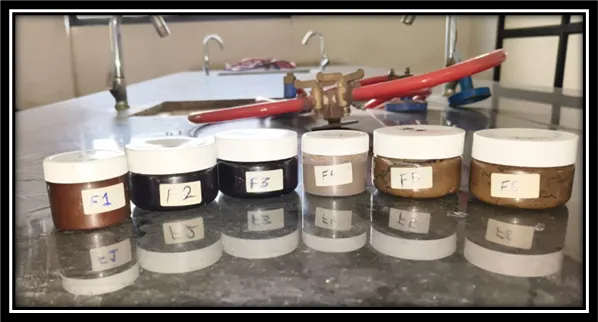
Fig No. 4 Formulation Batches of Body Scrub
Table No. 2 Final Batch Parameters
|
Sr.no |
Parameters |
Observation |
|
|
Colour |
Brown |
|
|
Odour |
Pleasant |
|
|
Consistency |
Thick |
|
|
Homogeneity and texture |
Creamery, Granular |
|
|
Wash ability |
Easily washable |
|
|
pH |
5.58 |
|
7. |
Irritation |
Non-Irritant |
|
8. |
Spread ability |
5-7 cm |
|
9. |
Foam Ability |
Slightly Foam able |
|
10. |
Stability |
Stable |
The assessment of the prepared facial exfoliant was conducted based on a variety of parameters, including organoleptic characteristics, pH level, irritability, wash ability, grittiness, extrudability, foamability, and spread ability, all of which met the required standards. The developed product effectively functions as a cleansing exfoliant that enhances skin health and radiance.
Organoleptic properties encompass factors such as
➤ Colour
➤ Fragrance,
➤Texture
➤ Consistency.
1. Spread ability
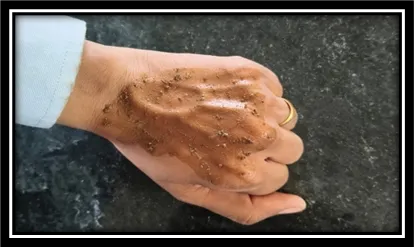
Fig. No. 5 Spread ability Test
This determines how easily the gel spreads across the skin. A glass slide with a small amount of sample on it is topped by another slide. The amount of weight applied to the slide, how long it took for it to expand, and how much of it was spread out are all measured. It computed using this formula:
L/t × m = S.
2. PH test

Fig. No. 6 pH Test
The pH test is carried out with a pH meter. The range of pH criteria for a good body scrub preparation is between 5-7.
3. Extrudability
10g of formulation taken in to an end closed and the collapsible ointment tube. One other end was kept opened slight pressure was applied closed tube side. The time taken to extrude and the amount of formulation extruded was noted.
4. Foamability
Different quantities of formulation with 10ml of water was mixed and shaken and foam. Observed.
5. Irritability

Small amount of the formulation. Applied on the skin and was found to be non-irritant Side. The time taken to extrude and the amount of formulation extruded was noted.
6. Wash ability

Fig. No. 10 Wash ability
Little quantity of scrub was applied over the skin and washed with water.
7. Stability Studies
Stability studies for herbal scrub was performed the product was kept for stability studies for 15 days at two different temperatures which refrigerated and room temperature and the change in its properties was observed. [18]
3. Result and Discussion
Comparative Discussion of Formulations
1. Physical Appearance: F1, F2, and F3 showed a light brown colour, indicating lower concentration of darker herbal ingredients. F4, F5, and F6 appeared darker brown, possibly due to higher concentration of coffee powder, neem powder, or walnut shell powder. F6 had a granular creamy texture, suggesting better exfoliating properties because of scrub particles.
Table. No. 3 Physical Parameter
|
Sr.no |
Formulation |
Physical Appearance |
||
|
Colour |
Odour |
Texture |
||
|
1 |
F1 |
Light brown |
Nutty |
Creamy |
|
2 |
F2 |
Light brown |
Nutty |
Creamy |
|
3 |
F3 |
Light brown |
Pleasant, Strong |
Creamy |
|
4 |
F4 |
Brown |
Pleasant, strong |
Slightly Creamy |
|
5 |
F5 |
Brown |
Pleasant |
Slightly Creamy |
|
6 |
F6 |
Brown |
Pleasant |
Creamy, Granular |
F1 and F2 possessed a nutty odour, likely due to walnut shell powder or natural seed components. F3 and F4 showed a pleasant dark odour, indicating better fragrance blending. F5 and F6 had the most pleasant odour profile, improving user acceptability.
3. Texture Evaluation
F1–F3 were creamy in consistency but comparatively thicker.
F4 and F5 became slightly creamy, improving spread ability over skin.
F6 exhibited creamy granular texture, which is ideal for a body scrub because it combines smooth application with exfoliation.
2. pH Comparison
All formulations had pH values between 5.12–5.58, which is close to normal skin pH F2 showed the highest pH (5.58). F1, F5, and F6 had pH 5.12, which is most compatible with skin and reduces chances of irritation. The formulations can therefore be considered skin-friendly.
Table. No 4. pH Test
|
Sr. No |
Formulation |
pH |
|
1 |
F1 |
5.12 |
|
2 |
F2 |
5.58 |
|
3 |
F3 |
5.56 |
|
4 |
F4 |
5.56 |
|
5 |
F5 |
5.12 |
|
6 |
F6 |
5.12 |
3. Spread ability Analysis
Spread ability increased progressively from F1 to F6: F1 showed lowest spread ability (4.5 cm), indicating thicker consistency. F6 showed highest spread ability (6.5 cm), suggesting smoother application and better ease of use. Improved spread ability indicates proper balance of glycerine, aloe Vera gel, and liquid components. Table. No 5. Spread ability Analysis
|
Sr. No |
Formulation |
Spread ability (cm) |
|
1 |
F1 |
4.5 |
|
2 |
F2 |
5 |
|
3 |
F3 |
5.3 |
|
4 |
F4 |
5.5 |
|
5 |
F5 |
6 |
|
6 |
F6 |
6.5 |
4. Wash ability
All formulations were easily washable, indicating: Good water compatibility Absence of excessive oily residue Suitable cleansing performance This is an important characteristic for herbal body scrub preparations.
Table. No. 6. Wash ability Test
|
Sr. No |
Formulation |
Wash ability |
|
1 |
F1 |
Easy to wash |
|
2 |
F2 |
Easy to wash |
|
3 |
F3 |
Easy to wash |
|
4 |
F4 |
Easy to wash |
|
5 |
F5 |
Easy to wash |
|
6 |
F6 |
Easy to wash |
6. Foamability
F1, F2, F4, and F5 showed no foam formation. F3 and F6 exhibited slight foaming, which may improve consumer perception of cleansing activity. Since herbal scrubs are primarily exfoliating products, excessive foam is not necessary.
Table. No.7 Foamability Test
|
Sr.no |
Formulation |
Formability |
|
1 |
F1 |
No foam |
|
2 |
F2 |
No foam |
|
3 |
F3 |
Slightly foaming |
|
4 |
F4 |
No foam |
|
5 |
F5 |
No foam |
|
6 |
F6 |
Slightly foaming |
7. Skin Irritation Study
All formulations were found to be non-irritant: No redness, no itching, no burning sensation observed This confirms that the herbal ingredients and pH range were safe for topical application.
Table. No. 8 Skin Irritation Study
|
Sr.no |
Formulation |
Skin irritation |
|
1 |
F1 |
No irritation |
|
2 |
F2 |
No irritation |
|
3 |
F3 |
No irritation |
|
4 |
F4 |
No irritation |
|
5 |
F5 |
No irritation |
|
6 |
F6 |
No irritation |
9. Stability Study
Stability studies revealed significant differences among batches:
F1 → Change in texture
F2 → Change in odour
F3 → Change in consistency
F4 → Slightly stable
F5 → Moderately stable
F6 → Stable
Among all batches, F6 demonstrated the best stability, indicating optimum ingredient compatibility and balanced formulation. Table.No.8 Stability Study
|
Sr.no |
Formulation |
Observation |
Stability |
|
1 |
F1 |
Change in texture |
Slightly stable |
|
2 |
F2 |
Change in odour |
Slightly stable |
|
3 |
F3 |
Change in consistency |
Slightly stable |
|
4 |
F4 |
No change |
Moderately stable |
|
5 |
F5 |
No change |
Stable |
|
6 |
F6 |
No change |
Stable |
CONCLUSION
4.1. Summury
This study focused on developing and evaluating a polyherbal body scrub using natural ingredients like Neem, Beetroot powder, Walnut shell powder, coffee powder, Khas khas, Chia seeds, Aloe Vera gel, Rose Water, and Glycerine. The scrub free of chemicals, effectively nourishes skin and reduce dust and dead skin cells. The findings confirmed its safety and efficacy, showing desirable attributes such as appearance, transparency, colour, of Each herbal ingredient contributed unique benefits, enhancing the Scrubs overall effectiveness. Stability tests identified Batch F6 as the optimal formulation the research highlights the potential of herbal extracts in Skincare, emphasizing their biological benefits, cost-effectiveness, and gentleness compared to synthetic scrub.
4.2. Conclusion
Preparation and evaluation of poly- herbal Scrub is a complex process that requires careful consideration of various factors, such as the selection of plant or herbal ingredients required for formulation, their procurement method, and the evaluation of the end or final product for its safety and efficacy. The use of herbal ingredients or plants in scrub formulation offers potential benefits such as improved skin health, reduced environmental impact, nourishing skin. The prepared herbal scrub formulations (F1–F6) were evaluated for physical appearance, pH, spread ability, wash ability, foamability, skin irritation, and stability. All batches showed good consistency and acceptable cosmetic properties. Among all formulations, batch F6 showed the best overall performance.
Evaluation studies showed good appearance, good wash ability, non-irritant to the skin, good foam stability, good dirt dispersion activity from the results, it may be concluded that F6 formulation meets all the requirements of the evaluation parameters among the two other formulations. Among all batches, F6 was considered the optimized formulation because it showed, Better spread ability Pleasant appearance and Odour, light foam ability, Good washing property, No skin irritation Better stability during stability studies.
REFERENCES


Virbhadra Kale*, Vaishnavi Dhandhe, Dulare I. Ali, Aishwarya Deshmukh, Rahul Bijwar, To Formulate and Evaluate Poly Herbal Cosmetic Scrub using Natural Ingredient, Int. J. of Pharm. Sci., 2026, Vol 4, Issue 5, 7022-7032. https://doi.org/10.5281/zenodo.20403398
 10.5281/zenodo.20403398