

We use cookies to ensure our website works properly and to personalise your experience. Cookies policy
Department of pharmacology, Aditya Institute of Pharmacy, Chalisgaon, 424101
The present study focuses on the formulation and evaluation of a herbal sunscreen lotion containing Centella asiatica extract as a natural photoprotective agent against harmful sun UV radiation. Exposure to ultraviolet radiation, particularly UV-A and UV-B rays, can lead to various skin disorders such as sunburn, erythema, premature aging, hyperpigmentation, loss of skin elasticity, oxidative stress, DNA damage, and an increased risk of skin cancer. Due to rising awareness about the adverse effects of prolonged sun exposure and the limitations associated with synthetic sunscreen agents, there is growing interest in herbal and eco-friendly cosmetic formulations. Centella asiatica, commonly known for its medicinal and dermatological benefits, possesses antioxidant, anti-inflammatory, antimicrobial, wound-healing, collagen-boosting, and skin-rejuvenating properties. These bioactive properties make it a promising ingredient for use in sunscreen formulations. In the present work, the herbal sunscreen lotion was prepared using suitable Thickning agents, humectants, preservatives, and stabilizers along with the plant extract in optimized concentrations. The prepared formulation was subjected to detailed evaluation tests including organoleptic properties, pH, viscosity, spreadability, homogeneity, washability, extrudability, drug content, drying time, stability studies, and skin irritation tests. The sunscreen activity of the formulation was determined by in vitro Sun Protection Factor (SPF) analysis and UV absorption studies. The results demonstrated that the lotion showed good physical appearance, smooth texture, appropriate pH, easy application, excellent spreadability, and satisfactory stability under different storage conditions. The formulation also exhibited effective UV protection with significant SPF value and no signs of skin irritation. Therefore, the developed herbal sunscreen lotion containing Centella asiatica extract can be considered a safe, effective, economical, and environmentally friendly alternative to conventional synthetic sunscreens for daily skin protection and care.
The skin is the largest and one of the most important organs of the human body. It forms the first line of defense against harmful external agents such as microorganisms, toxic chemicals, pollutants, temperature changes, and radiation from the sun. In addition to its protective role, the skin regulates body temperature, prevents excessive water loss, provides sensory perception, and contributes to immune function. Because the skin is directly exposed to the environment, it is highly vulnerable to damage caused by solar radiation, particularly ultraviolet (UV) rays. [1]. Continuous and unprotected exposure to sunlight can produce several harmful effects ranging from mild redness and tanning to severe photoaging and skin cancer. Therefore, protecting the skin from UV radiation has become an essential part of personal health care and dermatological practice [2]. Solar radiation reaching the earth consists of visible light, infrared rays, and ultraviolet radiation. Although UV radiation forms only a small portion of total sunlight, it has significant biological effects on the skin. Ultraviolet radiation is classified into three types according to wavelength: UVC (100–280 nm), UVB (280–320 nm), and UVA (320–400 nm). UVC possesses the highest energy and can cause severe cellular damage; however, it is almost completely absorbed by the ozone layer and normally does not reach the earth’s surface. UVB rays reach the superficial layers of the skin, mainly the epidermis, and are responsible for sunburn, erythema, inflammation, DNA mutations, and direct cellular injury. Repeated exposure to UVB is strongly associated with the development of skin cancers. [3]. UVA rays have longer wavelengths and penetrate deeper into the dermis. They generate reactive oxygen species (ROS), damage collagen and elastin fibers, and contribute to premature aging, wrinkles, pigmentation, and immunosuppression. UVA is present throughout the day, can penetrate clouds and glass, and causes cumulative long-term skin damage [4]. The harmful effects of UV radiation may be immediate or delayed. Acute effects include erythema, tanning, dryness, irritation, edema, and photosensitivity reactions. Chronic exposure may result in hyperpigmentation, leathery skin, wrinkles, uneven skin tone, actinic keratosis, cataracts, suppression of local immune responses, and malignant conditions such as basal cell carcinoma, squamous cell carcinoma, and melanoma. Increased outdoor activities, depletion of atmospheric ozone, changing climate patterns, and greater awareness of skin health have all contributed to the growing demand for effective photoprotective products [5].
Melanin is a natural pigment produced in the skin that plays an important role in protecting the body against harmful ultraviolet (UV) radiation from the sun. It is synthesized by specialized cells called melanocytes, which are located in the basal layer of the epidermis [1]. Melanin acts as the body’s natural sunscreen by absorbing, scattering, and neutralizing UV rays, thereby reducing damage to skin cells and deeper tissues [2]. When the skin is exposed to sunlight, especially UV-A and UV-B radiation, melanocytes become stimulated and increase the production of melanin through a biological process known as melanogenesis [3]. This increased melanin production results in tanning or darkening of the skin, which is considered a protective response to minimize further UV-induced damage [4]. Melanin forms a protective cap around the nucleus of skin cells, helping to shield cellular DNA from mutation and oxidative stress caused by radiation exposure [5].
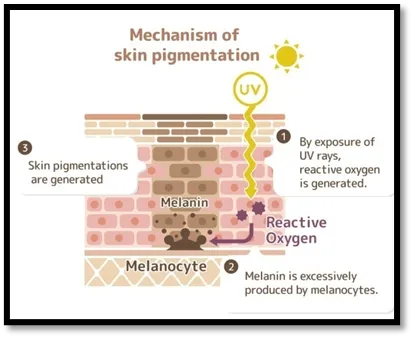
Fig.No.1 Mechanism of skin pigmentation
There are two main types of melanin present in human skin: eumelanin and pheomelanin. Eumelanin is brown to black in color and provides stronger UV protection, while pheomelanin is yellow to reddish and offers less protection against sunlight [6]. Individuals with higher eumelanin content generally have better natural resistance to sunburn and photoaging compared to those with lower melanin levels [7]. Although melanin provides significant natural protection, it is not sufficient to completely prevent damage caused by prolonged or intense sun exposure. Excessive UV radiation can still lead to sunburn, premature aging, hyperpigmentation, and skin cancer [8].
A sunscreen is a topical preparation intended to protect the skin from harmful ultraviolet radiation when applied externally. Sunscreens reduce UV penetration by absorbing, reflecting, scattering, or blocking ultraviolet rays before they reach living skin cells. Regular use of sunscreen helps prevent sunburn, minimizes photoaging, reduces pigmentation disorders, and lowers the risk of skin cancer. Sunscreens are now considered essential not only for recreational outdoor use but also for daily protection during routine exposure to sunlight [6].
Sunscreen products are available in many dosage forms such as creams, lotions, lotions, sprays, sticks, foams, ointments, mousses, and powders. The choice of dosage form depends on skin type, site of application, climatic conditions, cosmetic preference, and nature of active ingredients. Creams are commonly preferred for dry skin and facial use, while lotions are often chosen for oily skin and humid climates due to their light, non-greasy feel [6].
1. Chemical Sunscreens
These contain organic molecules that absorb UV radiation and convert it into less harmful heat energy. Examples include avobenzone, oxybenzone, octinoxate, octisalate, octocrylene, and homosalate [7].
2. Physical or Mineral Sunscreens
These contain inorganic particles such as zinc oxide and titanium dioxide that reflect and scatter UV rays. They are generally more stable and are often preferred for sensitive skin Many modern formulations combine both chemical and physical filters to achieve broad-spectrum protection, improved stability, and better cosmetic elegance [7].
Sun Protection Factor (SPF) is the most widely used parameter to express the protective efficiency of a sunscreen against UVB-induced erythema (sunburn). It indicates how much longer sunscreen-protected skin can remain exposed to sunlight before burning compared with unprotected skin[8].
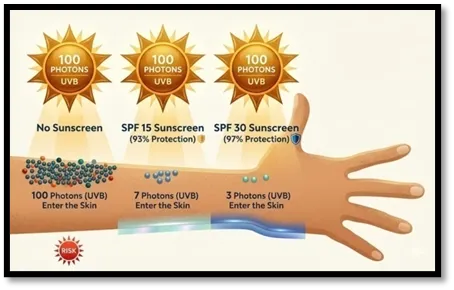
Fig.No.2 Sun Protection Factor
For example, if a person normally develops sunburn in 10 minutes, application of SPF 30 sunscreen theoretically allows approximately 30 times longer exposure (300 minutes) under the same conditions. In practical use, this value varies depending on quantity applied, sweating, rubbing, swimming, and intensity of sunlight [8].
Approximate UVB protection by common SPF values:
No sunscreen can provide 100% protection. Therefore, SPF should be considered along with reapplication frequency, water resistance, and broad-spectrum UVA coverage. Higher SPF products are particularly useful for sensitive skin, prolonged outdoor exposure, or regions with intense sunlight [8].
Fresh leaves of Centella asiatica were collected from a local medicinal plant source and authenticated by a botanist. The collected plant material was washed thoroughly with water to remove dirt and foreign particles. The leaves were shade dried for 7–10 days at room temperature and then powdered using a grinder. The powdered drug was stored in an airtight container for further extraction.
Table No. 1 Chemicals and Ingredients
|
Sr.no. |
Ingredient Name |
Role |
|
1 |
Xanthhan Gum |
Thikener |
|
2 |
Zinc Oxide |
Broad spectrum protection |
|
3 |
Centella asiatica extract |
Active ingredient |
|
4 |
Glycerin |
Humectant (Moisturizer) |
|
6 |
Methyl Paraben |
Preservative |
|
7 |
Distilled Water |
Solvant |
1. Zinc Oxide
Zinc oxide is an inorganic mineral compound widely used as a physical sunscreen agent. It protects the skin by reflecting, scattering, and absorbing harmful ultraviolet (UV) rays, including both UVA and UVB radiation. Due to its broad-spectrum protection and photostability, zinc oxide is considered one of the safest and most effective sunscreen ingredients. It is non-irritating and suitable for sensitive skin, making it ideal for cosmetic and dermatological formulations. In addition to UV protection, zinc oxide also possesses mild anti-inflammatory and skin-soothing properties that help reduce redness and irritation.
Role in formulation: UV filter and skin protectant.
2. Xanthan Gum
Xanthan gum is a natural polysaccharide produced through the fermentation of sugars by Xanthomonas campestris. It is commonly used in pharmaceutical and cosmetic formulations as a thickening, stabilizing, and suspending agent. In sunscreen formulations, xanthan gum improves viscosity, texture, and spreadability, ensuring uniform application on the skin. It also helps stabilize emulsions and prevents separation of ingredients during storage. Xanthan gum is non-toxic, biodegradable, and safe for topical use.
Role in formulation: Thickening agent and stabilizer.
3. Centella asiatica Extract
Centella asiatica, commonly known as Gotu Kola, is a medicinal herb rich in bioactive compounds such as asiaticoside, madecassoside, and flavonoids. The extract is widely recognized for its soothing, anti-inflammatory, antioxidant, and wound-healing properties. In sunscreen formulations, it helps reduce skin irritation caused by sun exposure and supports repair of the skin barrier. It also enhances skin hydration and promotes collagen synthesis, improving overall skin health.
Role in formulation: Skin-soothing and anti-inflammatory agent.
4. Glycerin
Glycerin is a colorless, odorless, and hygroscopic liquid commonly used as a humectant in skincare and cosmetic products. It attracts moisture from the environment into the skin, thereby maintaining hydration and preventing dryness. In sunscreen formulations, glycerin improves skin softness, smoothness, and elasticity. It also enhances the spreadability of the product and provides a pleasant skin feel after application.
Role in formulation: Humectant and moisturizing agent.
5. Methyl Paraben
Methyl paraben is a widely used antimicrobial preservative in cosmetic and pharmaceutical preparations. It prevents the growth of bacteria, fungi, and molds, thereby increasing the shelf life and safety of the product. In sunscreen formulations, methyl paraben helps maintain product stability and prevents microbial contamination during storage and use. It is effective at low concentrations and compatible with many cosmetic ingredients.
Role in formulation: Preservative.
6. Distilled Water
Distilled water is purified water free from impurities, minerals, and microorganisms. It serves as the primary solvent and base in many cosmetic and pharmaceutical formulations. In sunscreen preparations, distilled water dissolves water-soluble ingredients and helps form stable emulsions. It also contributes to the desired consistency, texture, and ease of application of the formulation.
Role in formulation: Solvent and formulation base.
Maceration Method
Fresh leaves of Centella asiatica were collected from a local medicinal plant source and washed thoroughly with water to remove dust, soil, and other foreign particles. The cleaned leaves were shade dried for about 7–10 days at room temperature until complete drying was achieved. The dried leaves were then powdered using a grinder and passed through a sieve to obtain a uniform coarse powder. The powdered drug was stored in an airtight container for further use.
For extraction, a known quantity of the dried powdered drug was accurately weighed and transferred into a clean and dry conical flask. A sufficient quantity of suitable solvent such as ethanol solvent was added to completely immerse the powdered material. The flask was tightly closed with a stopper or covered with aluminum foil to prevent solvent evaporation. The mixture was kept aside for 7 day for maceration with occasional shaking at regular intervals to ensure proper penetration of the solvent into the plant material and maximum extraction of active constituents. During this period, the solvent dissolved the phytochemical constituents present in the plant. After completion of the maceration period, the mixture was first filtered through muslin cloth to remove coarse plant particles and then filtered again using Whatman filter paper to obtain a clear filtrate. The filtrate containing the extracted constituents was collected carefully. The collected filtrate was concentrated by evaporating the solvent using a water bath at controlled temperature or by keeping it at room temperature until a semisolid or dry extract was obtained. The dried extract was weighed accurately and stored in an airtight container for further formulation of sunscreen lotion. This dried extract was used as the active herbal ingredient in the preparation of herbal sunscreen lotion.
Step 1: Preparation of Aqueous Phase
Step 2: Incorporation of Active Ingredient
Step 3: Addition of Zinc Oxide
Step 4: Homogenization
Step 5: Final Adjustment
Step 6: Packaging
Table no.2 Formulation F1, F2, F3
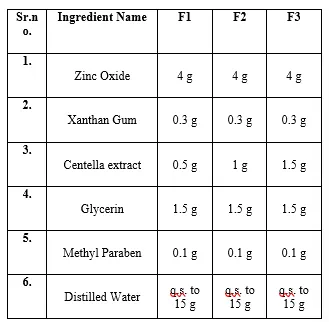
The prepared herbal sunscreen lotion containing Centella asiatica extract was evaluated for various physicochemical parameters to ensure its quality, stability, safety, and effectiveness. The formulations F1, F2, and F3 were subjected to the following evaluation tests.
All three formulations were visually inspected for color, odor, texture, and homogeneity.
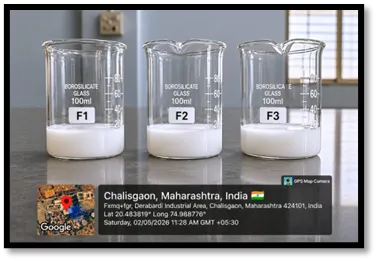
Fig.No.3 Formulation F1, F2, F3
Result Table:
1. Physical Appearance
Table No. 3 Physical Appearance
|
Formulation |
Color |
Odor |
Appearance |
Texture |
|
F1 |
White |
Characteristic |
Smooth |
Soft lotion |
|
F2 |
White |
Characteristic |
Smooth |
Uniform lotion |
|
F3 |
White |
Characteristic |
Slightly thick |
Dense lotion |
F2 showed the best appearance with smooth texture and good consistency without phase separation or lump formation.
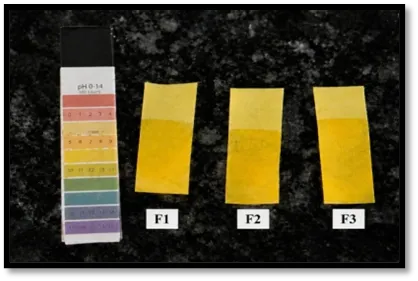
Fig.No.4 pH Determination
Table No. 4 pH Determination
|
Formulation |
pH |
|
F1 |
6.2 |
|
F2 |
6.5 |
|
F3 |
6.8 |
All formulations showed pH within the acceptable skin pH range (5.5–7.0), indicating suitability for topical application without causing irritation.
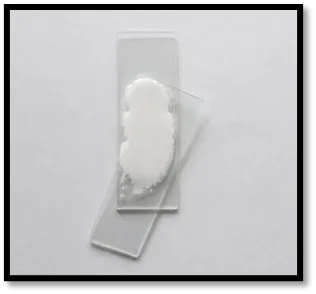
Fig.No. 5 Spreadability
Table no. 5 Spreadability
|
Formulation |
Spreadability (g·cm/sec) |
|
F1 |
18.5 |
|
F2 |
16.8 |
|
F3 |
13.9 |
F1 showed maximum spreadability due to lower viscosity, while F3 showed lower spreadability because of higher lotion thickness. F2 showed balanced spreadability and consistency.
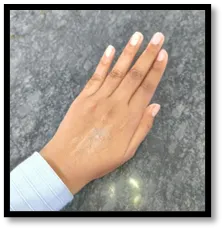
Fig.No. 6 Washability
Table no. 6 Washability
|
Formulation |
Washability |
|
F1 |
Easily washable |
|
F2 |
Easily washable |
|
F3 |
Moderately washable |
F3 required more washing due to higher viscosity and zinc oxide concentration, whereas F1 and F2 were easily removable.
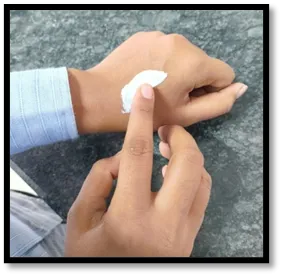
Fig.No. 7 Irritancy Test
Table no. 7 Irritancy Test
|
Formulation |
Irritation |
|
F1 |
No irritation |
|
F2 |
No irritation |
|
F3 |
No irritation |
F1 and F2 were found to be non-irritant, while F3 showed slight dryness because of higher zinc oxide content.
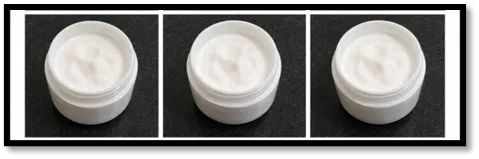
Day 15 Day 20 Day 40
Fig.No.8 Stability Study
Table 8: Stability Study of Formulation F1
|
Parameters |
Initial |
15 Days |
20 Days |
40 Days |
|
Physical Appearance |
Smooth cream |
No change |
No change |
Slight change |
|
Texture |
Smooth and homogeneous |
Smooth |
Smooth |
Slightly thick |
|
Colour |
Light green |
No change |
No change |
Slight fading |
|
Odour |
Characteristic |
No change |
No change |
Slight decrease |
|
pH Value |
6.8 ± 0.02 |
6.8 ± 0.03 |
6.7 ± 0.02 |
6.6 ± 0.03 |
|
Thermal Stability |
Stable |
Stable |
Stable |
Stable |
|
Degradation of Product |
Nil |
Nil |
Nil |
Very slight |
Observation: F1 showed acceptable stability up to 40 days with minor changes in colour and texture
Table 9: Stability Study of Formulation F2
|
Parameters |
Initial |
15 Days |
20 Days |
40 Days |
|
Physical Appearance |
Smooth cream |
No change |
No change |
No change |
|
Texture |
Smooth and homogeneous |
Smooth |
Smooth |
Smooth |
|
Colour |
Light green |
No change |
No change |
No change |
|
Odour |
Characteristic |
No change |
No change |
No change |
|
pH Value |
6.9 ± 0.01 |
6.9 ± 0.02 |
6.8 ± 0.02 |
6.8 ± 0.03 |
|
Thermal Stability |
Stable |
Stable |
Stable |
Stable |
|
Degradation of Product |
Nil |
Nil |
Nil |
Nil |
Observation: F2 remained stable throughout the study period without any noticeable physical or chemical changes.
Table 10: Stability Study of Formulation F3
|
Parameters |
Initial |
15 Days |
20 Days |
40 Days |
|
Physical Appearance |
Smooth cream |
No change |
Slight change |
Moderate change |
|
Texture |
Smooth and homogeneous |
Smooth |
Slightly thick |
Thickened |
|
Colour |
Light green |
No change |
Slight fading |
Moderate fading |
|
Odour |
Characteristic |
No change |
Slight decrease |
Noticeable decrease |
|
pH Value |
7.0 ± 0.02 |
6.9 ± 0.03 |
6.8 ± 0.03 |
6.6 ± 0.04 |
|
Thermal Stability |
Stable |
Stable |
Stable |
Slight instability |
|
Degradation of Product |
Nil |
Nil |
Slight |
Moderate |
Observation: F3 exhibited comparatively greater changes during storage, indicating lower stability than F1 and F2.
Table 11. SPF Determination
|
Formulation |
SPF Value |
|
F1 |
24.1 |
|
F2 |
24.6 |
|
F3 |
24.3 |
SPF value increased with increasing concentration of zinc oxide and Centella asiatica extract. F3 showed the highest SPF value, but F2 provided better balance between SPF and cosmetic acceptability.
CONCLUSION
The present study was successfully carried out to extract the active constituents from Centella asiatica using the maceration method and to formulate a herbal sunscreen lotion using the obtained extract. The plant extract was selected because of its well-known antioxidant, anti-inflammatory, wound healing, and skin-protective properties, which make it a suitable candidate for topical sunscreen preparations. Three different formulations of herbal sunscreen lotion (F1, F2, and F3) were prepared as the Thickning agent, zinc oxide as the physical UV filtering agent, glycerin as the humectant, methyl paraben as the preservative, and distilled water as the vehicle. The concentrations of zinc oxide, and Centella asiatica extract were varied to obtain the best formulation. The study concludes that Centella asiatica extract can be effectively used in the formulation of herbal sunscreen lotion and may serve as a safe, effective, and economical natural alternative to synthetic sunscreen products. This formulation provides protection against harmful ultraviolet radiation while also offering additional skin benefits due to the herbal extract. Further studies such as long-term stability testing, microbial studies, and clinical evaluation on human volunteers may help in the development of this formulation for commercial use.
REFERENCES

Amrapali Pagare, Kirti Gadhari*, Raindra Rathod, Yash Shimpi, Ishwar Chandane, Vaibhavi Pawar, To formulation and Evaluation of Herbal Sunscreen Lotion Containing Centella asiatica Extract., Int. J. of Pharm. Sci., 2026, Vol 4, Issue 6, 16-27. https://doi.org/10.5281/zenodo.20482248
 10.5281/zenodo.20482248