

We use cookies to ensure our website works properly and to personalise your experience. Cookies policy
1.Pharm D Students, Ezhuthachan College of Pharmaceutical Sciences, Marayamuttom Neyyattinkara, Thiruvananthapuram
2Assistant Professor, Department of Pharmacy Practice, Ezhuthachan College of Pharmaceutical Sciences, Marayamuttom Neyyattinkara, Thiruvananthapuram.
3Consultant General & Laparoscopic Surgeon, Nims Medicity Neyyatinkara, Thiruvananthapuram.
4 HOD/Principal, Department of Pharmacy Practice, Ezhuthachan College of Pharmaceutical Sciences, Marayamuttom Neyyattinkara, Thiruvananthapuram
Stevens-Johnson Syndrome (SJS) is a rare and life-threatening skin disorder. It features severe skin cell death and detachment, usually caused by medications. SJS is part of a group of serious skin reactions. It can lead to significant illness and death due to complications like sepsis, fluid loss, and damage to multiple organs. Drug-induced SJS happens as an immune response to certain drugs. The condition usually starts with early symptoms like fever and fatigue. It then progresses quickly to red or purple spots, blistering, and affects mucosal areas like the mouth, eyes, and genitals. A 51-year-old male was admitted to general surgery department with complaints of rashes and skin peel all over the body. He has history of L emphysema, TB on empirical Anti Tubercular Treatment (ATT) under National Tuberculosis Elimination Programme (NTEP), grade 4bedsore, (R) LL BK amputation, recent CVA -left hemiparesis. According to physical examination, symptoms, laboratory investigation the patient was diagnosed with drug induced Stevens Johnsons disease and managed with iv antibiotic, IV steroid, topical agents and other supportive measures. over course of treatment patients clinical condition worsened and shifted to MDICU. Inspite of all resuscitative effort’s patient declared clinically expired.
Definition
Stevens-Johnson Syndrome (SJS) is a rare but deadly severe cutaneous adverse reaction (SCAR) that is marked by extensive epidermal necrosis and skin detachment and involves the mucosa. It belongs to the same disease spectrum as toxic epidermal necrolysis (TEN), which is distinguished from it on the basis of body surface area involvement. That is, less than 10% in case of SJS and more than 30% in case of TEN.[1]
Epidemiology
SJS is an extremely rare disease that occurs in about 1-6 people per year per million populations. However, despite being rare, SJS is associated with very high morbidity and mortality rates due to its complications such as sepsis, fluid imbalance, organ dysfunction, and mucosal damage.[2]
Etiology
The main trigger factors of SJS include medications, namely, sulphonamide antibiotics, antiepileptics, allopurinol, NSAIDs, and antiretrovirals. One of the most famous triggering drugs is trimethoprim-sulfamethoxazole since it can cause delayed hypersensitivity reactions.[3]
Pathophysiology
The disease development process is associated with type IV hypersensitivity reaction in which drug-specific cytotoxic T lymphocytes and natural killer cells cause massive keratinocyte apoptosis via secretion of granulysin, perforin, and granzyme B. [4]
Clinical Presentation
In terms of clinical features, SJS starts with a prodromal stage characterized by fever, malaise, sore throat, and conjunctivitis followed by painful erythematous or purpuric skin rashes, vesicle formation, sloughing of epidermis, and mucosal erosion affecting the oral, ocular, and genital mucosa.[5]
Diagnosis
The diagnosis depends mostly on clinical grounds, where the recent drug use history, specific signs, and symptoms are taken into account; laboratory tests and skin biopsy can assist in making the diagnosis in case of need.[6]
Treatment
Treatment includes withdrawal of the culprit drug and supportive therapy involving proper hydration, electrolyte balance correction, wounds' treatment, nutrition, infection prevention, pain relief, and immunomodulatory treatment if appropriate.[7]
CASE PRESENTATION
History and Clinical examination
A 51-year-old male patient was admitted to the Department of General Surgery with complaints of widespread skin rashes with peeling of skin from all over the body.
The patient had an important past medical history of left emphysema, tuberculosis on empirical ATT through NTEP, grade IV bedsore, right lower limb below-knee amputation, and recently occurred cerebrovascular accident with left hemiparesis. The patient underwent right lower limb below-knee amputation due to diabetic foot ulcers and was given tablet trimethoprim–sulfamethoxazole (Bactrim DS). One week after the commencement of treatment, he developed fever, erythematous macular rash followed by skin peeling and mucocutaneous lesions.
Consultation
Consultation was done to the dermatology department. Patient had a generalized macular rash with purpura and epidermal shedding and involvement of the mucosa with oral erosion. The suspected drug responsible for the skin condition was stopped at once. Measures for the skin management include:
Stopping the suspected drug
Investigations and Diagnosis
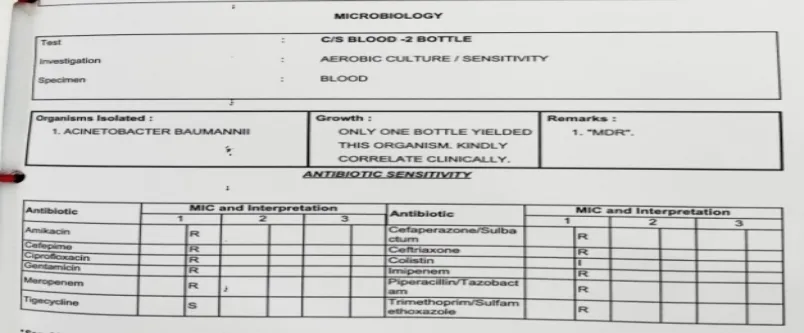
Inpatient workup was done for possible secondary infections. The blood cultures showed the presence of Acinetobacter baumannii that were found to be multidrug-resistant (MDR). Sensitivity tests showed that the organisms had multiple antibiotic resistances such as meropenem, imipenem, ceftriaxone, ciprofloxacin, piperacillin-tazobactam, and trimethoprim-sulfamethoxazole; while sensitivity to tigecycline was noted. The urine cultures also indicated the presence of Candida tropicalis, sensitive to antifungal drugs like caspofungin and fluconazole.
From culture reports, antimicrobial treatment regimen was changed and tigecycline and polymyxin B were given to the patient besides other management strategies. The patient was under the care of infectious diseases and dermatology departments. On follow-up, worsening of the oral ulcers and skin lesions was observed.
Clinical Course
Regardless of the aggressive intervention, the patient’s medical state continued to deteriorate with ongoing fever, inflammatory markers, hyponatremia, and respiratory dysfunction. The patient developed severe tachypnea and desaturation. Consequently, he needed an increased respiratory support and transfer to the MICU.
In MICU, the patient developed sepsis with septic shock due to Acinetobacter baumannii. Further optimization of antibiotic treatment according to sensitivities was done. Despite that, the medical condition of the patient deteriorated with hypotension and bradycardia leading to cardiac arrest. Cardiopulmonary resuscitation was attempted but without success.
The patient was declared clinically expired.
DISCUSSION
Just like in the study by Mockenhaupt et al., in which medicines were recognized as the most common causes of SJS/TEN and the discontinuation of the medication led to better results, the causative treatment was stopped immediately in the current case.[2] Contrary to those patients that responded well to supportive treatment, our patient acquired infection caused by multidrug resistant Acinetobacter baumannii, which worsened his prognosis and led to death.
As stated by Schneck et al., SJS/TEN mortality depends on disease severity, age of the patient, other health problems, and complications such as infections.[3] Similarly, the current patient had several risk factors, such as old age, presence of chronic lung disease, previous cerebrovascular accident, pressure sore and skin lesions with subsequent infection.
In addition, De Risi-Pugliese et al. pointed out that infections caused by bacteria were frequent in SJS/TEN as a result of breakdown of the skin barrier function.[4] In the present case, blood cultures revealed infection with Acinetobacter baumannii that was resistant to many antibiotics and needed to be treated with sensitive drugs including tigecycline and polymyxin.
Thus, the current case reveals the fact that despite early diagnosis, stopping the offending drug, corticosteroid treatment, and supportive care being extremely important, infections and concomitant diseases may largely affect the outcome of SJS.
CONCLUSION
Sulfamethoxazole/trimethoprim-induced Stevens–Johnson syndrome is an uncommon but potentially life-threatening adverse drug reaction that requires immediate recognition and intervention. In the present case, establishing a timely diagnosis based on clinical findings and identifying the offending medication enabled prompt initiation of appropriate management. Early withdrawal of the causative drug, supportive care, meticulous wound management, and multidisciplinary treatment contributed to a favourable clinical outcome.
This case emphasizes the importance of maintaining a high index of suspicion for Stevens–Johnson syndrome in patients presenting with acute mucocutaneous lesions following recent drug exposure. Prompt diagnosis, immediate discontinuation of the suspected medication, and comprehensive supportive management are essential to minimize disease progression, prevent serious complications, and improve patient outcomes. Furthermore, reporting such adverse drug reactions strengthens pharmacovigilance efforts and promotes safer prescribing practices.
REFERENCES


Renjitha M.S., Vibisha Victor, Chintha Chandran, Azeem Mohamed Basheer, Shaiju Dharan, Trimethoprim- Sulfamethoxazole (Bactrim Ds) Induced Stevens Johnson Syndrome: A Case Report, Int. J. of Pharm. Sci., 2026, Vol 4, Issue 7, 5428-5432. https://doi.org/ 10.5281/zenodo.21652705
 10.5281/zenodo.21652705