

We use cookies to ensure our website works properly and to personalise your experience. Cookies policy
School of Pharmacy, Abhilashi University, Chail Chowk, Mandi, Himachal Pradesh, India-175028.
Herbal medicine has gained significant attention in recent decades due to its therapeutic efficacy, minimal side effects, and natural origin. The present study aims to investigate the phytochemical profile and solubility behavior of a polyherbal extract composed of four widely used medicinal plants: Rosmarinus officinalis (rosemary), Allium sativum (garlic), Cinnamomum verum (cinnamon), and Camellia sinensis (green tea). These plants are known individually for their antioxidant, antimicrobial, anti-inflammatory, and metabolic regulatory effects, attributed to their rich phytochemical constituents such as flavonoids, terpenoids, alkaloids, and tannins. The polyherbal extract was prepared through soxhlet extration and subjected to preliminary phytochemical screening to determine the presence of major bioactive groups. Additionally, solubility studies were conducted in various solvents including water, ethanol, methanol, and acetone to evaluate the extract’s polarity behavior and potential application in pharmaceutical formulations. The findings revealed significant presence of flavonoids, tannins, terpenoids, and carbohydrates, with moderate solubility in ethanol and methanol. This study supports the synergistic potential of combining multiple plant species and provides a scientific basis for developing polyherbal formulations with enhanced therapeutic effects and better solubility characteristics for pharmaceutical use.
Throughout history, medicinal plants have played a significant role in traditional medical systems such as Ayurveda, Traditional Chinese Medicine, and Unani. The pharmacological potential of plant-based formulations is being investigated more and more in light of the renewed interest in natural therapies and phytotherapy (1, 2). Herbal remedies provide a diversified approach by working on multiple biochemical targets at once, in contrast to synthetic pharmaceuticals that frequently target a single pathway. Medicinal plants include a complex variety of phytochemicals that are mostly responsible for this broad-spectrum activity (3, 4, 5). Traditional treatment systems have placed a strong emphasis on using polyherbal formulations, which are mixes of two or more medicinal plants, to increase therapeutic efficacy through synergistic effects (6, 7). It is thought that combining several herbs will maximize the intended pharmacological impact and reduce any potential negative effects. To comprehend their behavior, bioavailability, and their uses in pharmaceutical and nutraceutical products, systematic phytochemical and solubility research are necessary, as there is currently little scientific confirmation of such combinations (8, 9, 10). Four widely used medicinal plants were employed in this investigation to create a polyherbal extract: green tea (Camellia sinensis), garlic (Allium sativum), cinnamon (Cinnamomum verum), and rosemary (Rosmarinus officinalis). The health-promoting qualities of each of these herbs have been thoroughly investigated, and they all contain a variety of bioactive substances. Finding the main bioactive groups, including flavonoids, tannins, alkaloids, terpenoids, glycosides, and saponins, is the main goal of this study's phytochemical screening of the polyherbal extract. The extract's capacity to dissolve will also be assessed using solubility testing in polar and semi-polar solvents. In addition to confirming the polyherbal combination's potential for therapeutic benefit, the study's findings will offer a scientific foundation for its development into gels, capsules, syrups, or topical medications.
MATERIAL AND METHODS
Collection Of Plant Material
The plant was collected from local fields of mandi, Himachal Pradesh. The plant was washed and dried under shade and make powder.
Extraction
This powder of various herb was then extracted by using a soxhlet extraction method and ethanol is used as solvent. 100gm of powder was extracted with 700 ml of ethanol for 6hr. The ethanolic extract of these various herbs was concentrated with distillation method and evaporate excessive solvent.
Phytochemical analysis
Phytochemical analysis is perform to identify different phytochemical present in the polyherbal extract by using different tests (11).
a. Mayer’s test
Take few ml of polyherbal sample extract, two drops of Mayer’s reagent are added along the sides of test tube. Appearance of white creamy precipitate indicates the presence of alkaloids (12).
b. Wagner’s test
A few drops of Wagner’s reagent are added to few ml of polyherbal extract along the sides of test tube. A reddish- Brown precipitate confirms the test as positive (13).
5.5.2 Test for Carbohydrates
A. Molish’s test
To 2 ml of polyherbal sample extract, two drops of alcoholic solution of α- naphthol are added. The mixture is shaken well and few drops of concentrated sulphuric acid is added slowly along the sides of test tube. A violet ring indicates the presence of carbohydrates.
b. Benedict’s test
To 0.5 ml of filtrate, 0.5 ml of Benedict’s reagent is added. The mixture is heated on a boiling water bath for 2 minutes. A characteristic coloured precipitate indicates the presence of sugar.
5.5.3 Test for Fixed oils and Fats
a. Spot test
A small quantity of extract is pressed between two filter papers. Oil stain on the paper indicates the presence of fixed oils.
b. Saponification test
A few drops of 0.5 N alcoholic potassium hydroxide solution is added to a small quantity of extract along with a drop of phenolphthalein. The mixture is heated on a water bath for 2 hours. Formation of soap or partial neutralization of alkali indicates the presence of fixed oils and fats (14).
5.5.4 Test for Glycosides
For 50 mg of extract is hydrolysed with concentrated hydrochloric acid for 2 hours on a water bath, filtered and the hydrolysate is subjected to the following tests.
a. Borntrager’s test
To 2 ml of filtered hydrolysate, 3 ml of choloroform is added and shaken, choloroform layer is separated and 10% ammomia solution is added to it. Pink colour indicates presence of glycosides (11).
b. Legal’s test
50 mg of extract is dissolved in pyridine, sodium nitroprusside solution is added and made alkaline using 10% NaOH. Presence of glycoside is indicated by pink colour.
5.5.5 Test for Phenolic compounds and Tannins
a. Ferric Chloride test
The extract (50 mg) is dissolved in 5 ml of distilled water. To this few drops of neutral 5% ferric chloride solution are added. A dark green colour indicates the presence of phenolic compound (15).
b. Gelatin test
The extract (50 mg) is dissolved in 5 ml of distilled water and 2 ml of 1% solution of Gelatin containing 10% NaCl is added to it. White precipitate indicates the presence of phenolic compounds (11).
c. Lead acetate test
The extract (50 mg) is dissolved in of distilled water and to this 3 ml of 10% lead acetate solution is added. A bulky white precipitate indicates the presence of phenolic compounds.
d. Alkaline reagent test
An aqueous solution of the extract is treated with 10% ammonium hydroxide solution. Yellow fluorescence indicates the presence of flavonoids.
e. Magnesium and Hydrochloric acid reduction
The extract (50 mg) is dissolved in 5 ml of alcohol and few fragments of magnesium ribbon and concentrated hydrochloric acid (drop wise) are added. If any pink to crimson colour develops, presence of flavonol glucosides is inferred (16).
5.5.6 Test for Proteins
The extract (100 mg) is dissolved in 10 ml of distilled water and filtered through Whatmann No. 1 filter paper and the filtrate is subjected to test for proteins.
a. Millon’s test
To 2 ml of filtrate few drops of Millon?s reagent are added. A white precipitate indicates the presence of proteins (17).
b. Biuret test
2 ml of filtrate is treated with 1 drop of 2% copper sulphate solution. To this 1 ml of ethanol (95%) is added, followed by excess of potassium hydroxide pellets. Pink colour ethanolic layer indicates the presence of protein (18).
5.5.7 Test for Saponins
The extract (50 mg) is diluted with distilled water and made up to 20 ml. The suspension is shaken in a graduated cylinder for 15 minutes. A two cm layer of foam indicates the presence of saponins (11).
Solubility of Plants Extract
Garlic Solubility
? Preparation of Standard Stock Solution:
? Determination of λmax:
? Calibration Curve Preparation:
Y = 0.2705x + 0.0463 (R2 = 0.9998)
? Solubility Testing in Different Solvents:
? Quantification of Solubility:
Cinnamon Solubility
? Preparation of Standard Stock Solution:
? Determination of λmax:
? Calibration Curve Preparation:
Y = 0.1988x + 0.0176 (R2 = 0.9997)
? Solubility Testing in Different Solvents:
? Quantification of Solubility:
Solubility was expressed as concentration (µg/mL) of extract soluble in each solvent.
Green tea Solubility
? Preparation of Standard Stock Solution:
? Determination of λmax:
? Calibration Curve Preparation:
Y = 0.2203x + 0.02 (R2 = 0.9997)
? Solubility Testing in Different Solvents:
? Quantification of Solubility:
Solubility was expressed as concentration (µg/mL) of extract soluble in each solvent.
Rosemary Solubility
? Preparation of Standard Stock Solution:
? Determination of λmax:
? Calibration Curve Preparation:
Y = 0.2564x + 0.0462 (R2 = 0.9988)
? Solubility Testing in Different Solvents:
? Quantification of Solubility:
Solubility was expressed as concentration (µg/mL) of extract soluble in each solvent.
RESULT
Table 1. Preliminary phytochemical analysis of Polyherbal extract
|
Phytoconstituents |
Presence |
Approximate Range |
||
|
Terpenoids |
Present |
Moderate |
||
|
Tannins |
Present |
Moderate to High (8–15%) |
||
|
Glycosides |
Present |
|
||
|
Flavonoids |
High |
15–25% |
||
|
Alkaloids |
Trace to low |
~2–4% |
||
|
Proteins |
Present |
~8–12% |
||
|
Carbohydrates |
Present |
~20–30% |
||
|
Saponins |
Mild |
Low to Moderate (2–5%) |
||
|
Fats and fixed oil |
Present |
~1–3% |
Garlic Solubility
The solubility of garlic (Allium sativum) extract was assessed using UV-Visible spectrophotometry at a wavelength of 266 nm. The method was validated by constructing a calibration curve using standard concentrations of the extract (2–10 µg/mL), which showed excellent linearity with the equation:
Table 2. Absorbance, Concentration values of the different concentrations of Garlic.
|
Concentration |
Absorption |
|
2 |
0.6 |
|
4 |
1.11 |
|
6 |
1.67 |
|
8 |
2.211 |
|
10 |
2.754 |
Y = 0.2705x + 0.0463 (R2 = 0.9998)
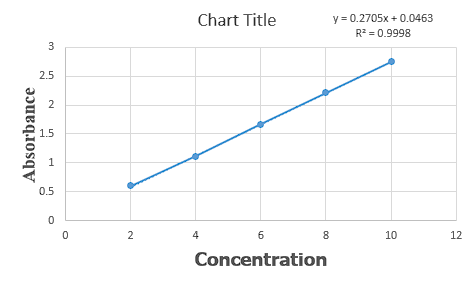
The high R² value confirms the accuracy and reliability of the method for quantifying garlic extract concentration. Among the various solvents tested, the extract showed the highest solubility in [water], with an absorbance value of [2.754], corresponding to a concentration of [10 µg/mL]. This indicates that [water] is the most suitable solvent for dissolving garlic extract and can be used for further formulation or analytical work.
Cinnamon Solubility
The solubility of cinnamon extract was assessed using UV-Visible spectrophotometry at a wavelength of 282 nm. The method was validated by constructing a calibration curve using standard concentrations of the extract (2–10 µg/mL), which showed excellent linearity with the equation:
Table 3. Absorbance, Concentration values of the different concentrations of Cinnamon.
|
Concentration |
Absorption |
|
2 |
0.425 |
|
4 |
0.826 |
|
6 |
1.22 |
|
8 |
1.6 |
|
10 |
2.0 |
Y = 0.1988x + 0.0176 (R2 = 0.9997)
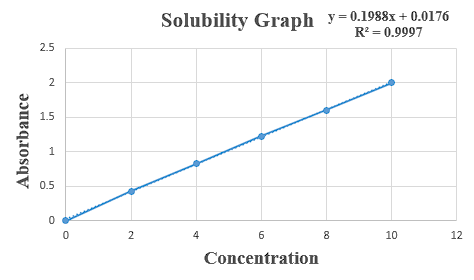
The high R² value confirms the accuracy and reliability of the method for quantifying cinnamon extract concentration. Among the various solvents tested, the extract showed the highest solubility in [ethanol], with an absorbance value of [2.0], corresponding to a concentration of [10 µg/mL]. This indicates that [ethanol] is the most suitable solvent for dissolving cinnamon extract and can be used for further formulation or analytical work.
Green Tea Solubility
The solubility of green tea extract was assessed using UV-Visible spectrophotometry at a wavelength of 274 nm. The method was validated by constructing a calibration curve using standard concentrations of the extract (2–10 µg/mL), which showed excellent linearity with the equation:
Table 4. Absorbance, Concentration values of the different concentrations of green tea.
|
Concentration |
Absorption |
|
2 |
0.465 |
|
4 |
0.924 |
|
6 |
1.35 |
|
8 |
1.78 |
|
10 |
2.21 |
Y = 0.2203x + 0.02 (R2 = 0.9997)
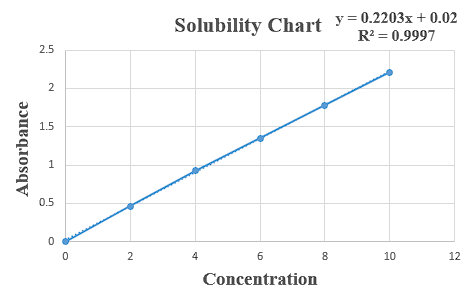
The high R² value confirms the accuracy and reliability of the method for quantifying green tea extract concentration. Among the various solvents tested, the extract showed the highest solubility in [ethanol], with an absorbance value of [2.21], corresponding to a concentration of [10 µg/mL]. This indicates that [ethanol] is the most suitable solvent for dissolving green tea extract and can be used for further formulation or analytical work.
Rosemary Solubility
The solubility of rosemary extract was assessed using UV-Visible spectrophotometry at a wavelength of 272 nm. The method was validated by constructing a calibration curve using standard concentrations of the extract (2–10 µg/mL), which showed excellent linearity with the equation:
Table 5. Absorbance, Concentration values of the different concentrations of rosemary.
|
Concentration |
Absorption |
|
2 |
0.594 |
|
4 |
1.104 |
|
6 |
1.574 |
|
8 |
2.114 |
|
10 |
2.584 |
Y = 0.2564x + 0.0462 (R2 = 0.9988)
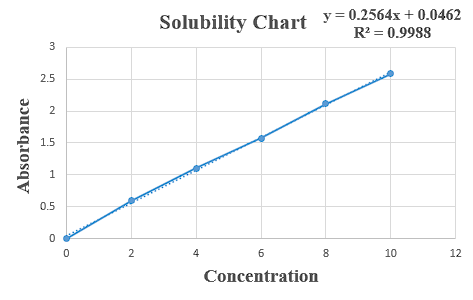
The high R² value confirms the accuracy and reliability of the method for quantifying rosemary extract concentration. Among the various solvents tested, the extract showed the highest solubility in [ethanol], with an absorbance value of [2.584], corresponding to a concentration of [10 µg/mL]. This indicates that [ethanol] is the most suitable solvent for dissolving rosemary extract and can be used for further formulation or analytical work.
CONCLUSION
The present study successfully demonstrated the phytochemical richness and solubility characteristics of a polyherbal extract composed of rosemary (Rosmarinus officinalis), garlic (Allium sativum), cinnamon (Cinnamomum verum), and green tea (Camellia sinensis). Preliminary phytochemical screening confirmed the presence of key bioactive constituents such as flavonoids, terpenoids, tannins, glycosides, alkaloids, and saponins—indicating the potential of the formulation for antioxidant, anti-inflammatory, and metabolic health benefits. Solubility studies revealed that the extract shows moderate to high solubility in ethanol, which suggests these solvents could be optimal for extraction and formulation development. The synergy of these four medicinal plants in a single polyherbal blend not only enhances therapeutic potential but also supports the traditional concept of polyherbalism in a scientific manner. These findings offer a foundational basis for the development of novel herbal dosage forms such as gels, capsules, or syrups, and pave the way for future studies involving pharmacological validation and clinical application. Further investigation into the standardization, stability, and bioavailability of this polyherbal extract is recommended to ensure its efficacy and safety in therapeutic use.
REFERENCES

Deeksha Sharma*, Dr. Dev Prakash Dahiya, Dr. Chinu Kumari, Dr. Nishant Sharma, Phytochemical and Solubility Studies of a Polyherbal Extract from Four Medicinal Plants: Rosemary, Garlic, Cinnamon, and Green Tea, Int. J. of Pharm. Sci., 2025, Vol 3, Issue 10, 853-862 https://doi.org/10.5281/zenodo.17309934
 10.5281/zenodo.17309934