

We use cookies to ensure our website works properly and to personalise your experience. Cookies policy
13rd PG Scholar, Department of P.G Studies in Rasashastra and Bhaishajya Kalpana, Karnataka Ayurveda Medical College and Hospital, Mangalore.
2HOD and Professor, Department of P.G Studies in Rasashastra and Bhaishajya Kalpana, Karnataka Ayurveda Medical College and Hospital, Mangalore.
3Professor, Department of P.G Studies in Rasashastra and Bhaishajya Kalpana, Muniyal Institute of Ayurveda Medical Sciences, Manipal.
4Consultant, Ksharapani Ayurvedic Care, Udupi.
53rd PG Scholar, Department of P.G Studies in Rasashastra and Bhaishajya Kalpana, Karnataka Ayurveda Medical College and Hospital, Mangalore.
63rd PG Scholar, Department of P.G Studies in Rasashastra and Bhaishajya Kalpana, Karnataka Ayurveda Medical College and Hospital, Mangalore.
Dushtavrana is a most challenging case faced by the medical practitioners in their day-to-day practice. It has many complications and might end up in amputation. Acharya Sushruta has explained in detail about Dushtavrana in Ayurveda and has said Shashtirupakrama in its management. Dushtavrana can be correlated to Non-Healing Diabetic foot ulcers. Diabetic foot ulceration is a devasting complication of diabetes that is associated with infection, amputation and death. Diabetic foot ulcer is defined as a set of symptoms secondary to current or previous diabetes, including skin chapping, ulceration, infection or destruction of foot tissue [1]. Even after the wound healing there is a high chance of recurrence and amputation. Thus, this shows the need of improvement in treatment methods of Diabetic Foot ulcers. This is a case report of male patient aged 73 years, came to OPD presenting with the complaints of non-healing ulcer with pain, pus discharge and foul smell in the plantar aspect of left foot since 3 years. Patient was administered with Vrana shodhana, Vrana prakshalana with Go Arka and Panchavalkala Kashaya, kshara karma, Jathyadi taila dressing externallay and internally Laghu Malini Vasanta Rasa, Gandhaka Rasayana, Paripatadi Kashaya, Mahamanjishtadi Khada and abhayarishta was given. Thus, by the above said treatment, the case of dushtavrana was successfully treated. Thus, this study aims to study the effect of Vrana shodhana, Vrana prakshalana and kshara karma along with shamanoushadhis in dushtavrana.
Acharya Sushruta has explained the concept of Vrana [2] in detail and has dedicated many chapters which explains the types and different treatment methods of Vrana. According to him, Vrana is defined as “vrana gaatra vichurnane, vrana iti vranaha” [3] which means the condition where in the tissue undergoes destruction.
Vranaropana is the natural process of wound healing but if the vrana is infected and takes long time to heal or if it doesn’t heal, it leads to Dushtavrana. It is of six types. Dushtavrana is characterized by the symptoms like Ativedana (painful), Atigandha (foul smelling), Puyasraava (pus discharging), Deergha kaalunubandha (chronic), Daaha (burning sensation), Paaka (suppuration), Raaga (reddish discoloration), Kandu (itching), Shopa (swelling) etc [4]. All these symptoms can be observed in Non-Healing Diabetic foot ulcers.
Acharya Sushruta has said Shashtirupakrama [5] in the management of Vrana which not only promote healing but also prevent the recurrence of vrana, showcasing the timeless relevance of his surgical principles.
Approximately, 18.6 million people with diabetes develop a foot ulcer each year worldwide. Approximately, up to 34% of the people with type 1 or 2 diabetes develop a foot ulcer during their lifetime. About 20% of the people with a diabetic foot ulcer will undergo a lower extremity amputation, either minor or major. Infection and progressive gangrene are the primary causes of lower extremity amputation, with approximately 50% of diabetic foot ulcers becoming infected. Approximately, up to 20% of the people with a diabetic foot ulcer require hospitalization and between 15% to 20% of hospitalized patients undergo a lower extremity amputation [6].
Diabetic foot ulcer is defined as a break of the epidermis and at least a part of dermis in a person with diabetes. More superficial or closed lesions that do not penetrate to dermis (e.g., callous, blisters or erythema) are characterized as preulcerative but are at the high risk of progression to ulcer. Repetitive minor trauma causes ulcer formation in most cases, typically as a result of elevated pressure at plantar weight bearing sites, friction and shearing due to poorly fitting shoes or gait abnormalities, or an unrecognized injury sustained on an insensate foot. Structural deformities, such as Charcot neuroarthropathy, confer additional risk to DFU. Following a minor traumatic event, complex and multifactorial pathways ultimately lead to ulceration [7].
In modern science, Surgical debridement, reduction of weight bearing pressure on the affected area, treating lower extremity ischemia and foot infection and early referral for multidisciplinary care are the first- line therapies for diabetic foot ulcers [8].
Dushtavrana can be treated successfully with the Ayurvedic treatment modalities.
CASE STUDY
In the present case, a 73-year-old male patient came to OPD presented with the complaints of non-healing ulcer with pain, pus discharge and foul smell in the plantar aspect of left foot since 3 years.
HISTORY OF PRESENT ILLNESS
Patient was apparently normal before 3 years. Gradually he developed a painful swelling in the plantar aspect of the left foot after he accidentally fell and got hurt. Later patient noticed foul smelling pus discharge from the wound. He consulted a local hospital and wound dressing was done and was also given with some oral medications. He was relieved from the symptoms temporarily. But later he again developed with pain and foul-smelling pus discharge from the wound. So, for the further management of the condition, he visited our OPD.
PAST HISTORY
K/c/o Hypertension, Diabetes since 30 years and on regular medication.
K/c/o DVT
PERSONAL HISTORY
On Examination
Systemic examination
PERSONAL HISTORY
Ashtasthana/Ashtavidha pareeksha
Dashavidha pareeksha
VRANA PAREEKSHA
LOCAL EXAMINATION OF WOUND
ON INSPECTION
ON PALPATION
TABLE 1: SHOWING EXAMINATION OF VASCULARITY
|
ARTERY |
RIGHT LOWER LIMB |
LEFT LOWER LIMB |
|
Dorsalis pedis artery |
Normal |
Normal |
|
Anterior tibial artery |
Normal |
Normal |
|
Posterior tibial artery |
Normal |
Normal |
|
Popliteal artery |
Normal |
Normal |
|
Femoral artery |
Normal |
Normal |
MATERIALS AND METHODS
Table 2: Showing ABHYANTARA CHIKITSA.
|
SL. NO. |
MEDICINE |
SEVANA KAALA |
DOSAGE |
ANUPANA |
FREQUENCY |
|
1. |
Laghu Malini Vasanta Rasa |
After Food |
2 Tablets |
Sukhoshna Jala |
Morning and Night |
|
2. |
Gandhaka Rasayana |
After Food |
2 Tablets |
Sukhoshna Jala |
Morning and Night |
|
3. |
Paripatadi Kashaya |
Before Food |
2 tsp |
Sukhoshna Jala |
Morning and Night |
BAHYA CHIKITSA.
PATHYA -APATHYA
AFTER TREATMENT
Table 3 Showing follow-up and outcome
|
VISIT |
MEDICINE |
OUTCOME |
CONTINUATION OR DISCONTINUATION OF MEDICINE |
|
01/01/2025-First Visit |
|
- |
Continue all medicines for 15 days. |
|
15/01/2025 |
|
Pain, swelling and pus discharge was significantly reduced. |
Continue all the above medicines. Added Mahamanjishtadi Khada |
|
10/02/2025 |
|
Patient had constipation. Features of healthy scar like jihvathalabha (red coloured wound floor) was achieved. |
Paripatadi Kashaya and Mahamanjishtadi Khada was discontinued. Abhayarishta was added and was continued for 1 week. Rest of the medicines were continued for 1 month. External application was continued till the wound was healed. |
COMPOSITIONS OF PRESCRIBED FORMULATION MEDICINES
Table 4: Showing ingredients of Laghumalini Vasanta rasa
|
INGREDIENTS |
QUANTITY |
|
Rasaka Bhasma |
2 parts |
|
Maricha |
1 part |
|
Navaneeta |
50% of the ingredients |
|
Nimbu swarasa |
Quantity Sufficient |
Table 5: Showing ingredients of Gandhaka Rasayana
|
INGREDIENTS |
QUANTITY |
|
Gandhaka |
1 part |
|
Godugdha |
Quantity Sufficient |
|
Ela |
Quantity Sufficient |
|
Twak |
Quantity Sufficient |
|
Patra |
Quantity Sufficient |
|
Nagakeshara |
Quantity Sufficient |
|
Guduchi |
Quantity Sufficient |
|
Haritaki |
Quantity Sufficient |
|
Vibhitaki |
Quantity Sufficient |
|
Amalaki |
Quantity Sufficient |
|
Shunti |
Quantity Sufficient |
|
Bringaraja |
Quantity Sufficient |
|
Ardraka |
Quantity Sufficient |
|
Sita |
Quantity Sufficient |
Table 6: Showing ingredients of Paripatadi Kashaya
|
INGREDIENTS |
QUANTITY |
|
Paripatha |
260mg |
|
Nimba |
50mg |
|
Parpata |
100mg |
|
Patala |
50mg |
|
Patola |
100mg |
|
Sweta Chandana |
50mg |
|
Rakta Chandana |
50mg |
|
Vasa |
100mg |
|
Dhanvayasa |
50mg |
|
Amalaki |
50mg |
|
Hribera |
50mg |
|
Katuka |
50mg |
|
Musta |
100mg |
|
Aragwadha |
100mg |
|
Guduchi |
50mg |
|
Yasti |
100mg |
|
Kiratatikta |
100mg |
|
Shatapatrika |
50mg |
|
Ushira |
25mg |
|
Haridra |
25mg |
|
Draksha |
50mg |
|
Dhataki |
100mg |
|
Guda |
4470mg |
Table 7: Showing ingredients of Mahamanjishtadi Khada
|
INGREDIENTS |
QUANTITY |
|
Manjishta |
1 Part |
|
Musta |
1 Part |
|
Kutaja |
1 Part |
|
Guduchi |
1 Part |
|
Kushta |
1 Part |
|
Nagara |
1 Part |
|
Bharangi |
1 Part |
|
Kshudra |
1 Part |
|
Vacha |
1 Part |
|
Nimba |
1 Part |
|
Haridra |
1 Part |
|
Daruharidra |
1 Part |
|
Haritaki |
1 Part |
|
Vibhitaki |
1 Part |
|
Amalaki |
1 Part |
|
Patola |
1 Part |
|
Katuki |
1 Part |
|
Murva |
1 Part |
|
Vidanga |
1 Part |
|
Asana |
1 Part |
|
Chitraka |
1 Part |
|
Shatavari |
1 Part |
|
Trayamana |
1 Part |
|
Krishna |
1 Part |
|
Indrayava |
1 Part |
|
Vasa |
1 Part |
|
Bringaraja |
1 Part |
|
Mahadaru |
1 Part |
|
Patha |
1 Part |
|
Khadira |
1 Part |
|
Chandana |
1 Part |
|
Trivrit |
1 Part |
|
Varuna |
1 Part |
|
Kiratatikta |
1 Part |
|
Bakuchi |
1 Part |
|
Krtamalaka |
1 Part |
|
Shakotaka |
1 Part |
|
Mahanimba |
1 Part |
|
Karanja |
1 Part |
|
Ativisha |
1 Part |
|
Jala |
8 parts |
|
Indravaruni |
1 Part |
|
Ananta |
1 Part |
|
Sariva |
1 Part |
|
Parpata |
1 Part |
Table 8: Showing ingredients of Abhayarishta
|
INGREDIENTS |
QUANTITY |
|
Abhaya |
4.8kg |
|
Mridwika |
2.4kg |
|
Vidanga |
480g |
|
Madhuka Kusuma |
480g |
|
Jala |
49.152lt |
|
Guda |
4.8kg |
|
Gokshura |
96g |
|
Trivrit |
96g |
|
Dhanyaka |
96g |
|
Dhataki |
96g |
|
Indravaruni |
96g |
|
Chavya |
96g |
|
Mishreya |
96g |
|
Shunti |
96g |
|
Dhanti |
96g |
|
Mocharasa |
96g |
Table 9: Showing ingredients of Panchavalkala Kashaya
|
INGREDIENTS |
QUANTITY |
|
Ashwatha |
1 part |
|
Udumbara |
1 part |
|
Plaksha |
1 part |
|
Vata |
1 part |
|
Parisha |
1 part |
|
Jala |
5x16 parts |
Table 10: Showing ingredients of Jatyadi taila
|
INGREDIENTS |
QUANTITY |
|
Jati |
|
|
Nimba |
|
|
Patola |
|
|
Naktamala |
|
|
Siktaka |
|
|
Madhuka |
|
|
Kushta |
|
|
Haridra |
|
|
Daruharidra |
1 part |
|
Katukarohini |
|
|
Manjishta |
|
|
Padmaka |
|
|
Lodhra |
|
|
Abhaya |
|
|
Neelotpala |
|
|
Tuttha |
|
|
Sariva |
|
|
Tila taila |
4 parts |
|
Jala |
16 parts |
RESULT
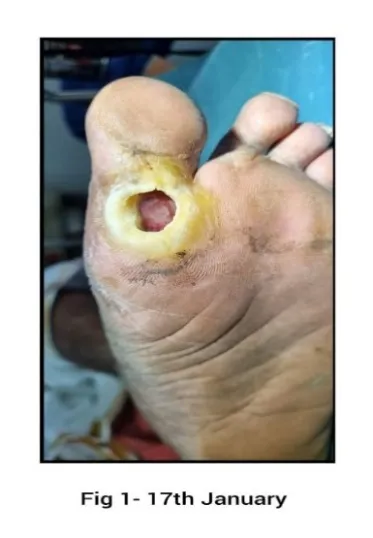
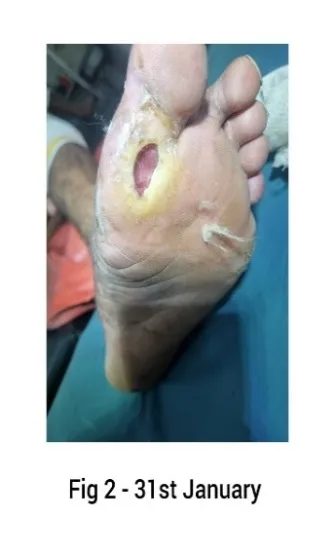
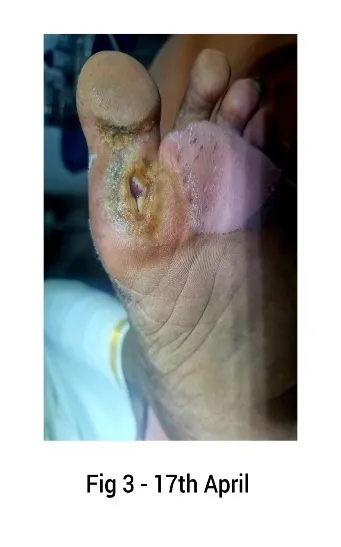
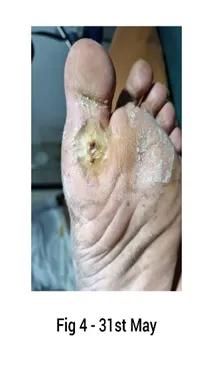
Wound was completely healed with the step wise management of the case. In the first visit, patient was having non-healing ulcer with pain, foul smelling pus discharge in the plantar aspect of left foot. After the treatment, Pain, swelling and pus discharge was significantly reduced, along with that there was almost complete absence of necrotic tissue, exudate and slough by 17th day. By 31st day of the regular treatment, features of Shuddha vrana like jihvathalabha (red coloured wound floor) was achieved. Wound healing was started and wound size was reduced. Wound was almost healed within 5 months.
DISCUSSION
In this modern period, because of mithya ahara and vihara, most of the people are prone to develop with prameha. In case of chronic uncontrolled diabetes, it may end up in the complication like non healing diabetic ulcer which is difficult to cure and might end up in amputation in highly infected condition. So, it is very important to treat this condition with the combination of shamanoushadhis and bahyaparimarjana chikithsa.
The main aim of this study was to evaluate the efficacy of bahya chikithsa like Vrana shodhana, Vrana prakshalana with Go Arka and Panchavalkala Kashaya, kshara karma, Jathyadi taila dressing and shamanoushadhis like Laghu Malini Vasanta Rasa, Gandhaka Rasayana, Paripatadi Kashaya, Mahamanjishtadi Khada and abhayarishta in Dushtavrana.
MODE OF ACTION OF LAGHUMALINI VASANTA RASA9
RASAKA- It possesses Kashaya and katu rasa, sheeta guna. It is kaphapitta rogahara. It is indicated in prameha. It has “shleshma kala sankochaka” property which prevents the excessive secretions from the wound and heal them.
MARICHA- It has katu rasa, ushna veerya, laghu and Tikshna guna, katu vipaka. It is kaphavatahara, Deepana, pramathi.
NAVANEETA- It has Madhura rasa and vipaka, sheeta guna and veerya. It is agnideepaka, vatapittahara,.
NIMBU- It has amla and katu rasa, laghu and theekshna guna, ushna virya, amla vipaka. It has vatakaphahara, Deepana, pachana properties. It also has anti-inflammatory property.
Laghumalini vasanta rasa has tikta katu rasa, snigdha guna, sheetha virya and Madhura vipaka. Rasaka mainly acts on rasa and raktha dhatvagni and in turn improves the immunity. Maricha has pramathi guna through which it travels to Sukshma srotas, relieves the srotorodha and does preenana of the srotas. If there is srotorodha due to rukshata of srotas, Navaneeta does the snehana of ruksha srotas and relieves srotorodha. It also reduces the rukshata of rasaka and maricha.
MODE OF ACTION OF GANDHAKA RASAYANA10
GANDHAKA – Shuddha Gandhaka has rasayana properties. It possesses Madhura rasa, katu vipaka and ushna virya. It is agnideepaka, pachaka and vishagna. It acts as kaphahara and kledagna as it has ushna virya and katu vipaka.
GODUGDHA- It is having Madhura rasa, sheeta virya, Madhura vipaka, mridu, snigdha, bahala, slakshna, picchila,guru, manda, Prasanna guna. It is also vatapittahara, ojovardhaka, jeevaniya and rasayana.
TWAK- It has katu, tikta, Madhura rasa, laghu, ruksha, Tikshna guna, ushna virya, katu vipaka. It has vatapittahara, balya, varnya, kandughna and krimighna.
ELA- It has katu, Madhura rasa, laghu ruksha guna, sheeta virya, katu vipaka. It acts as kaphavatahara, dipana.
PATRA- It has Madhura katu rasa, ushna virya, Tikshna laghu picchila guna, and katu vipaka. It is kaphavatahara. It is indicated in prameha.
NAGAKESHARA- It has Kashaya tikta rasa, laghu ruksha Tikshna guna, ushna virya and katu vipaka. It is kaphapittahara, pramathi, pachaka, vishahara, shothahara, kandugna and kushtagna.
GUDUCHI- It has tikta Kashaya rasa, guru snigdha guna, ushna virya and Madhura vipaka. It is tridoshahara, rasayana, dipaniya, kandugna and does dahaprashamana. It has its action on prameha, kushta, krimi etc.
HARITHAKI- It has Kashaya pradhana lavana varjitha pancharasa, laghu ruksha guna, ushna virya, Madhura vipaka. It is tridoshahara, anulomaka, rasayana, lekhana, shothahara. It has its action on prameha, kushta, vrana, krimi etc.
VIBHITAKI- It is having Kashaya rasa, laghu ruksha guna, ushna virya, Madhura vipaka. It is kaphapittahara.
AMALAKI- It is amla pradhana lavana varjitha pancharasa, sheeta virya, Madhura vipaka. It is tridoshahara, rasayana and has action on prameha, kushta, shula etc.
BRINGARAJA- It has katu tikta rasa, laghu ruksha guna, ushna virya, katu vipaka. It is kaphavatahara, rasayana, krimigna, kushtagna and shothagna.
ARDRAKA- It has Katu rasa, guru, ruksha, tikshna guna, ushna virya, Madhura vipaka. It has vatakaphahara, dipana, bhedana, shulaprashamana, vranahara, kushtagna and shophahara properties.
SITA- It is Madhura rasa, ruchya, vatapittahara, dahagna, kushtahara, vranahara.
Gandhaka rasayana is pittapradhana tridoshahara and rakthaprasadaka. Gandhaka shodhana is done with godugdha and gritha which reduces the ushnata of gandhaka. And gritha removes the toxicity of gandhaka by its vishgna property. Sita neutralizes the ruksha guna of the formulation. Sugandha dravyas like chaturjataka has ability to reach Sukshma srotas and clears srothorodha. Here most of the drugs have laghu ruksha guna and ushna virya which acts as kledashoshaka and dhatwagnipradeepaka.
MODE OF ACTION OF PARIPATADI KASHAYA11
Most of the drugs in this Kashaya are Katu, tikta and Kashaya rasa pradhana, laghu ruksha guna, sheeta virya and katu vipaka.
Drugs like patola, kiratatikta, katuka, Chandana, yasti, ushira has dahaprashamana property. Aragwadha, yashti, Chandana, katuka, kiratatikta, haridra, musta, nimba, patola, guduchi and amalaka has kandugna, krimigna and kushtagna properties. Drugs like nimba, yasti, kiratatikta, haridra are vranaropaka.
Chandana, ushira, yashti, patola are varnya and help in restoring the skin tone and texture. Patala, kiratatikta, yasti has shothahara property. Mushta, haridra and katuka has lekhana karma which scraps out the dead tissue present in the wound. Haridra, vasa, nimba, katuka, Chandana, gududchi, aragwadha, amalaki are indicated in prameha.
Most of the drugs in this formulation has dipana, pachana, kaphapittahara and rakthashodhaka properties and helps in healing of the wound.
Extract of Shunti, Gingerol activates vascularization, myofibroblasts and fibrin deposition in such a manner to synthesize new tissues and help in the scar formation. It is having anti-inflammatory action and promotes new tissue formation via vascularization process during the wound healing12.
MODE OF ACTION OF MAHAMANJISHTADI KADHA13
Manjishta which is the main ingredient of this formulation has Madhura tikta rasa, guru ruksha guna, ushna virya and katu vipaka. It has varnya, kapha pittashamaka, pramehahara, raktashodhaka, vishagna properties.
Manjishta, kutaja, kantakari, nimba, daruharidra, asana, Khadira, sariva, parpata etc has rakthashodhaka property. Chandana, manjishta, haridra etc has varnya property which helps to improve the skin tone and texture. Sariva and asana are dahashamaka. Aragwadha, ativisha, bakuchi, karanja, mahanimba, trivrit, Khadira, devadaru, vidanga and nimbatwak acts as krimigna and kushtagna.
Most of the drugs in this Kashaya are tikta rasa pradhana, laghu ruksha guna, ushna virya and katu vipaka. And has varnya, kaphapittashamaka, shothagna, kushtagna, vranaropaka, rakthashodhaka, dahaprashamana, kandugna, vedanashamaka, krimighna properties.
MODE OF ACTION OF ABHAYARISHTA14
Abhaya which is the main ingredient of abhayarishta has Kashaya pradhana lavana varjitha pancharasa, laghu ruksha guna, ushna virya, Madhura vipaka. It is tridoshahara, anulomaka, rasayana, lekhana, shothahara. Due to its rechaka and anulomaka properties it increases the peristaltic movement and helps in easy evacuation of the stool.
Drugs like Abhaya, indravaruni, trivrit, danti, draksha are having the property of rechana. Shunti, trivrit and danti are bhedaka. Deepana and pachana property of the drugs helps in increasing the jatharagni by amapachana. Most of the drugs in this formulation have vatahara, Deepana, pachana and vibandhahara properties which helps in the evacuation of mala.
MODE OF ACTION OF GOMUTRA ARKA
Gomutra has kandugna, kushtagna and krimigna properties15. Kashaya rasa and Kaphahara property of gomutra helps to reduce kandu and srava. Kashaya rasa is vranaropana and lekhana. Vatahara and ushna guna reduces pain. Tikta and Kashaya rasa helps in alleviating foul smell from the wound. Tikshna guna helps to penetrate deeper. Tikshna, Sukshma, vyavayi guna of arka aids in quick action. Gomutra arka has kshara guna, lekhana and chedana property which helps in scrapping the slough and nectrotic tissue and promotes wound healing.
MODE OF ACTION OF KSHARA16
Acharya Sushrutha has mentioned the application of kshara in dushta vrana which helps in wound debridement. Ushna guna of kshara might have action upon the pain and katu tikshna guna helps in vranashodhana. Shoshana guna of kshara helps in reducing the swelling, lekhana guna removes the slough and necrotic tissue. Sthambhana guna checks vrana srava. Kshara has vrana shodhana and ropana karma also which collectively helps in wound healing.
MODE OF ACTION OF JATYADI TAILA17
Majority of ingredients of jatyadi taila has tikta Kashaya rasa and laghu ruksha guna. Tikta Kashaya rasa is pitta kaphahara and does vranashodhana and ropana.
Major ingredient of jatyadi taila is jati which has tikta Kashaya rasa, laghu snigdha mridu guna, ushna virya and katu vipaka. It has vishagna, kushtagna, rakthadoshashamaka, vranaropana, vranashodhana, shothagna karma.
Drugs like jati, nimba, haridra has antibacterial, anti-inflammatory, anti-microbial properties. Tuttha which is one of the ingredients, has lekhana karma which helps in removing the slough from the wound. Drugs like haridra, lodhra, manjishta, patola etc has varnya karma. Most of the drugs are having rakthashodhaka, vranaropana, varnya, krimigna, kandugna properties which collectively help in the healing of the wound.
MODE OF ACTION OF PANCHAVALKALA KASHAYA18
Ingredients of Panchavalkala Kashaya mostly has Kashaya rasa, guru ruksha guna, sheeta virya, katu vipaka. They are kaphapittahara, pramehahara, kushtagna, varnya, sthambaka and does vranashodhana and ropana.
Panchavalkala Kashaya has Kashaya rasa which has sthambana and kledopashamana properties which helps reduce vrana srava. Ruksha guna and katu vipaka helps to reduce vrana srava and vrana shotha. Kaphapittahara property helps to reduce kandu and daha. Guru guna of panchavalaka Kashaya might have an action on pain. These properties along with vranashodhana and ropana properties collectively help in wound healing.
CONCLUSION
Acharya Sushruta has dedicated a separate chapter for the treatment of dushtavrana in chikithsa sthana which shows the importance of dushtavrana chikithsa in ancient period. He has said Shashtirupakrama in the management of Vrana which not only promote healing but also prevent the recurrence of vrana. Among Shashtirupakrama, appropriate treatment has to be selected according the condition of the vrana.
Here in this case, Vrana shodhana, Vrana prakshalana with Go Arka and Panchavalkala Kashaya, kshara karma along with the shamanoushadhis helped in wound debridement which washed away the exudate, necrotic tissue and slough from the ulcer. And helped to reduce pain and swelling.
This study shows that the step wise management with bahyaparimarjana chikithsa and shamanoushadis was highly effective in treating the non-healing diabetic foot ulcer. As it is a single case study, further more cases of dushtavrana are need to be studied to know the effect of this treatment protocol for the scientific recognition.
REFERENCES
Dr. Chaithra P. B, Dr. Rachana C, Dr. Parikshitha, Dr. Ashwin Shetty, Dr. Shristy Shetty, Dr. Samarth Ballyaya, Ayurvedic Management of Non-Healing Diabetic Foot Ulcer W.S.R. To Dushtavrana: A Case Study, Int. J. of Pharm. Sci., 2026, Vol 4, Issue 8, 1960-1973, https://doi.org/10.5281/zenodo.21900837
 10.5281/zenodo.21900837