

We use cookies to ensure our website works properly and to personalise your experience. Cookies policy
Shri Rawatpura Sarkar Institute of Pharmacy, Jabalpur, Madhya Pradesh
Traditional topical wound dressing applications like pastes, gels, and ointments suffer from poor patient compliance due to localised thickness, prolonged drying time, and staining of clothing. Terminalia arjuna is renowned for its excellent natural astringent and wound-healing properties, but its high polyphenolic content poses significant formulation challenges. The objective of this study is to formulate and evaluate the fast-drying, non-sticky topical film-forming spray (FFS) containing Terminalia arjuna bark extract using different film-forming polymers. Various polymers, including Carbopol, hydroxypropyl methyl cellulose (HPMC), and polyvinylpyrrolidone (PVP), were used for compatibility in spray formulation development. Physicochemical parameters, including pH, drying time, and polymer compatibility, were evaluated. An ethanol-water mixture (90:10) was used as a solvent system, and lavender oil was incorporated as a permeation enhancer and fragrance enhancer. Preliminary pharmacognostic evaluation of the extract, including ash value determination, was also performed to assess the quality of the crude drug. During formulation trials, the Carbopol-based formulation exhibited high stickiness, whereas the HPMC formulation showed phase separation and poor physical stability with the herbal extract of T. arjuna. Among all these polymers, the PVP-based formulation demonstrated satisfactory film-forming properties, good compatibility, and acceptable physicochemical characterization with a drying time of 40-50 seconds. Conclusion: The optimised PVP-Arjuna spray provides an excellent system for herbal topical care, forming a transparent protective film with a pH of 5.44±0.02.
Herbal formulations have gained importance due to their therapeutic potential, patient acceptability, and low adverse effects. Recently, novel drug delivery systems based on herbal medicines have attracted attention for improving the application and effectiveness of phytoconstituents[1]. Among these systems, film-forming sprays represent a promising topical drug delivery approach. Film-forming sprays are polymeric liquid preparations that produce a thin film after application and solvent evaporation. These formulations provide advantages such as ease of application, rapid drying, improved adherence to skin, enhanced patient compliance, and convenient dosing[2]. The selection of a suitable polymer plays a crucial role in determining the stability, sprayability, and film-forming characteristics of the formulation[3]. Terminalia arjuna, a medicinal plant in the family Combretaceae, is widely used in traditional medicine systems. The bark of the plant contains tannins, flavonoids, glycosides, triterpenoids, and polyphenolic compounds responsible for various pharmacological activities, including antioxidant, anti-inflammatory, antimicrobial, cardioprotective, and wound-healing effects[4]. Various brief studies about conventional dose forms of Terminalia arjuna report limited availability of the topical film-forming spray system. Therefore, this study was performed to formulate and evaluate an herbal, topical film-forming spray containing Terminalia arjuna bark extract using different polymers, such as Carbopol, HPMC, and PVP. This study focuses on the selection of a compatible polymer to deliver Arjuna bark extract in a spray formulation using a high-ethanol solvent system to ensure rapid evaporation and improve film integrity.
The bark of Terminalia arjuna was authenticated by Mr Avadhesh Singh Choudhary, HOD of the Department of Agriculture, School of Agriculture Science, Technology and Research, Sardar Patel University, Balaghat (M.P.). The hydroethanolic extract was used in the preparation of a film-forming spray[5]. Polyvinylpyrrolidone (PVP) was obtained from BRM Chemicals Pvt. Ltd., with batch no. 2025-11-01. All other chemicals and solvents used in the study were of analytical grade. Hydroxypropyl Methylcellulose (HPMC), Carbopol 934, Ethanol (99.9%), Lavender Oil, distilled water.
To identify the optimal polymeric vehicle to incorporate the herbal extract, three separate batches (Formulation T1, T2, and T3) were formulated based on polymer differences. The uniform base vehicle was prepared using a 90% ethanol and 10% water (v/v) solvent system to ensure rapid evaporation. The film-forming polymers—Carbopol 934 (Formulation T1), HPMC (Formulation T2), and PVP K-30 (Formulation T3)—were incorporated. T. arjuna bark extract was slowly introduced into the different bubble-free polymeric solutions. Pure lavender essential oil was blended into the matrix solution. The completed formulations were stored in a 50ml spray bottle (Figure 1).
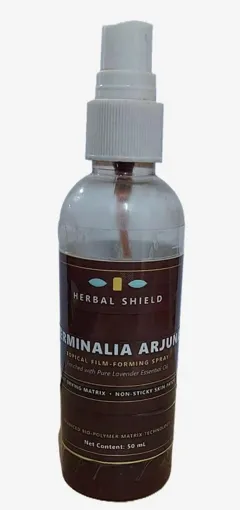
figure 1 Herbal film-forming spray
2.2 Evaluation of Herbal Film-Forming Spray
The pH value is determined and maintained to prepare a stable formulation and to be suitable for the area of application and faster healing in case of burns. The pH of the film-forming spray solution was determined using a digital pH meter at room temperature; the ideal pH range is 5- 6 to control microbial growth[6].
Liquid formulations are checked for colour, clarity, homogeneity, and the absence of any suspended particles or precipitate of polymer inside the container[7].
To ensure fast application, the drying time of a film is measured after FFS is sprayed. According to guidelines, the drying time of the film was measured by spraying a measured quantity of the formulation uniformly on a clean glass surface or a Petri dish and recording the time required for the applied film to become completely dry[6].
One spray circle radius was determined by spraying the formulation onto Whatman filter paper from a fixed, predetermined distance; the diameter of the resulting spray pattern was measured using a ruler, and the spray radius was calculated as half of the measured diameter (Figure 2)[3].
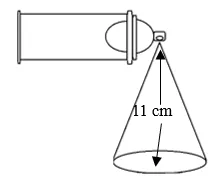
figure 2 spray radius determination
The stickiness of the formed film can be determined by gently placing a piece of cotton wool over the dried film without applying any external pressure. The degree of stickiness was evaluated according to the amount of cotton adhering to the film surface. The dried film containing extensive cotton adhesion was categorised as very sticky, and those showing no adhesion were categorised as non-sticky[6][8].
The density of the FFS formulation was determined using a calibrated specific gravity bottle (pycnometer). The empty, clean, and dry bottle was weighed accurately, and its weight was measured and recorded as W1. The bottle was filled with water, and the weight was measured and recorded as W2. The bottle was filled with film-forming spray solution, ensuring the absence of any air bubbles, and the weight was measured and recorded as W3[9]. The density of the formulation was calculated using the following equation:
Relative density = W3-W1/W2-W1 g/cm3
Where,
W1 = mass of empty, clean, and dry gravity bottle with its stopper.
W2 = mass of the gravity bottle filled with water.
W3 = mass of the gravity bottle filled with test solution (film-forming spray solution)
Viscosity assessment of film-forming spray (FFS) solution was performed to evaluate the sprayability of the solution. Viscosity of the solution was determined at a controlled temperature using an Ostwald viscometer[9]. The viscosity of the formulation was calculated using the following equation:
η2 = η1 × (ρ2 × t2 / ρ 1 × t1)
Where,
η1 = coefficient of viscosity of reference liquid
ρ 1 = density of the reference liquid
t1 = average flow time of the reference liquid
ρ2 = density of the test sample
t2 = average flow time of the test sample
The water washability of the film-forming spray was evaluated using an in-vitro method. A fixed dose of FFS was applied to the clean glass slide surface and allowed to dry at room temperature. The dried film was placed under slow-running water, and its washability was examined visually[10].
Preparation of FFS was done using three different polymers, Carbopol 934, HPMC, and PVP, with formulation codes T1, T2, and T3 respectively (Table 1). Lavender oil was added to all the formulations as a permeation enhancer and fragrance enhancer[11]. Formulation T2 shows phase separation with herbal extract, as the T. arjuna extract contains a high concentration of tannins, which form a precipitate with HPMC[5]. This phase separation results in formulation failure, while formulation code T3 shows an excellent homogeneous solution without any phase separation and is considered for further evaluation studies.
Table 1 Film-forming spray formulation
|
Ingredients |
Formulation code |
||
|
T1 |
T2 |
T3 |
|
|
HPMC |
- |
50mg |
- |
|
PVP |
- |
- |
50mg |
|
Carbopol 934 |
50mg |
- |
- |
|
Ethanol |
45ml |
45ml |
45ml |
|
Water |
5ml |
5ml |
5ml |
|
T. extract |
2.5mg |
2.5mg |
2.5mg |
|
Lavender oil |
5 drops |
5 drops |
5 drops |
The pH of the formulation code T3 was found to be 5.44 ± 0.02, determined using a digital pH meter (Figure 3). The physical appearance of formulation T3 was found to be brown in colour, homogeneous, and absence of any foreign particles and polymer precipitate in it, while formulation T2 showed significant phase separation of herbal extract with HPMC polymer. These parameters play a very crucial role in the equal distribution of the formulation throughout the skin. The drying time of the film formed by spray T3 was found to be 40 to 50 seconds, formulation T1 showed a very high drying time. Both formulations T1 and T3 form a clear, transparent thin film on the applied area; the colour of the solution helps to blend with skin tone. Formulation T3 was evaluated for spray circle radius, which was found to be 4.5cm from the fixed height of 11cm. Formulation code T1 possesses a higher degree of stickiness as compared to T3 and is categorised as very sticky.
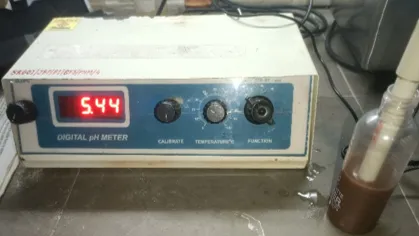
figure 3 Digital pH meter
Relative density of the formulation T3 was calculated using a specific gravity bottle, and the density of the solution was found to be 0.8465, which is within the standard value of 0.80 – 0.98[12]. Similarly, the viscosity of formulation T3 was calculated using an Ostwald viscometer with water as a reference liquid at room temperature, and the viscosity of the solution was found to be 13.25 cP. All the formulations are easily washable with water at standard room temperature.
The development of a film-forming spray (FFS) requires a balance between polymer properties, solvent evaporation rates, and active ingredient compatibility. In this study, three different polymers-Carbopol 934 (T1), HPMC (T2), and PVP (T3)-were evaluated. The immediate failure and phase separation observed in formulation T2 (HPMC) can be attributed to the chemical nature of the Terminalia arjuna extract. T. arjuna is rich in polyphenolic compounds, specifically tannins. Tannins are known to cross-link and form insoluble precipitates with certain hydrophilic polymers like HPMC through hydrogen bonding[5]. This incompatibility resulted in a heterogeneous system, showing T2 unsuitable for topical application. Formulation T1, using Carbopol 934, successfully maintained a homogeneous phase but exhibited an unacceptable degree of stickiness very high drying time. Generally, Carbopol polymers form highly cross-linked, high-viscosity hydrogels upon neutralization. While this also supports excellent mucoadhesion properties[13], the high molecular weight and water-retention properties caused the residual film to feel uncomfortably tacky, which severely limits patient compliance. In contrast, formulation T3 (PVP) demonstrated better physicochemical characteristics. PVP (Polyvinylpyrrolidone) is a highly water-soluble, inert, non-toxic, and non-ionic polymer known for its excellent film-forming capability and low viscosity in alcoholic solutions[14]. T3 exhibited a viscosity of 13.25 cP, which is ideal for achieving a fine, uniform atomization through a mechanical spray pump without clogging the nozzle. This low viscosity results in a highly controlled spray circle radius of 4.5 cm from a standard 11 cm height, ensuring precise localized application.
Furthermore, the rapid drying time of 40 to 50 seconds is attributed to the volatile hydroalcoholic vehicle (Ethanol: Water ratio). This quick evaporation allows the PVP matrix to rapidly transform into a clear, transparent, and pleasing thin film that blends naturally with the skin tone. The recorded pH of 5.44 ± 0.02 matches the natural acidic mantle of human skin (typically pH 4.5-5.5), minimizing the risk of localized skin irritation. Finally, the non-ionic nature of the PVP film ensured excellent water-washability, allowing easy removal without aggressive scrubbing.
In conclusion, a stable topical film-forming spray containing Terminalia arjuna extract was successfully developed and evaluated. Among the tested polymers, HPMC was found to be chemically incompatible with the tannin-rich herbal extract, while Carbopol 934 produced a film with undesirable stickiness. Polyvinylpyrrolidone (PVP), utilized in formulation T3, emerged as the optimal polymer matrix. Formulation T3 demonstrated excellent homogeneity, skin-compatible pH, rapid drying kinetics, and ideal sprayability parameters. These findings indicate that the PVP-based film-forming spray holds significant potential as a patient-compliant, transparent, and easily washable drug delivery system for the topical administration of Terminalia arjuna extract.
The authors are highly grateful to the management and administration of Shri Rawatpura Sarkar Institute of Pharmacy, Jabalpur, for providing the necessary laboratory facilities, chemicals, and equipment required in the formulation and development of the herbal film-forming spray.
REFERENCES


Mohit Kushwaha, Shefali Usrethe, Formulation and Preliminary Characterization of a Novel Fast-Drying Topical Film-Forming Spray Containing Terminalia arjuna Bark Extract, Int. J. of Pharm. Sci., 2026, Vol 4, Issue 9, 2986-2992. https://doi.org/10.5281/zenodo.22930627
 10.5281/zenodo.22930627