

We use cookies to ensure our website works properly and to personalise your experience. Cookies policy
Department of Pharmaceutics, The Erode College of Pharmacy and Research Institute, Erode, Tamil Nadu, India, (Affiliated to The Tamil Nadu Dr MGR Medical University, Chennai).
Microsponge drug delivery systems are used to treat skin problems. The usual ways of giving medicine to the skin do not work very well. The medicine does not stay on the skin for long, it gets released quickly and people must put it on a lot. This can also irritate the skin. Microsponge systems are a way to solve these problems. This also helps the product to stay on the skin for a long time by releasing it slowly. It makes the drug long lasting with better efficiency. It also makes people more likely to use it. This review talks about microsponge technology. It covers the basics of skin and how medicine is delivered to it. It also talks about what microsponges are made of how they are made and how they work. We discuss the bad things about microsponges and how they are used to treat skin problems. Microsponge technology is getting better. New kinds of microsponges are being made that are friendly to the environment. Can respond to changes. These new microsponges are made with materials that can break down naturally. They are also very small, which makes them work better. We also talk about what might happen in the future with microsponge technology. We think that smart materials and personalized medicine could make microsponges even better. Microsponges are a way to deliver medicine to the skin. They make the medicine work better and are easier for people to use. As we learn more, materials and how to make medicine microsponges will become a more important part of treating skin problems and delivering medicine in a targeted way.
The skin is a part of our body. It keeps us safe. Does many important jobs. These jobs include keeping our body at the temperature fighting off bad things that can make us sick and helping us feel things. Because the skin is big and easy to reach it is a way to give people medicine, especially for skin problems. Giving medicine through the skin has benefits.(1) Medicine solves the problem, so it works better and does not make us feel sick in other ways. It also means we do not have to take the medicine which makes it easier for people to remember to take it. The usual ways we give medicine through the skin like creams and lotions do not always work well.(1) They can irritate the skin. The medicine does not always last long. That is why scientists have been working on ways to give medicine through the skin. One of these ways is called the Microsponge Drug Delivery System.(2) It uses balls called microsponges that hold medicine and release it slowly over time. This helps the medicine longer and work better and it can also help reduce irritation.
The microsponges are very good at holding onto the medicine and releasing them in a way that helps the skin. People have used microsponges to deliver kinds of medicine such as medicine for acne, fungus and inflammation. New discoveries in materials science and design have made microsponges better so they can be used to help people.(2) This article will tell you all about microsponge drug delivery systems. It will talk about how microsponges are made, how they work and what kinds of medicine they can be used for. It will also discuss the challenges and possibilities for the future of microsponges in medicine. The skin is a way to give medicine and microsponges are a promising way to do it. Microsponge drug delivery systems are a part of medicine, and they will continue to be used to help people with skin problems.(1) The Microsponge Drug Delivery System is an example of how scientists are working to make medicine better and more effective.
SKIN AND TOPICAL DRUG DELIVERY BASICS:
Structure of the Skin:
There are three layers present in the structure of skin namely the epidermis (Outermost layer), the dermis (Middle layer), the hypodermis (Subcutaneous layer).(3)
Skin Barrier and Drug Penetration:
The stratum corneum is very thin. It is 10 to 20 micrometers thick.(6) It is a big obstacle for drugs to get through. This is because the stratum corneum has a structure made of lipids. For drugs to work well they need to be small. They need to have a weight of than 500 Da. (6)They also need to be able to dissolve in both water and fat. Many things can affect how well drugs are absorbed into the skin. These things include how hydrated the skin is, the age of the person, disease and temperature. The skin is a barrier that drugs need to get through. The stratum corneum is the barrier.(3)
Drugs can get through the skin in three ways:
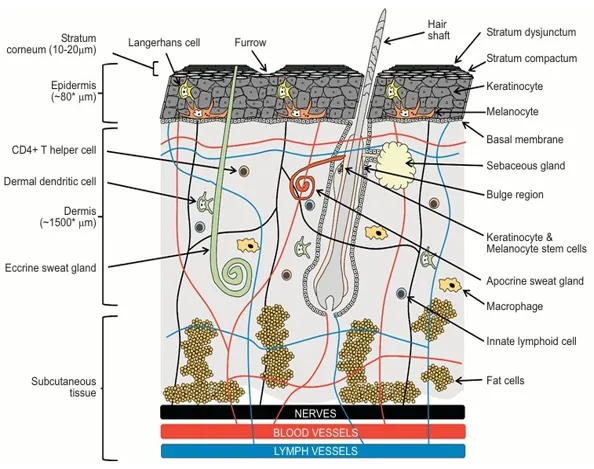
Fig. (1). Diagrammatic illustration of human skin. Barriers, sites of action and drug delivery opportunities.(7)
Topical Drug Delivery and The Need for Advanced Systems:
Drug delivery is used to treat skin problems. It does this by putting the drug on the skin. This way the drug does not have to go through the body. It is better than taking medicine by mouth. (8)This is because it avoids the liver and reduces side effects. It is also easier to use. Creams, ointments and gels are commonly used for acne, eczema and other skin conditions. Topical drug delivery is very useful. The skin is the target of the drug.(9)
These traditional forms have some problems. They include skin penetration, rapid drug release and irritation. To solve these problems new systems have been developed. These systems include liposomes, niosomes and microsponge drug delivery systems.(8) Microsponge systems are very interesting. They release drugs slowly. Improve drug stability. They also reduce irritation. These features make them very valuable. They are valuable for the long-term treatment of skin disorders. Microsponge drug delivery systems are important. They are important for drug delivery. The skin and topical drug delivery are closely related.(9)
FUNDAMENTALS OF MICROSPONGES AND PREPARATIONS:
Definition:
Microsponges are porous balls made of polymer. They are designed to hold medicines and release them slowly. These microsponges are usually between 5 and 300 micrometers in size. They have a porous structure that can hold both water-loving and fat-loving drugs. This structure protects the drugs from getting damaged.(10) The Quasi-Emulsion Solvent Diffusion method is often used to make microsponges. This method makes porous microsponges that can hold a lot of medicine. They also release the medicine in a sustained way. Microsponges are good for delivering medicine. They help make medicine longer reduce irritation and make it easier for patients to take their medicine. That is why microsponges are being used more and more for delivering medicine through the skin and for uses where medicine needs to be released slowly. Microsponges have a lot of potential in these areas. Microsponges can make medicine work better.(10)
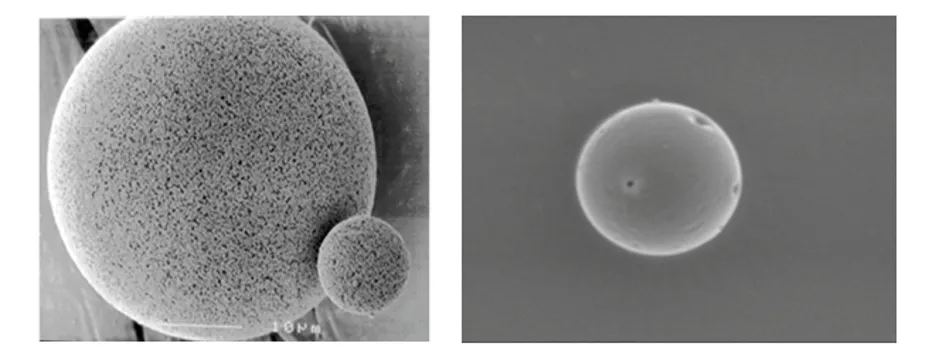
Fig. (2). SEM Photographs Showing Microsponges. (11)
PREPARATIONS:
1. Liquid-Liquid Suspension Polymerization Method:
Liquid-Liquid Suspension Polymerization is a method to formulate microsponges. We do this by making a polymer matrix around the drug. To make it happen we mix vinyl-type monomers like styrene. Methyl methacrylate with the drug. After that we pour this mixture into water mixed with surfactant. When the mixture was heat or add catalysts the monomers react with each other. This creates microspheres that can hold the drug inside. The drug helps create the structure of microsponges.(12)
Advantages:
Limitations:
2. Quasi-Emulsion Solvent Diffusion Method:
The Quasi-Emulsion Solvent Diffusion method is another process which uses preformed polymers to make microsponges, preformed polymers like Eudragit RS100 and RL100.(13) This method is different from suspension polymerization because it does not have any conditions, this method is best and good for heat and chemicals sensitive drugs.
To use this method the drug and polymer are mixed with a solvent that evaporates easily. Then this mixture is slowly added to water that has polyvinyl alcohol in it. The mixture is stirred all the time. As the solvent evaporates and the water moves in the polymer forms a shell around the drug making particles that are like sponges and have very little solvent left in them. The Quasi-Emulsion Solvent Diffusion method allows us to adjust the amount of drug and polymer and the conditions we use to get the particles right and to control how the drug is released.(12)
Advantages:
Limitations:
The Quasi-Emulsion Solvent Diffusion method is a way to make microsponge drug delivery systems because it is easy to use, can be adapted to different situations and gives very consistent results. The Quasi-Emulsion Solvent Diffusion method is used a lot in both research and industry to develop medications.(13)
3. Oil in Oil Emulsion Solvent Diffusion Method:
The Oil in Oil Emulsion Solvent Diffusion method is a way of making tiny particles called microsponges. This method is good for Oil in Oil Emulsion Solvent Diffusion when we have drugs that do not like water or break down easily in water. We do this by mixing the drug and a special helper called Eudragit in a liquid that evaporates easily. Then we put this mixture into another oil that does not mix with the one. We keep stirring until the liquid that evaporates easily goes into the oil. This makes the helper form a coating around the drug.(12)
The Oil in Oil Emulsion Solvent Diffusion method has some points:(13,14)
The Oil in Oil Emulsion Solvent Diffusion method also has some not so good points:(13,14)
So, the Oil in Oil Emulsion Solvent Diffusion method is a choice when we want to make microsponges, with drugs that do not like water or break down easily. It helps to ensure the drug’s safety, quality and efficacy.
4. Freeze-Drying Method:
This method is to make porous microsponges of sensitive drugs for heat and moisture like proteins, enzymes and peptides. This method is different from other methods because it turns the solvents into gas under low temperature and vaccum which helps to keep the drug stable. First the drug and a special material are mixed in a liquid. Then quickly froze. The frozen liquid is then removed in two steps: by turning it into gas under vacuum and then by removing any leftover moisture. This makes a light and porous microsponge, with the size and distribution of pores depending on how the mixture was frozen.(15)
Benefits:
Drawbacks:
Even though freeze-drying is not commonly used for making microsponges, it is useful, for making drug delivery systems were keeping the drug stable and making porous structures is important.(15)
5. Porogen Addition Method:
The Porogen Addition Method is a way of making things. It involves putting a forming agent also called a porogen into the polymer matrix when we are making microsponges. Then we take out the porogen by extracting it leaching it or letting it evaporate. This makes a lot of holes in the material that are all connected. We can control how big these holes are and how many there are, which helps us decide how the drug will be released.(15)
Advantages:
Limitations:
The Porogen Addition Method is mostly used when we are trying to develop formulations, and we need to be very precise about the holes in the microsponges. The Porogen Addition Method is good, for research because it lets us control the porosity of the microsponges carefully.(15)
6. Advanced Particle Engineering Techniques:
Advanced particle engineering techniques have been created to make microsponges with uniform particle size and controlled morphology. This is because the old ways of making microsponges had some problems. These new techniques are mostly used for research and for delivering drugs in ways.(15)
Vibrating Orifice Aerosol Generator (VOAG):
A solution that has a drug and a polymer in it is passed through a nozzle that is vibrating. This makes drops that then turn into microsponge particles that are all the same size. This method is very good at controlling the size of the particles and making sure they are all the same. This method also needs specific equipments to perform and only make microsponges in small quantities.(12,15)
Electro-Hydrodynamic atomization (EHDA):
This is the method which uses an electric field to convert a drug-polymer solution into very small and charged drops. These drops then turn into particles that have holes in them and are all the size. The Electrohydrodynamic Atomization method makes microsponges with controlled morphology. It is hard to perform and get correct results. Like VOAG it can only make microsponges in small quantities. It is widely known as Electrospraying or Electrospray.(12,15)
Ultrasound Assisted Method:
This method uses high-frequency sound waves to make the drops more uniform when making microsponges. The Ultrasound Assisted Method makes the microsponges more uniform in size. Can be used with the old ways of making microsponges. However, if the sound waves are too strong, they can make the mixture get too hot. That can be bad for some drugs.(12,15)
Advantages:
Limitations:
These advanced particle engineering techniques are very good for making microsponges that're just right, but they are mostly used for research and for making special drugs not for making large amounts of microsponges all the time. The advanced particle engineering techniques are used for precision microsponge fabrication. They are not used as much for routine commercial manufacturing.(15)
CHARACTERIZATION OF MICROSPONGES:
To really understand microsponges we need to study them. This helps us figure out if they are quality. We want to know if they can hold onto the drug if they are stable and if they can release the drug in a controlled way. These studies help us make the best microsponges possible. They make sure that every batch is the same. We can even predict how well the microsponges will work to deliver the drug. To do all this we use a combination of techniques to look at the microsponges from all angles.(16)
Particle Size Analysis:
The particle size of the microsponge particles is essential because it denotes the drug release, penetration and stability. It ranges from 10 and 25 micrometers in size. Depending on the method of preparation it also ranges from 5 to 300 micrometers. Smaller particles release the drug faster because they have a surface area. Larger particles release the drug slower. We usually measure the size of the particles using machines like the Light Scattering machine or the laser diffraction machine.(16,17)
Surface Morphology:
The Scanning Electron Microscope is needed to look at the surface of the microsponges. This microscope shows lots of tiny holes which are connected to each other. This structure allows the microsponges to hold onto the drug and release it slowly.(16,17)
Drug Entrapment Efficiency and Drug Content:
We need to know how well the microsponges can hold onto the drug. This is called drug entrapment efficiency. We also need to know how much drug is inside the microsponges. This is called the drug content. The UV spectrophotometer or the High-Performance Liquid Chromatography (HPLC) machine is used to measure microsponges. The high amount in result denotes the drugs are good at holding with the microsponges and denotes that the drug is evenly distributed.(16,17)
Production yield:
The production yield tells us how efficient the process of making microsponges is. It compares how much we make to how much we should make. This helps us figure out if we are losing any material during the process. Things like how the polymer's how fast we stir how fast the solvent evaporates and how much emulsifier we use can all affect the production yield.(16,17)
Drug–Polymer Compatibility Studies:
We use a machine called the Fourier Transform Infrared Spectroscopy machine to see if the drug and polymer are compatible. This machine helps us identify the parts of the molecules. We also use the Differential Scanning Calorimetry machine to look at the properties of the microsponges like their melting point and glass transition temperature. This helps us confirm that the drug is inside the microsponges and that they are stable.(16,17)
Porosity and Density:
The microsponges are porous it means that they have lots of holes which makes it a unique formulation. This affects how drug they can hold and how it is released. We use a machine called the mercury intrusion porosimeter to measure the size of the holes how many there are and the surface area. We also use the helium gas pycnometry machine to measure the density of the microsponges. This tells us about the structure and how are they compact(16,17)
In Vitro Drug Release Studies:
We do special studies to see how the drug is released from microsponges. We use machines like the Franz diffusion cells or the USP dissolution apparatus. These studies help us understand how the drug is released over time and how we can make the microsponges better.(16,17)
Polymer Composition:
The type of polymer we use and how much of it we use affects the properties of the microsponges. This includes how porous they are, how well they hold onto the drug, how strong they are and how the drug is released. If we use polymer or cross-link it the microsponges get stronger and the drug is released slower. If we use cross-linking the drug is released faster.(9,16)
Stability Studies:
We do studies to see if the microsponges are stable over time. We follow the guidelines set by ICH. Check things like the size of the particles, how much drug is inside how well the microsponges hold onto the drug, the pH, how they look and how the drug is released. This ensures that the microsponges are quality and will work well for a long time.(9,16,17)
Skin Irritation and In Vivo Evaluation:
We do studies to see if the microsponges irritate the skin. We look for signs of irritation like redness and swelling. We also do studies to see how well microsponges work in life. We check things like how much drug's retained in the skin, how much is deposited, how well it works and if there are any changes in the skin. The microsponges are usually better than formulations because they keep the drug in the skin and release it slowly and do not irritate the skin as much.(9,17)
Advance techniques:
There are techniques that we can use to study microsponges. These include things like the Design of Experiments Ultra-Performance Liquid Chromatography and confocal laser scanning microscopy. These techniques help us understand more about how the drug's delivered, how it penetrates the skin and how it is released. They also help us make microsponges that work even better to deliver the drug.(9)
MECHANISM OF ACTION:
Drugs are released from microsponges through a process called controlled diffusion. This happens across a kind of material that is very porous and has strong links between its parts. This material is called a matrix. It helps to release the drugs in a steady way, and it makes sure the drugs go to the right place in the body.(18) When you first apply the microsponges some of the drug is released quickly to start working. Then the rest of the drug comes out slowly through the tiny holes in the material. This slow release of the drug happens because the drug is moving from an area with a lot of drugs to an area with drug. This process is often explained using the Higuchi and Korsmeyer–Peppas models. (14,19)These models help us understand how the drug is released. They help to keep the right amount of drug in the body for a long time.
The way the drug is released from microsponges depends on one thing. These things include what kind of material the microsponges are made of, how much of this material's used how strongly the parts of the material are linked together how big the microsponges are, how many holes they have, how big these holes are, how much drug is inside the microsponges and how much drug is compared to the material. Some materials, like ethyl cellulose and Eudragit RS100 are not very good at letting the drug out.(19) This is because they form a network that slows down the release of the drug. On the hand if the microsponges have a lot of holes the drug can come out more quickly. The release of the drug can also be affected by things from outside the microsponges such as pressure, temperature, moisture and pH. (20)These things can help the drug to come out of the microsponges quickly. This combination of release and release that is affected by outside factors helps to keep the drug where it is needed makes the drug work better reduces the amount of drug that gets into the whole body reduces skin irritation and makes microsponges a good way to deliver drugs through the skin or, in other controlled ways.(18)
ADVANTAGES OF MICROSPONGES:
LIMITATIONS OF MICROSPONGES:
DERMATOLOGICAL APPLICATIONS OF MICROSPONGES:
Microsponges are good at helping to deliver drugs to the skin in a way that is controlled and sustained. This means that the drug is released slowly over time, which helps to keep the skin healthy.(1) Microsponges also help to keep the drug on the skin for a time, which reduces the amount of drug that gets into the bloodstream.(26) This is especially helpful for people who have skin problems that need to be treated for a time.
The good thing about microsponges is that they can be used in different types of skin care products, such as creams, gels, lotions, ointments and emulgels. (1)This gives doctors and scientists a lot of flexibility when they are creating treatments for skin problems. Microsponges are used to treat different skin diseases like acne vulgaris. They also help to cure psoriasis, eczema, rosacea, fungal skin infections and skin cancer(14)
Microsponges are also used to treat hair problems like dandruff, hair loss, hyperpigmentation disorder and other scalp problems(1). They are even used in sunscreens and other cosmetic products such as moisturizers, anti-aging creams, deodorants and fragrances.(26) In these products microsponges help to keep the product stable, reduce skin irritation and make the product more pleasant to use. Microsponges are a useful tool for helping to keep the skin healthy and they have many different applications, in dermatology including the treatment of acne vulgaris, psoriasis and eczema.(1)
RECENT ADVANCES:
There have been some improvements in microsponge technology. This means that microsponges can now be used for things than just putting medicine on the skin. New materials like PLGA, polylactic acid, chitosan and collagen-based materials are safe for people and the environment. These materials are biodegradable and biocompatible.(27) We are also using ways to make microsponges that are better for the earth. These green formulation approaches use solvents that're not harmful and manufacturing processes that are sustainable.(28)
People who work on making medicines have also made some microsponges that can release medicine when they sense changes in their surroundings. These stimuli- microsponges can release medicine when they notice changes in pH, temperature, moisture or enzymes. This means that the medicine can be delivered where it is needed.(28) Some new systems combine microsponges with nanoparticles, nanosponges, hydrogels and collagen scaffolds.(29) These systems are very good at delivering medicine. Can even help the medicine get into the body tissues. They are also very good at delivering peptides, proteins and other medicines that're sensitive.
Micro sponge technology is not just used for skin problems anymore. Now it is being used for microsponge, microsponge ophthalmic, microsponge pulmonary, microsponge parenteral and microsponge tissue-engineering applications. People are also using Quality by Design principles and new ways to characterize and optimize microsponge formulations.(30) This means that microsponges can be made in a way that's consistent and can be used in a big way. All these developments show that microsponges are very important for delivering medicine in a controlled way.
People have been doing some research on nanosponges, nanoferrosponges and microsponge-based nanohybrid systems. This is to make the delivery of medicine to the place in our body more effective.
We can even control when the medicine is released.
The microsponge–nanohybrid systems are also very useful. They are made by combining microsponges with small particles, special kinds of liquids or other tiny materials.(33)
This combination makes medicine more stable. It gets released in a controlled way. It also helps the medicine get into our body tissue better and work effectively. These new systems are a deal because they can help us deliver medicine in a smarter way. They will likely be used more in industry to make microsponge-based medicines better.
FUTURE PROSPECTS:
The Microsponge technology has a lot of potential for making drug delivery systems. This is because Microsponge technology is very versatile, safe and can release drugs in a controlled way. In the future researchers will probably focus on using stimuli-responsive polymers for Microsponge technology. (30)This will help create Microsponge systems that can release drugs when they are needed like when the body is sick. The Microsponge technology field will also likely use manufacturing techniques and environmentally friendly materials. This will make the drug delivery systems safer and better for the environment. It will also make it easier to produce these systems on a scale.
New technologies like 3D printing, personalized medicine and Microsponge–nanoparticle hybrid systems will probably make it possible to create drug delivery systems that are tailored to each patient.(33) These systems will be able to load drugs make the drugs work better in the body and deliver the drugs to the right place. Researchers will also try to use Microsponge technology for types of therapies, such as oral, ophthalmic, pulmonary, injectable and tissue-engineering therapies.(28) This will be especially important for drugs like peptides, proteins, genes and anticancer drugs.(34)
Even though there are still some challenges to overcome, like making sure the manufacturing process is safe and consistent and getting approval from regulators the Microsponge technology will likely become a part of advanced drug delivery systems in the future. (35)This is because scientists are continually coming up with innovations, in polymer science, formulation engineering and biomedical technologies that will help the Microsponge technology field grow. (35)The Microsponge technology will make drug delivery systems that are tailored to each patient and will improve the way we take drugs.
People think that future studies will look at how to make microsponge-based nanohybrids and nanoferrosponges. (32)These things need to be able to respond to things like fields, pH, temperature or enzymes. This will help get drugs to people in a personalized way. Also using artificial intelligence and new manufacturing technologies with microsponge platforms may help make drug delivery better. This can make it easier to get drugs to people who need them. It can also help make generation targeted drug delivery systems. Microsponge-based nanohybrids and nanoferrosponges are very important, for this.(32)
CONCLUSION:
Microsponge drug delivery systems are a way to give people medicine through their skin. They do a job than the usual methods because they can control how much medicine is released and for how long. This means the medicine stays on the skin for a time and does not irritate it as much. Microsponge drug delivery systems are also better at keeping the medicine stable. All these things together mean that people get results from their medicine and are more likely to use it.
New ways of making drug delivery systems have made them even more useful. We can now make them with kinds of materials that can break down naturally or react to their surroundings. We can also make small versions of microsponges that are mixed with other tiny materials. These new developments have made microsponge technology for more than just putting medicine on the skin.
With all these new developments there are still some problems to solve. We need to figure out how to make a lot of microsponge drug delivery systems at the time and how to make sure they are all the same. We also need to make sure the government says it is okay to use them. Microsponge drug delivery systems are a great way to give people medicine, and they have a lot of potential to help people in the future. Microsponge technology is a way to give people personalized medicine and to create new skin treatments. Microsponge technology is also useful, for areas of medicine and science.
REFERENCES

Mohammed Musraf A, Yuvaashri S S, Sundareswaran V, Mohammed Saad J, Mohamed Sameer M, Kanishka S, Microsponges Drug Delivery Systems for Topical Therapy: Advances in Dermatological Application, Int. J. of Pharm. Sci., 2026, Vol 4, Issue 8, 4378-4392. https://doi.org/10.5281/zenodo.22116596
 doi.org/10.5281/zenodo.22116596