

We use cookies to ensure our website works properly and to personalise your experience. Cookies policy
Pravara Rural Education Society’s College of Pharmacy (For Women), Chincholi, Nashik.
Central nervous system (CNS) disorders are difficult to treat because traditional oral or parenteral delivery often fails to deliver sufficient quantities of therapeutic compounds to the brain. Major challenges include limited drug permeability, systemic toxicity, enzymatic degradation, and the blood–brain barrier (BBB). Because the nasal canal is physically related to the brain through olfactory and trigeminal pathways, intranasal delivery has drawn attention as a non-invasive method. By boosting drug solubility, shielding labile molecules, extending nasal residency, and regulating drug release, nanocarriers may further enhance this pathway. CNS delivery has been studied using polymeric nanoparticles, PLGA and chitosan systems, liposomes, solid lipid nanoparticles, nanostructured lipid carriers, micelles, nanogels, and biomimetic systems. However, care must be used when interpreting nose-to-brain research. Because systemic absorption, enhanced stability, and extended nose residency might potentially increase brain exposure, increased brain concentration following intranasal delivery does not by itself demonstrate direct neural transport. The anatomical routes, physiological hurdles, nanocarrier techniques, and applications in Parkinson's disease (PD) and Alzheimer's disease (AD) are summarized in this critical review, with a focus on brain-targeting assessment, safety, manufacturing, and regulatory issues. Significant preclinical potential is shown by current data; nonetheless, effective clinical translation necessitates repeatable nasal deposition, suitable controls, regional brain analysis, long-term safety evaluation, scalable production, and proof of significant therapeutic efficacy.
Neurodegenerative, neurological, psychiatric, and neoplastic diseases are part of the disorders of the central nervous system (CNS), involving the brain, spinal cord, and associated neural pathways. Due to their progressive nature, requiring prolonged treatment, Parkinson's disease (PD), and Alzheimer's disease (AD) are of special significance. Degeneration of dopaminergic neurons and consequent motor dysfunction are the main clinical features of Parkinson's disease (PD), whereas Alzheimer's disease (AD) is related to cognitive decline, synaptic dysfunction, and neuronal destruction. Effective treatment requires both pharmaceutical effectiveness and enough exposure at the relevant CNS region.
Prior to reaching the brain, most traditional oral or intravenous drugs that are administered are exposed to the systemic circulation. The blood-brain barrier (BBB), which comprises specialised brain endothelial cells connected by tight junctions, surrounded by pericytes, astrocytes, and a basement membrane, significantly affects entry into the central nervous system. Molecular size, lipophilicity, polarity, ionisation, stability, and interactions with transporters influence BBB penetration, and efflux transporters may further reduce CNS exposure. Subsequently, increasing the systemic dose may increase toxicity and peripheral exposure without a corresponding increase in brain concentration 1,2,16.
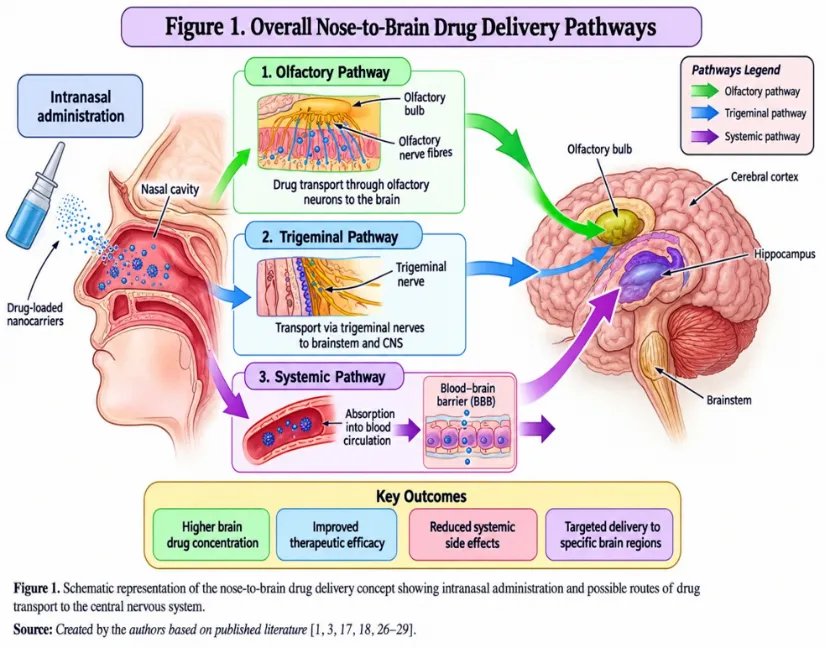
Olfactory and trigeminal nerves allow access to the nasal cavity, which is near the central nervous system. Intranasal delivery offers an alternative route of administration. A medication may reach the brain via systemic absorption followed by BBB transport, direct olfactory or trigeminal-associated routes, or a combination, depending on the deposition and formulation 3,17,18,26-29. For some medications, the route can also decrease first-pass hepatic metabolism and gastrointestinal degradation.
Although intranasal administration has several advantages, it is not inherently successful. Nasal enzymes can break down sensitive molecules, the nasal epithelium restricts the transport of big or hydrophilic substances, and mucociliary clearance may quickly eliminate a formulation. Deposition is further complicated by the human olfactory region's tiny size. Consequently, the design of the device, the method of administration, the viscosity of the formulation, the size of the droplets or particles, and the surface characteristics are significant factors that influence performance 4,5,16,18.
Researchers are looking at using nanocarriers to concurrently solve many of these constraints. Lipid-based and polymeric systems can enhance solubility, lengthen residency, alter release, prevent drug degradation, and promote contact with the nasal mucosa 3,13,14. However, complexity does not necessarily translate into better performance. A formulation has to show that drug loading, residence duration, transportation, safety, stability, and manufacturability are all in harmony. Therefore, this review focuses on the data needed to differentiate between enhanced systemic exposure and true nose-to-brain transport, in addition to the possible advantages of intranasal nanocarriers.
2. BIOLOGICAL AND ANATOMICAL BASIS OF NOSE-TO-BRAIN DELIVERY
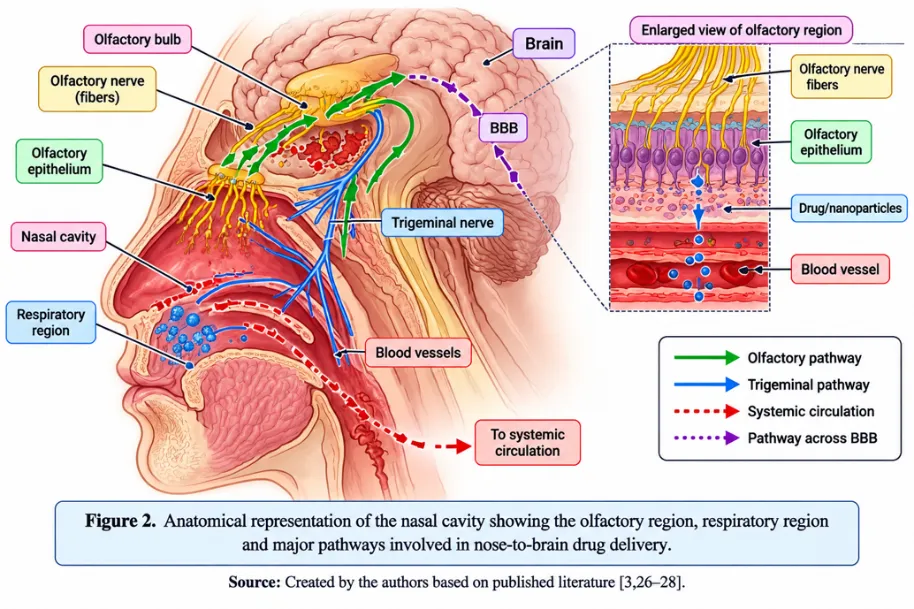
Respiration, filtration, humidification, smell, and mucosal defense are all carried out by the nasal cavity. It can be widely viewed in terms of the pulmonary, olfactory, and vestibular regions. The vestibule is not the main target for CNS administration since it is comparatively keratinized. The respiratory area is crucial for systemic absorption since it takes up the majority of the nose cavity and has a robust blood supply. The olfactory area, which is smaller and located close to the nasal cavity's roof, is home to Bowman's glands, supporting and basal cells, olfactory receptor neurons, and related nerve fibers.
A possible anatomical interface for direct transport is created when axons of olfactory receptor neurons go through the cribriform plate in the direction of the olfactory bulb 26–28.
Mucus, which contains mucins, water, salts, proteins, and other substances, covers the nasal surface. Mucus is transported to the nasopharynx via ciliary action. Although it can reduce formulation residence time, this mucociliary system is crucial for defense. Therefore, maintaining enough nasal residency without interfering with regular mucus migration is a difficulty 4,16,18.
2.1 The olfactory route
The most commonly suggested method for direct nose-to-brain transfer is the olfactory pathway. Nasal cavity → olfactory epithelium → olfactory-associated structures → olfactory bulb → brain is the conceptual order. Extracellular or perineural movement, transcellular uptake, paracellular movement, and, in certain cases, intraneuronal transport are all possible forms of transport. The physicochemical characteristics of the drug and carrier, the deposition location, and the experimental circumstances all affect each mechanism's precise contribution 26,28.
The olfactory area can lessen reliance on the BBB, which makes it appealing. However, it only makes up a small portion of the nasal surface, and traditional sprays could not always leave enough formulation there. Therefore, the presence of drug in the olfactory bulb should not automatically be interpreted as proof that the entire drug dose travelled by a direct neural route.
2.2 The trigeminal route
Large portions of the nasal cavity get sensory innervation from the trigeminal nerve. Another suggested link between the nasal mucosa and the central nervous system is provided by its branches, which stretch across the respiratory and olfactory areas. Nasal mucosa → trigeminal nerve terminals → trigeminal branches → brainstem and other CNS locations is the conceptual route 27,28. When formulations are applied outside of the limited olfactory area, this route could be particularly important. However, it is challenging to determine its quantitative impact in many investigations.
2.3 The systemic route
The nasal mucosa → blood circulation → BBB → brain is the systemic route. Because of its surface size and vascularity, the respiratory region is crucial for this pathway. Because gastrointestinal degradation and some first-pass metabolism may be avoided, intranasal systemic absorption may be preferable to oral dosing. Nevertheless, a medication is still susceptible to normal distribution, metabolism, peripheral toxicity, and BBB restrictions after it enters systemic circulation 16,18.
Therefore, the difference between direct and indirect transmission is a key problem in nose-to-brain research. Direct olfactory or trigeminal transport, higher plasma exposure, protection against degradation, extended nasal residency, or a combination of these factors can all lead to increased brain concentration following intranasal delivery. Robust experimental designs should assess plasma and regional brain concentrations over time and compare intranasal therapy with an intravenous or other comparable systemic control 1,26–30.
3. MAJOR BARRIERS TO NOSE-TO-BRAIN DELIVERY
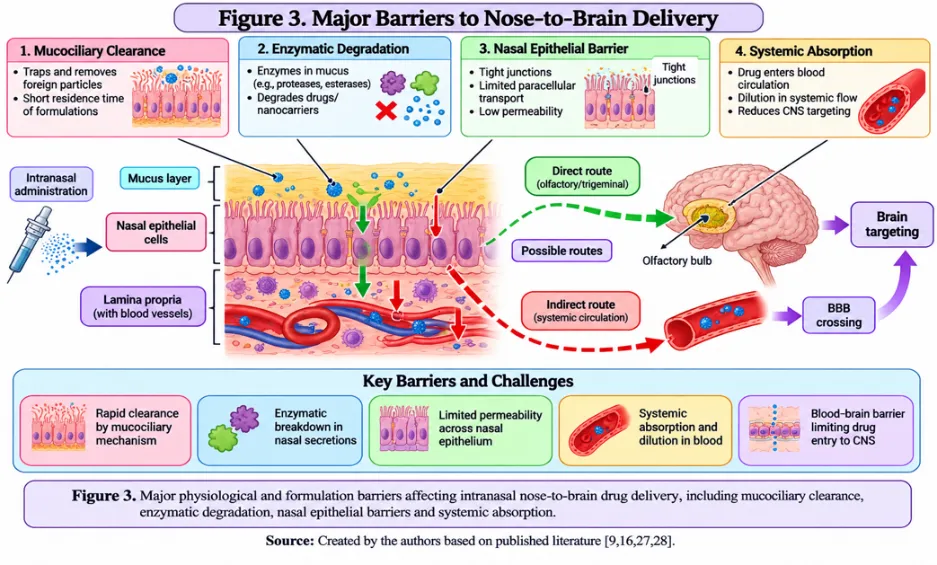
Before a therapeutic molecule may enter the central nervous system, intranasal administration must go past a number of interrelated physiological hurdles. Mucociliary clearance, enzymatic breakdown, the nasal epithelial barrier, and the blood-brain barrier (BBB) for fractions entering systemic circulation are the main obstacles 4,9,16,27,28.
3.1Mucociliary clearance
Mucus catches particles and ciliated epithelial cells transport mucus into the nasopharynx as part of a natural defensive process called mucociliary clearance. This procedure can eliminate a formulation prior to sufficient dissolution, epithelial contact, or brain transport, even when it is protective. Mucus characteristics, ciliary activity, formulation viscosity, surface charge, particle size, degree of mucoadhesion, nasal illness, administered volume, and device efficacy.
Residence duration may be extended by mucoadhesive polymers such chitosan, carbopol, alginate, and polycarbophil; in-situ gels; and suitably engineered polymeric or lipid nanocarriers. Additionally, devices that enhance upper-nasal deposition could be crucial 4,5. On the other hand, excessive mucoadhesion can cause discomfort, obstruct ciliary activity, and trap particles in mucus. Therefore, the objective is to achieve a suitable equilibrium between mucus transport and retention rather than maximal adhesion. Another practical obstacle is the nasal cavity's restricted capacity. Any extra formulation might get up in the throat and be consumed. A good system must retain acceptable viscosity and tolerability while delivering a sufficient dosage in a small amounll affect clearance 4,5,16.
3.2 Enzymatic degradation
Drugs may become less stable before absorption due to nasal enzymes. Nucleic acids, proteins, peptides, and other labile compounds are especially susceptible. The percentage of intact medication accessible for transportation may be decreased by proteases, peptidases, esterases, and other enzymes 9,16,27.
Physical protection can be obtained by encapsulation in polymeric or lipid carriers, and stability can be further enhanced by stabilizing excipients, suitable formulation conditions, chemical modification, prodrug methods, and controlled release. The formulation for biologics has to maintain biological activity while avoiding denaturation or aggregation. Protection must be weighed against medication availability as excessive retention within a carrier might itself decrease release and absorption.
3.3 Nasal epithelial barrier
Movement between the nasal lumen and the underlying tissue is controlled by the nasal epithelium. Drug transport can happen via endocytosis, receptor-mediated uptake, transcellular or paracellular pathways, or movement close to brain regions 9,27,28. Passive permeability is often lower in large, hydrophilic, and strongly polar substances. On the other hand, excessive use of surfactants, fatty acids, bile salts, or cationic polymers to increase membrane permeability may result in irritation or epithelial injury.
While liposomes, polymeric nanoparticles, and surface-modified systems may promote cell contact, chitosan and its derivatives may enhance mucoadhesion and affect epithelial transport.
Since increased permeability is useless if it impairs the nasal barrier, these methods must be assessed in conjunction with epithelial integrity, inflammation, ciliary function, and olfactory function 4,9.
3.4 Blood–brain barrier
When a medication is administered intranasally and enters the systemic circulation, the BBB is still crucial. Through efflux transporters, it may actively remove some medications and restrict the entrance of several big, hydrophilic, highly polar, and ionized substances 1,16,27. Although they may lessen reliance on the BBB, olfactory and trigeminal routes do not completely eradicate systemic exposure or the BBB. Therefore, rather than assuming that every medicine supplied via intranasal devices crosses the blood-brain barrier, they should be assessed as multimodal delivery systems.
3.5 Direct versus indirect transport
The most crucial point is that direct nose-to-brain transfer is not the same as drug detection in the brain. Intranasal and intravenous groups with similar systemic exposure, serial plasma and brain pharmacokinetics, analysis of various brain regions, olfactory-bulb measurements, direct-transport calculations, and imaging or tracking of intact nanocarriers should all be included in studies whenever possible 26–34. When a formulation additionally enhances medication stability or systemic absorption, these measures are more crucial.
4. NANOCARRIER-BASED STRATEGIES
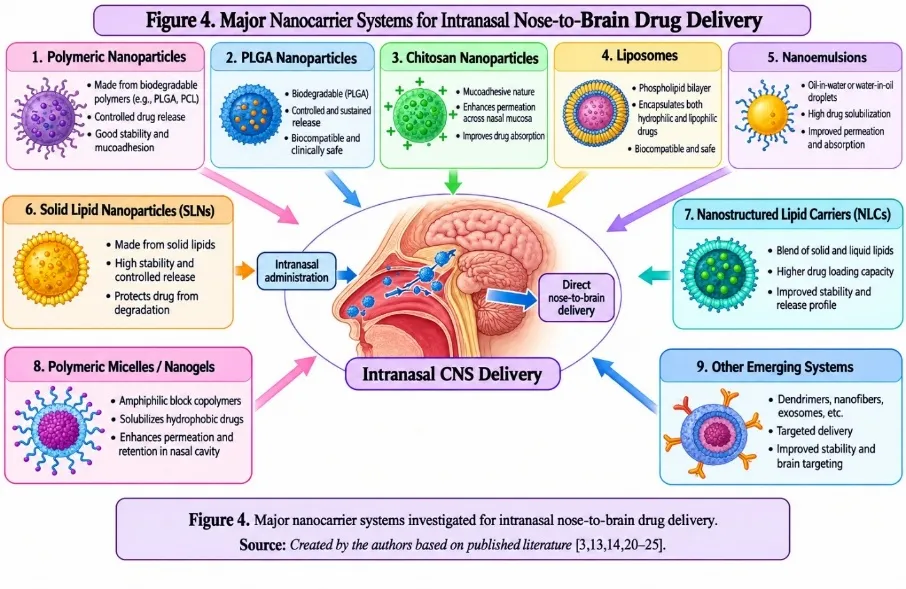
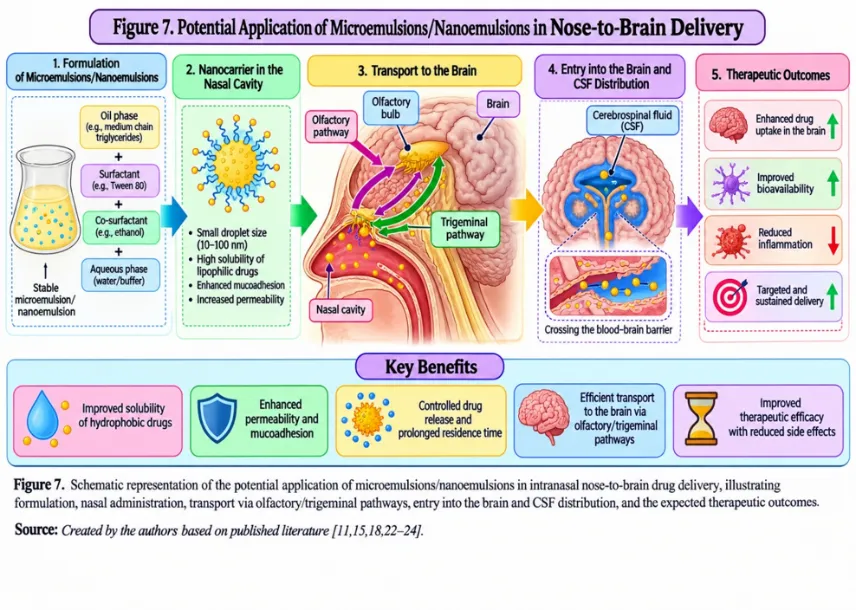
Nanocarriers combine formulation techniques meant to enhance drug stability, solubility, residence time, and controlled release with the anatomical benefits of intranasal delivery. Polymeric nanoparticles, solid lipid nanoparticles (SLNs), PLGA and chitosan systems, liposomes, nanoemulsions, nanostructured lipid carriers (NLCs), polymeric micelles, nanogels, dendrimers, and biomimetic or exosomal systems are examples of major systems 3,13,14,20–25.
4.1 Polymeric nanoparticles
Drugs can be dissolved, encapsulated, adsorbed, or chemically linked inside a polymer matrix by polymeric nanoparticles. Numerous studies have been conducted on PLGA, PLA, chitosan, and related biodegradable polymers. Drug protection, possible prolonged release, better handling of poorly soluble drugs, and the potential for surface modification with targeted ligands are their main benefits 3,13,14. Burst release, aggregation, inconsistent encapsulation efficiency, residual solvent issues, degradation-related effects, scale-up challenges, and ambiguity about repeated-dose accumulation are some of their drawbacks.
The biodegradability and controlled release capabilities of PLGA make it particularly pertinent. Polymer composition, molecular weight, particle size, drug loading, and surface properties all influence its release behavior. PLGA and chitosan together may increase mucoadhesion and residence, but too much adhesion might obstruct regular mucus drainage. Additionally, PLGA–chitosan systems have been studied for intranasal administration of dopamine in Parkinson's disease mice 11,13.
4.2 Chitosan-based nanocarriers
A cationic polysaccharide with mucoadhesive and perhaps permeation-enhancing qualities is chitosan. Interaction with negatively charged mucins and epithelial surfaces may be facilitated by its positive charge. Because of these characteristics, chitosan can be used to improve epithelial transport and increase residence 4,9,14.
However, molecular weight, concentration, formulation pH, and degree of deacetylation all affect performance. Strong mucus trapping or discomfort may result from an excessive positive charge. Reproducibility may also be impacted by batch-to-batch variance. Therefore, rather than only enhancing mucoadhesion, chitosan should be improved in accordance with the necessary balance between retention, penetration, and tolerability.
4.3 Liposomes
Liposomes are phospholipid vesicles that may transport lipophilic substances inside the lipid bilayer and hydrophilic ones in their aqueous core. They are appealing for intranasal CNS administration due to their adaptability, biocompatibility, and ability to modify their surface. To alter retention and cellular contact, chitosan, polyethylene glycol, and targeting ligands can be added to or linked with liposomal systems 3,14,17.
Drug leakage, lipid oxidation or hydrolysis, physical instability, quick clearance, and manufacturing complexity are significant drawbacks. Product quality may be significantly impacted by storage conditions. Thus, repeatable manufacturing and stability must be taken into account in addition to laboratory efficacy.
4.4 Nanoemulsions
Surfactants and, where necessary, co-surfactants stabilize oil and water dispersions to create nanoemulsions. For medications that are lipophilic or poorly soluble in water, they are very helpful. Intranasal nanoemulsions have been studied for the brain targeting of medications like risperidone 20–23. Small droplets can offer a wide interfacial area and excellent spreading along the nasal mucosa.
The main drawbacks are possible nasal toxicity, physical instability, droplet development, and irritation caused by surfactants. While increasing the concentration of surfactant may enhance permeability or solubilization, it may also harm the mucosa. Surfactant concentration and selection must thus be carefully optimized.
4.5 Solid lipid nanoparticles and nanostructured lipid carriers
SLNs can preserve lipophilic medications while providing regulated release because they have a solid lipid matrix that is maintained by surfactants. Lipid polymorphism, aggregation, variable release, drug expulsion during storage, and very low drug loading are some of its drawbacks 24,33.
Solid and liquid lipids are combined by NLCs to create a less ordered matrix. When compared to SLNs, this can enhance drug loading, lower drug ejection, and provide more flexible release management. However, consideration must be given to the solid-to-liquid lipid ratio, oxidation of liquid lipids, surfactant tolerability, and scale-up repeatability 24,25. Important quality characteristics for lipid-based systems include pH, release behavior, encapsulation effectiveness, surface charge, and particle size and dispersion.
4.6 Dendrimers and biomimetic systems
Dendrimers provide highly branched structures with several functional groups that can be altered for targeting or drug conjugation. Concerns of cytotoxicity, complicated manufacturing, expense, biodegradation, and repeated-dose buildup accompany their promise. Exosomes, extracellular vesicles, and nanoparticles coated in cell membranes are examples of biomimetic strategies that might enhance cellular communication and biologic drug delivery. Source variability, purification, characterisation, sterility, dosage consistency, storage stability, and large-scale production are their main obstacles. Although these technologies show promise, before they can be widely adopted, better manufacturing and regulatory frameworks are needed 3,14,25.
4.7 Mucoadhesive, mucus-penetrating and ligand-targeted systems
Nanocarriers may be made to pass through or stick to mucus. While mucus-penetrating methods aim to more effectively access the epithelial surface, mucoadhesive compounds can prolong residence duration. While quick mucus penetration may minimize residency, excessive adhesion may decrease mobility, thus neither approach is always better.
Receptor-mediated uptake may be aided by surface ligands such lactoferrin, lectins, transferrin, peptides, aptamers, and antibodies. However, brain targeting is not shown by ligand attachment alone. Immune cells, peripheral organs, or nasal epithelial cells may all experience increased absorption. Therefore, biodistribution, imaging, and pharmacodynamic data are required for targeting claims 3,13,25,32.
SUGGESTED FORMULATIONS
|
Dosage form |
Nanocarriers suitable |
Main advantage |
Main limitation |
Citation |
|
Nasal spray |
Polymeric nanoparticles, liposomes, nanoemulsions, NLCs |
Uniform dosing and convenient administration |
Device-dependent deposition |
[41–44] |
|
Nasal drops |
Nanoparticles, liposomes, micelles |
Simple preparation and low equipment requirement |
Rapid clearance and throat drainage |
[42,43] |
|
In-situ gel |
Nanoparticles, liposomes, nanoemulsions |
Prolonged nasal residence and controlled release |
Excessive viscosity or nasal discomfort |
[41,45] |
|
Nasal powder |
Dry nanoparticles or nanoparticle-containing microparticles |
Improved stability and prolonged mucosal contact |
Difficult powder dispersion |
[41–43] |
|
Nanoemulsion spray/drop |
Nanoemulsions and lipid nanoparticles |
Improved solubility of lipophilic drugs |
Surfactant toxicity and physical instability |
[41,44] |
|
Nasal film |
Nanoparticles and liposomes |
Sustained release and reduced drainage |
Difficult placement and limited surface area |
[41,42] |
|
Microsphere system |
Nanoparticle-loaded microspheres |
Mucoadhesion and prolonged retention |
More complex manufacturing |
[42,43] |
5A. FORMULATION AND PERFORMANCE FACTORS
Particle size alone does not affect an intranasal nanocarrier's effectiveness; rather, a number of interrelated formulation factors do. Mucus interaction, aggregation, epithelial contact, and the repeatability of nasal deposition are all impacted by particle size and size distribution. Surface charge can alter how mucins and epithelial membranes interact: less sticky surfaces may encourage mucus passage, whereas cationic systems may exhibit higher mucoadhesion. Therefore, whether the formulation is meant to stay close to the mucosal surface or enter the mucus layer determines the ideal surface characteristic 3,4,9,14.
Because the nasal cavity can only hold a certain amount of medication, drug loading and encapsulation efficiency are particularly crucial. While highly concentrated systems may increase viscosity or cause local irritation, formulations with low drug loading may need an unfeasibly large amount. While controlled release might extend exposure, too-slow release can decrease the quantity of free medication available for absorption. On the other hand, quick release may lessen the intended effect of continuous administration and increase local or systemic exposure.
Along with the carrier, the drug's physicochemical characteristics must be taken into account. While polymeric systems can offer helpful protection and controlled release for a wider spectrum of molecules, lipophilic medications may benefit from nanoemulsions, lipid nanoparticles, or micelles. Additional consideration must be given to the stability, aggregation, and preservation of biological activity of peptides, proteins, and nucleic acids 3,14,17. Therefore, rather than starting with a preference for a certain type of nanocarrier, formulation selection should start with the therapeutic chemical and the anticipated delivery method.
Additionally, the nasal formulation itself needs to have the right viscosity, tonicity, and pH. These factors affect device performance, mucus behavior, comfort, and epithelial integrity. Because variations in viscosity or surface characteristics affect the spray pattern and deposition, a formulation that works well in an isolated laboratory experiment may not work well when included into a nasal spray. Therefore, rather than being a distinct final-stage issue, device-formulation compatibility should be considered as part of formulation development 5,35.
5B. CHARACTERIZATION AND QUALITY ATTRIBUTES
Physical, chemical, pharmacological, and biological characteristics should all be included in the characterization of intranasal nanocarriers. The fundamental characteristics of the nanocarrier include particle or droplet size, polydispersity, morphology, surface charge, encapsulation efficiency, drug loading, and in-vitro release. Because aggregation, lipid polymorphism, drug leakage, or polymer degradation may alter performance, storage stability and changes in particle properties over time are especially crucial for lipid and polymeric systems 14,24,33.
Drug release studies need to be carefully understood. Since mucus, enzymes, epithelium transport, and systemic absorption might change the formulation's disposition, an in-vitro release profile cannot accurately predict nasal release or brain exposure. In a similar vein, higher therapeutic effectiveness is not always indicated by high encapsulation efficiency. A sufficient portion of the active medication must be released by the carrier at a suitable rate.
Characterization for nasal products should go beyond the nanocarrier. Where the formulation is deposited depends on a number of factors, including spray weight, dosage uniformity, droplet-size distribution, plume geometry, and spray pattern 5,35.
These qualities have to be consistent throughout the product's shelf life and various dosages. Evidence of real deposition is especially crucial if the hypothesized mechanism rely on deposition in the olfactory area.
Nasal penetration, mucosal contact, cytotoxicity, and, where applicable, cellular uptake should all be included in biological characterization. Cellular absorption in a cultured epithelium model, however, shouldn't be taken as evidence of brain targeting. Studies on animal biodistribution can offer further proof, but they need to take into consideration variations in nasal morphology and plasma exposure. Therefore, formulation characterisation, nasal deposition/permeation, plasma pharmacokinetics, regional brain distribution, pharmacodynamics, and repeated-dose safety make sense 26–34.
5C. CRITICAL COMPARISON OF NANOCARRIER CLASSES
Polymeric nanoparticles provide strong protection and controlled-release options, especially when the formulation calls for biodegradable matrices. Manufacturing complexity and potential particle characteristic variations are their drawbacks. Chitosan has the added advantages of mucoadhesion and potential permeability augmentation, but if its charge and concentration are not regulated, it may cause excessive contact with mucus or epithelium. 4,9,14
Because they can hold both hydrophilic and lipophilic medications and be altered using polymers or ligands, liposomes are adaptable. Physical and chemical stability, together with the intricacy of large-scale manufacture, are their primary weaknesses.
Lipid-based substitutes with potential benefits for poorly water-soluble chemicals are offered by SLNs and NLCs. Compared to SLNs, NLCs may increase drug loading and decrease drug expulsion, however lipid composition needs to be carefully regulated. While nanogels and in-situ hydrogels may be helpful for hydrophilic molecules and extended residency, micelles can enhance apparent solubility and offer tiny structures. Their principal drawbacks are related to viscosity, dilution stability, and repeatable gel formation.
Although such methods as dendrimers and biomimetic approaches appear to be more advanced and promising in relation to biologic transportation and surface engineering, they seem to involve a series of additional regulatory and characterisation challenges. At the same time, considering extracellular vesicles and exosomes, one can notice that these options are hardly optimal because of their insufficient control over the process. Thus, although they may potentially provide better biological interfaces, their use appears to be complicated by the limitations related to isolation and heterogeneity. Therefore, it could be concluded that the most advanced option is not necessarily the best choice. For instance, a complex technology which seems to be appropriate only in particular circumstances may not be better than a less sophisticated but more consistent, safe, and scalable approach.
To match carrier to the formulation problem, consider which nanoscale delivery systems can be used: for instance, micelles or nanoemulsions could be suitable if low aqueous solubility is the key formulation challenge, while polymeric nanoparticles might be the preferred strategy if protection and targeted release are the key formulation barriers. Liposomes offer the advantage of being able to accommodate both hydrophilic and lipophilic compounds. A well-adjusted mucoadhesive or in-situ gel system can also be considered if prolonged retention in the nasal cavity is desired. Rather than basing decisions purely on assumptions about what different nanocarriers can do, the choice must be informed by comparative experimental work 3,13,14,24,25.
5. APPLICATION IN ALZHEIMER’S DISEASE
Alzheimer's disease is a progressive neurodegenerative condition characterized by neural malfunction and cognitive loss. The development of the illness is influenced by oxidative stress, amyloid-beta buildup, synaptic loss, mitochondrial malfunction, and persistent neuroinflammation. Inadequate CNS exposure continues to be a significant problem as relevant pathophysiology is found in the brain 6,7.
The low BBB penetration of several medicinal drugs has sparked interest in intranasal administration. Nanocarriers can preserve delicate molecules, extend nasal residency, increase the solubility of poorly water-soluble medications, and offer controlled release. Potential uses for cholinesterase inhibitors like donepezil, rivastigmine, and galantamine, memantine, antioxidants, anti-inflammatory drugs, peptides, proteins, insulin, neurotrophic factors, and nucleic acid-based treatments are listed in the original text 6,7.
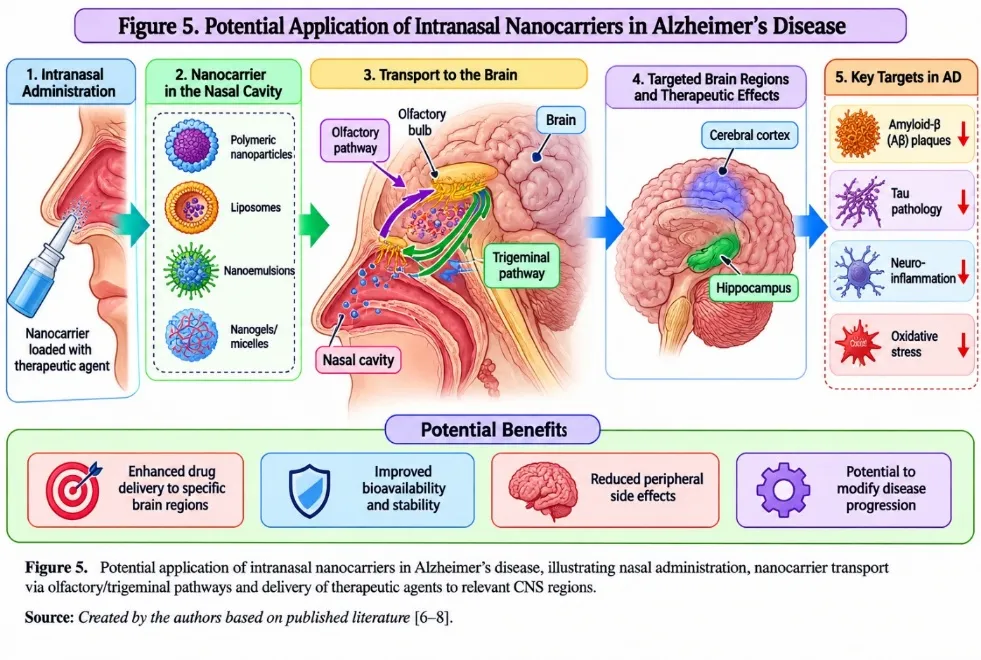
AD-related delivery research has examined polymeric nanoparticles, liposomes, nanoemulsions, SLNs, and NLCs. Additionally, an experimental trial using intranasal nanoparticulate docetaxel that prevented neurodegenerative alterations in an animal model is described in the source publication 8. These results show that nanocarriers can change exposure and experimental results, but they shouldn't be seen as proof that a clinical illness has changed.
The largely preclinical character of AD evidence is its main drawback. Improvements in rodent behavior or cognition may not always transfer to therapeutic benefits for humans, and extrapolation is made more difficult by variations in nose anatomy. Moreover, systemic absorption rather than direct neural transport may be the cause of elevated brain concentration. Chronic nasal tolerability, olfactory function, systemic safety, and long-term biodistribution need special consideration since AD therapy may need to be administered for an extended period of time 1,6–8.
6. APPLICATION IN PARKINSON’S DISEASE
Parkinson's disease is primarily linked to decreased dopamine signaling in the striatum and loss of dopaminergic neurons in the substantia nigra. Tremor, stiffness, and bradykinesia are examples of motor manifestations; non-motor symptoms are also possible. While levodopa can enter the brain and be metabolized to dopamine, dopamine itself has a low blood-brain barrier 10–13. However, long-term use of levodopa may cause dyskinesia and motor irregularities.
Dopamine, levodopa, dopamine agonists, and other neuroprotective drugs are being studied in intranasal nanocarriers. While liposomes, nanoemulsions, and lipid nanoparticles help formulate poorly soluble chemicals, polymeric systems may offer protection and controlled release. Nasal adhesion and epithelial contact may be enhanced by chitosan-based systems 10–13.
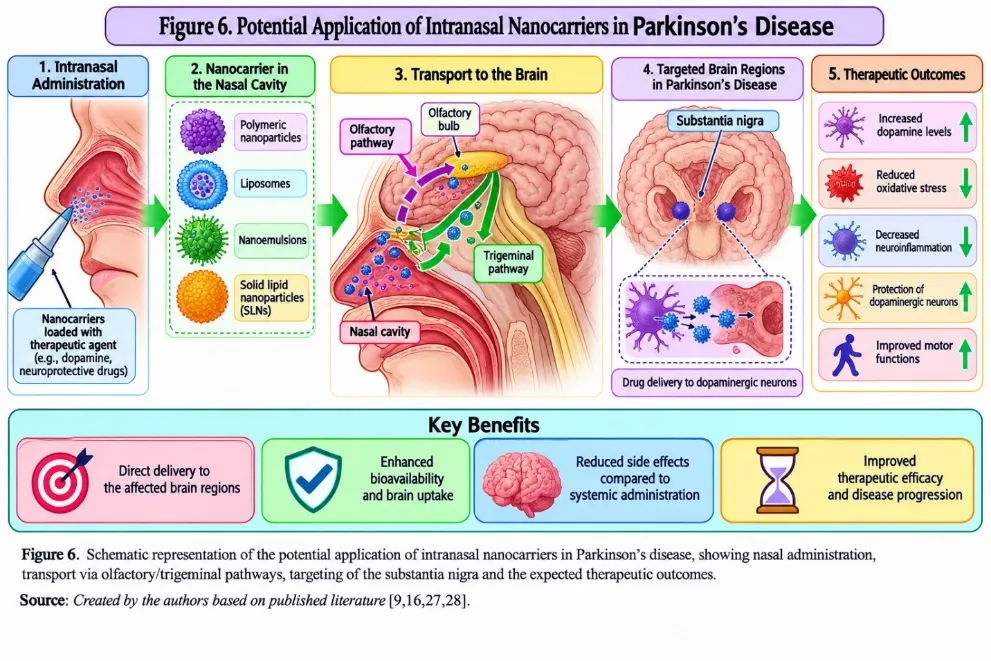
Preclinical research using a PLGA–wheat germ agglutinin nanoparticle system for intranasal L-dopa administration is described in the original text 11, which reports enhanced brain delivery, around 73% drug retention, and release for roughly nine hours in a mouse model. Although intriguing, these findings are still preclinical and should be interpreted with consideration for species differences, controls, and experimental design.
Stable dopaminergic exposure is a major formulation difficulty in Parkinson's disease. While overly prolonged release may change the therapeutic window, rapid release may result in a short-lived impact. Nasal discomfort, ciliary function, and olfactory effects must also be assessed after long-term intranasal dosing.
7. CRITICAL EVALUATION OF BRAIN-TARGETING EVIDENCE
Animal pharmacokinetic and behavioral tests, as well as in vitro release and cellular research, provide evidence for intranasal nanocarriers. Although they cannot prove that a formulation reaches the brain, in vitro experiments are helpful for assessing particle stability, release, cellular absorption, and cytotoxicity. Ex-vivo nose models do not replicate live mucus flow, blood circulation, or neuronal transport, but they can offer insights into penetration and epithelial contact.
Although they have significant limitations, animal studies offer more pertinent pharmacokinetic and pharmacodynamic information. Human behavior may differ from that of a formulation that effectively deposits in a rodent's olfactory area 1,2,5,28.
Therefore, a variety of complimentary tests should be used to evaluate brain targeting. Measurements of brain and plasma concentrations should be made at several intervals and, if feasible, in different parts of the brain. In order to differentiate exposure resulting from systemic absorption from direct transport, intranasal delivery should be contrasted with an intravenous or other systemic control. Direct transport percentage (DTP) and drug-targeting efficiency (DTE) can yield valuable quantitative data, but their interpretation is highly dependent on the sampling schedule, control group quality, and computation assumptions 31,32,34.
Although carrier localization may not always indicate that the active medication was released at the target location, imaging or monitoring the intact nanocarrier can support mechanistic interpretation. Because a high brain concentration without a significant biological impact would not indicate therapeutic efficacy, pharmacodynamic results are also crucial. Therefore, formulation characterisation, plasma pharmacokinetics, regional brain distribution, direct-transport studies, carrier tracking, histopathology, and clinically significant pharmacodynamic endpoints should all be included in a robust evidence package 26–34
8. SAFETY, TRANSLATIONAL AND REGULATORY CHALLENGES
Because the formulation directly meets the nasal mucosa and may possibly reach the systemic circulation and central nervous system, safety is crucial to the development of intranasal nanocarriers. If the formulation produces neurological or nasal toxicity, improved brain exposure is insufficient.
8.1 Local nasal safety
Nasal tolerability may be impacted by variations in pH, osmolarity, viscosity, surfactant content, and polymer composition. Irritation, inflammation, epithelium damage, or altered mucociliary clearance may result with repeated dosing. Although they can improve absorption, permeation enhancers have the potential to harm epithelial membranes. Nasal irritation, epithelial integrity, ciliary movement, mucus production, histology, local inflammatory responses, olfactory function, and tolerance to repeated doses should all be evaluated 4,9,35,38.
8.2 Systemic and CNS safety
The medicine and nanocarrier components may be exposed to the body if a portion of the dosage enters the systemic circulation. Hematological and biochemical indicators, liver and kidney function, immunological reactions, biodistribution, buildup of non-biodegradable materials, and the toxicity of surfactants or preservatives should all be evaluated in studies. Potential neuroinflammation, oxidative stress, microglial activation, neuronal damage, and long-term particle accumulation should all be looked at for CNS safety 2,3,35–37.
Additional immunological or off-target effects may be introduced by biologics and targeted ligands. Therefore, rather than focusing just on the active pharmaceutical component, the safety evaluation should take into account the entire formulation.
8.3 Human translation and nasal deposition
The nasal anatomical differences between animals and humans are one of the main obstacles to translation. Compared to often utilized laboratory rats, humans have a smaller and more challenging olfactory area. Instead of the intended upper nasal area, a large portion of the formulation may be deposited in the anterior or respiratory region using conventional nasal devices 5,35,39,40.
It is consequently necessary to combine the development of devices and formulations. Spray pattern, plume geometry, droplet-size distribution, dosage uniformity, administration angle, and repeatability are important device attributes. High-dose medications may be challenging to administer without drainage or swallowing since the nasal cavity can only hold a certain amount.
8.4 Manufacturing and scale-up
Excellent particle size, encapsulation, and the release properties may be achieved in the laboratory formulation, but these qualities are often lost during the scale-up process. Control of the particle size distribution, and medication loading, surface modification, sterility or microbiological purity, storage stability, and compatibility with the delivery devices are often critical during commercial manufacturing. In addition, important quality characteristics for the nasal products include spray weight, droplet–size distribution, plume geometry, spray pattern, unit–dose consistency, and the device performance 35,38.
8.5 Regulatory considerations
Complex properties of the material of nanocarriers products require an in-depth examination. Such parameters as particle size distribution and morphology, surface charge, chemical composition, drug release, degradation products, residual solvents, biodistribution, immunogenicity, nasal or central nervous system toxicity, are of particular relevance 35-40. The scarcity of standardized methods for proving direct transfer of brain is also a challenge. It is not possible to compare studies due to the differences in control, time points of sampling, brain regions, calculations of DTE and DTP. Unified analytical technologies, reproducible preparation, and proof of connection between formulation properties and medicinal efficacy in humans are required.
9. FUTURE PERSPECTIVES
Rather than focusing on improving the complexity of nanocarriers, future studies should concentrate on developing reliable delivery mechanisms. Modern nasal devices may reduce delivery technique variation and improve deposition in the olfactory area. By linking particle size, surface charge, polymer, drug release, nasal residence, and brain exposure, artificial intelligence and machine learning may optimize formulations and potentially reduce trial-and-error testing.
More controlled release is possible with smart nanocarriers that respond to pH, enzymes, temperature, oxidative conditions, or disease-specific signals. Exosomes, extracellular vesicles, and cell membrane-coated nanoparticles are biomimetic systems that may offer opportunities for biologic and nucleic acid delivery; however, production, purification, characterization, and source variation remain significant challenges.
In addition, more relevant human experimental models are required. Compared to conventional small-animal models, nasal organoids, sophisticated epithelial models, organ-on-a-chip systems, computational fluid-dynamic simulations, and imaging-based deposition studies may improve the prediction of human performance 2,25,39,40. Individual nasal architecture, mucus properties, age, disease-related inflammation, administration method, and eventually tailored formulations may be integrated for personalized delivery. Matched systemic controls, regional brain analysis, intact-carrier tracking if relevant, long-term safety analyses, repeatable dosing, and clinically significant disease outcomes should all be included in future research. Only when enhanced brain exposure is connected with repeatable and clinically significant therapeutic benefit could a formulation be considered successful.
CONCLUSION
A promising approach to improve the delivery of CNS drugs is the intranasal nanocarrier mediated nose-to-brain transport. This method can overcome several limitations of the conventional intranasal administration by improving solubility, protecting fragile molecules, prolonging residence time in the nasal cavity, and controlling the release rate. All these nanoparticles have their own advantages and disadvantages in terms of formulation; however, their application is not always more beneficial than conventional drugs.
The major limitation of the discussed preclinical data is that the intranasal administration followed by enhanced brain exposure does not necessarily mean successful nose-to-brain delivery. The observed effect could be caused by prolonged residence time and improved stability and bioavailability. As a result of that, strict controls, brain-optimizing computations, imaging, carrier tracking, plasma and regional brain pharmacokinetics, and pharmacodynamic results are required.
The key challenges to clinical translation remain long-term nose and central nervous system safety, repeated nasal deposition, limited administration volume, scale-up, device compatibility, and regulatory characterization. Overall, intranasal nanocarriers are considered to be very promising but primarily preclinical technology. Integrated medication, nanocarrier, device and administration technique optimization will be required for their effective development. It is followed by compelling evidence of safety, repeatability and significant benefit in human patients.
REFERENCES




Kshiteeja Gunjal, Neha Kadam, Sakshi Avhad, Sujata Sangale, Nose-to-Brain Nanocarrier Delivery for Neurodegenerative Diseases: From Anatomical Pathways and Biological Barriers to Brain-Targeting Evidence and Clinical Translation, Int. J. of Pharm. Sci., 2026, Vol 4, Issue 10, 3605-3620. https://doi.org/10.5281/zenodo.23637539
Severity: 8192
Message: substr(): Passing null to parameter #1 ($string) of type string is deprecated
Filename: frontend/article.php
Line Number: 706
Severity: 8192
Message: substr(): Passing null to parameter #1 ($string) of type string is deprecated
Filename: frontend/article.php
Line Number: 706
Severity: 8192
Message: substr(): Passing null to parameter #1 ($string) of type string is deprecated
Filename: frontend/article.php
Line Number: 741
 10.5281/zenodo.23637539
Severity: 8192
Message: substr(): Passing null to parameter #1 ($string) of type string is deprecated
Filename: frontend/article.php
Line Number: 890
Severity: 8192
Message: substr(): Passing null to parameter #1 ($string) of type string is deprecated
Filename: frontend/article.php
Line Number: 925
Severity: 8192
Message: substr(): Passing null to parameter #1 ($string) of type string is deprecated
Filename: frontend/article.php
Line Number: 925
Severity: 8192
Message: substr(): Passing null to parameter #1 ($string) of type string is deprecated
Filename: frontend/article.php
Line Number: 957
Severity: 8192
Message: substr(): Passing null to parameter #1 ($string) of type string is deprecated
Filename: frontend/article.php
Line Number: 957