

We use cookies to ensure our website works properly and to personalise your experience. Cookies policy
Shree Dhanvantary Pharmacy College, Kim, Surat, Gujarat, India.
Analytical Quality by Design (AQbD) is a systematic, science- and risk-based approach for analytical method development that ensures robustness, reliability, and lifecycle management. Unlike traditional trial-and-error methods, AQbD focuses on predefined objectives, comprehensive method understanding, and statistical evaluation of method variables. Regulatory authorities encourage AQbD implementation to enhance method performance and flexibility. This review describes the AQbD framework, including Analytical Target Profile (ATP), Critical Quality Attributes (CQAs), risk assessment, Design of Experiments (DoE), Method Operable Design Region (MODR), control strategy, and lifecycle management, with emphasis on pharmaceutical analytical applications
Analytical methods play a critical role in ensuring the quality, safety, and efficacy of pharmaceutical products. Conventional analytical method development often relies on univariate experimentation, which may lead to limited method understanding and poor robustness. Analytical Quality by Design (AQbD), derived from the Quality by Design (QbD) concept, provides a structured framework for developing high-quality analytical methods through predefined objectives and scientific understanding. [1]
2. Regulatory Background
AQbD principles are supported by international regulatory guidelines such as ICH Q8 (R2), ICH Q9, ICH Q10, and ICH Q14 along with ICH Q2 (R2). Regulatory agencies including the US FDA and EMA promote AQbD to improve analytical method reliability and lifecycle management. [2]
Table No.2 - ICH Guideline for QbD
|
ICH Guideline |
|
|
Q8 |
Pharmaceutical Development |
|
Q9 |
Quality Risk Management |
|
Q10 |
Pharmaceutical Quality System |
3. History of quality by design
A. 1990: - Dr. Joseph M. Juran developed the QbD concept of „quality should be designed into a product, and the majority of quality issues originate from the initial form of the product.
B. 2002: - The food and drug administration (FDA) inspires risk-based approaches and the adoption of Quality-by-design principles in drug product development, manufacturing, and regulation
C. 2004 - 2012: - ICH guidelines which outline Quality by design concept Method flexibility with MODR and allowing continuous improvement Focus on robust and cost- effective method Replacing the need for revalidation and minimizing OOT and OOS Analytical target profile (ATP)
D. 2004: ICH Q8 pharmaceutical development
E. 2005: ICH Q9 quality risk management
F. 2012: ICH Q11 development and manufacturing of drug substances
G. 2011: EMA-FDA pilot program for parallel assessment of QbD application.
H. 2017: Survey of pharmaceutical companies on the implementation of the AQbD concept.
I. 2020: Aug 2020 MHRA response and strategy for AQbD concept to pharmacopeial standards for medicines.
J. 2021: - USP & BP workshop on AQbD& analytical procedure life cycle (APLC). [3]
4. Traditional approach Vs. AQbD approach.
Table No. 2 - Traditional approach Vs. AQbD approach
|
Traditional approach[4] |
AQbD approach[4] |
|
Trial and error method |
Planned and scientific method |
|
Include studies of One factor at a time |
Multiple factors studied together (DoE) |
|
Less understanding of method |
Deep understanding of method |
|
Less robust |
Highly robust |
|
More variations are there |
Less variation are there |
|
More rework required |
Less rework needed |
5. Analytical Quality by Design Framework
AQbD integrates systematic planning, risk assessment, and statistical tools to ensure consistent analytical performance.
5.1 Analytical Target Profile (ATP)
The ATP defines the objective of the analytical method and specifies performance requirements such as accuracy, precision, specificity, linearity, and range. ATP acts as the foundation of AQbD-based method development. The ATP outlines the method performance requirements, while risk assessment (e.g., using Ishikawa or FMEA tools)
identifies variables that influence analytical performance. The DoE helps establish method robustness, linearity, and accuracy. [5]
5.2 Critical Quality Attributes (CQAs)
CQAs are measurable attributes that define method performance. In chromatographic methods, typical CQAs include resolution, retention time, tailing factor, theoretical plates, and signal-to-noise ratio. [6]
5.3 Risk Assessment
Risk assessment identifies method variables that may affect CQAs. Tools commonly used include Ishikawa diagrams, Failure Mode and Effects Analysis (FMEA), and risk ranking methods. [7]
5.4. Design of Experiments (DoE)
DoE is a multivariate statistical technique used to evaluate the effect of method parameters simultaneously. It enables identification of significant factors and their interactions, reducing experimental effort while enhancing method understanding. Design of experiments (DoE) is a statistics optimization tool. [8]
Full factorial design: Factorial experiment : It is an experiment whose design consist of two or more factor each with different possible values or level. FD technique introduced by “Fisher” in 1926.Factorial design applied in optimization techniques. Factor: factors can be “Quantitative” (numerical number) or they are qualitative. They may be names rather than numbers likes method 1, site B or present or absent. Factorial design depends on independent variables for development of new formulation. Factorial design also depends on levels as well as coding. [9]
Response surface methodology: It includes optimization procedure for the setting of factorial variables, such that the response reaches a desired maximum or minimum value.
[10]
Central composite design: It is an experimental design, useful in creating relatively sophisticated models, usually second order (quadratic) model for the output function without needing to use other designs. [10]
Axial or star points: These points are marked by “α”. They are located symmetrically around the design center. The value of α depends on the number of input factors involved (this value is determined a prior and could be found in statistical tables - software products)
Corner points: According to the design of the type full factorial design at two levels of variation of the factors. It is depends on preliminary experience and information. Factorsare coded as “+1” and “-1” The choice of the intervals of variation for the factors is an important task for the scientist. Central point is marked by 0. [10]
5.5 Critical Method Parameters (CMPs)
CMPs are method variables that significantly influence CQAs, such as mobile phase composition, pH, flow rate, column temperature, and detection wavelength. [11]
5.6 Method Operable Design Region (MODR)
MODR represents the multidimensional combination of CMPs that assures method performance meeting ATP requirements. Operation within MODR offers regulatory flexibility. [12]
5.7 Control Strategy and Lifecycle Management
Control strategies ensure consistent method performance through system suitability tests and continuous monitoring. AQbD supports method lifecycle management and post- approval changes. [13]
6. Analytical Method Validation and Regulatory Perspective
Analytical method validation, as described in ICH Q2(R1), verifies that the analytical procedure is suitable for its intended purpose. Validation parameters include specificity, linearity, accuracy, precision, limit of detection (LOD), limit of quantification (LOQ), and robustness. Regulatory agencies encourage AQbD principles to ensure analytical methods are fit-for-purpose and meet compliance throughout their lifecycle. [14]
7. Example of AQbD: Design of Experiment (DoE) [15]
Box–Behnken Design (BBD) was used to optimize the method parameters and evaluate the effect of critical method parameters on chromatographic responses.
Table No.3 Factorial Design for AQbD
|
Factor |
Low Level |
Medium Level |
High Level |
|
Mobile phase (%) |
60 |
70 |
80 |
|
Flow rate (mL/min) |
0.8 |
1.0 |
1.2 |
|
Column temperature (°C) |
25 |
30 |
35 |
Table No.4 Optimized HPLC Conditions obtained
|
Parameter |
Condition |
|
Column |
C18 column |
|
Mobile phase |
Methanol : Water |
|
Flow rate |
1 mL/min |
|
Detection wavelength |
254 nm |
|
Injection volume |
20 µL |
Design Space
A design space was established using statistical analysis where acceptable resolution, retention time, and peak symmetry were obtained. Within this design space, small variations in parameters do not affect method performance.
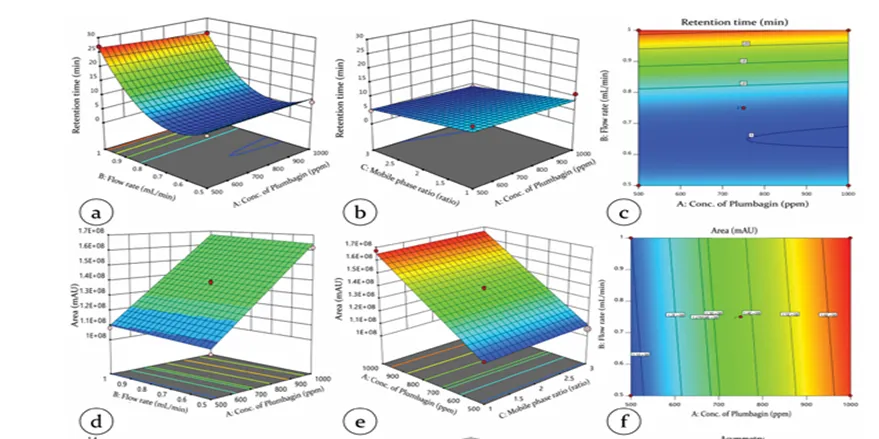
Figure no. 1: Three dimensional response surface and two-dimensional contour plot obtained for the studied critical analytical attributes (CAAs). (a–c) retention time; (d–f) area
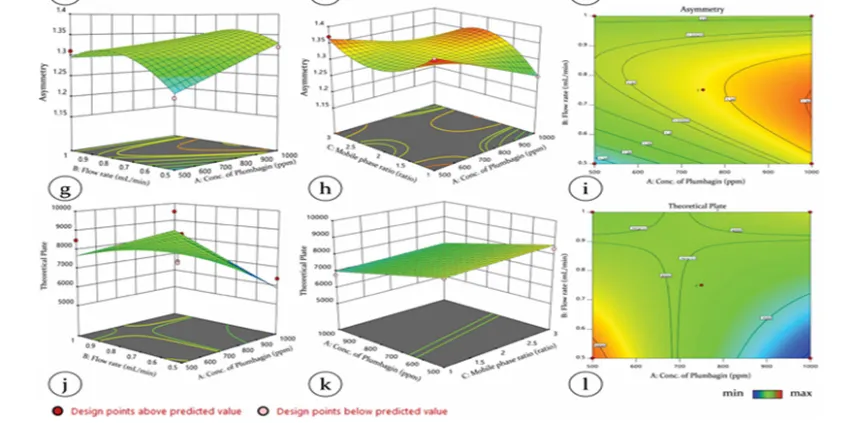
Figure no. 2 : Three dimensional response surface and two-dimensional contour plot obtained for the studied critical analytical attributes (CAAs). (g–i) asymmetry; (j–l) theoretical plates.
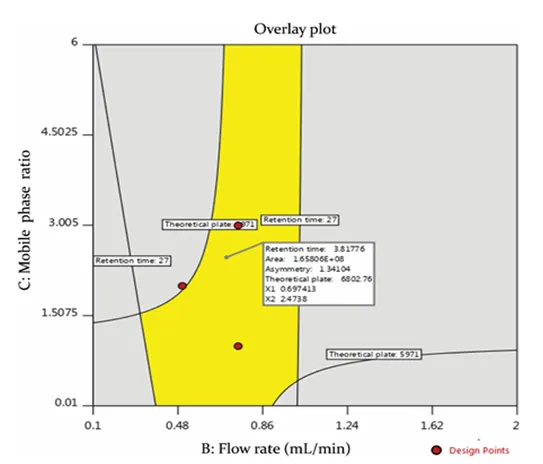
Figure no. 3: Overlay plot showing the optimal analytical design space.
CONCLUSION
AQbD represents a paradigm shift in analytical method development by integrating scientific understanding, risk assessment, and statistical tools. Adoption of AQbD ensures robust, reliable, and regulatory-compliant analytical methods suitable for modern pharmaceutical development.
REFERENCES


Kiran Makwana, Kamini Pal Review on - Analytical Quality by Design (AQbD) A Novel Approach for Method Development, Int. J. of Pharm. Sci., 2026, Vol 4, Issue 6, 3872-3877, https://doi.org/10.5281/zenodo.20715674
 10.5281/zenodo.20715674